

The flight is booked.
The apartment handover is scheduled.
The boxes are packed.
But your financial life in Germany does not disappear when you cross the border.
You may still have a German bank account receiving payments, a landlord holding your Mietkaution, pension contributions recorded with Deutsche Rentenversicherung, a future tax return, insurance contracts, direct debits, subscriptions, a brokerage account and a Rundfunkbeitrag account.
Some things should end.
Some should be updated.
Others may be worth keeping temporarily.
Leaving Germany is therefore not just a moving problem. It is also a financial closing-out process.
Here is how to approach it without accidentally cutting off access to money or rights you may still need.
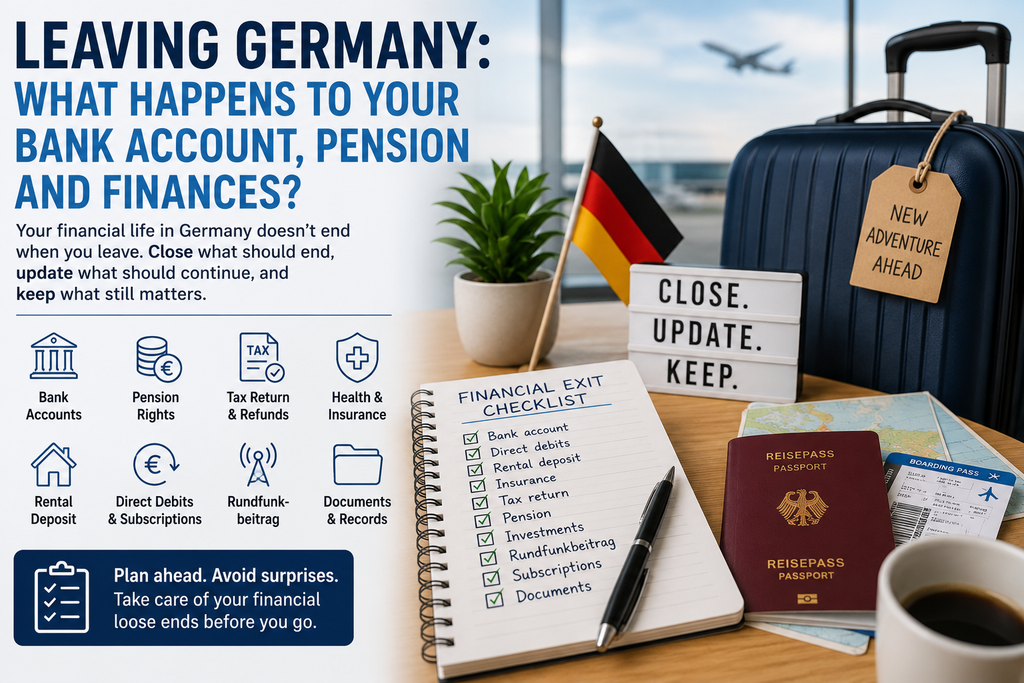
Start With a Financial Exit Checklist
Before cancelling anything, make one list covering these ten areas:
- Bank accounts
- Direct debits and standing orders
- Rental deposit
- Health and private insurance
- German taxes
- Pension records
- Investments and brokerage accounts
- Rundfunkbeitrag
- Utilities, memberships and subscriptions
- Important financial documents
The order matters less than the principle.
Do not treat every item as something that must be cancelled immediately.
A German bank account, for example, may still be useful for receiving your rental-deposit refund. Your pension contributions usually remain relevant long after departure. An electricity contract, by contrast, normally has no purpose once responsibility for the apartment ends.
Think of the process as three boxes:
Close. Update. Keep.
1. Can You Keep Your German Bank Account After Leaving?
Possibly.
There is no useful universal rule saying everyone who leaves Germany must close their German bank account.
Whether you can keep it can depend on:
- the bank’s terms;
- your new country of residence;
- tax-residency information;
- identification requirements;
- compliance rules applying to customers abroad.
Some providers accommodate customers living abroad. Others may limit services or decide not to maintain relationships with residents of particular countries.
That is why the best time to ask your bank is before you move, not after your German address has disappeared.
Tell the bank about changes to relevant information such as your:
- residential address;
- tax residence;
- telephone number and email;
- other requested customer-identification information.
Do not simply leave an old German address on the account because it feels easier.
There are also several practical reasons to keep a German account temporarily.
You may still need to receive:
- your old rental deposit;
- final salary corrections;
- employer reimbursements;
- a German tax refund;
- insurance refunds;
- utility credits.
And money may still need to leave the account for legitimate final German bills.
The objective is not necessarily to keep the account forever.
It is to avoid cutting off a useful financial bridge before the transition is finished.
2. Do Not Close Your Bank Account Too Early
Imagine leaving Germany on 1 October.
You close your account on 2 October.
Then:
Your landlord wants to return your deposit.
Your electricity provider calculates a final credit.
Your former employer processes an expense reimbursement.
A forgotten annual charge is still outstanding.
None of these events is unusual enough to justify creating unnecessary complications for yourself.
Before closing a German account, review:
- SEPA direct debits
- standing orders
- subscriptions paid from the account
- upcoming final bills
- payments you are still expecting
Cancel standing orders that no longer serve a purpose, but do not blindly block every direct debit before checking whether a legitimate final payment is still due.
Keeping a small amount of liquidity available during the transition can also prevent a €30 forgotten charge from turning into reminders or collection problems.
This is one of those moments when a well-sized emergency fund in Germany proves useful: moving internationally creates timing problems even when your overall finances are healthy.
Keep enough access and liquidity to finish the transition cleanly.
3. What Happens to Your Rental Deposit?
Handing back your apartment does not necessarily mean your Mietkaution appears in your bank account that afternoon.
The rental deposit exists to secure legitimate claims connected with the tenancy.
German case law does not establish one simple universal repayment deadline that applies identically to every rental. The Federal Court of Justice has recognised that the landlord may have an appropriate period to examine whether claims remain before the deposit becomes due for repayment. Outstanding matters can also include operating-cost issues.
This is particularly important when leaving Germany because you may no longer be easy to contact.
Before departure, give the landlord:
- a valid forwarding address;
- appropriate bank details;
- current contact information.
And keep:
- the rental agreement;
- handover protocol;
- photographs from the handover;
- correspondence about defects or repairs;
- evidence of payments;
- the final utility or operating-cost documents you receive.
If you are still preparing for this stage, Crown Altessa’s guide to the upfront costs of renting an apartment in Germany explains how the deposit fits into the broader housing cash flow.
Most importantly, do not build your moving budget around the assumption that the old Kaution will be immediately available to finance life in your new country.
It may arrive later.
4. Health Insurance When Leaving Germany
Do not assume that deregistering your address automatically and instantly ends German health insurance.
What happens depends on your circumstances.
Relevant factors can include:
- whether German employment has ended;
- whether the move is permanent;
- whether you move within the EU/EEA/Switzerland or elsewhere;
- whether you acquire insurance rights in the destination country;
- whether you were statutorily or privately insured.
The Federal Ministry of Health points people with cross-border health-insurance questions to the Deutsche Verbindungsstelle Krankenversicherung – Ausland because international coordination depends heavily on the destination and circumstances.
For longer-term moves within Europe, German statutory coverage can sometimes interact with the destination country’s social-security system rather than simply disappearing. Outside the EU and relevant coordination arrangements, the situation can be very different. Verbraucherzentrale therefore advises people moving abroad to contact their health insurer early.
The practical step is simple:
Tell your insurer you are leaving and obtain confirmation of what happens to your membership and the effective date.
Do not guess.
And arrange appropriate health coverage in your destination country so that cancelling German arrangements does not create an uninsured gap.
If the distinction between public insurance, private insurance and other German policies is still unclear, Crown Altessa’s insurance in Germany guide provides the broader background.
5. What About Your Other German Insurance Policies?
Moving abroad does not mean every private insurance contract automatically cancels itself.
Review your policies individually.
Privathaftpflicht
Check whether your private liability insurance continues to cover permanent residence abroad, for how long, and in which territories.
Hausratversicherung
If you have given up the German household, the insured risk has changed materially. Tell the insurer about the move and ask what documentation or contractual steps are required.
Rechtsschutzversicherung
Legal-expenses coverage can be territorially and contractually specific. Check whether it still has value once you live abroad.
Car insurance
Selling, exporting or re-registering a vehicle creates different insurance consequences. Deal with the vehicle and insurer together rather than assuming leaving Germany alone resolves the contract.
Occupational disability insurance
This is especially important not to cancel casually. A long-term income-protection contract may or may not continue abroad depending on its conditions. Review the wording and speak with the insurer before making an irreversible decision.
The broader principle is:
Does the insured risk still exist, and does the contract still cover it where you will live?
Some policies may need cancelling.
Others may need only an address update.
Some may remain valuable.
6. Do You Still Need to File a German Tax Return?
Leaving Germany does not erase the part of the tax year during which you lived or earned income there.
Tax becomes particularly sensitive because your residence can change during a calendar year.
German law broadly distinguishes between unlimited tax liability for people with a German residence or habitual abode and limited tax liability for certain German-source income after those connections no longer exist.
Possible issues after departure include:
- German employment income earned before leaving;
- whether you were required to file;
- whether a voluntary return could still be relevant;
- a German tax refund;
- German-source income received after departure;
- foreign income earned during the same year;
- the application of a double-taxation agreement;
- changes in tax residence.
This is exactly where oversimplified internet advice becomes dangerous.
Suppose you live and work in Germany from January through August, then move abroad and start a new job in September.
Your German tax return may need to be considered in the context of both parts of that year, and treaty rules can affect the treatment.
For ordinary employee deductions, Crown Altessa’s German tax return guide for employees explains work-related expenses such as commuting, home office, training and relocation.
But cross-border taxation deserves extra caution. If significant foreign income, dual residence, business interests or substantial investments are involved, qualified tax advice can be worthwhile.
Do not assume either:
“I left, therefore Germany no longer cares about this tax year.”
or:
“Germany automatically taxes everything I earn after leaving.”
Both are too simplistic.
7. What Happens to Your German Pension Contributions?
This is one of the most misunderstood parts of leaving Germany.
Your German pension contributions do not simply disappear because you move abroad.
Deutsche Rentenversicherung pays German statutory pensions to many people living outside Germany, and pension payments abroad are generally possible. The precise entitlement and treatment can depend on insurance history, residence and applicable international rules.
If you worked and contributed to Germany’s statutory pension system, those contribution periods remain relevant to your insurance record.
Moving within the EU/EEA or to a country with a social-security agreement
European coordination rules and bilateral social-security agreements can allow insurance periods from different countries to interact when determining pension rights.
Deutsche Rentenversicherung explains that people living in an EU-coordinated country or a country with a German social-security agreement can often submit a pension application through the pension institution where they live, which then coordinates with the German system.
Can you get your pension contributions refunded?
Sometimes—but this is not automatic.
Deutsche Rentenversicherung explicitly states that people moving abroad can qualify for contribution refunds under certain conditions. Nationality, residence, eligibility for voluntary insurance, contribution history and international agreements can matter.
For example, its current guidance gives cases where a contribution refund is not available because sufficient German contribution periods already create pension rights, while other non-EU situations may allow an application after specified conditions are satisfied.
So do not follow advice saying:
“Leave Germany and withdraw your pension after two years.”
That is not a universal rule.
And do not assume:
“I left Germany, so all that pension money is gone.”
That is also wrong.
The correct question is:
What pension rights do my contribution record, nationality, destination and applicable international rules give me?
If meaningful German pension contributions are involved, retain your records and contact Deutsche Rentenversicherung for your specific case.
8. Investments and Brokerage Accounts
A move abroad also changes the information your broker or investment platform has about you.
Before relocating, check whether the provider supports customers resident in your destination country.
Relevant issues can include:
- new residential address;
- tax residence;
- tax-identification details;
- withholding-tax treatment;
- account access;
- products that may not be available to residents of the new country;
- local reporting requirements.
Do not assume that moving abroad means you should automatically sell investments.
Selling can itself have tax and investment consequences.
The safer process is:
update → understand → decide
rather than:
move → panic → sell everything
Where substantial portfolios, capital gains or multiple tax jurisdictions are involved, cross-border tax advice can be useful.
9. Rundfunkbeitrag, Utilities and Subscriptions
This is the administrative section that can quietly cost money when ignored.
Rundfunkbeitrag
If you permanently move abroad and completely give up your dwelling in Germany, the official Beitragsservice allows you to deregister that dwelling from the Rundfunkbeitrag. Proof of deregistration with the local registration authority is required.
Use the official Wohnung abmelden process rather than merely stopping payments.
Electricity and gas
Notify the relevant providers and provide final meter readings where applicable.
Keep evidence of the readings and wait for the final settlement.
Internet and mobile phone
Check the contract.
Moving abroad does not mean you should simply stop the direct debit and assume the contract has disappeared.
Also review
- gym memberships;
- public-transport subscriptions;
- parking contracts;
- streaming services;
- newspaper subscriptions;
- clubs and associations;
- storage;
- other recurring services.
Deregistration from Germany is not a universal cancel button for private contracts.
Each contractual relationship needs to be dealt with on its own terms.
10. Keep Your German Financial Records
Moving is a terrible time to throw away documents simply because they look old.
Keep important German records securely, preferably with reliable digital copies.
These can include:
- payslips;
- Lohnsteuerbescheinigungen;
- tax returns and tax assessments;
- pension statements;
- social-insurance records;
- employment contracts;
- insurance documents;
- rental agreement;
- apartment handover protocol;
- final operating-cost settlements;
- utility settlements;
- relevant bank statements.
There is no useful universal retention period covering every document on that list.
Different records serve different purposes.
A pension record can matter decades later.
A rental handover document may become relevant if your old landlord claims damage.
Employment records can support future pension or administrative questions.
Tax documents may be needed for later filings or queries.
If you are trying to understand German payroll documents before archiving them, Crown Altessa’s German payslip guide explains the major fields, while the gross vs net salary guide provides the broader salary context.
A useful rule is:
Do not destroy a financial record merely because you no longer live in the country that issued it.
A Practical Before-Leaving-Germany Financial Checklist
Before departure:
- Contact your German bank and ask whether the account can remain open from your destination country.
- Update your address, contact information and relevant tax-residency information.
- Review direct debits and standing orders.
- Keep your bank account accessible long enough for outstanding payments and refunds where practical.
- Complete your apartment handover and keep the protocol and photographs.
- Give the landlord a forwarding address and suitable refund details.
- Notify your health insurer and confirm what happens to coverage and when.
- Review private insurance individually.
- Check whether a German tax return is required or relevant.
- Download and save your pension records.
- Contact Deutsche Rentenversicherung where your international pension position is unclear.
- Update brokerage and investment providers.
- Deregister your German dwelling with the Rundfunkbeitrag where eligible.
- End or update electricity, gas, internet and other subscriptions.
- Save important German financial documents somewhere you can access abroad.
The checklist is short because the objective is not to create another relocation project.
It is to prevent unfinished German finances from following you unnecessarily.
Common Financial Mistakes When Leaving Germany
Several mistakes create avoidable problems:
Closing the bank account immediately.
You may still need it for refunds or final payments.
Assuming the rental deposit arrives on handover day.
The landlord may still need an appropriate period to settle legitimate matters.
Assuming pension contributions have disappeared.
Your German pension record generally remains relevant.
Assuming everyone can withdraw pension contributions.
Refund eligibility is conditional and can depend on several international factors.
Forgetting the tax year.
Moving abroad does not erase income earned in Germany earlier that year.
Assuming German health insurance automatically ends.
Confirm your circumstances and effective date with the insurer.
Cancelling long-term insurance without checking international cover.
A policy may still be useful abroad.
Stopping direct debits without checking what is still legitimately owed.
Assuming Anmeldung/Abmeldung cancels private contracts.
It generally does not function as a universal contractual cancellation.
Failing to update your contact details.
A letter about tax, pension or an outstanding account is much harder to deal with if it never reaches you.
Frequently Asked Questions
Can I Keep My German Bank Account After Leaving Germany?
Possibly. It depends on the bank’s policies, your destination, residency and compliance requirements. Contact the bank before moving and update your residence and tax information rather than assuming the account can continue unchanged.
What Happens to My German Pension if I Leave?
Your contribution history does not simply disappear. German pension rights can remain relevant after you move, and German pensions can generally be paid abroad, although individual rules can depend on residence and insurance history.
Can I Get My German Pension Contributions Back?
Only in certain circumstances. Deutsche Rentenversicherung says contribution refunds can be available when specific requirements are met; nationality, residence, contribution history, voluntary-insurance eligibility and international agreements can affect the answer.
Do I Need to File a Tax Return After Leaving Germany?
Potentially. Departure does not automatically eliminate tax obligations for the year. German income before departure, German-source income afterward, foreign income during the same year and tax-residence changes can all matter. Cross-border cases may require professional advice.
What Happens to My Rental Deposit?
It does not necessarily have to be repaid on the exact handover date. The landlord can have an appropriate period to examine legitimate claims, and unresolved operating-cost matters may also be relevant.
Do I Need to Cancel German Health Insurance?
You should notify your insurer and establish what happens in your circumstances rather than assuming coverage ends automatically. Destination, employment and the type of insurance can all matter.
Do I Need to Cancel Rundfunkbeitrag?
If you permanently move abroad and completely give up your German dwelling, the Beitragsservice provides a process to deregister the dwelling. It currently requires proof of deregistration with the local registration authority.
Conclusion
Leaving Germany does not automatically close your financial life there.
Some accounts may be useful for a while longer.
Some contracts need explicit action.
Some final payments may arrive months later.
And some rights, particularly German pension rights, may remain relevant for decades.
The safest approach is straightforward:
Close what should end, update what should continue, and keep records of everything that may still matter after you have moved.
For a broader beginner-friendly framework for managing money through major life changes, Personal Finance Made Simple for Beginners is also available on Gumroad and Amazon.
My book on Gumroad:
https://ukandu0.gumroad.com/l/bteyh
Or on Amazon:
Feeling financially stuck?
When financial pressure becomes constant, long-term decisions start feeling emotionally heavy.
The Crown Altessa newsletter was created to help people rebuild clarity slowly and strategically through practical financial frameworks, long-term thinking, and structured decision-making insights.
Join the newsletter and receive:
• the free Financial Foundation Guide
• strategic financial insights
• practical tools for long-term stability
• frameworks designed to reduce financial overwhelm
Start building financial clarity one step at a time.