
You move to Germany and suddenly there seems to be an insurance policy for everything.
Krankenversicherung.
Privathaftpflicht.
Hausratversicherung.
Berufsunfähigkeitsversicherung.
Rechtsschutzversicherung.
Kfz-Versicherung.
The list can make it sound as though responsible financial planning means buying every policy available.
It doesn’t.
Some insurance is legally required. Some protects against risks that could seriously damage your finances. Other policies are useful only when your circumstances make the risk significant.
A useful insurance portfolio is therefore not measured by the number of policies you own.
A better question is:
Which financial losses would be difficult or impossible for me to absorb myself?
That distinction makes German insurance considerably easier to understand.
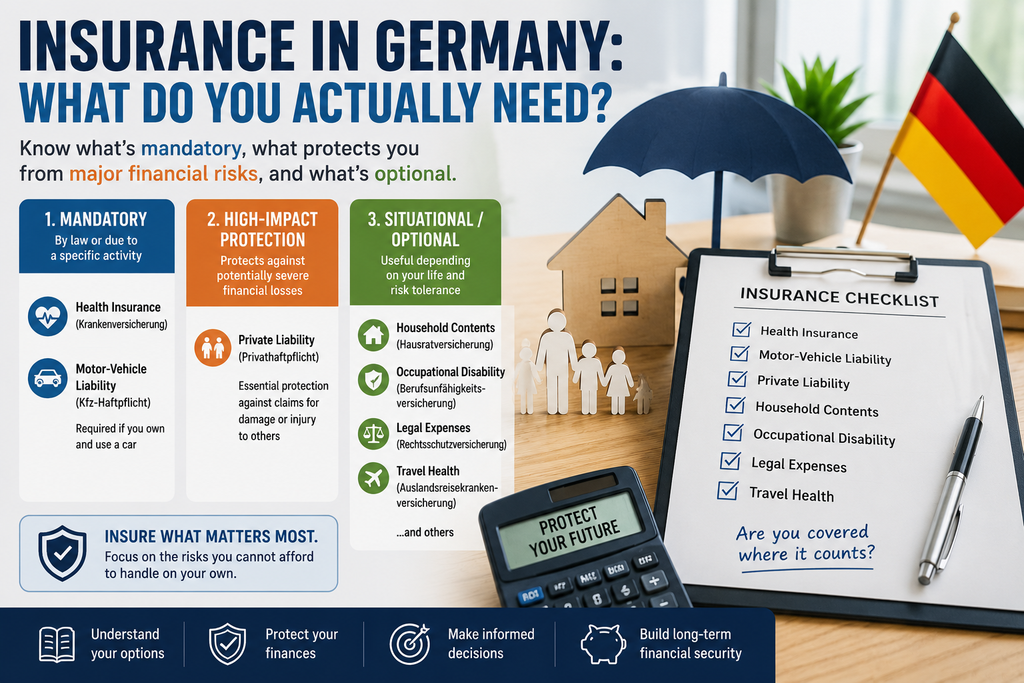
The Three Levels of Insurance in Germany
Before looking at individual policies, divide insurance into three broad categories.
1. Mandatory insurance
This is insurance required by law or as a consequence of a particular activity.
Health insurance is the obvious example. Motor-vehicle liability insurance also becomes mandatory when the relevant vehicle is subject to Germany’s compulsory insurance rules.
2. High-impact protection
These policies may not be legally compulsory but protect against risks capable of causing severe financial damage.
Private liability insurance is the clearest example.
3. Situational or optional insurance
The usefulness of these policies depends on factors such as:
- assets;
- profession;
- dependants;
- housing;
- travel;
- vehicle ownership;
- ability to absorb losses yourself.
This framework prevents a common mistake: treating a €1,000 replaceable loss as though it deserves the same insurance priority as a potentially life-changing liability claim.
1. Health Insurance — Krankenversicherung
Health insurance is mandatory in Germany.
The Federal Ministry of Health states that people resident in Germany are required to have health coverage. Depending on their circumstances, they may belong to the statutory system (gesetzliche Krankenversicherung, GKV) or obtain coverage through the private system (private Krankenversicherung, PKV).
For employees, the choice isn’t always unrestricted.
In 2026, employees earning more than €603 per month but no more than €77,400 per year generally fall under compulsory statutory health insurance, subject to the applicable rules and exceptions. Employees above the relevant annual earnings threshold may, depending on their circumstances, have the option of remaining voluntarily in the GKV or switching to private insurance.
That is enough for the purpose of this article. Choosing between GKV and PKV deserves a separate analysis.
For an employee, health and other social-insurance deductions will normally also appear on the monthly payroll statement, which is why understanding your German payslip is useful when checking where gross salary goes.
Priority: Mandatory
2. Motor-Vehicle Liability — Kfz-Haftpflicht
If you keep a vehicle in Germany that falls under the compulsory motor-insurance rules, Kfz-Haftpflichtversicherung is mandatory.
Germany’s Pflichtversicherungsgesetz requires the vehicle holder to maintain liability insurance covering specified personal injury, property damage and financial loss caused through use of the vehicle. Using a vehicle for which the required liability insurance does not exist is prohibited.
This is different from Kaskoversicherung.
Kfz-Haftpflicht
Covers liability toward third parties and is the legally required core coverage for relevant vehicles.
Teilkasko
Optional partial comprehensive coverage that can protect against specified risks affecting your own vehicle.
Vollkasko
Broader optional comprehensive coverage for your vehicle, subject to the policy terms.
A leasing or financing agreement may also contractually require additional coverage even though that does not make Vollkasko a universal legal requirement for every car owner.
When calculating whether a car fits the household budget, insurance is also only one part of the true cost. Fuel, tax, maintenance, depreciation and repairs matter too.
Priority: Mandatory if applicable
3. Private Liability Insurance — Privathaftpflicht
Privathaftpflichtversicherung is not generally legally mandatory.
That distinction matters because it is sometimes discussed in Germany as though it were.
However, independent consumer organisations regard it as one of the most important forms of private insurance. Verbraucherzentrale places private liability among the core policies designed to protect against potentially existential financial risks.
Why?
Because German liability isn’t limited to the amount sitting in your bank account.
Imagine accidentally causing:
- serious injury to another person;
- extensive damage to somebody else’s property;
- an accident producing long-term financial consequences.
Breaking someone’s €300 television would be annoying.
That is not the main reason to consider liability insurance.
The real problem is a claim so large that paying it personally could damage your finances for years.
Verbraucherzentrale notes that liability claims can reach very high amounts and potentially threaten someone’s financial existence.
This illustrates the broader insurance principle well:
Insure catastrophic risks before worrying about small replaceable losses.
A person with a healthy emergency fund might comfortably replace a broken €500 device.
The same savings account is unlikely to solve a catastrophic personal-liability claim.
That is what makes Privathaftpflicht fundamentally different from gadget insurance.
Priority: High for many people, although not generally legally mandatory
4. Occupational Disability Insurance — Berufsunfähigkeitsversicherung
Your ability to earn an income may be one of your largest financial assets.
Berufsunfähigkeitsversicherung, usually abbreviated to BU, is intended to provide agreed financial protection if illness or injury leaves someone unable to continue their occupation under the policy’s conditions.
Verbraucherzentrale considers loss of earning capacity an existential financial risk and regards occupational disability coverage as particularly important for people who depend on their income.
That does not mean everyone should automatically buy the first BU policy offered to them.
The product is highly individual.
Factors can include:
- occupation;
- age;
- medical history;
- insured benefit;
- exclusions;
- contract wording;
- affordability.
Health history can materially affect access and pricing, while some occupations can be considerably more expensive to insure than others. Policy quality can also differ substantially.
The relevant financial question is:
What happens to the household if my ability to earn this salary disappears for years?
For someone whose entire financial system depends on employment income, that is a much larger risk than replacing a stolen smartphone.
For someone with substantial independent assets or another reliable source of long-term income, the calculation may look different.
BU therefore belongs in the serious consideration category, but its suitability and affordability are individual rather than universal.
Priority: Potentially important, highly individual
5. Household Contents Insurance — Hausratversicherung
Hausratversicherung protects household belongings against specified insured events.
Typical covered risks can include:
- fire;
- burst-pipe or other covered mains-water damage;
- burglary;
- robbery;
- vandalism following burglary;
- storm and hail.
Exact protection depends on the contract, and additional natural-hazard coverage may need to be added separately for risks such as flooding.
Unlike health insurance or Kfz-Haftpflicht, Hausratversicherung is not something everyone is legally required to have.
The useful question is:
If much of what I own were destroyed tomorrow, could I afford to replace it?
Someone moving into their first apartment with inexpensive second-hand furniture and few valuable possessions might decide that the potential loss is manageable.
Someone with expensive furniture, computers, electronics, bicycles, jewellery and other valuable possessions may reach a very different conclusion.
Verbraucherzentrale makes essentially the same distinction: the usefulness of household-contents insurance depends substantially on the value of the possessions that would need replacing.
This is particularly worth reviewing when calculating the upfront costs of renting an apartment in Germany. Moving into a new home can change both the value of your possessions and the risks you need to consider.
Priority: Situation-dependent
6. Legal Expenses Insurance — Rechtsschutzversicherung
Rechtsschutzversicherung can cover specified costs associated with legal disputes.
Depending on the policy and selected modules, protection may cover areas such as:
Privatrechtsschutz — private legal matters
Arbeitsrechtsschutz — employment disputes
Verkehrsrechtsschutz — traffic disputes
Mietrechtsschutz — tenancy disputes
This can be useful because pursuing or defending a legal claim can become expensive.
But Rechtsschutz is not an all-purpose ticket to free legal representation.
Policies can contain:
- exclusions;
- deductibles;
- waiting periods;
- limits on covered legal areas;
- restrictions concerning disputes that had already begun or were foreseeable before the policy started.
Verbraucherzentrale specifically warns that legal insurance does not cover every dispute and that a conflict already underway or foreseeable when the contract begins generally cannot simply be insured retroactively.
Whether it is worthwhile therefore depends heavily on the risks someone wants to cover.
An employee particularly concerned about employment disputes may value Arbeitsrechtsschutz.
A tenant may care more about tenancy protection.
A frequent driver may place greater value on traffic-related coverage.
Someone comfortable self-funding occasional legal advice may reach another conclusion.
Priority: Optional / situation-dependent
7. Travel Health Insurance — Auslandsreisekrankenversicherung
Domestic German health insurance does not necessarily mean every medical cost abroad is fully covered.
For people covered by statutory health insurance, coverage abroad can be limited by the destination and local system. Medical repatriation to Germany is also not part of normal statutory health-insurance coverage.
This is why Verbraucherzentrale regards Auslandsreisekrankenversicherung as the most important travel-related insurance.
The policy can be particularly relevant for:
- travel outside the EU;
- private medical treatment abroad;
- gaps in statutory coverage;
- potentially expensive medical repatriation.
Private health-insurance customers should not automatically assume everything is already covered either. Existing contract terms, geographic coverage, duration and repatriation provisions should be checked.
Someone who never travels abroad obviously has little reason to insure that risk.
Someone who travels internationally several times a year has a much clearer use case.
Priority: Useful for international travellers
8. Insurance That Depends on Your Situation
Beyond the major policies, Germany has many forms of insurance that make sense only when a particular risk exists.
| Insurance | Who might consider it? | Main reason |
|---|---|---|
| Tierhalterhaftpflicht | Owners of relevant animals | Liability for damage caused by the animal |
| Wohngebäudeversicherung | Property owners | Protecting the building itself |
| Risikolebensversicherung | People with financially dependent family or shared debts | Financial protection following death |
| Unfallversicherung | People for whom accident-related consequences create an important coverage gap | Accident-related financial consequences |
| Fahrradversicherung | Owners of expensive bicycles where existing coverage is insufficient | Theft/damage risk |
| Zahnzusatzversicherung | People wanting additional dental-cost protection | Costs beyond standard health-insurance benefits |
Pet liability deserves particular caution.
German civil law can make animal owners liable for damage caused by their animals, but specific insurance obligations can depend on the animal and federal-state rules. There is no useful universal statement that every pet owner everywhere in Germany must purchase exactly the same policy.
Property ownership changes the calculation too. A tenant’s Hausratversicherung protects possessions, whereas Wohngebäudeversicherung concerns the building itself and is primarily relevant to property owners. Verbraucherzentrale identifies building insurance as a major consideration for homeowners.
The common principle is simple:
The policy follows the risk.
No car? Kfz insurance isn’t relevant.
No dependants or shared debt? The case for term life insurance may be very different.
No valuable bicycle? Dedicated bicycle insurance may solve a problem you don’t have.
Insurance You May Not Need
Insurance can feel reassuring even when the financial risk is small.
That can lead to a collection of policies covering:
- phones;
- tablets;
- small electronics;
- luggage;
- extended warranties;
- individual appliances;
- other relatively modest purchases.
These policies are not automatically bad.
But ask what happens in the worst realistic case.
Suppose a €600 phone breaks.
Losing €600 is unpleasant.
But if you have sufficient accessible savings, it may be a loss you can absorb without threatening rent, food or long-term financial stability.
Compare that with accidentally causing severe permanent injury to another person.
Those two risks do not deserve equal priority merely because both can be insured.
Verbraucherzentrale’s general approach is to prioritise risks that threaten someone’s financial existence; its current travel guidance, for example, describes luggage insurance as generally dispensable while giving much greater priority to overseas health coverage.
This connects insurance directly with savings.
Building financial reserves in Germany can allow smaller losses to be self-insured rather than transferring every minor risk to an insurance company.
Insurance becomes most valuable when the possible loss is too large to comfortably absorb yourself.
How to Decide Whether an Insurance Policy Is Worth It
Before purchasing another policy, run it through seven questions.
1. Is it legally required?
If yes, the decision is largely made. The remaining question is choosing appropriate coverage.
2. What is the worst plausible financial loss?
Don’t focus only on the most common small claim.
Ask what happens if the serious version of the event occurs.
3. Could I comfortably absorb that loss myself?
A €300 loss and a €300,000 liability are fundamentally different financial problems.
4. How relevant is the risk to my life?
Someone without a car doesn’t need car insurance.
Someone who never travels internationally has less reason for overseas travel-health coverage.
5. What does the policy actually cover?
The product name is not enough.
Read the insured events, limits and definitions.
6. What exclusions, waiting periods and deductibles apply?
A policy can look comprehensive until the conditions are examined.
7. Is something else already covering the same risk?
Employer benefits, another insurance policy, family coverage or an existing contract may already provide some protection.
Paying twice for overlapping protection is not automatically safer.
This framework also prevents insurance costs from quietly consuming too much disposable income. When deciding how much of your salary to save, recurring insurance premiums belong in the broader household budget just like other regular commitments.
A Simple Insurance Priority Table
| Insurance | General priority |
|---|---|
| Health insurance | Mandatory |
| Kfz-Haftpflicht for relevant vehicle owners | Mandatory |
| Privathaftpflicht | High priority for many people |
| Berufsunfähigkeitsversicherung | Potentially important; highly individual |
| Hausratversicherung | Situation-dependent |
| Rechtsschutzversicherung | Optional / situation-dependent |
| Auslandsreisekrankenversicherung | Useful for international travellers |
| Term life / building / pet liability etc. | Depends on the underlying risk |
| Small gadget and single-item policies | Often lower priority |
This is a prioritisation framework, not a shopping list.
Someone’s actual order can change with family, assets, employment, health, housing and other circumstances.
Insurance for Newcomers to Germany
Insurance can be particularly confusing after moving from another country because familiar terms don’t necessarily map neatly onto the German system.
A few distinctions solve much of the confusion.
Health insurance is mandatory.
Private liability insurance is widely regarded as important, but it is not generally a legal requirement.
If you keep a vehicle subject to Germany’s compulsory motor-insurance rules, liability coverage is mandatory.
A landlord asking about insurance also does not, by itself, turn a particular policy into a universal statutory requirement.
And an insurance policy from another country should not automatically be assumed to provide equivalent German protection. Coverage territory, applicable law, duration, exclusions and individual circumstances can matter.
For employed newcomers, the first place many insurance contributions become visible is payroll. Understanding how to read a German payslip helps distinguish statutory social-insurance deductions from private policies you purchase separately.
It also helps to understand the broader distinction between gross and net salary in Germany, because insurance and social-security costs affect how much income is actually available for the rest of the household budget.
Frequently Asked Questions
What Insurance Is Mandatory in Germany?
Health insurance is mandatory. Kfz-Haftpflichtversicherung is compulsory for vehicles falling under Germany’s mandatory motor-insurance rules. Other insurance obligations can arise from particular activities or circumstances.
Do I Need Private Liability Insurance?
Privathaftpflicht is generally not legally mandatory, but Verbraucherzentrale regards it as one of the most important private policies because liability claims can become financially severe.
Do I Need Hausratversicherung?
Not necessarily. Its value depends heavily on what you own and whether replacing your household belongings after a major insured event would create a serious financial problem.
Is Occupational Disability Insurance Necessary?
It can protect against a potentially serious loss of employment income, but suitability, premiums, health history and policy conditions vary significantly. It should therefore be evaluated individually rather than treated as a universal purchase.
Do I Need Legal Expenses Insurance?
Not necessarily. Rechtsschutz can be valuable where legal-cost exposure is important to you, but policies contain exclusions and may not cover existing or foreseeable disputes.
Do I Need Travel Health Insurance?
For international travellers, it can fill important gaps left by normal German health coverage, particularly for treatment abroad and medical repatriation. Verbraucherzentrale regards it as the most important travel-insurance protection.
Which Insurance Can I Skip?
There is no universal list. Policies covering losses you could comfortably replace from savings are generally lower priority than insurance protecting against catastrophic liability, loss of income or other financially severe events. Small gadget and luggage policies are examples worth evaluating critically rather than buying automatically.
Conclusion
Not every risk needs an insurance policy.
Start with what is legally required.
Then look at risks capable of causing financial damage too large for the household to absorb comfortably.
Only after those risks are addressed does it make sense to spend much time worrying about insurance for smaller losses.
That approach produces a very different insurance portfolio from simply buying a policy every time something could theoretically go wrong.
A useful insurance portfolio is not the one with the most policies. It is the one that protects the risks capable of seriously damaging your finances.
For readers building the rest of their financial system alongside insurance, Personal Finance Made Simple for Beginners provides a broader introduction to managing money:
Gumroad: https://ukandu0.gumroad.com/l/bteyh
Amazon:
Sources & Further Reading
Bundesministerium für Gesundheit — German health-insurance obligations and current 2026 statutory health-insurance rules.
Gesetze im Internet — Pflichtversicherungsgesetz — statutory requirement for motor-vehicle liability insurance.
Verbraucherzentrale — independent consumer guidance on insurance priorities, private liability and occupational disability.
Verbraucherzentrale — household-contents insurance and the importance of assessing the value of possessions.
Verbraucherzentrale — current 2026 guidance on legal-expenses insurance.
Verbraucherzentrale — current 2026 guidance on international travel health insurance and gaps in domestic health coverage abroad.
Feeling financially stuck?
When financial pressure becomes constant, long-term decisions start feeling emotionally heavy.
The Crown Altessa newsletter was created to help people rebuild clarity slowly and strategically through practical financial frameworks, long-term thinking, and structured decision-making insights.
Join the newsletter and receive:
• the free Financial Foundation Guide
• strategic financial insights
• practical tools for long-term stability
• frameworks designed to reduce financial overwhelm
Start building financial clarity one step at a time.