
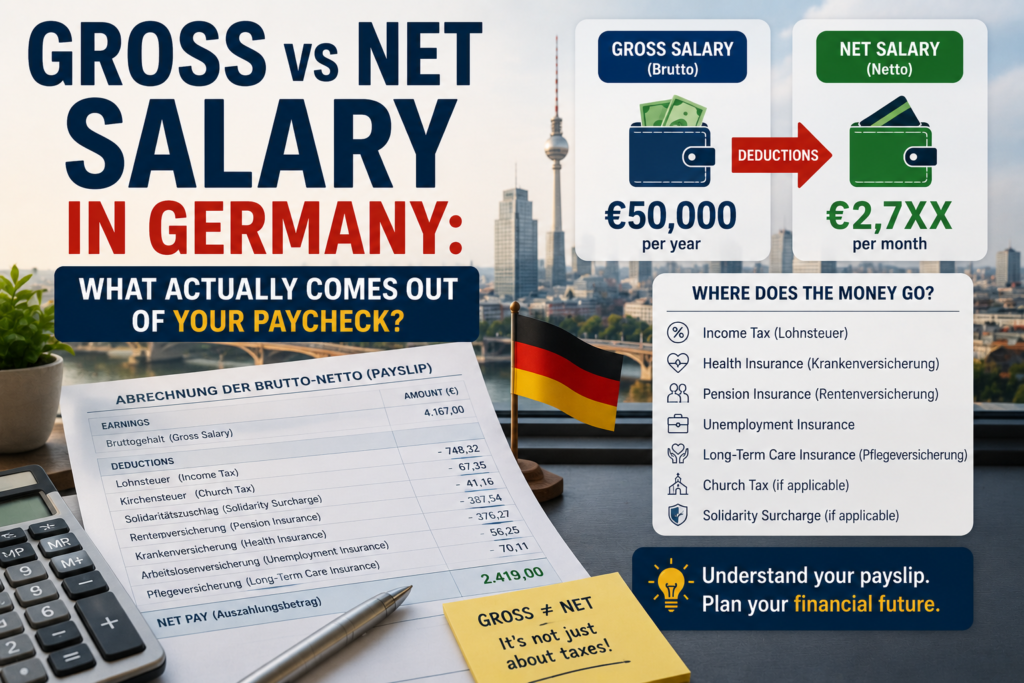
You receive a German job offer for €50,000 per year.
You divide that number by twelve.
€4,166.67 per month.
For a moment, you imagine that amount arriving in your bank account every month.
Then your first salary payment arrives.
It is considerably lower.
Where did the rest go?
The basic answer is simple:
Gross salary (Brutto) is your pay before applicable payroll deductions.
Net salary (Netto) is what remains after applicable taxes and employee social-security contributions have been deducted.
The difference has not simply disappeared.
Part of it goes toward income tax. Part may go toward statutory pension, health, unemployment and long-term care insurance. Depending on your circumstances, church tax or the solidarity surcharge may also apply.
And two people with exactly the same gross salary can still receive different net salaries.
That is why understanding gross vs net salary in Germany matters much more than simply putting a number into a calculator.
A calculator can estimate your take-home pay.
Understanding the deductions helps you make sense of the result.
What Is Gross Salary in Germany?
Gross salary is the amount you earn before employee payroll deductions.
The German term is Brutto or Bruttogehalt.
When a German employment contract says:
Jahresbruttogehalt: €50,000
it generally means an annual gross salary of €50,000.
If paid evenly over twelve months:
€50,000 ÷ 12 ≈ €4,167 monthly gross salary.
That is the starting point for payroll.
It is not the amount you should expect to receive in your bank account.
German employment offers commonly use gross salary because each employee’s eventual take-home pay depends on individual circumstances.
Those circumstances can include:
- tax class
- whether church tax applies
- health insurer and its additional contribution
- child-related differences in long-term care insurance
- other payroll-relevant information
This is why comparing German job offers using only the headline salary can be misleading.
A €60,000 salary tells you your gross contractual salary before employee payroll deductions. It does not represent the employer’s total cost of employing you, because employers generally pay additional employer-side social-security contributions.
And it does not automatically tell you how much money you can spend each month.
What Is Net Salary?
Net salary is your take-home pay after the applicable payroll deductions have been made.
In German, this is Netto or Nettogehalt.
If your payslip shows:
Brutto: €4,167
and later shows:
Netto: a lower figure,
the difference consists mainly of taxes and employee social-insurance contributions.
There is no single gross-to-net conversion percentage that works for everyone.
This is important because people often ask:
“What percentage of a German salary gets deducted?”
There is no honest universal answer.
Your net pay depends on your individual tax and insurance circumstances. Even employees earning the same gross salary may not receive the same monthly net amount.
Where Does the Money Between Gross and Net Salary Go?
For many employees, the main deductions fall into two broad groups:
- Taxes
- Social-security contributions
Here is the beginner-friendly overview.
| Deduction | What it broadly funds | Who generally pays it? |
|---|---|---|
| Lohnsteuer | Income tax collected through payroll | Employee |
| Rentenversicherung | Statutory pension system | Usually employee and employer |
| Krankenversicherung | Statutory healthcare | Usually employee and employer |
| Arbeitslosenversicherung | Unemployment insurance and labour-market support | Usually employee and employer |
| Pflegeversicherung | Long-term care system | Usually employee and employer |
| Kirchensteuer | Eligible religious communities | Employee, where applicable |
| Solidaritätszuschlag | Federal solidarity surcharge | Employee, where applicable |
Several social-security contributions are shared between employee and employer rather than being paid entirely from your salary.
That distinction matters.
If a statutory contribution rate is 18.6%, for example, that does not necessarily mean 18.6% is being taken from your paycheck. For standard employees, the employer may pay part of the contribution separately.
German Social Security Contributions Explained
Germany’s payroll system can look intimidating because several insurance deductions appear on the same payslip.
They each serve a different purpose.
For 2026, the key rates and contribution ceilings for a typical employee can be summarised like this:
| Insurance | 2026 overall rate | Typical employee share | 2026 contribution ceiling |
|---|---|---|---|
| Pension insurance | 18.6% | 9.3% | €8,450/month (€101,400/year) |
| Unemployment insurance | 2.6% | 1.3% | €8,450/month (€101,400/year) |
| Statutory health insurance | 14.6% + insurer-specific additional contribution | Generally half | €5,812.50/month (€69,750/year) |
| Long-term care insurance | 3.6% standard rate | Generally 1.8%, subject to family circumstances | €5,812.50/month (€69,750/year) |
For statutory health insurance, the government-set average additional contribution rate for 2026 is 2.9%, although the actual additional contribution depends on your health insurer. The Federal Ministry of Health also reports that the average rate actually charged by insurers was 3.13% as of 1 April 2026. Employer and employee generally split the insurer-specific contribution equally.
A contribution ceiling (Beitragsbemessungsgrenze) means that earnings above that amount are not used to calculate additional contributions for that particular branch of social insurance.
Pension Insurance — Rentenversicherung
The statutory pension-insurance contribution rate is 18.6% in 2026.
For a standard insured employee, the contribution is generally shared equally, giving an employee share of 9.3% on earnings subject to contributions.
The contribution ceiling is €8,450 per month or €101,400 per year.
Pension insurance helps finance Germany’s statutory pension system.
Health Insurance — Krankenversicherung
For statutory health insurance (gesetzliche Krankenversicherung or GKV), the general contribution rate is 14.6%.
Health insurers also charge an additional contribution (Zusatzbeitrag), which varies between insurers. Employer and employee generally split both the standard contribution and the insurer-specific additional contribution equally.
This means two employees with identical gross salaries can have slightly different health-insurance deductions if their health insurers charge different additional rates.
Unemployment Insurance — Arbeitslosenversicherung
The unemployment-insurance contribution rate is 2.6% in 2026, generally divided equally between employer and employee.
For a standard employee, that corresponds to an employee share of 1.3% on earnings subject to the contribution.
It uses the same €8,450 monthly contribution ceiling as statutory pension insurance.
Long-Term Care Insurance — Pflegeversicherung
Long-term care insurance is separate from ordinary health insurance.
Its standard contribution rate is 3.6% in 2026. For most employees, employer and employee generally each pay 1.8%.
There are important exceptions.
Childless members over 23 generally pay an additional 0.6 percentage-point surcharge. Eligible parents with multiple children under 25 can receive reductions in their employee contribution. Saxony also has a different employer-employee split.
So family circumstances can change take-home pay even when two employees have identical gross salaries.
What About German Income Tax?
Social insurance is only part of the difference between gross and net salary.
Employees may also have Lohnsteuer, or wage tax, withheld through payroll.
Lohnsteuer is essentially the collection of income tax from employment income during the year. Your employer calculates the withholding using the relevant payroll information and transfers it to the tax authorities.
Germany uses a progressive income-tax system.
That means higher portions of taxable income can face higher marginal tax rates.
But this is commonly misunderstood.
Moving Into a Higher Tax Bracket Does Not Mean Your Entire Salary Is Taxed at That Rate
Suppose part of your taxable income moves into a higher marginal band.
That higher rate applies to the relevant additional portion—not retroactively to every euro below it.
Think of it like filling a series of containers.
You fill the first one before income begins flowing into the next.
Filling the next container does not change what happened to the money already in the first.
That is why earning a raise does not normally make you poorer simply because some additional income enters a higher marginal tax range.
For 2026, Germany’s basic tax-free allowance (Grundfreibetrag) is €12,348.
Gross salary and taxable income, however, are not identical concepts. Payroll calculations take account of relevant allowances and rules, which is another reason multiplying your gross salary by a headline tax rate will not reliably produce your net salary.
What Are German Tax Classes?
Germany uses Steuerklassen, or tax classes, primarily to determine how wage tax is withheld through payroll.
They influence monthly withholding.
They should not simply be interpreted as your personal final tax rate.
For beginners, the most useful principle is:
Tax class affects what is withheld during the year. It does not by itself determine your complete final annual tax position.
This distinction is particularly useful for married couples, people with multiple jobs and anyone wondering why a colleague with the same gross salary receives a different monthly net amount.
Church Tax and the Solidarity Surcharge
These deductions do not apply to everyone.
Church Tax — Kirchensteuer
If you are a member of a recognised religious community that levies church tax, it can be collected through payroll.
Depending on the federal state, church tax is generally 8% or 9% of the relevant wage/income tax.
It is not 8% or 9% of your gross salary.
Someone not subject to church tax can therefore have a different net salary from another employee with otherwise similar circumstances.
Solidarity Surcharge — Solidaritätszuschlag
The solidarity surcharge still exists, but exemption thresholds mean many employees do not pay it on ordinary employment income.
For 2026, the relevant annual income-tax assessment exemption threshold is €20,350 in the standard individual case and €40,700 in the joint-assessment case specified by the law. A transition zone applies above the threshold.
The important beginner takeaway is simply:
Do not assume every employee automatically has a solidarity surcharge deducted from every paycheck.
Why Can Two People With the Same Gross Salary Take Home Different Amounts?
Imagine two employees.
Both earn €50,000 gross per year.
Both work full-time.
Yet their monthly net salaries differ.
That does not automatically mean somebody has been paid incorrectly.
Their payroll circumstances may simply be different.
Tax Class
Different tax classes can produce different wage-tax withholding during the year.
Again, this does not necessarily mean the employees’ final annual tax burdens will differ by exactly the same amount.
Church Tax
One employee may be subject to Kirchensteuer while another is not.
That changes monthly deductions.
Health Insurer
Employees in statutory health insurance can belong to different health insurers.
Because each insurer can set its own additional contribution rate, otherwise similar employees may have slightly different health-insurance deductions.
Children and Long-Term Care Insurance
Family circumstances can affect the employee contribution to long-term care insurance.
For example, a childless employee over 23 generally faces the additional surcharge, while eligible parents may have different contribution levels.
Other Payroll Circumstances
Additional employment, taxable benefits, bonuses and other payroll items can also affect the result.
This is why:
“What is the net salary for €50,000 in Germany?”
does not have one universally correct answer.
A better question is:
“What would €50,000 gross look like after deductions under my circumstances?”
Comparing your take-home pay directly with somebody else’s can therefore be misleading. If those comparisons start affecting how you view your progress, it can help to remember that modern financial success is not defined by one salary or payslip.
A €50,000 Salary Does Not Mean €4,167 in Monthly Take-Home Pay
Return to our original example.
A German employer offers you:
€50,000 gross per year
The first calculation is straightforward:
€50,000 ÷ 12 = approximately €4,166.67 gross per month
That gives you monthly Brutto.
Then payroll deductions are calculated.
Conceptually:
€50,000 annual gross salary
↓
approximately €4,167 monthly gross
↓
applicable wage tax
↓
employee pension contribution
↓
employee health-insurance contribution
↓
employee unemployment-insurance contribution
↓
employee long-term care contribution
↓
church tax and/or solidarity surcharge where applicable
↓
monthly net salary
The exact net amount depends on the employee.
That is why it would be misleading to claim:
“€50,000 gross always equals €X net.”
For someone considering a job offer, however, the lesson is immediate:
Do not build your monthly budget around annual gross salary divided by twelve.
That is your gross starting point, not your disposable monthly income.
This becomes particularly important in cities where housing and everyday costs consume a significant share of take-home pay. Crown Altessa’s guide to saving money in Germany explores why a salary that looks comfortable on paper can feel different after payroll deductions and living costs.
How to Read a German Payslip
Your first German payslip can look less like a salary statement and more like a page of abbreviations.
Fortunately, you do not need to understand every payroll code immediately.
Start with the major sections.
| German term | English meaning | What it represents |
|---|---|---|
| Brutto / Bruttogehalt | Gross salary | Earnings before applicable deductions |
| Netto / Nettogehalt | Net salary | Amount remaining after payroll deductions |
| Lohnsteuer | Wage tax | Income tax withheld through payroll |
| Rentenversicherung / RV | Pension insurance | Employee pension contribution |
| Krankenversicherung / KV | Health insurance | Employee health-insurance contribution |
| Arbeitslosenversicherung / AV | Unemployment insurance | Employee unemployment-insurance contribution |
| Pflegeversicherung / PV | Long-term care insurance | Employee long-term-care contribution |
| Kirchensteuer / KiSt | Church tax | Applicable where relevant |
| Solidaritätszuschlag / SolZ | Solidarity surcharge | Applicable where relevant |
| Steuerklasse | Tax class | Used for payroll withholding |
| Auszahlungsbetrag | Amount paid out | Final amount transferred after relevant adjustments |
The exact design varies by employer and payroll provider, but the logic is generally similar.
Start With Your Gross Earnings
Look for Brutto, Gesamtbrutto or Bruttogehalt.
This tells you the gross earnings being processed.
If you received overtime, a bonus or taxable benefits, these may appear separately before contributing to the relevant gross totals.
Find the Tax Deductions
Look for:
- Lohnsteuer
- Kirchensteuer, if applicable
- Solidaritätszuschlag, if applicable
These are tax items rather than social-insurance contributions.
Look at Social Insurance
You will commonly see:
- KV — Krankenversicherung
- RV — Rentenversicherung
- AV — Arbeitslosenversicherung
- PV — Pflegeversicherung
This section often surprises newcomers.
A significant part of the difference between Brutto and Netto may consist of social-insurance contributions rather than simply income tax.
Find the Payout Amount
Your Netto is important, but depending on the payslip there may be additional adjustments after the displayed net figure.
The amount ultimately transferred to your bank account may be labelled Auszahlungsbetrag.
If the number arriving in your bank account does not match the headline Netto, check whether the payslip contains reimbursements, deductions or other adjustments.
A German payslip becomes much easier to understand when you see it as a sequence:
earnings → taxes → social insurance → adjustments → payout
How to Evaluate a German Job Offer Properly
A headline salary matters.
But it should not be the only number you examine.
Suppose you receive two job offers:
Offer A: €60,000 gross in Munich
Offer B: €55,000 gross with more remote work and lower commuting costs elsewhere
Offer A has the higher contractual salary.
That does not automatically mean it leaves you financially or personally better off.
A thoughtful comparison considers several dimensions.
Expected Take-Home Pay
Estimate your likely monthly net income using your actual payroll circumstances.
Do not compare offers purely using annual gross salary.
Cost of Living
Salary has different purchasing power depending on where you live.
Housing costs in Munich, for example, may make a higher salary feel considerably less generous than the same income in a lower-cost location.
Commuting
Consider:
- public transport
- fuel
- parking
- vehicle expenses
- commuting time
A job requiring an expensive or lengthy commute has a cost that does not appear in gross salary.
Benefits
Depending on the employer, benefits may include:
- employer pension arrangements
- subsidised transport
- meal benefits
- childcare support
- additional insurance
- equipment or mobility benefits
Consider what those benefits are genuinely worth to you rather than assuming every benefit has equal value.
Bonuses
If part of the compensation is variable, distinguish guaranteed contractual salary from performance-dependent or discretionary compensation.
Avoid building essential monthly commitments around income that is not guaranteed.
Vacation and Working Time
A €5,000 salary difference may look substantial until you discover that one role requires considerably longer hours or offers fewer days off.
Compensation should be considered alongside the amount of your time the employer receives in return.
Remote-Work Possibilities
Remote or hybrid work can affect:
- commuting expenses
- housing choices
- childcare logistics
- meals
- everyday flexibility
The financial value varies by person.
Professional Development
A position that develops valuable skills or creates a strong career path may have financial value beyond the first year’s salary.
Conversely, a slightly higher salary in a stagnant role may be less attractive over a longer horizon.
This is one reason career choices and personal finance often overlap. Workers can earn a respectable salary while still feeling constrained, as explored in Why Young Workers Feel Financially Trapped.
The better question is not simply:
“Which offer pays more?”
It is:
“Which employment package gives me the strongest combination of take-home income, affordability, time, stability and future opportunity?”
Gross Salary vs Net Salary for Foreigners Moving to Germany
For someone moving to Germany, gross and net salary can be especially confusing because salary conventions and social-insurance systems differ between countries.
A job offer that initially looks straightforward can become harder to evaluate once payroll deductions and local living costs enter the picture.
German Offers Commonly Quote Gross Salary
If a recruiter says:
“The salary is €55,000”
clarify the contractual wording, although German professional employment discussions commonly refer to Jahresbruttogehalt.
Do not assume the figure represents what reaches your bank account.
Social Insurance Is a Major Part of Payroll
Someone arriving from a country where healthcare or pensions are financed differently may be surprised by the number of deductions on a German payslip.
Health insurance, pension insurance, unemployment insurance and long-term care insurance are distinct components.
They should not all be mentally grouped under “tax.”
Comparing Gross Salaries Internationally Can Be Misleading
Suppose you earn €60,000 in Germany and previously earned the equivalent of €60,000 elsewhere.
That does not mean your financial position is identical.
Countries differ in their:
- tax systems
- healthcare arrangements
- social-insurance systems
- pension structures
- housing costs
- employment benefits
A more meaningful comparison considers:
take-home pay + benefits + living costs + working conditions + future opportunities
Your First Net Salary May Still Surprise You
Even if you use a calculator before moving, your actual payslip can differ from the estimate because payroll depends on the information and circumstances used in the calculation.
When your first German payslip arrives, check:
- tax class
- health insurer
- social-insurance deductions
- whether church tax appears
- bonuses or taxable benefits
- payout amount
If something appears inconsistent with your circumstances, ask your employer’s payroll team for an explanation rather than trying to diagnose the issue from an online calculator alone.
Net Income Needs Context
A newcomer earning what appears to be a strong net salary can still face financial pressure once rent, deposits, furniture, transportation and other relocation costs are included.
That does not automatically mean the salary is poor.
It means relocation changes the financial context around the salary.
For newcomers establishing themselves financially, saving money in Germany can be difficult at first. And when an unfamiliar system makes every money decision feel uncertain, building financial confidence may be more useful than trying to memorise every German payroll rule immediately.
Common Gross-vs-Net Salary Mistakes
German payroll becomes easier to understand once you stop treating the difference between Brutto and Netto as one mysterious percentage.
Most confusion comes from a handful of recurring assumptions.
“My Annual Salary Divided by 12 Is My Monthly Take-Home Pay”
No.
If your contract says €50,000 gross per year, dividing by twelve gives you roughly €4,167 monthly gross.
That is before applicable wage tax and employee social-security deductions.
“Everyone Earning €50,000 Gets the Same Net Salary”
Also no.
Payroll circumstances differ.
Tax class, church tax, health insurer, family circumstances and other payroll items can change take-home pay.
“All Payroll Deductions Are Income Tax”
A substantial part of the gap between gross and net can consist of social-insurance contributions.
These include pension, health, unemployment and long-term care insurance.
Grouping all deductions under “tax” makes the system look more confusing than it is.
“If I Enter a Higher Tax Bracket, My Entire Salary Gets Taxed at the Higher Rate”
No.
Germany’s progressive system applies higher marginal rates to the relevant additional portions of taxable income.
Moving into a higher marginal band does not retroactively apply that rate to all your earlier income.
“A Gross-to-Net Calculator Tells Me Exactly What I Will Always Receive”
A calculator is useful, but it remains an estimate.
The result depends on the information you enter and whether the calculator reflects current rules.
Actual payroll can also contain bonuses, taxable benefits, reimbursements or other adjustments.
Should You Use a Gross-to-Net Salary Calculator?
Yes—just use it for the right purpose.
A current German gross-to-net calculator can help estimate:
- monthly take-home pay
- likely payroll deductions
- the difference between gross and net compensation
- how different payroll circumstances may change withholding
That is useful when evaluating a job offer.
But a calculator should not replace understanding.
A sensible approach is:
- Use a reputable calculator updated for 2026.
- Enter your actual circumstances as accurately as possible.
- Treat the result as an estimate, not a guaranteed future payslip.
- Once employed, compare the estimate with your actual payroll statement.
- Ask payroll or a qualified professional if something significant appears incorrect.
A calculator tells you what your estimated net salary may be.
Understanding payroll tells you why.
Frequently Asked Questions
What Is the Difference Between Gross and Net Salary in Germany?
Gross salary (Brutto) is your earnings before applicable employee payroll deductions.
Net salary (Netto) is what remains after applicable taxes and employee social-security contributions have been deducted.
The net amount is therefore much closer to the money available for your monthly spending and saving.
What Percentage of Salary Is Deducted in Germany?
There is no universal percentage.
The amount depends on income, tax circumstances, health insurance, family circumstances, church tax where applicable and other payroll details.
A fixed percentage for every German employee would oversimplify the system.
Why Is My German Net Salary Lower Than Expected?
Common deductions include:
- wage tax
- pension insurance
- health insurance
- unemployment insurance
- long-term care insurance
- church tax where applicable
- solidarity surcharge where applicable
Many newcomers underestimate social-insurance deductions because they assume almost the entire difference between gross and net is income tax.
Is Health Insurance Deducted From Salary in Germany?
For employees in statutory health insurance, the employee share is generally deducted through payroll while the employer pays its share separately.
The general statutory health-insurance rate in 2026 is 14.6%, plus an insurer-specific additional contribution. The government-set average additional contribution rate for 2026 is 2.9%, although individual insurers set their own rates.
Does Everyone Pay the Same Amount of Tax?
No.
Germany has a progressive income-tax system, and payroll withholding depends on individual circumstances.
Two employees with the same gross salary can therefore have different monthly net salaries.
What Does Brutto Mean in Germany?
Brutto means gross.
It refers to earnings before applicable employee deductions.
If a job offer says €60,000 Brutto per year, that is not €60,000 of take-home pay—and it is not necessarily the employer’s total employment cost either.
What Does Netto Mean?
Netto means net.
It is the amount remaining after applicable payroll deductions.
On a payslip, the final Auszahlungsbetrag may occasionally differ from the displayed net amount because of additional adjustments.
Why Do Two People With the Same Gross Salary Have Different Net Salaries?
Possible reasons include:
- tax class
- church tax
- different statutory health-insurer additional contributions
- child-related long-term-care rules
- taxable benefits
- bonuses
- other payroll circumstances
Gross salary alone does not uniquely determine net salary.
Is €50,000 Gross or Net When Listed in a German Job Offer?
German job offers and employment contracts commonly discuss annual gross salary (Jahresbruttogehalt).
If you see €50,000 in an offer, do not assume it is take-home pay. Check the contractual wording.
How Can I Estimate My Take-Home Salary in Germany?
Use a reputable gross-to-net calculator updated for 2026 and enter your actual circumstances as accurately as possible.
Treat the result as an estimate.
Once you start working, your real payslip is the better source for understanding exactly what has been processed.
Conclusion
A German salary becomes much easier to understand once you stop thinking of the difference between gross and net as money simply “disappearing.”
Your gross salary describes your contractual earnings before employee payroll deductions.
Your net salary shows what remains after applicable taxes and employee social-insurance contributions.
Between those two numbers sit several different systems:
- income tax
- pension insurance
- health insurance
- unemployment insurance
- long-term care insurance
- and, for some employees, church tax or the solidarity surcharge
Understanding that journey is more useful than memorising one gross-to-net percentage.
It helps you evaluate job offers realistically.
It helps you compare employment opportunities.
It helps you read your payslip.
And it helps you build expectations around the money that will actually reach your bank account rather than the headline number in an employment contract.
The most useful habit is simple:
Whenever you see a German salary figure, ask whether it is Brutto or Netto before making financial assumptions.
That one distinction prevents a surprising amount of confusion.
If you want a broader beginner-friendly guide to managing money beyond payroll, my book Personal Finance Made Simple for Beginners covers the foundations in plain language.
My book on Gumroad:
https://ukandu0.gumroad.com/l/bteyh
Or on Amazon:
Sources & Further Reading
For 2026 statutory health-insurance rates, the average additional contribution and health-insurance contribution ceiling, see the Federal Ministry of Health (Bundesministerium für Gesundheit).
For the 2026 pension, unemployment and long-term-care rates and contribution ceilings, official Federal Ministry of Health social-insurance figures confirm the rates used above.
For the 2026 income-tax tariff and €12,348 Grundfreibetrag, see the Federal Ministry of Finance’s 2026 Income Tax Act guidance.
For the 2026 solidarity-surcharge thresholds and calculation rules, see the Federal Ministry of Finance’s 2026 wage-tax guidance.
Feeling financially stuck?
When financial pressure becomes constant, long-term decisions start feeling emotionally heavy.
The Crown Altessa newsletter was created to help people rebuild clarity slowly and strategically through practical financial frameworks, long-term thinking, and structured decision-making insights.
Join the newsletter and receive:
• the free Financial Foundation Guide
• strategic financial insights
• practical tools for long-term stability
• frameworks designed to reduce financial overwhelm
Start building financial clarity one step at a time.