
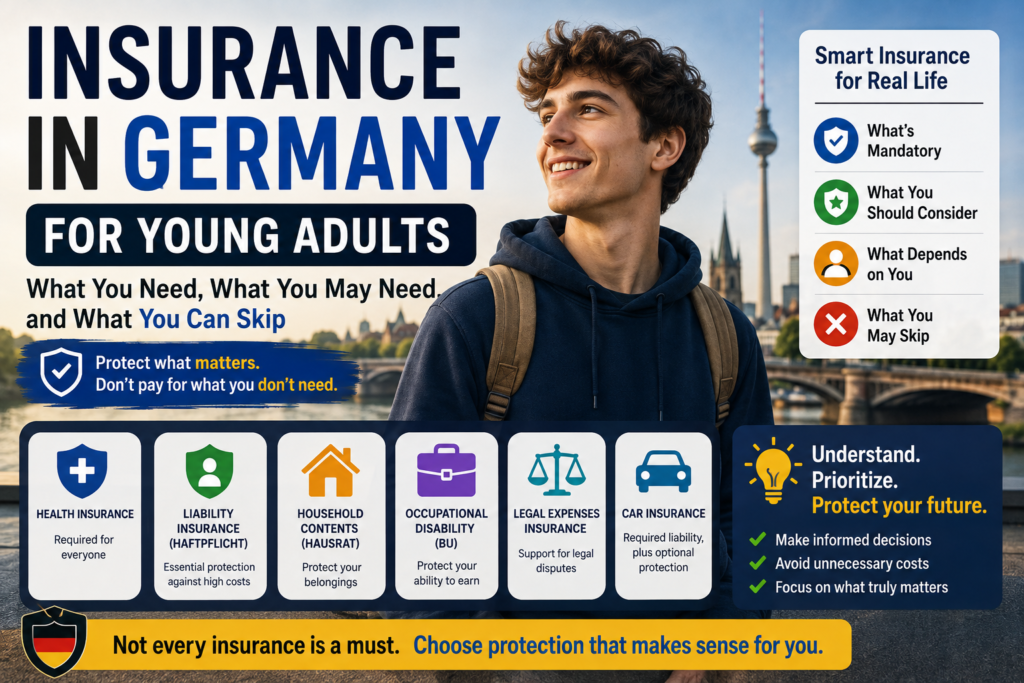
Germany offers insurance for almost every imaginable risk. This guide helps young adults distinguish mandatory protection, serious financial risks, optional cover, and policies they may not need.
You start earning your own money.
Suddenly, everybody seems to have an insurance policy you supposedly need.
Health insurance.
Private liability insurance.
Household contents insurance.
Legal insurance.
Travel insurance.
Occupational disability insurance.
Phone insurance.
Pet insurance.
The list keeps growing.
If you bought every policy someone suggested, insurance itself could become a significant monthly expense.
So the useful question isn’t:
“How many insurance policies should I have?”
It is:
“Which financial risks are serious enough that I should pay someone else to take them?”
That distinction matters.
Insurance is particularly valuable when the potential financial consequences of an event would be extremely difficult—or impossible—for you to absorb yourself.
A broken €300 phone is inconvenient.
Being legally responsible for a severe accident that causes enormous personal injury is a fundamentally different financial risk.
Independent German consumer guidance follows a similar principle: prioritise risks that could threaten your financial existence, while being more selective about policies covering small losses you could reasonably pay yourself.
That framework makes German insurance much easier to understand.
The Golden Rule: Insure Risks That Could Seriously Hurt You Financially
Before buying another insurance policy, ask six questions:
- Is this insurance legally required?
- What event am I actually protecting against?
- How financially serious could that event become?
- Could I comfortably absorb the loss myself?
- Do I already have protection through another policy or social-insurance system?
- What important situations does the policy exclude?
These questions separate high-impact risks from ordinary inconveniences.
Suppose your headphones stop working.
Replacing them may be frustrating, but if you can comfortably pay for another pair from savings, the financial consequence is limited.
Now suppose you accidentally cause an incident in which another person suffers life-changing injuries.
German civil liability can expose someone who causes damage culpably to substantial—and potentially very long-lasting—financial claims. This is why Verbraucherzentrale describes private liability insurance as essential protection against an existential financial risk.
The two events should not receive equal insurance priority.
That is the basic principle behind sensible insurance planning:
The larger the potential financial damage relative to your ability to absorb it, the stronger the case for transferring that risk to an insurer.
This does not mean always buying the most expensive policy.
It means focusing first on consequences that could genuinely destabilise your financial life.
That becomes especially important for young workers who are still building savings and may already feel financially stretched by everyday costs.
Tier 1: Insurance You Are Required to Have
Not every commonly recommended policy is legally mandatory.
That distinction is important.
Two major areas deserve attention immediately: health insurance and motor-vehicle liability where you own or use a vehicle subject to the compulsory insurance rules.
Health Insurance — Krankenversicherung
Health insurance is fundamental to the German system.
Germany requires residents to have health coverage under the applicable statutory or private framework. For employees, whether statutory health insurance (gesetzliche Krankenversicherung, GKV) applies depends partly on employment status and income.
For 2026, employees earning more than €603 per month but not above the annual compulsory-insurance threshold are among the groups generally subject to statutory health-insurance membership. Other categories—including students, trainees, unemployed people, pensioners and self-employed people—can be governed by different rules.
For a young employee, the most important distinction is between:
GKV — gesetzliche Krankenversicherung
Statutory health insurance.
and
PKV — private Krankenversicherung
Private health insurance.
These are not simply two versions of the same product where everybody can freely choose whichever looks cheapest.
Eligibility matters.
Employment status matters.
Income can matter.
Family circumstances can matter.
And switching systems can have long-term implications.
For that reason, this article will not turn GKV versus PKV into a superficial comparison.
The beginner takeaway is simpler:
Make sure you understand which health-insurance system applies to your circumstances before treating health coverage like an optional consumer purchase.
If you’ve just begun working in Germany, your first payslip will also show how health-insurance contributions interact with payroll. Crown Altessa’s guide to gross vs net salary in Germany explains where those deductions fit into your take-home pay.
Motor Vehicle Liability — Kfz-Haftpflichtversicherung
If you do not own a car, you do not need car insurance simply because you live in Germany.
But if you own or register a vehicle covered by Germany’s compulsory motor-insurance rules, liability insurance is not optional.
Germany’s Pflichtversicherungsgesetz requires relevant vehicle holders to maintain liability insurance covering personal injury, property damage and certain financial losses caused through the use of the vehicle. Using a vehicle where the legally required liability cover does not exist is prohibited.
This mandatory cover is Kfz-Haftpflichtversicherung.
Its purpose is primarily to deal with liability for damage caused to other people.
That is different from optional protection for damage to your own vehicle, which we’ll discuss later.
So a useful distinction is:
Kfz-Haftpflicht: potentially mandatory.
Teil- or Vollkasko: optional protection whose usefulness depends on your vehicle and circumstances.
Tier 2: Insurance That Can Be Extremely Important Even When It Is Not Legally Required
A policy does not have to be compulsory to protect against a financially serious risk.
This is where private liability insurance becomes especially important.
Private Liability Insurance — Privathaftpflichtversicherung
Private liability insurance is not generally a legal requirement for every adult in Germany.
Yet Verbraucherzentrale describes it as indispensable because German liability for damage caused to others can extend to very large amounts.
Why?
Because everyday life creates liability risks that are easy to underestimate.
You might:
- cause an accident while cycling;
- accidentally damage somebody else’s expensive property;
- injure another person through negligence;
- cause damage in a rented property;
- create an incident whose consequences continue for years.
Small property damage may be annoying.
Serious personal injury is where the financial consequences can become extraordinary.
That is exactly the kind of risk insurance is well suited to transfer.
What private liability insurance generally does
At a high level, a private liability policy can:
- examine whether a liability claim against you is justified;
- defend against unjustified claims within the policy framework;
- pay covered justified claims up to the contractual limits.
That last point is important.
Having liability insurance does not mean every conceivable accident is covered.
Policy wording matters.
Exclusions matter.
Coverage limits matter.
Who is insured matters.
Activities and risks can also be treated differently between contracts.
For example, deliberately causing damage is fundamentally different from accidentally causing it. Verbraucherzentrale notes that intentional damage is excluded from private liability protection.
Before purchasing a policy, therefore, the useful question isn’t only:
“How cheap is it?”
It is:
“If the financially serious event I am worried about happens, does this contract actually protect me?”
That mindset is more useful than buying insurance based on the headline premium alone.
Occupational Disability Insurance — Berufsunfähigkeitsversicherung
For most young adults, their largest financial asset is not their phone.
Or their television.
Or even their car.
It is something much less visible:
their ability to earn an income for the next several decades.
Imagine a 27-year-old who expects to work until their sixties.
Even without an exceptionally high salary, the total income that person could earn over a working life may be far more economically significant than almost everything they currently own.
That is the risk Berufsunfähigkeitsversicherung, or occupational disability insurance, is designed to address.
Its purpose is generally to provide a contractual income benefit when illness or disability means you can no longer perform your occupation to the degree required by the policy.
Verbraucherzentrale considers protection against losing your ability to work one of the most important forms of private financial protection for people who depend on their earned income. It also distinguishes occupational disability cover from Germany’s statutory disability protections, which do not necessarily replace the income a worker previously earned or protect the exact occupation in the same way.
But this is also an area where simplistic recommendations are particularly unhelpful.
Why occupational disability insurance is complicated
Premiums and availability can depend on factors including:
- occupation;
- age;
- health history;
- hobbies;
- requested benefit;
- contract terms.
Applications can involve detailed health questions.
Pre-existing conditions may affect:
- whether cover is offered;
- exclusions;
- premiums;
- other contract conditions.
Policies also differ substantially in wording and quality.
That means:
“Everyone should just buy the cheapest BU policy” is poor advice.
The financial risk deserves serious consideration.
The individual contract deserves equally serious scrutiny.
Occupational disability is not the same as accident insurance
Another common misunderstanding is assuming that an accident policy provides equivalent protection.
Occupational disability can result from illness as well as accidents.
Verbraucherzentrale specifically warns that private accident insurance does not provide comprehensive protection against loss of earning capacity because permanent income loss is far more often connected to illness than to accidents.
The underlying financial question is therefore:
“If my ability to earn my salary disappeared for years, what would support me?”
That is a very different risk from replacing a damaged device or stolen suitcase.
Why Insurance Priority Matters More Than Insurance Quantity
At this point, notice something important.
We have not created a shopping list.
We have created a risk hierarchy.
At the top sit things that are legally required.
Next come potentially devastating financial risks.
Later we’ll consider risks where the answer depends much more heavily on what you own, where you live and what you could comfortably replace yourself.
That order matters.
Someone can own eight small insurance policies and still be poorly protected.
For example, they might insure:
- their smartphone;
- glasses;
- luggage;
- individual electronics;
while having no meaningful protection against a severe personal liability claim.
That is backwards from a risk-management perspective.
Good insurance planning asks:
“What could cause the greatest financial damage?”
before asking:
“What could go wrong?”
Almost anything can go wrong.
Not everything needs to be insured.
That distinction becomes even more important when your budget is limited. Building a personal finance system can help you see insurance premiums alongside savings, bills and other essential commitments instead of treating each policy as an isolated purchase.
Tier 3: Insurance That Depends on Your Situation
Some insurance policies are neither universally required nor universally unnecessary.
Their value depends on what you own, what you do, and how difficult a loss would be for you to absorb.
That is why these policies belong in a third category:
potentially useful, depending on your circumstances.
Household Contents Insurance — Hausratversicherung
Hausratversicherung generally protects the contents of your home against specified risks such as fire, burglary, certain water damage and other insured events, depending on the contract.
Think about everything you would need to replace if the contents of your home were suddenly destroyed.
Furniture.
Electronics.
Clothing.
Kitchen equipment.
Bicycles or other possessions where covered.
For someone living in a furnished student room with relatively few belongings, that potential loss may be manageable.
For someone who has spent years building a household filled with valuable possessions, replacing everything at once could be financially painful.
That is why household contents insurance should not be treated as automatically essential for everyone.
The better question is:
“If I lost most of the contents of my home tomorrow, could I realistically replace them without creating a serious financial problem?”
If the answer is yes, self-insuring that risk through savings may be reasonable.
If the answer is no, household contents insurance deserves more consideration.
Also check what the policy actually covers. A policy may distinguish between risks such as burglary, simple theft, water damage or valuables, and coverage limits can differ.
Legal Expenses Insurance — Rechtsschutzversicherung
Legal expenses insurance is designed to help cover the costs of certain legal disputes.
Depending on the policy modules, that might include areas such as:
- employment disputes;
- traffic-related disputes;
- tenancy issues;
- private contractual disputes.
But this is a good example of why insurance should never be bought based on its name alone.
Rechtsschutzversicherung does not mean “every legal problem is insured.”
Verbraucherzentrale notes that important areas can be excluded or only partly covered. Common examples include some disputes involving divorce, inheritance, construction projects and investment matters. Many policies also contain waiting periods, often around three months, meaning a dispute that already exists or is foreseeable when you take out the policy generally cannot simply be insured after the fact.
This policy may therefore make more sense for someone who has meaningful exposure in areas they specifically want covered.
For example:
A tenant worried about potentially expensive rental disputes may evaluate the policy differently from someone living with their parents.
A regular driver may place more value on traffic legal protection than someone who rarely uses a vehicle.
And some people already have access to certain legal support through organisations such as a trade union or tenants’ association, depending on membership and the issue involved.
Before buying, ask:
Which exact legal disputes am I trying to insure—and are they actually covered?
Travel Health Insurance — Auslandskrankenversicherung
Travel health insurance deserves special attention because many people assume their ordinary German health insurance provides equivalent protection everywhere.
That is not necessarily the case.
For people covered by statutory health insurance, the European Health Insurance Card can provide access to medically necessary treatment under the rules applicable in various European countries.
But important gaps can remain.
For example, German statutory health insurance generally does not pay for a medical repatriation to Germany. Depending on the destination and provider, treatment outside the statutory system can also leave travellers with costs they must initially or ultimately pay themselves.
That is why Verbraucherzentrale regards private travel health insurance as particularly important when travelling abroad.
Still, the contract matters.
Check:
- maximum trip duration;
- whether repatriation is covered;
- wording around medically “necessary” versus medically “sensible” transport;
- territorial coverage;
- exclusions;
- deductibles.
Someone taking a weekend trip within Europe faces different practical circumstances from somebody travelling for several months outside Europe.
Again, circumstance matters.
Pet Owner Liability — Tierhalterhaftpflichtversicherung
Pet liability is a useful example of why German insurance rules cannot always be reduced to one nationwide answer.
Small domestic animals such as cats and rabbits are generally covered through private liability insurance.
Dogs and horses are different.
Verbraucherzentrale states that damage caused by dogs and horses generally requires separate animal-owner liability cover rather than ordinary private liability insurance.
For dogs, legal requirements vary by federal state.
Some states require liability insurance for all dogs, while others impose requirements only for particular dogs or circumstances.
That means:
Do not assume the same rule applies everywhere in Germany.
If you own a dog, check the law in your Bundesland as well as the actual policy terms.
For horses, animal-owner liability remains particularly important because potential third-party damage can be substantial, even though a nationwide compulsory-insurance requirement does not apply.
Optional Car Comprehensive Insurance — Teilkasko and Vollkasko
As discussed earlier, motor-vehicle liability insurance is legally required for relevant vehicles.
Comprehensive cover for your own vehicle is different.
Two common types are:
Teilkasko — partial comprehensive cover.
Vollkasko — more extensive comprehensive cover.
These policies protect against specified damage to your own vehicle rather than merely liability toward other people.
Whether that is worthwhile depends heavily on the car.
Imagine two drivers.
One owns an older vehicle worth €2,500.
The other has a nearly new car worth €45,000.
The financial consequences of losing those vehicles are very different.
Verbraucherzentrale notes that comprehensive cover is voluntary and tends to be particularly relevant for more valuable or newer vehicles.
This returns us to the central rule:
Insure based on the financial consequence of the loss—not simply because a policy exists.
Insurance You May Not Need
This may be the most important section in the article.
Insurance is useful.
That does not mean more insurance automatically creates greater financial security.
Some policies protect against relatively small losses that many people could reasonably absorb themselves.
If you pay premiums for enough small risks, those premiums become a financial risk of their own: a permanent drag on your monthly cash flow.
This does not mean the following products are always bad.
It means they deserve more scrutiny.
Smartphone and Small-Device Insurance
A salesperson offers you insurance immediately after you’ve bought a new phone.
The logic feels convincing.
You’ve just spent €800.
Surely protecting it is sensible.
But step back.
Ask:
- What does the policy cost over two or three years?
- Is theft actually covered under the circumstances most likely to occur?
- Is accidental damage covered?
- What deductible applies?
- What is the device likely to be worth after two years?
- Could I comfortably replace or repair it myself?
Verbraucherzentrale’s consumer guidance on device guarantee insurance notes that certain repair costs can be lower than repeated insurance premiums, while existing legal warranty rights or household contents insurance may already cover some situations.
If losing the device would be unpleasant but financially manageable, saving the premium yourself may sometimes be more efficient.
Extended Warranties and Guarantee Insurance
Retailers frequently offer extended protection alongside electronics and appliances.
Again, the question is not whether the policy can ever pay out.
It can.
The question is whether the risk is large enough to justify transferring it to an insurer.
You may already have legal rights if a newly purchased product is defective.
Some other damage may fall within existing household insurance where the event itself is covered.
And many small repairs can reasonably be paid from savings.
Read the exclusions carefully before paying for protection that may overlap with rights or cover you already have.
Luggage Insurance
Luggage insurance sounds attractive because lost luggage is frustrating.
But frustration and catastrophic financial risk are not the same thing.
Verbraucherzentrale generally considers separate luggage insurance dispensable for many travellers, noting restrictions, exclusions and the high standard of care expected from policyholders.
Before buying it, estimate the realistic value of what you normally carry.
Would replacing those items cause a financial crisis?
Or an inconvenient expense?
That distinction should influence the decision.
Narrowly Defined Small-Risk Policies
You may also encounter:
- glasses insurance;
- bicycle add-ons;
- small-device protection;
- specialised payment insurance;
- narrowly defined accident products.
There may be circumstances where one of these solves a real problem.
But as a general decision principle:
The easier it would be for you to pay the loss yourself, the stronger the case for considering self-insurance through savings instead of paying recurring premiums.
This is not an argument against insurance.
It is an argument for using insurance where insurance is strongest:
low-frequency, high-impact financial risks.
Insurance Is Not the Same as an Emergency Fund
Insurance and savings are often discussed as though one can replace the other.
They cannot.
They solve different problems.
Insurance transfers specific contractual risks to an insurer.
Emergency savings provide flexible cash.
Imagine you accidentally cause a covered liability claim resulting in extremely large damages.
Your emergency fund is unlikely to be an appropriate substitute for substantial liability insurance.
Now imagine your washing machine breaks.
That’s probably not what private liability insurance is designed to solve.
Your emergency savings may be exactly the right tool.
An emergency fund can help with situations such as:
- replacing essential appliances;
- urgent travel;
- temporary income disruption;
- insurance deductibles;
- expenses excluded from insurance;
- smaller financial shocks.
Insurance is valuable because it can transfer risks that are too large for you to reasonably absorb.
Cash reserves are valuable because they allow you to absorb smaller, unpredictable costs without borrowing money.
A financially resilient person may therefore need both.
Crown Altessa’s guide on building an emergency fund without feeling overwhelmed explains the savings side of this equation.
Another useful way to think about the distinction is:
Insurance protects against defined catastrophes.
Emergency cash protects against life’s messy unpredictability.
Trying to insure every €200 problem is often inefficient.
Trying to save enough cash to personally absorb a multimillion-euro liability claim is unrealistic.
Good financial planning gives each tool the job it performs best.
How Much Should You Spend on Insurance?
There is no responsible universal answer such as:
“Spend 5% of your income on insurance.”
That would ignore how different people’s lives are.
Insurance spending should follow risk exposure, not an arbitrary budgeting percentage.
Consider two 25-year-olds earning the same salary.
The first:
- lives with parents;
- has no car;
- has few expensive possessions;
- has no dependants;
- rarely travels.
The second:
- rents their own apartment;
- owns a car;
- has a dog;
- travels internationally;
- financially supports a child.
They do not have identical insurance needs simply because their incomes are identical.
Before deciding how much insurance is reasonable, consider:
- Who depends on your income?
- What valuable assets do you own?
- What liabilities could arise from your activities?
- Do you own a vehicle?
- Do you own pets?
- What does your housing situation expose you to?
- How often do you travel?
- How much loss could you comfortably absorb?
- What protection do you already have?
- Are you paying twice for overlapping risks?
The last question matters more than many people realise.
Insurance contracts tend to accumulate.
Someone buys a policy at 21.
Moves at 24.
Changes job at 27.
Moves in with a partner at 29.
Yet the old policies continue renewing in the background.
Your insurance needs should change when your life changes.
More insurance is not automatically better.
The objective is appropriate protection at a sustainable cost.
If premiums become so large that you’re unable to build emergency savings or meet other important financial goals, it is worth reviewing whether every policy is genuinely serving a meaningful purpose.
Insurance for Young Adults Living With Their Parents
Moving into adulthood does not always mean every insurance policy needs to start immediately in your own name.
Some young adults may still be covered under family policies.
But this depends heavily on:
- the type of insurance
- age
- education or training status
- employment
- whether you still live in the same household
- the wording of the actual policy
That means you should never assume:
“I’m still covered by my parents.”
Check.
Private Liability Insurance
Some family private-liability policies can continue covering children beyond age 18 under certain conditions, for example during school, vocational training or a first course of study.
But the exact rules depend on the contract.
Once you enter full employment, finish qualifying education, marry, or otherwise leave the conditions defined in the policy, family cover may end.
The practical lesson is simple:
Ask for the policy wording and verify whether you are still included by name or status.
Do not rely on family memory.
Household Contents Insurance
If you live with your parents, your possessions may often sit within the household covered by their policy, depending on the contract.
If you move into your own home, that can change.
Again, check the policy rather than assuming coverage automatically follows you.
Health Insurance
Health insurance follows its own legal framework and should not be confused with ordinary private family policies.
Young people may be eligible for family insurance within statutory health insurance under certain conditions, but age, education, income and other circumstances matter. This is an area where current official health-insurance rules should always be checked carefully. (bundesgesundheitsministerium.de)
For a young adult becoming financially independent, the transition from family arrangements to personal responsibility is a good moment to review insurance deliberately rather than simply copying what parents have always done.
Insurance for Foreigners Moving to Germany
Moving to Germany can make insurance feel especially confusing because familiar words often hide very different legal or financial systems.
Someone arriving from Italy, Nigeria, Canada or India may already have insurance in their home country.
That does not automatically mean the same protection works in Germany.
Start With Health Insurance
Health insurance is one of the first systems newcomers need to understand.
Do not assume a foreign policy automatically satisfies German requirements.
What matters is whether your coverage is recognised under the applicable rules and whether you are eligible for statutory or private insurance in Germany.
Learn the German Terms
A few words appear repeatedly:
- Krankenversicherung — health insurance
- Privathaftpflichtversicherung — private liability insurance
- Hausratversicherung — household contents insurance
- Rechtsschutzversicherung — legal expenses insurance
- Berufsunfähigkeitsversicherung — occupational disability insurance
- Kfz-Haftpflichtversicherung — motor vehicle liability insurance
You do not need to become an insurance expert.
You do need to understand what problem each policy is supposed to solve.
Private Liability Is More Commonly Discussed in Germany
Newcomers are often surprised by how frequently private liability insurance is recommended.
That reflects Germany’s legal environment around personal liability and the potentially large financial consequences of causing damage to others.
The point is not that every foreigner must automatically buy the first policy offered.
The point is that this is a risk category worth understanding early.
Bringing or Buying a Car
If you bring a vehicle to Germany or buy one locally, motor-vehicle liability requirements become relevant.
Do not assume insurance from your home country continues unchanged after registration or relocation.
Read Geographic Limits
Some policies look comprehensive until you examine where they actually apply.
Check whether coverage applies:
- only in Germany
- throughout the EU
- worldwide
- for limited periods abroad
This is particularly important for travel, liability and legal insurance.
Check Existing Foreign Cover
Do not cancel a foreign policy simply because you assume German insurance replaces it.
Likewise, do not assume the foreign policy remains sufficient.
Compare the actual contractual scope.
For newcomers already dealing with deposits, payroll and relocation expenses, this is another reason to keep some cash reserves for unexpected costs. Insurance cannot replace flexible cash for every expense.
How to Decide Whether an Insurance Policy Is Worth It
Whenever someone offers you a new insurance product, use the same framework.
Do not begin with:
“Is this policy popular?”
Begin with:
“What risk am I actually transferring?”
Then ask these eight questions.
1. What exact event am I insuring?
Be specific.
“Damage” is too vague.
“Accidental damage to my own smartphone” is clearer.
“Liability for injuring another person” is clearer still.
If you cannot explain the insured event in one sentence, you probably do not understand the policy well enough yet.
2. What is the maximum realistic financial damage?
A cracked phone screen and a serious liability claim are different worlds financially.
The larger the possible loss, the stronger the case for insurance.
3. Could I absorb the loss myself?
If replacing a €400 device would be annoying but manageable, paying premiums for years may not be necessary.
If the loss could consume your entire savings or future income, insurance deserves more attention.
4. How much will the premiums cost over several years?
A small monthly premium can look harmless.
Multiply it by 60 months.
Now compare that total with the likely insured loss.
This does not automatically tell you whether the policy is worthwhile, but it helps reveal the true cost.
5. What is excluded?
This question is often more important than the headline coverage.
Policies can exclude:
- certain causes of damage
- pre-existing conditions
- specific activities
- geographical areas
- intentional acts
- predictable disputes
Read exclusions before you need the policy.
6. Is there a deductible?
A deductible (Selbstbeteiligung) means you pay part of a claim yourself.
A policy with a high deductible may provide less day-to-day protection than you expect.
That is not necessarily bad.
It may actually be sensible if the purpose is to insure large losses rather than small ones.
7. Is the same risk already covered elsewhere?
Duplication wastes money.
Examples can include overlap between:
- household insurance and specialised device cover
- travel benefits and other travel policies
- union membership and some legal-support arrangements
- existing family policies and new individual policies
8. Is the policy protecting me from catastrophe or inconvenience?
This is the final filter.
If the answer is catastrophe, take the policy seriously.
If the answer is inconvenience, compare the premium with simply saving the money yourself.
Before Signing an Insurance Contract: Check These Things
Insurance should be understood before it is purchased.
At minimum, check:
- coverage limits
- deductibles
- exclusions
- waiting periods
- contract duration
- cancellation terms
- territorial coverage
- who is actually insured
- whether the contract renews automatically
- whether similar protection already exists elsewhere
Coverage Limits
A policy can sound comprehensive until you discover that the maximum payout is too low for the kind of loss you are trying to insure.
For high-impact risks, the limit matters enormously.
Deductibles
A higher deductible can reduce premiums.
But you need enough savings to comfortably pay it.
This is another reason an emergency fund and insurance should work together rather than competing with each other.
Waiting Periods
Some policies do not cover events immediately after purchase.
Legal expenses insurance is a common example.
Do not assume you can buy a policy today to solve a problem that already existed yesterday.
Contract Duration and Cancellation
Understand how long you are committed.
Know when cancellation must be submitted.
Do not let a low introductory premium distract you from the long-term contract.
Territorial Coverage
A policy that works in Germany may not provide identical protection abroad.
Check especially if you travel frequently or temporarily live in another country.
Who Is Covered?
Does the policy cover:
- only you?
- a spouse or partner?
- children?
- household members?
The answer changes from one contract to another.
Cheapest Does Not Mean Best
A cheaper policy with major exclusions may be poor value.
Most Expensive Does Not Mean Best
A more expensive policy may simply contain features you do not need.
Price matters.
Coverage fit matters more.
Common Insurance Mistakes Young Adults Make
Insurance mistakes are rarely dramatic.
Most are small decisions repeated for years.
Buying Every Policy Offered
The existence of a policy does not prove you need it.
Insurance sales often happen at moments when you already feel vulnerable:
buying a phone,
leasing a car,
booking a trip,
signing a rental contract.
Pause before adding another recurring cost.
Insuring Tiny Risks While Ignoring Serious Ones
This is backwards prioritisation.
Someone may insure:
- a phone
- luggage
- electronics
while neglecting severe liability exposure.
Start with high-impact risks.
Assuming Parents Still Cover You
Family coverage can end when circumstances change.
Always verify.
Choosing Only on Price
Low premiums can come with:
- low coverage limits
- large deductibles
- narrow protection
- significant exclusions
Ignoring Exclusions
Insurance protects what the contract says it protects.
Not what you assume the name implies.
Paying for Duplicate Coverage
Review policies together rather than one at a time.
Overlap is easy to miss.
Never Reviewing Policies
Life changes.
Insurance should change with it.
A policy that made sense as a student may not fit a full-time employee ten years later.
Confusing Insurance With Saving
Insurance transfers defined risks.
Savings create flexible financial capacity.
They are different tools.
Buying Complex Products Without Understanding Them
If you cannot explain what triggers a payout, how much you could receive and what is excluded, pause before signing.
A Simple Insurance Priority Checklist
When insurance feels overwhelming, use this order.
FIRST: What am I legally required to have?
Examples may include:
- health insurance under the applicable German framework
- motor-vehicle liability if you own or register a relevant vehicle
Deal with mandatory protection first.
THEN: What risks could financially devastate me?
Examples may include:
- major liability claims
- loss of long-term earning capacity
These deserve serious attention.
THEN: What risks would be painful but manageable?
Examples might include:
- household contents
- legal disputes
- damage to a valuable car
Whether insurance makes sense depends on your circumstances.
FINALLY: What small risks could I simply pay for myself?
Examples may include:
- minor electronics
- low-value luggage
- small repair bills
Savings may be a more efficient tool.
That sequence keeps insurance focused on financial resilience rather than fear.
Frequently Asked Questions
What insurance is mandatory in Germany?
Health insurance is required under Germany’s applicable statutory or private health-insurance framework.
Motor-vehicle liability insurance is compulsory if you own or register a vehicle subject to Germany’s motor-insurance law.
Other requirements can depend on specific activities or circumstances.
Do I need private liability insurance in Germany?
Private liability insurance is not generally compulsory for every adult, but independent consumer organisations such as Verbraucherzentrale regard it as particularly important because personal liability claims can become financially severe.
Whether you buy a specific policy is still an individual decision.
What insurance should a young adult have in Germany?
Start by identifying:
- legally required insurance;
- risks that could seriously damage your finances;
- risks that depend on your lifestyle and assets;
- small risks you could reasonably self-insure.
For many young adults, health insurance is mandatory, private liability deserves strong consideration, and occupational disability cover may deserve careful evaluation.
Other policies depend heavily on circumstances.
Is household contents insurance necessary?
Not universally.
It becomes more useful when replacing your household possessions after a major insured event would create a significant financial burden.
Someone with few inexpensive belongings may assess the risk differently.
Do I need legal insurance in Germany?
Not necessarily.
Legal expenses insurance can be useful for some people, but policies differ in covered legal areas, exclusions, deductibles and waiting periods.
Evaluate the disputes you actually want covered before buying.
What insurance should foreigners get in Germany?
Start by understanding Germany’s health-insurance requirements.
Then assess private liability, vehicle insurance if relevant, household contents, travel health and other policies according to your situation.
Do not assume foreign cover automatically provides equivalent protection in Germany.
Is occupational disability insurance necessary?
It is not legally mandatory.
However, losing the ability to earn an income can create a major long-term financial risk.
Whether occupational disability insurance is suitable depends on factors including health, occupation, cost, available protection and policy terms.
Is phone insurance worth it?
Sometimes, but often the economic case is weak if you could comfortably replace or repair the phone yourself.
Compare long-term premiums, deductibles, exclusions and the realistic future value of the device before deciding.
Can I still be covered by my parents’ insurance?
Possibly.
It depends on the policy, your age, education, employment status, living arrangement and other contractual conditions.
Check the actual policy rather than assuming.
How much should I spend on insurance?
There is no universal percentage.
Insurance spending should reflect the risks you face and your ability to absorb losses.
Someone with dependants, a car, valuable assets and irregular income may reasonably have different insurance costs from someone living at home with few liabilities.
Conclusion
Good insurance planning is not about insuring everything.
It is about identifying the risks that could seriously damage your financial life and deciding which of those risks are better transferred to an insurer.
Some risks are compulsory.
Some deserve serious attention because the potential consequences are enormous.
Others depend on your home, work, travel, pets and assets.
And some small risks may be better handled with savings.
That distinction is the heart of sensible insurance planning.
A financially resilient person does not necessarily own the most insurance.
They understand:
- what could realistically go wrong;
- how expensive the consequences could become;
- what they could afford to handle themselves;
- what needs professional risk transfer.
The goal is not maximum insurance.
It is appropriate protection.
If you want a broader beginner-friendly foundation for organising savings, insurance and other financial priorities, my book Personal Finance Made Simple for Beginners covers those fundamentals in plain language.
My book on Gumroad:
https://ukandu0.gumroad.com/l/bteyh
Or on Amazon:
Sources & Further Reading
For independent guidance on which insurance risks consumers should prioritise, see Verbraucherzentrale: Welche Versicherungen brauche ich? (verbraucherzentrale.de)
For private liability insurance and the financial consequences of personal liability, see Verbraucherzentrale: Private Haftpflichtversicherung. (verbraucherzentrale.de)
For occupational disability insurance and income-protection considerations, see Verbraucherzentrale: Berufsunfähigkeit. (verbraucherzentrale.de)
For statutory health-insurance information, including family insurance and eligibility, see the Bundesministerium für Gesundheit. (bundesgesundheitsministerium.de)
For compulsory motor-vehicle liability requirements, see Germany’s Pflichtversicherungsgesetz. (gesetze-im-internet.de)
For travel-health and luggage insurance guidance, see Verbraucherzentrale: Auslandsreisen – welcher Versicherungsschutz ist notwendig? (verbraucherzentrale.de)
Feeling financially stuck?
When financial pressure becomes constant, long-term decisions start feeling emotionally heavy.
The Crown Altessa newsletter was created to help people rebuild clarity slowly and strategically through practical financial frameworks, long-term thinking, and structured decision-making insights.
Join the newsletter and receive:
• the free Financial Foundation Guide
• strategic financial insights
• practical tools for long-term stability
• frameworks designed to reduce financial overwhelm
Start building financial clarity one step at a time.