One of the most common personal finance questions isn’t whether you should save or invest.
It’s deciding how much money should remain available in cash once you’ve already started doing both.
Many people reach a point where they’ve built some savings, begun investing, or are preparing to invest. At that stage, the challenge changes.
Keep too little cash available, and an unexpected expense could force you to sell investments at an inconvenient time.
Keep too much cash, and money intended for long-term goals may quietly lose purchasing power while inflation gradually reduces what it can buy.
The answer isn’t choosing between cash and investing.
It’s understanding that different money has different jobs.
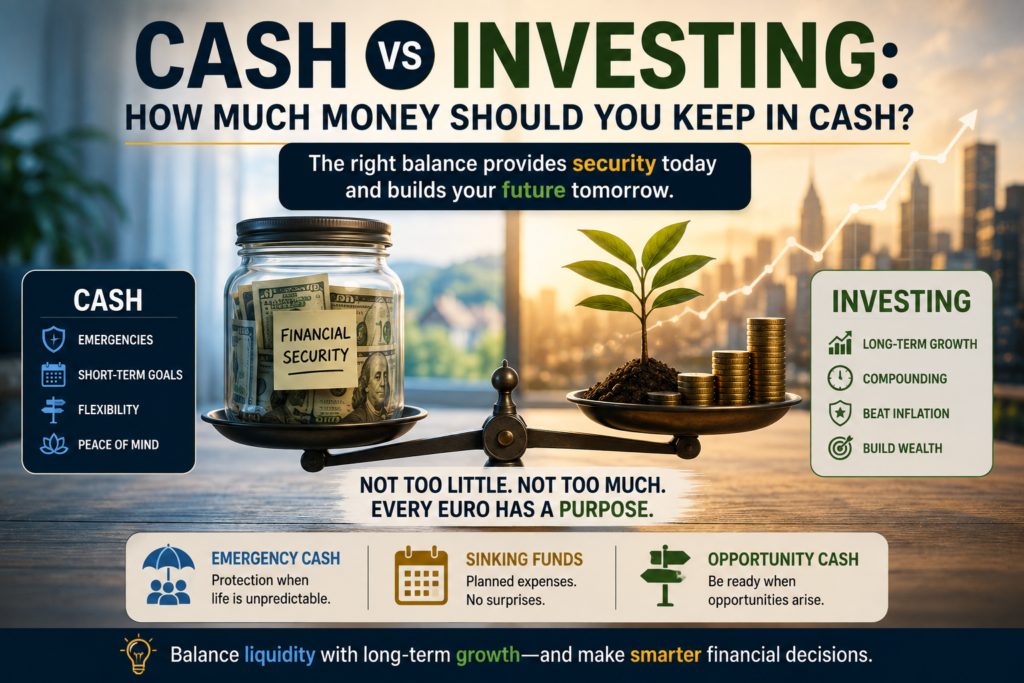
Some money protects you from emergencies.
Some money is waiting for planned expenses.
Some money gives you the flexibility to seize opportunities.
And some money is intended to work toward long-term financial goals through investing.
Thinking this way changes the conversation completely.
Instead of asking,
“Should I save or invest?”
a more useful question becomes:
“How much accessible cash do I realistically need for my life?”
There isn’t one universal answer.
The appropriate amount depends on your income, responsibilities, future plans, comfort with uncertainty and financial goals.
This guide explains how to think about cash as part of a complete financial system, why holding both too little and too much cash has trade-offs, and how to decide what balance makes sense for your own circumstances.
Why This Question Matters
Many financial discussions create the impression that cash and investing compete against each other.
In reality, they solve different problems.
Imagine building a house.
You wouldn’t expect a hammer, a tape measure and a ladder to perform the same job.
Each tool exists because different tasks require different solutions.
Money works in much the same way.
Cash is designed to provide flexibility, stability and immediate access.
Investments are designed to pursue long-term growth while accepting uncertainty along the way.
When people treat every euro as though it has the same purpose, financial planning often becomes unnecessarily complicated.
For example:
- Money you may need next month serves a different purpose from money intended for retirement decades from now.
- Cash reserved for replacing your car is different from money invested for future wealth.
- Savings for emergencies should not necessarily be viewed in the same way as money allocated for long-term investing.
Once you begin assigning specific jobs to different portions of your money, financial decisions usually become much clearer.
The goal is no longer to maximise cash or maximise investments.
The goal is to ensure that every euro knows what job it has been assigned.
The Purpose Of Cash
Cash sometimes receives an unfair reputation.
Because it doesn’t usually generate investment returns, people occasionally describe cash as “doing nothing.”
But that’s a misunderstanding of its role.
Cash isn’t designed to produce the highest possible return.
Its job is to provide certainty where certainty is valuable.
A Different Analogy
Imagine your financial life as a large sailing ship.
Investments are the sails.
They help move you toward your long-term destination.
Cash is the anchor.
The anchor doesn’t help the ship travel faster.
In fact, if you dropped the anchor while trying to sail, it would slow you down.
But during a storm, that same anchor may become the most valuable piece of equipment on board.
Its purpose is completely different.
Cash works in much the same way.
It provides stability when stability matters most.
Emergency Expenses
Unexpected events happen to almost everyone.
Examples include:
- urgent medical costs
- unexpected car repairs
- essential home repairs
- temporary job loss
- family emergencies requiring immediate travel
Cash provides the flexibility to deal with these situations without necessarily needing to interrupt long-term financial plans.
That is one reason building an emergency fund remains an important part of many financial plans.
Financial Flexibility
Cash also provides options.
Suppose an unexpected opportunity appears.
Perhaps you want to complete a professional qualification.
Perhaps a relocation creates a better career opportunity.
Perhaps you simply need time to make an important financial decision without feeling rushed.
Accessible cash often provides something that investments cannot always provide immediately:
Choice.
Peace Of Mind
One benefit of cash rarely appears in financial calculations.
Reduced stress.
Behavioural finance shows that people make better financial decisions when they feel secure rather than panicked.
Knowing that money is immediately available for genuine needs can make temporary setbacks feel much less overwhelming.
Cash doesn’t eliminate uncertainty.
It often helps reduce panic.
The Purpose Of Investing
If cash provides stability, investing serves a different purpose.
Investing gives money the opportunity to participate in long-term economic growth.
Unlike cash, investments fluctuate.
Some years are positive.
Others are disappointing.
Future returns are never guaranteed.
That uncertainty is part of investing.
Long-Term Growth
Many financial goals take years or even decades to achieve.
Examples include:
- retirement
- financial independence
- building family wealth
- future education costs
- long-term financial security
Because these goals are often many years away, some people choose to invest money that they do not expect to need in the near future.
The expectation isn’t certainty.
The expectation is simply that long-term investing may help money grow over extended periods.
Compounding
One of investing’s defining characteristics is compounding.
Imagine planting a tree.
At first it grows slowly.
Eventually it develops branches.
Those branches grow more branches.
Growth begins creating additional growth.
Long-term investing can work in a similar way.
The greatest effects often appear after many years rather than after only a few months.
Preserving Purchasing Power
Cash provides certainty.
Investing seeks growth.
Over long periods, inflation can reduce what cash is able to buy.
Investing is one way some people attempt to grow wealth over time in an effort to preserve purchasing power, although investments can rise or fall in value and future outcomes remain uncertain.
Our beginner guides on What Is Volatility? and ETF vs Individual Stocks explain why temporary market movements are a normal part of long-term investing and why different investment approaches involve different trade-offs.
The important point is this:
Cash and investing are not enemies.
They’re designed for different jobs.
Emergency Cash vs Sinking Funds vs Opportunity Cash
One of the biggest misconceptions about cash is that all cash serves the same purpose.
In reality, several different types of cash reserves can exist within a healthy financial plan.
Understanding these distinctions makes it much easier to decide how much cash you actually need.
Emergency Cash
Emergency cash exists for situations you cannot reasonably predict.
Examples include:
- unexpected medical expenses
- sudden job loss
- urgent home repairs
- essential car repairs
- genuine financial shocks
This money isn’t intended to earn the highest possible return.
Its purpose is protection.
Ideally, you hope you won’t need it—but if life takes an unexpected turn, you’ll be glad it’s there.
Sinking Funds
Unlike emergencies, sinking funds are designed for expenses you already know are coming.
Examples include:
- annual insurance premiums
- holidays
- home maintenance
- replacing a car
- upgrading a laptop or smartphone
- festive spending
These expenses aren’t surprises.
They’re expected costs that become easier to manage when you prepare gradually.
Opportunity Cash
A third category receives far less attention.
Opportunity cash.
This isn’t money for emergencies.
It’s money that gives you flexibility when attractive opportunities appear.
Examples include:
- changing careers
- paying for further education
- relocating for a better opportunity
- starting a business
- supporting an unexpected opportunity that aligns with your long-term goals
Opportunity cash doesn’t protect you from problems.
It helps you take advantage of possibilities.
The key insight is this:
Not all cash performs the same job.
Emergency cash protects you.
Sinking funds prepare you.
Opportunity cash gives you choices.
Once you begin thinking about cash in this way, deciding how much to keep available often becomes much clearer.
The Hidden Cost Of Holding Too Much Cash
Cash is valuable.
It provides flexibility, stability and peace of mind.
But like every financial tool, it has trade-offs.
Holding more cash than your financial plan requires can quietly reduce your ability to build long-term wealth—not because cash is bad, but because it is being asked to do a job it was never designed to perform.
Inflation Slowly Changes What Cash Can Buy
Imagine placing €20,000 in a safe.
Ten years later, you open it.
The number hasn’t changed.
You still have €20,000.
But can those euros buy the same groceries, holidays, rent or home improvements as they could ten years earlier?
Perhaps not.
Inflation gradually changes purchasing power.
Cash usually maintains its face value, but over long periods, it may buy less than it once did.
This doesn’t mean cash should be avoided.
It simply means that money intended for very long-term goals may deserve a different role than money intended for next month’s expenses.
Opportunity Cost
Behavioural finance often focuses on the decisions we make.
Economics reminds us to think about the decisions we don’t make.
This is known as opportunity cost.
Suppose two people each accumulate €30,000 beyond what they realistically need for emergencies and planned expenses.
One keeps all of it in cash indefinitely.
The other gradually allocates part of it toward long-term goals while still maintaining appropriate cash reserves.
Neither person knows exactly what future markets will do.
But each has assigned their money a different purpose.
Opportunity cost isn’t about regretting the past.
It’s about asking whether every euro is performing the job you intended.
Security Can Become an Illusion
Cash often feels emotionally reassuring.
Seeing a large bank balance can reduce anxiety.
That’s understandable.
Behavioural finance shows that people naturally prefer certainty over uncertainty.
However, after a certain point, additional cash may increase emotional comfort far more than it improves genuine financial resilience.
If your emergency fund is already sufficient, your planned expenses are covered and your opportunity cash is clearly defined, continually accumulating more cash without a purpose may simply delay progress toward long-term goals.
The objective isn’t to minimise cash.
It’s to avoid holding cash without a reason.
The Hidden Risk Of Investing Too Much
If holding excessive cash has disadvantages, the opposite extreme also deserves attention.
Some people become so enthusiastic about investing that they begin viewing every euro not invested as a missed opportunity.
That mindset can create problems of its own.
Unexpected Expenses Rarely Wait
Life rarely coordinates its surprises with financial markets.
A boiler doesn’t choose to fail when markets are rising.
A medical expense doesn’t arrive only after your portfolio reaches a new high.
If all of your available money is invested, unexpected costs may leave you with difficult choices.
Selling Investments At The Wrong Time
One of the biggest risks isn’t simply losing money.
It’s being forced to sell investments because you need cash immediately.
Markets rise and fall.
If you must sell during a temporary downturn because you have insufficient liquidity, a temporary decline may become a permanent financial loss.
This illustrates why accessible cash and long-term investments often work best together rather than replacing one another.
Liquidity Has Value
Cash provides immediate access.
Investments generally require selling before they become cash, and their value may have changed since you invested.
That doesn’t make investing less useful.
It simply means liquidity itself has value.
One way to think about this is:
Cash buys time.
Time allows you to make thoughtful decisions rather than rushed ones.
That may be one of the most valuable roles cash can perform.
Finding The Right Balance
The obvious follow-up question is:
“So how much cash should I actually keep?”
The honest answer is:
It depends on your circumstances.
There isn’t a universal figure that works for everyone because life itself isn’t universal.
Instead of looking for one number, consider the factors that influence how much liquidity makes sense for you.
Stable Employment
Someone with a predictable monthly salary and relatively secure employment may feel comfortable holding different cash reserves than someone whose income changes every month.
Predictability can reduce the need for additional short-term flexibility.
Self-Employment
Business owners, freelancers and contractors often experience irregular income.
Many therefore choose to maintain larger cash reserves to help smooth periods when revenue fluctuates.
That isn’t necessarily because they are more cautious.
It’s because their financial reality is different.
Buying A Home
Preparing to buy a home often changes the purpose of cash.
Money that might otherwise have been invested may instead be reserved for planned purchases, moving costs, furnishing a property or creating a financial buffer during the transition.
This doesn’t mean investing stops being important.
It means the role of cash temporarily changes.
Starting A Family
Growing families often introduce new financial responsibilities.
Unexpected expenses become more likely.
Financial priorities evolve.
Some people therefore choose to increase accessible cash during this stage of life.
Others may prioritise different goals.
Neither choice is universally correct.
Approaching Retirement
As retirement approaches, financial priorities often change again.
The focus may gradually shift from accumulating wealth to ensuring sufficient liquidity for future spending needs.
Cash can therefore become more important—not because investing loses value, but because immediate access to money may become increasingly relevant.
Irregular Income
Seasonal workers, commission-based employees and people with variable earnings frequently face a different financial reality from those receiving a fixed salary.
Maintaining additional liquidity may simply reflect the practical nature of their income rather than a different investing philosophy.
Personal Comfort Matters Too
Behavioural finance reminds us that numbers alone don’t determine good financial decisions.
Behaviour matters.
Some people remain calm during market downturns.
Others sleep better knowing they have larger cash reserves.
Neither response is inherently right or wrong.
The best financial plan is often the one you can confidently maintain through changing circumstances rather than abandoning during stressful moments.
Signs You May Be Holding More Cash Than You Need
Holding cash isn’t a problem.
Holding cash without a purpose may be worth reviewing.
Ask yourself these questions.
- Has my emergency fund already reached the level I intended?
- Does my cash balance continue growing even though I can’t explain what it’s for?
- Do I keep postponing long-term investing because I’m waiting for the “perfect” moment?
- Is inflation gradually reducing the purchasing power of money that has no short-term purpose?
- Am I making decisions because of a financial plan—or because uncertainty makes me uncomfortable?
None of these questions automatically means you should invest more.
Instead, they encourage reflection.
Every euro should ideally have a reason for existing where it is.
If the only explanation is “because it feels safer”, it may be worth asking whether that feeling reflects genuine financial need or simply fear of uncertainty.
A thoughtful financial plan doesn’t try to eliminate uncertainty.
It prepares for it.
That preparation may involve both accessible cash and long-term investments—each performing the role they were designed for.
Common Mistakes Beginners Make
Most people don’t struggle because they lack financial intelligence.
They struggle because it’s difficult to balance certainty today with uncertainty tomorrow.
Here are some of the most common mistakes people make when deciding how much cash to keep available.
Holding Cash Without A Purpose
One of the easiest habits to fall into is simply accumulating cash because it feels reassuring.
Saving money is rarely a mistake.
But once your emergency cash, sinking funds and opportunity cash are already serving their intended roles, continuing to build cash without a clear objective may delay progress toward long-term goals.
A useful question to ask yourself is:
“If I looked at every euro in my account today, could I explain why it’s there?”
If the answer is no, your financial plan may benefit from assigning each portion of your money a clearer purpose.
Trying To Predict The Perfect Time
Some people delay investing because they believe they should wait until markets “feel safer.”
Others postpone because they think prices might fall next month.
The difficulty is that nobody consistently knows when the perfect moment will arrive.
Waiting for complete certainty can quietly become a long-term habit rather than a short-term decision.
Treating Every Goal The Same
Money for next year’s holiday shouldn’t necessarily be managed in the same way as money intended for retirement thirty years from now.
Different goals often require different levels of liquidity, different time horizons and different expectations.
Separating your money according to its purpose usually makes financial planning much easier.
Copying Someone Else’s Cash Strategy
It’s natural to compare yourself with friends, colleagues or people online.
You may hear someone say they keep very little cash because they invest almost everything.
Another person may proudly describe holding several years’ worth of expenses in cash.
Neither approach automatically suits your own situation.
Your income, responsibilities, family circumstances, career plans and comfort with uncertainty are unique.
Your cash allocation should reflect your life—not someone else’s.
Ignoring Behaviour
Behavioural finance teaches an important lesson:
A financial plan only works if you can realistically follow it.
Some people become anxious if their accessible cash falls below a certain level.
Others feel uncomfortable seeing large amounts of cash sitting idle.
Neither reaction is inherently right or wrong.
The objective isn’t to build the “perfect” financial plan on paper.
It’s to build one you can maintain consistently through changing circumstances.
Frequently Asked Questions
Should I keep cash or invest?
For most people, this isn’t an either-or decision.
Cash and investing perform different roles within a healthy financial plan.
Cash provides liquidity, flexibility and financial resilience.
Investing is generally intended to support long-term wealth building while accepting that investments can fluctuate in value.
The key question is not which is better, but how much money each role requires.
How much cash should I keep?
There is no universal amount.
The appropriate level of cash depends on factors such as:
- income stability
- emergency preparedness
- upcoming planned expenses
- future opportunities
- family responsibilities
- personal comfort with financial uncertainty
Rather than aiming for someone else’s number, think about what your own financial life realistically requires.
Can cash lose value?
Cash normally maintains its face value, but inflation can reduce its purchasing power over time.
This is one reason many people distinguish between money intended for short-term stability and money intended for long-term growth.
Should beginners invest all their savings?
Generally, investing every available euro can create unnecessary pressure if unexpected expenses arise.
Likewise, keeping all long-term money in cash may reduce its ability to support future financial goals.
Many people find that maintaining appropriate cash reserves alongside long-term investing creates a more balanced financial plan.
Is an emergency fund separate from investing?
Yes.
An emergency fund is designed to provide immediate financial resilience during unexpected situations.
Investments are generally intended for longer-term objectives and may fluctuate in value.
Keeping these purposes separate often reduces financial stress and makes decision-making easier during uncertain periods.
Conclusion
The question “cash vs investing” is often presented as though you must choose one side.
In reality, that’s rarely the decision most people need to make.
A more useful question is:
“How much accessible cash allows me to feel financially secure while still giving my long-term goals room to grow?”
That shift in thinking changes everything.
Cash is not simply money waiting to be invested.
It has important jobs to perform.
Some cash protects you from unexpected setbacks.
Some prepares you for planned expenses.
Some allows you to recognise and act on opportunities.
And some money can remain focused on long-term investing because it isn’t needed today.
One way to picture this is to imagine your finances as a well-organised workshop.
Every tool has a specific purpose.
A hammer isn’t better than a screwdriver.
A ladder isn’t more important than a tape measure.
Problems arise only when the wrong tool is asked to perform the wrong job.
Your money works in exactly the same way.
Every euro becomes more valuable when it has a clearly defined purpose.
Some euros provide stability.
Others provide flexibility.
Others quietly work toward future financial goals.
The strongest financial plans rarely come from choosing one extreme.
They come from understanding the different roles money can play and assigning each role intentionally.
There is no universally correct amount of cash.
There is only the amount that supports your income, your responsibilities, your opportunities and your peace of mind.
That balance may change throughout your life—and that’s perfectly normal.
If you’re continuing to build your financial knowledge, you may also find it helpful to learn about What Is Volatility?, investment risk and return and How To Build an Emergency Fund Without Feeling Overwhelmed, as each explores a different piece of the broader financial picture.
My book on Gumroad:
https://ukandu0.gumroad.com/l/bteyh
Or on Amazon:
Feeling financially stuck?
When financial pressure becomes constant, long-term decisions start feeling emotionally heavy.
The Crown Altessa newsletter was created to help people rebuild clarity slowly and strategically through practical financial frameworks, long-term thinking, and structured decision-making insights.
Join the newsletter and receive:
• the free Financial Foundation Guide
• strategic financial insights
• practical tools for long-term stability
• frameworks designed to reduce financial overwhelm
Start building financial clarity one step at a time.