
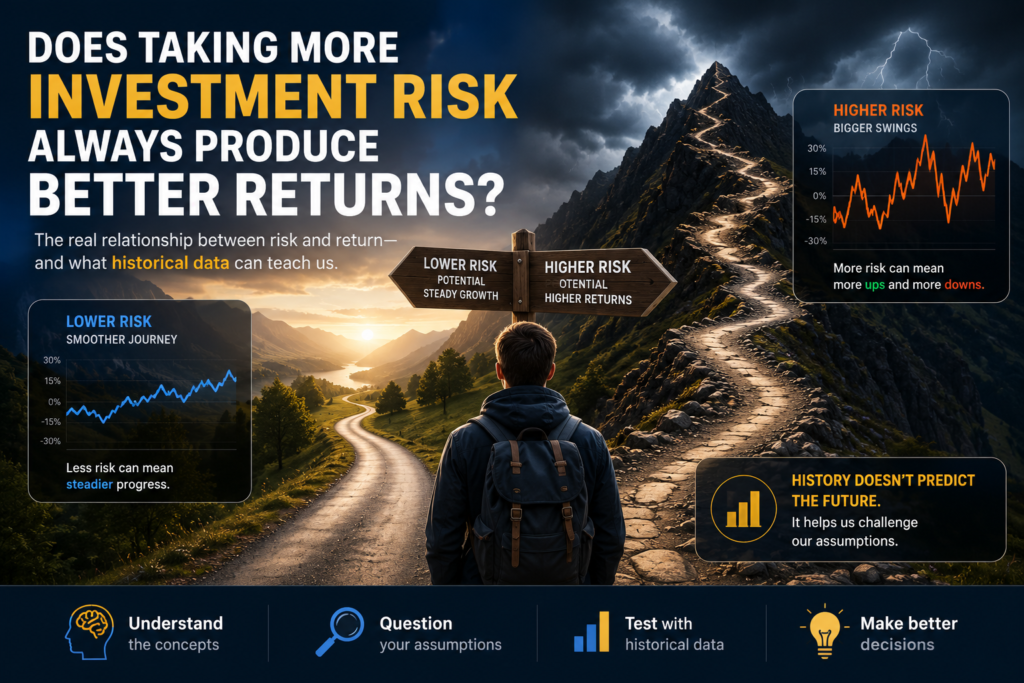
One of the first ideas many people hear about investing is surprisingly simple:
“If you want higher returns, you have to take more risk.”
At first glance, that sounds perfectly reasonable.
After all, why would anyone choose a riskier investment if it didn’t offer the possibility of greater rewards?
Yet this simple statement often leads to a misunderstanding.
Many beginners quietly translate it into something very different:
“The riskiest investment will probably make me the most money.”
Those two ideas are not the same.
Risk can increase the possibility of higher returns.
It does not create a guarantee of higher returns.
In fact, some investors take considerably more risk than others while ultimately achieving lower long-term results.
Others build substantial wealth through patient, disciplined investing without constantly chasing the highest possible returns.
Understanding why requires looking beyond simple slogans and exploring what investment risk actually means.
This article explains the relationship between investment risk and return, explores why people often seek increasingly risky investments, examines how behavioural biases influence investment decisions and shows how historical experiments can challenge assumptions without pretending to predict the future.
The Common Belief About Risk And Reward
The phrase “higher risk, higher reward” appears almost everywhere in investing.
Although it contains an important idea, it is often misunderstood.
A better way to think about it is this:
Higher risk creates the possibility of higher returns because the outcome is more uncertain.
Notice what isn’t included in that sentence.
There is no promise.
There is no guarantee.
There is only uncertainty.
Imagine two bridges crossing the same river.
One is made from solid concrete.
The other is a narrow rope bridge that swings dramatically in the wind.
The rope bridge may offer a faster route.
Or it may slow you down.
Or conditions may make it impossible to cross safely.
The point isn’t that one bridge always leads somewhere better.
The point is that one journey involves much greater uncertainty.
Investment risk works in a similar way.
Risk is not a reward waiting to be collected.
It is uncertainty about future outcomes.
Some higher-risk investments eventually produce exceptional returns.
Others experience years of disappointing performance.
Some never recover from major losses.
Markets constantly change.
Economic conditions change.
Businesses succeed and fail.
Technologies emerge and disappear.
Because the future is uncertain, risk can never guarantee success.
This is one reason why experienced investors often focus less on finding the “highest return” and more on building an investment strategy they can realistically maintain over many years.
A strong financial foundation also makes it easier to think rationally about investment decisions. Before taking investment risk, it helps to have a personal finance system that actually works, so unexpected events are less likely to force emotional decisions.
Why Investors Often Chase Risk
If higher risk doesn’t guarantee higher returns, why do so many people actively seek it?
The answer lies partly in psychology.
Humans are naturally drawn to stories of extraordinary success.
A headline about someone earning 300% on an investment attracts far more attention than a story about someone patiently investing for twenty years through diversified monthly contributions.
This creates several behavioural biases.
Fear Of Missing Out (FOMO)
Perhaps you’ve seen headlines like:
“This stock doubled in six months.”
“Investors are making fortunes in artificial intelligence.”
“Everyone is buying…”
Whether the topic is technology stocks, cryptocurrencies or another fast-growing asset, these stories often create the feeling that everyone else is becoming wealthy while you’re being left behind.
Fear of missing out encourages investors to focus on recent winners rather than asking whether those investments still match their goals or tolerance for uncertainty.
Overconfidence
Success can sometimes make investors believe they possess greater investing skill than they actually do.
After several profitable investments, it becomes tempting to think future success will continue simply because previous decisions worked out well.
Behavioural research suggests people often attribute successes to skill while blaming failures on bad luck.
That makes taking progressively larger risks feel justified.
Survivorship Bias
We constantly hear about extraordinary investing success stories.
We hear much less about the thousands of investors whose aggressive strategies quietly failed.
Imagine reading biographies only of Olympic gold medallists.
You might conclude that becoming an Olympic champion is relatively common.
The countless athletes who trained just as hard but never reached the podium remain invisible.
Investing stories often work the same way.
The winners receive attention.
The unsuccessful attempts largely disappear from view.
Social Media And Headline Investing
Modern investing information moves faster than ever.
Market updates appear every minute.
Influencers share confident opinions.
Short videos promise rapid wealth.
Friends discuss investments over dinner.
This environment can create the impression that successful investing requires constant action.
In reality, constantly reacting to headlines often increases emotional decision-making.
Our article on why smart people still make bad money decisions explores why intelligence alone doesn’t protect us from psychological biases when money is involved.
Similarly, the hidden cost of constant financial comparison explains why comparing your financial journey with carefully curated stories from others can encourage unnecessary risk-taking.
Risk Is The Price You Pay For Opportunity
Risk is often presented as something negative.
A danger.
A problem.
Something to eliminate.
A more helpful way to think about investment risk is this:
Risk is the price you pay for uncertainty.
Without uncertainty, there would be very little opportunity for investment returns in the first place.
Imagine two hiking trails.
The first follows a wide, paved path.
The second climbs a narrow mountain ridge with breathtaking views.
The mountain trail may offer a more rewarding experience.
It also requires greater preparation, more careful decisions and a willingness to accept that conditions can change unexpectedly.
Neither trail is universally better.
The right choice depends on the traveller.
Investing works in much the same way.
Higher-risk portfolios often experience:
- larger price swings
- greater uncertainty
- deeper temporary declines
- stronger emotional pressure
- potentially higher long-term opportunities
At the same time, those opportunities come with the possibility of disappointing outcomes.
Risk should therefore never be viewed as a punishment.
Nor should it be viewed as a shortcut to wealth.
It is simply part of the trade-off investors accept when seeking potentially higher returns.
An important lesson many beginners overlook is that two portfolios can produce similar long-term returns while feeling completely different to own.
One portfolio might experience relatively modest fluctuations.
Another may lose a substantial portion of its value during difficult market periods before eventually recovering.
Mathematically, the long-term outcomes may appear similar.
Emotionally, the journeys can feel worlds apart.
That emotional experience matters.
Because an investment strategy only works if you can realistically stick with it.
Understanding what volatility is can help investors recognise that uncomfortable market swings are not automatically evidence that their long-term plan is failing.
Likewise, developing financial confidence during uncertain times often depends less on predicting markets and more on understanding how uncertainty has always been part of investing.
A Historical Experiment
One of the easiest ways to develop stronger investing instincts is to test assumptions against history rather than relying on opinions.
Many people instinctively believe that the most aggressive portfolio will always produce the highest long-term return.
History shows that reality is often more nuanced.
Using the Crown Altessa educational investment simulator, we compared several investment strategies using the same historical market period.
The purpose was not to identify a “winning” portfolio.
Instead, the exercise explored how different levels of investment risk influenced the investing journey under identical historical conditions.
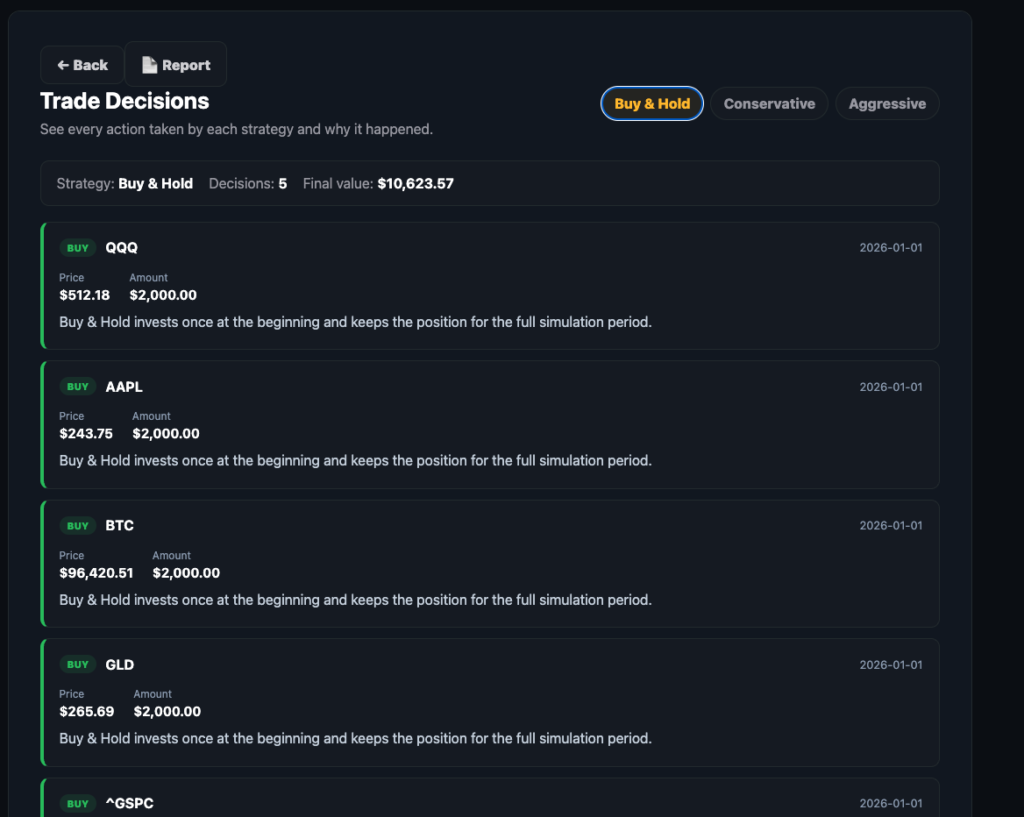
Strategies compared:
- Conservative Portfolio
- Balanced Portfolio
- Growth Portfolio
- User Buy & Hold Portfolio
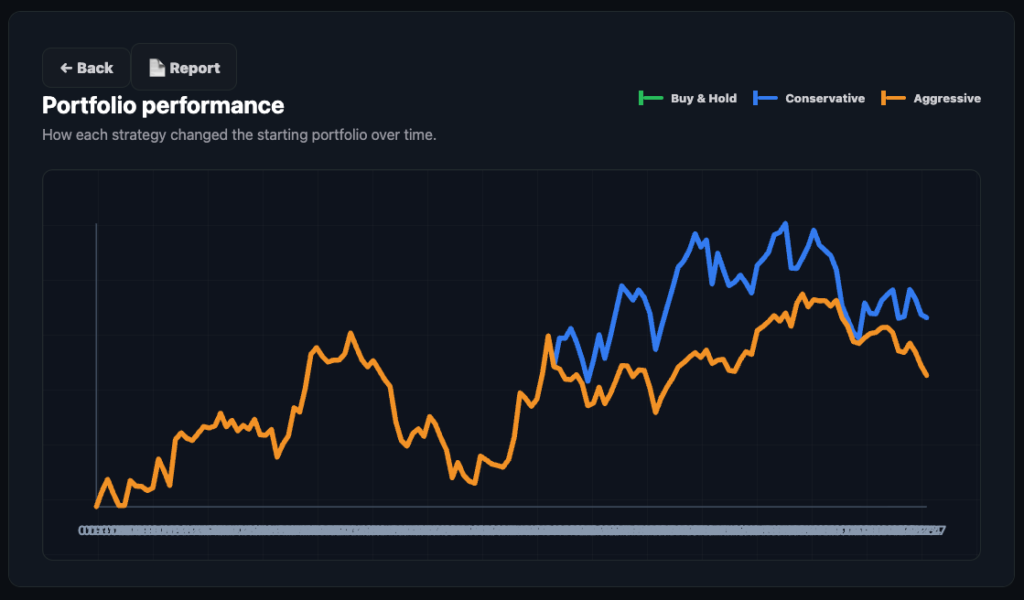
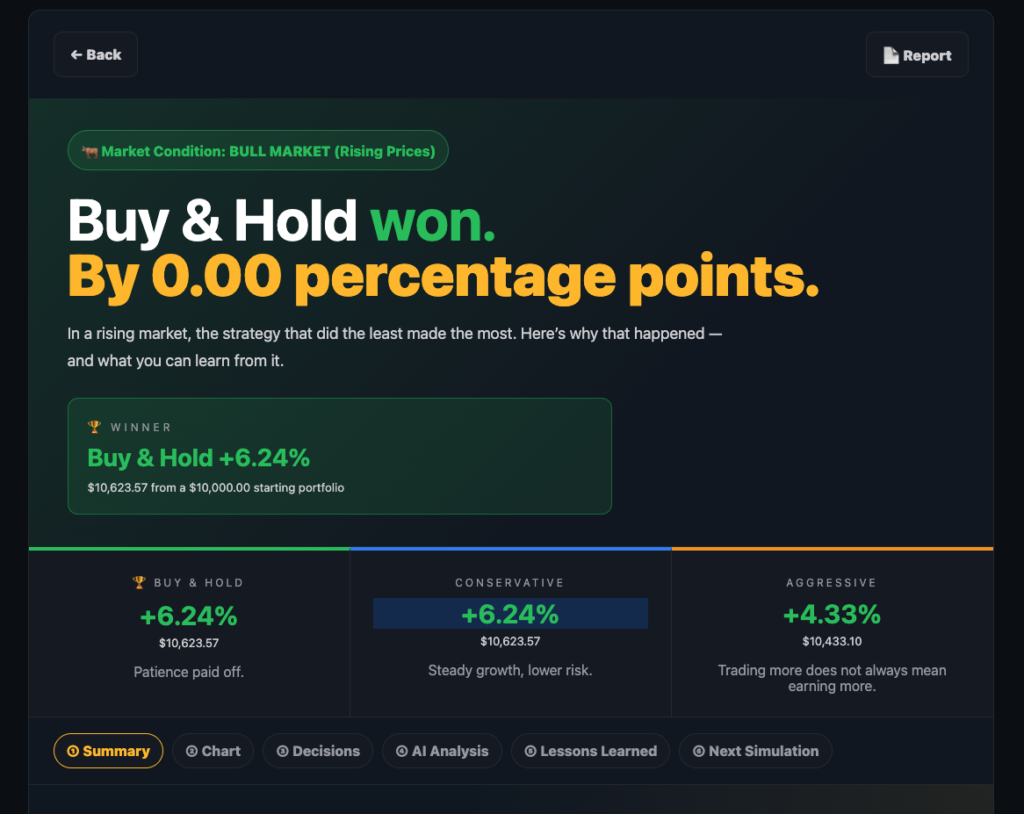
When reviewing the results, avoid focusing exclusively on which portfolio finished with the highest ending value.
Instead, ask broader questions.
- Which portfolio experienced the largest temporary declines?
- Which one recovered most consistently after market downturns?
- Did the highest-risk strategy actually finish first?
- Were there periods when lower-risk strategies outperformed?
- How different did each investing journey feel, even if some long-term outcomes were relatively close?
These observations often provide more valuable lessons than a single performance figure.
For example, two portfolios may finish with similar ending values while following completely different paths.
One might experience relatively steady progress.
Another might lose a significant portion of its value during difficult periods before eventually recovering.
Those differences matter because investing isn’t experienced as a single number at the end of twenty years.
It’s experienced one day at a time.
A strategy that looks attractive in hindsight may have been emotionally difficult to hold when markets were falling sharply.
That’s an important lesson that historical charts alone don’t always communicate.
Historical simulations help bridge that gap by showing not only where different strategies finished, but also what investors would have experienced along the way.
Why One Historical Experiment Is NOT Proof
Historical investing experiments can teach valuable lessons.
They cannot prove universal truths.
Imagine repeating the same simulation using a different starting year.
Or ending the analysis five years earlier.
Or extending it another decade.
The results might look very different.
A strategy that appears strongest during one historical period may underperform during another.
Economic environments change.
Interest rates change.
Inflation changes.
Technology evolves.
Entire industries rise and decline.
Investor expectations shift.
Because markets constantly adapt, no single historical period represents every future possibility.
Another important limitation is selection bias.
If someone deliberately chooses a historical period that favours a particular investment strategy, the conclusions may appear stronger than they really are.
That is why experienced investors prefer examining multiple historical periods rather than relying on one carefully selected example.
Most importantly:
Past performance does not predict future performance.
This phrase appears frequently because it reflects an important reality.
History provides evidence about what happened.
It does not guarantee what will happen next.
Historical simulations therefore work best as educational tools.
They challenge assumptions.
They encourage curiosity.
They improve understanding of investment behaviour.
They do not recommend investments or eliminate uncertainty.
Understanding that distinction is one of the foundations of sound investing.
Question Your Assumptions
One of the most valuable habits an investor can develop is questioning their own expectations.
Before looking at historical results, write down what you genuinely believe.
For example:
- Which strategy do I think will perform best?
- Why do I believe that?
- Which portfolio do I expect to experience the largest market swings?
- Which strategy would make me feel most uncomfortable during a severe market decline?
- If my portfolio fell by 30%, would I realistically stay invested?
Only after writing your answers should you run a historical simulation.
Once you’ve reviewed the results, ask yourself a second set of questions.
- Did the results match my expectations?
- What surprised me the most?
- Which assumption turned out to be wrong?
- Did I underestimate how emotionally difficult large market declines might feel?
- Did I overestimate the benefits of taking more investment risk?
Notice that this exercise isn’t about predicting future markets.
It’s about understanding yourself.
Many investing mistakes begin long before money is invested.
They begin with assumptions that are never questioned.
By comparing expectations with historical evidence, you train yourself to think more critically about investing.
The simulator simply provides a structured way to perform that exercise.
The real lesson comes from reflecting on what you expected—and why.
Historical simulations should always be viewed as educational exercises.
They illustrate how different strategies behaved under specific historical conditions.
They cannot predict how markets will behave in the future, nor do they recommend one investment strategy over another.
Choosing The Right Level Of Investment Risk
After learning about risk and return, many beginners naturally ask:
“So what level of investment risk should I take?”
The honest answer is:
It depends.
There is no universally “best” investment strategy because there is no universally “best” investor.
A strategy that feels comfortable for one person may cause another to lose sleep during periods of market volatility.
Choosing an appropriate level of investment risk involves more than trying to maximise returns. It also means understanding yourself.
Consider Your Investment Horizon
Time is one of the biggest factors influencing how investors experience risk.
Someone investing for retirement in thirty years may view temporary market declines very differently from someone who expects to use their money within the next two years.
Longer investment horizons have historically provided more time for markets to recover from periods of volatility, although future outcomes can never be guaranteed.
That doesn’t mean long-term investors should ignore risk.
It means they often have greater capacity to tolerate temporary market swings.
Understand Your Risk Tolerance
Risk tolerance isn’t about what sounds exciting.
It’s about how you genuinely react when markets become uncertain.
Many people believe they’re comfortable with risk during rising markets.
The real test often comes during falling markets.
Ask yourself honestly:
- How would I feel if my portfolio lost 20% of its value?
- Would I feel tempted to sell immediately?
- Would I remain comfortable continuing my investment plan?
- Would market declines affect my daily life or sleep?
There are no “correct” answers.
The objective is self-awareness.
Choosing a strategy you can realistically maintain is often more valuable than choosing one that looks impressive on paper.
Match Your Investments To Your Financial Goals
Different financial goals naturally involve different approaches.
Saving for a home deposit over the next few years may require a different level of risk than investing for retirement decades into the future.
Likewise, someone building long-term wealth may accept greater short-term uncertainty than someone who expects to need their money soon.
Rather than asking:
“Which investment has the highest potential return?”
A more useful question is:
“Which investment strategy best supports the goal I’m trying to achieve?”
That shift in thinking encourages better long-term decision-making.
Don’t Ignore Your Emergency Fund
One reason some investors panic during market declines has nothing to do with investing.
They simply need access to their money.
An emergency fund provides breathing room.
Unexpected expenses such as car repairs, medical costs or temporary unemployment become less likely to force difficult investment decisions during unfavourable market conditions.
This is why building financial resilience outside your investment portfolio is just as important as choosing investments within it.
The Sleep-At-Night Factor
One of the most underrated aspects of investing is emotional comfort.
Imagine two portfolios.
Both have similar long-term expected outcomes.
One experiences relatively modest fluctuations.
The other regularly experiences sharp market swings.
If the second portfolio causes constant stress, encourages panic selling or dominates your thoughts every day, it may not actually be the better strategy for you.
Successful investing isn’t only about mathematics.
It’s also about behaviour.
The best investment strategy is often the one you can consistently follow through changing market conditions.
Frequently Asked Questions
Does higher investment risk guarantee higher returns?
No.
Higher investment risk increases uncertainty, not certainty.
Some higher-risk investments produce excellent long-term returns.
Others perform poorly.
Risk creates the possibility of both stronger gains and larger losses.
Can low-risk investments outperform high-risk investments?
Yes.
Over specific historical periods, lower-risk investments have sometimes outperformed higher-risk alternatives.
Different economic environments favour different investment strategies.
This is one reason why drawing broad conclusions from a single historical example can be misleading.
What is the relationship between risk and reward?
Risk and reward are connected because investors generally expect additional compensation for accepting greater uncertainty.
However, higher expected returns never become guaranteed returns.
The future always remains uncertain.
How do I know my risk tolerance?
Risk tolerance depends on several personal factors, including your financial goals, investment horizon, emergency savings and emotional comfort with market volatility.
One useful question is:
“Would I still feel comfortable following my investment plan after a significant market decline?”
Your honest answer often provides valuable insight.
Should beginners choose aggressive investments?
Not necessarily.
Beginners often benefit more from understanding investing principles than from seeking the highest-risk opportunities.
Building a diversified portfolio that matches your financial goals and emotional comfort can be more sustainable than chasing maximum potential returns.
If you’re unsure which approach suits your circumstances, consider seeking guidance from a qualified financial adviser.
Conclusion
The relationship between investment risk and return is more nuanced than many investing slogans suggest.
Higher risk can create greater opportunities.
It can also create greater uncertainty, deeper market declines and stronger emotional pressure.
Understanding that distinction helps move us away from simplistic thinking.
Successful investing isn’t about taking the most risk.
Nor is it about avoiding risk altogether.
It’s about understanding which risks align with your goals, your time horizon and your ability to remain disciplined when markets become uncomfortable.
History can teach valuable lessons.
Behavioural finance can help explain why investors often make emotional decisions.
Neither can remove uncertainty.
And that’s perfectly normal.
The most successful investors are rarely those who predict every market movement correctly.
More often, they are the ones who understand uncertainty, question their assumptions and consistently follow a thoughtful investment strategy over time.
Instead of asking,
“How much risk should I take to maximise my returns?”
consider asking,
“What level of risk can I realistically understand, accept and stay committed to?”
That small change in perspective can lead to much better investing decisions over the long term.
My book on Gumroad:
https://ukandu0.gumroad.com/l/bteyh
Or on Amazon:
Feeling financially stuck?
When financial pressure becomes constant, long-term decisions start feeling emotionally heavy.
The Crown Altessa newsletter was created to help people rebuild clarity slowly and strategically through practical financial frameworks, long-term thinking, and structured decision-making insights.
Join the newsletter and receive:
• the free Financial Foundation Guide
• strategic financial insights
• practical tools for long-term stability
• frameworks designed to reduce financial overwhelm
Start building financial clarity one step at a time.