

Many people believe they’re bad at managing money because they struggle to stay disciplined.
They promise themselves they’ll save more next month.
Review their budget every weekend.
Start investing after their next pay rise.
Finally organise all those financial documents sitting in a drawer.
For a few days, everything goes well.
Then work becomes busy.
Life gets in the way.
Unexpected expenses appear.
The motivation fades.
This cycle is incredibly common—not because people don’t care about their finances, but because they’re relying on willpower to do a job that systems do far better.
Think of your finances like a garden.
Motivation is like watering the plants once when you feel inspired.
A good financial system is like installing an irrigation system.
One depends on remembering.
The other quietly works in the background, even on days when you’re busy, tired or distracted.
That is why building a personal finance system isn’t about becoming more disciplined.
It’s about making good financial decisions easier by default.
Why Good Intentions Usually Aren’t Enough
Almost everyone has good financial intentions.
Few people wake up planning to miss a bill, forget to save money or overspend unnecessarily.
Yet these things happen every day.
Why?
Because modern life demands constant decisions.
By the end of a normal working day, you’ve probably made hundreds of choices.
What to eat.
Which emails to answer.
How to organise your work.
Whether to exercise.
What to cook for dinner.
Behavioural finance research shows that as mental energy declines, people naturally look for the easiest available option.
That often means postponing financial tasks.
Reviewing your budget feels like something you can always do tomorrow.
Checking your subscriptions can wait another week.
Updating your savings plan suddenly feels less important than relaxing on the sofa.
Good intentions fail when they rely on memory instead of systems.
If remembering is the only thing keeping your finances organised, life will eventually interrupt you.
A good system removes that burden.
Instead of constantly asking yourself,
“Did I remember to transfer money into savings?”
the transfer happens automatically.
Instead of wondering whether a bill is due next week, reminders already exist.
The fewer financial decisions you need to make repeatedly, the more mental energy you keep for the decisions that genuinely deserve your attention.
What A Personal Finance System Actually Is
When people hear the phrase personal finance system, they often imagine a complicated spreadsheet filled with formulas and colourful charts.
In reality, a good financial system is much simpler than that.
A personal finance system is a collection of habits, routines and automatic processes that make good financial decisions easier.
It works quietly in the background.
Rather than depending on motivation every month, it creates a structure that supports consistent behaviour.
For example, your system might include:
- automatic transfers into savings
- monthly reminders to review spending
- automatic bill payments where appropriate
- a regular investing schedule
- a simple budgeting routine
- an organised place to store important financial documents
- a calendar reminder to review insurance or subscriptions once a year
None of these actions is particularly exciting.
That is precisely why they work.
Financial success rarely comes from one brilliant decision.
More often, it comes from hundreds of ordinary decisions that happen consistently.
Our article on financial habits explores this idea in greater depth: lasting financial progress usually comes from repeated behaviour rather than occasional bursts of motivation.
A good system doesn’t remove every financial challenge.
It simply makes good choices easier to repeat.
Why Systems Beat Motivation
This is where many people misunderstand personal finance.
They assume successful people simply have more self-control.
In reality, many successful people have something far more reliable:
Systems.
Motivation comes and goes.
Some weeks you’ll feel highly organised.
Other weeks you’ll have deadlines at work, family commitments or simply feel mentally exhausted.
If your financial wellbeing depends entirely on motivation, your progress will naturally become inconsistent.
Systems remove much of that uncertainty.
Automation reduces the number of decisions you need to make.
Habits reduce the amount of willpower required.
Simple routines eliminate unnecessary friction.
Successful people don’t make perfect financial decisions every day.
They build systems that reduce the number of decisions they have to make.
Imagine two people trying to save €200 every month.
The first promises themselves they’ll remember to transfer the money manually.
The second sets up an automatic transfer that happens the day after payday.
Neither person is necessarily more disciplined.
One simply has a better system.
Over the course of a year, the difference can become significant.
This same principle also applies to investing, budgeting and reviewing your finances.
Systems quietly protect you from your future busy self.
They acknowledge an important truth:
The person making financial decisions six months from now may be more tired, stressed or distracted than the person making plans today.
Design your system for that version of yourself.
Not for your most motivated one.
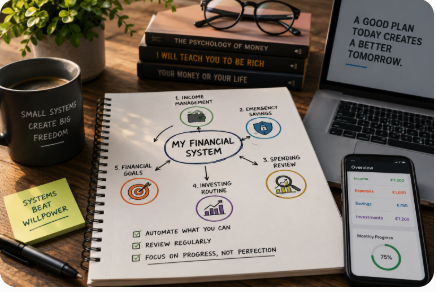
The Five Building Blocks Of A Strong Financial System
Every personal finance system looks slightly different because every person’s circumstances are different.
However, most effective systems contain five essential building blocks.
1. Income Management
The first step is knowing what comes in and where it goes.
This doesn’t require tracking every euro.
Instead, create a simple overview of your regular income and essential monthly expenses.
When you understand your cash flow, planning becomes much easier.
2. Emergency Savings
Unexpected expenses are part of life.
A good financial system prepares for them instead of hoping they never happen.
That’s why building an emergency fund is one of the strongest foundations for long-term financial stability.
Emergency savings don’t eliminate uncertainty.
They reduce panic when uncertainty appears.
3. Spending Reviews
You don’t need to analyse every coffee purchase.
Instead, schedule a monthly review.
Ask yourself simple questions:
- Am I spending in line with my priorities?
- Have any subscriptions become unnecessary?
- Are there recurring expenses I no longer value?
One short review each month is often enough to prevent small spending habits from quietly becoming expensive routines.
4. Investing Routine
For people who choose to invest, consistency usually matters more than constantly changing strategies.
A simple investing routine removes emotional decision-making from the process.
Rather than wondering each month whether now is the “right” time, your system provides structure.
As discussed in our guide on start investing, building the habit is often more important than searching for the perfect moment.
5. Financial Goals
Finally, every system benefits from direction.
Goals don’t need to be dramatic.
They simply provide purpose.
Perhaps you want to:
- build emergency savings
- prepare for a career change
- reduce debt
- save for a home
- strengthen long-term financial security
When these goals become part of your financial system, everyday decisions become easier because they support something meaningful.
A Real-Life Example
Jonas is a 30-year-old software developer living in Berlin.
For years, he described himself as “bad with money.”
Not because he spent irresponsibly, but because everything felt disorganised.
Some bills were paid immediately.
Others were forgotten until reminders arrived.
Some months he saved several hundred euros.
Other months he saved nothing at all.
Whenever unexpected expenses appeared, he felt as though his finances were constantly starting from zero.
Eventually, Jonas stopped trying to become “more disciplined.”
Instead, he built a simple system.
His salary arrived on the first working day of each month.
The following day, automatic transfers moved money into emergency savings.
His regular bills were scheduled automatically.
On the first Sunday of every month, he spent twenty minutes reviewing his accounts and checking whether any subscriptions or recurring expenses needed attention.
Once his emergency fund reached a level that made him feel comfortable, he gradually introduced a simple long-term investing routine that fit his budget.
Nothing about his income changed dramatically.
His stress did.
Instead of constantly wondering whether he had forgotten something, Jonas trusted his system to handle the routine tasks.
For the first time, managing money felt calm rather than exhausting.
Mistakes People Make When Building Financial Systems
Creating a personal finance system doesn’t require perfection. In fact, one of the biggest reasons systems fail is that people try to make them too perfect from the beginning.
Here are some of the most common mistakes—and how to avoid them.
Making the system too complicated
Many people start with an ambitious plan involving multiple spreadsheets, budgeting apps, colour-coded categories and daily expense tracking.
That level of detail works for some people, but for many it quickly becomes exhausting.
A system only works if you’re willing to keep using it.
If maintaining your system feels like a second job, it’s probably too complicated.
Start simple.
You can always add complexity later if it genuinely helps.
Tracking everything
Not every euro needs to be analysed.
For most people, understanding major spending patterns is far more valuable than recording every small purchase.
Your financial system should help you make better decisions—not consume all your attention.
Expecting perfection
Life is unpredictable.
There will be months when unexpected expenses interrupt your savings.
You might miss a monthly review.
You may need to pause investing while dealing with a major life event.
None of that means your system has failed.
The goal is consistency over years, not perfection every month.
Constantly changing your system
Every few weeks, some people discover a new budgeting method, productivity app or financial trend and decide to start over.
Ironically, constantly changing your system prevents the consistency that makes systems valuable in the first place.
Improve your system gradually.
Don’t rebuild it every month.
How To Build Your Own Financial System
A strong personal finance system doesn’t have to be complicated.
It simply needs to fit your life.
Step 1: Automate what you can
Automation removes many opportunities for procrastination.
If possible, automate:
- savings transfers
- recurring bills
- regular financial reminders
Every automatic process reduces the number of financial decisions you need to make.
Step 2: Keep your budget simple
Your budget should answer one basic question:
“Does my spending reflect my priorities?”
It doesn’t need dozens of categories to achieve that.
A simple budget that you actually review is usually far more effective than a perfect budget you abandon after two weeks.
Step 3: Review your finances once a month
Choose one day each month.
Perhaps the first Sunday.
Or the day after payday.
During that review:
- check account balances
- review spending
- monitor progress toward savings goals
- look for unnecessary subscriptions
- update financial goals if needed
Treat this appointment as you would any important meeting.
Step 4: Remove unnecessary friction
Ask yourself:
“What makes good financial decisions harder than they need to be?”
Maybe your savings account is difficult to access.
Maybe important documents are scattered across different folders.
Maybe you postpone financial tasks because you don’t know where to begin.
Small improvements in organisation often create large improvements in consistency.
Step 5: Improve one habit at a time
Trying to transform everything at once usually leads to frustration.
Instead, focus on one improvement.
Once it becomes routine, introduce another.
Small changes repeated consistently almost always outperform dramatic changes that disappear after a few weeks.
Why A Good Financial System Creates Better Decisions
One of the biggest benefits of a financial system isn’t that it saves time.
It’s that it changes how you make decisions.
When bills are organised, savings happen automatically and your finances are reviewed regularly, you spend less mental energy worrying about money.
That reduced stress has surprising effects.
You become less likely to make impulsive purchases.
You’re less likely to ignore financial problems until they become urgent.
Major decisions—whether building an emergency fund, planning to start investing, or preparing for a career change—feel calmer because they happen within a structured plan rather than during moments of panic.
Systems quietly shape financial behaviour every single day.
They don’t eliminate uncertainty.
They reduce unnecessary chaos.
One way to think about it is this:
Your financial goals tell you where you want to go.
Your financial system decides whether you’ll still be moving in that direction six months from now.
That’s why systems are often more powerful than goals.
Goals provide inspiration.
Systems provide progress.
Over time, that consistency builds something even more valuable than money:
Confidence.
Not the confidence that nothing will ever go wrong.
The confidence that your finances are organised well enough to handle life’s inevitable surprises.
Frequently Asked Questions
What is a personal finance system?
A personal finance system is a collection of habits, routines and automated processes that make managing money easier and more consistent. It may include budgeting, automatic savings, regular financial reviews and organised bill payments.
Do I need a budget?
Not everyone needs a detailed budget.
Many people benefit from a simple spending plan that helps them understand where their money goes and whether it reflects their priorities.
The best budgeting approach is the one you’ll continue using.
How often should I review my finances?
For most people, a monthly review is enough.
Checking your accounts, reviewing spending and monitoring progress toward financial goals once each month helps you stay organised without becoming overwhelmed.
Can automation improve my finances?
Automation can reduce missed payments, encourage consistent saving and remove many repetitive financial decisions.
It doesn’t replace thoughtful planning, but it makes good habits much easier to maintain.
How do I stay consistent?
Focus on building systems rather than relying on motivation.
Keep your routines simple, automate where possible and accept that occasional setbacks are part of the process.
Consistency comes from making good financial decisions easier to repeat—not from expecting yourself to be perfectly disciplined every day.
Conclusion
Managing money isn’t about making perfect decisions every day.
It’s about creating an environment where good decisions happen naturally.
A well-designed personal finance system won’t eliminate every financial challenge.
Life will still surprise you.
Plans will occasionally change.
Unexpected expenses will appear.
But a strong system helps you respond with preparation instead of panic.
Start small.
Keep it simple.
Improve it gradually.
Over time, your system will begin doing what motivation never could:
Quietly supporting better financial decisions, month after month, year after year.
Because in personal finance, lasting success rarely comes from extraordinary effort.
More often, it comes from ordinary habits repeated consistently.
My book on Gumroad:
https://ukandu0.gumroad.com/l/bteyh
Or on Amazon:
Feeling financially stuck?
When financial pressure becomes constant, long-term decisions start feeling emotionally heavy.
The Crown Altessa newsletter was created to help people rebuild clarity slowly and strategically through practical financial frameworks, long-term thinking, and structured decision-making insights.
Join the newsletter and receive:
• the free Financial Foundation Guide
• strategic financial insights
• practical tools for long-term stability
• frameworks designed to reduce financial overwhelm
Start building financial clarity one step at a time.