
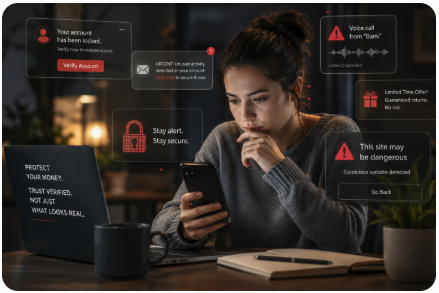

Receiving a message that looks like it’s from your bank.
Answering a phone call that sounds exactly like a family member.
Finding what appears to be a genuine investment website with professional branding and convincing customer reviews.
A few years ago, many scams were relatively easy to spot.
Poor spelling.
Suspicious email addresses.
Unprofessional websites.
Today, that is changing.
Artificial intelligence has made many legitimate tasks faster and easier. Businesses use it to improve customer service, translate languages and automate routine work.
Unfortunately, the same technology can also be misused by criminals.
AI can help create more convincing emails, realistic websites, persuasive chat messages and even cloned voices that sound remarkably authentic.
That doesn’t mean every message is dangerous or that technology itself should be feared.
Instead, it reminds us that good financial decisions increasingly depend on calm thinking rather than first impressions.
The encouraging news is that while technology evolves, the psychological tactics behind financial scams remain remarkably consistent.
Modern financial scams are becoming more sophisticated.
Knowing what to look for can dramatically reduce your risk.
Why Financial Scams Are Becoming Harder To Spot
Technology has transformed how people communicate.
Unfortunately, it has also transformed how criminals attempt to earn trust.
Years ago, scam emails often contained obvious spelling mistakes or poor formatting.
Today, AI tools can generate messages that appear polished, professional and convincing.
Fraudulent websites can closely resemble genuine banks, online stores or investment platforms.
Some fake customer support conversations feel almost indistinguishable from legitimate ones.
Voice cloning has introduced another challenge.
With enough publicly available audio, criminals may attempt to imitate someone you know or someone you naturally trust.
While these attacks remain less common than traditional scams, they illustrate an important point:
Technology helps honest people—but it also gives criminals better tools.
However, the technology itself is not the real problem.
Long before AI existed, scammers relied on the same human emotions.
Fear.
Urgency.
Trust.
Excitement.
Those psychological triggers remain remarkably effective regardless of how advanced the technology becomes.
That is why learning to recognise emotional manipulation is often more valuable than trying to memorise every new scam.
The Psychology Behind Financial Scams
One of the biggest misconceptions about financial scams is that they succeed because victims lack intelligence.
In reality, scammers usually succeed because they understand human psychology remarkably well.
Most financial scams are designed to trigger emotion before encouraging action.
Urgency is one of the most common tactics.
You might receive a message claiming:
“Your account will be suspended today.”
“A payment has failed.”
“Someone is trying to access your account.”
The purpose isn’t simply to inform you.
It’s to reduce the amount of time available for careful thinking.
Fear works in a similar way.
When people worry about losing money or access to important accounts, they naturally become more likely to react quickly.
Greed can also become a powerful influence.
Promises of guaranteed investment returns or exclusive financial opportunities encourage people to focus on potential rewards instead of asking difficult questions.
Authority adds another layer.
Messages that appear to come from banks, government agencies or recognised companies feel more trustworthy because our brains are accustomed to respecting familiar institutions.
Finally, scammers exploit trust itself.
A phone call apparently from a family member.
A message from what looks like your employer.
A customer support representative who sounds calm, knowledgeable and reassuring.
These situations feel believable because they imitate relationships that already exist.
Scammers often manipulate emotions before they steal money.
The money usually comes later.
The emotional reaction comes first.
Understanding this simple principle can improve many areas of personal finance, not only scam prevention.
Whenever emotions become unusually strong, thoughtful financial decisions become harder.
Why Intelligent People Still Fall For Scams
One of the most reassuring truths about financial scams is also one of the most important:
They do not primarily target intelligence.
They target human psychology.
Highly educated professionals.
Business owners.
Engineers.
Doctors.
Financially responsible people.
All have fallen victim to sophisticated scams.
Not because they lacked knowledge, but because they encountered the wrong situation at the wrong moment.
Imagine receiving an urgent phone call while you’re rushing to work.
Perhaps you’re caring for a sick family member.
Maybe you’ve just received worrying financial news.
Under stress, the brain naturally shifts its attention toward solving the immediate problem.
Critical thinking becomes more difficult.
Urgency narrows your focus.
You stop evaluating possibilities and start looking for the fastest solution.
This is exactly what scammers hope will happen.
Rather than convincing people through logic, they manufacture emotional pressure.
They want you to feel afraid enough to act immediately.
Excited enough to ignore warning signs.
Or reassured enough to stop asking questions.
Financial scams rarely succeed because people are unintelligent.
They succeed because criminals create situations where even careful people feel pressured to react before they have time to think.
There is no shame in slowing down before making an important financial decision.
In fact, pausing for just a few minutes is often one of the smartest financial habits you can develop.
The Most Common AI-Assisted Financial Scams
Although technology continues to evolve, many modern scams follow familiar psychological patterns.
AI simply makes them more convincing.
Fake investment platforms
Professional-looking websites may promise exceptional returns using impressive dashboards, polished branding and fabricated testimonials.
Some even allow small withdrawals initially to build trust before encouraging much larger deposits.
A useful reminder is that legitimate investing always involves uncertainty.
Anyone guaranteeing exceptional returns with little or no risk deserves careful scrutiny.
Cloned bank websites
Some fraudulent websites closely imitate genuine financial institutions.
A small difference in the website address may be enough to capture usernames, passwords or banking details.
Typing your bank’s web address directly into your browser instead of following unexpected links remains one of the simplest protective habits.
Voice cloning
AI-generated voices can imitate people surprisingly well.
A scammer may pretend to be a family member or bank employee requesting urgent action.
Rather than responding immediately, independently calling the person or organisation using a trusted number is often enough to reveal the deception.
Fake customer support
Searching online for customer support can sometimes lead to fraudulent phone numbers or websites.
The person answering may sound polite, knowledgeable and professional.
They may even ask you to install software or share sensitive information to “solve” the problem.
Legitimate organisations rarely pressure customers into making immediate security decisions.
Romance scams
Some of the most emotionally damaging scams begin with genuine-looking online conversations.
Weeks or even months may pass before money is ever mentioned.
Eventually, an emergency, travel problem or investment opportunity appears.
AI-generated images and convincing conversations can make these scams increasingly believable, but the underlying tactic remains the same:
Build trust before requesting money.
Fake cryptocurrency opportunities
Social media advertisements and private messages sometimes promote extraordinary investment opportunities that promise unusually high returns.
These scams often rely on excitement and fear of missing out rather than thoughtful decision-making.
If an opportunity feels designed to create urgency instead of understanding, slowing down is usually the wiser response.
Warning Signs You Should Never Ignore
Regardless of how technology changes, many warning signs remain remarkably consistent.
Be especially cautious if you notice several of these together:
- Pressure to act immediately.
- Requests to keep the conversation secret.
- Claims of guaranteed investment returns.
- Unexpected requests for passwords or verification codes.
- Requests to transfer money using unusual payment methods.
- Messages containing unexpected links.
- Little or no attempt to verify your identity.
- Pressure to bypass normal security procedures.
- Someone discouraging you from contacting your bank directly.
- Offers that seem significantly better than anything else available.
One warning sign alone doesn’t necessarily indicate fraud.
Several appearing together should encourage you to pause and verify independently.
A Real-Life Example
Markus is a 35-year-old engineer living in Munich.
One afternoon, he receives a phone call that appears to come from his bank.
The caller explains that suspicious activity has been detected on his account.
Everything sounds convincing.
The caller knows Markus’s full name.
The conversation is calm and professional.
Even the voice sounds authentic.
The caller asks Markus to confirm several security details before “protecting” his account.
For a moment, Markus considers cooperating immediately.
Then he remembers something he recently read:
Scammers often create urgency to prevent careful thinking.
Instead of continuing the conversation, he politely ends the call.
Rather than using the phone number provided by the caller, Markus finds the official customer service number on the back of his bank card and calls the bank directly.
After checking his account, the bank confirms there is no suspicious activity.
The earlier phone call had been fraudulent.
What protected Markus wasn’t technical expertise.
It was a simple decision:
He verified independently instead of reacting immediately.
That five-minute pause prevented what could have become a very expensive mistake.
How To Protect Yourself
The good news is that you don’t need to become a cybersecurity expert to reduce your risk.
Many successful scams can be prevented by building a few simple habits into your daily routine.
Verify independently
If you receive an unexpected phone call, email or text message claiming to be from your bank, an investment company or a government agency, avoid responding immediately.
Instead, end the conversation and contact the organisation using the official phone number or website you already know.
Independent verification is one of the most effective forms of scam prevention.
Never click unexpected links
A message may appear genuine while directing you to a fake website.
Whenever possible, type the company’s official web address directly into your browser or use its official mobile app rather than following links in unexpected emails or text messages.
Enable multi-factor authentication
Where available, multi-factor authentication (MFA) adds another layer of protection to your online accounts.
Even if someone discovers your password, they may still be unable to access your account without the additional verification step.
Protect your personal information
Be cautious about how much personal information you share publicly.
Birthdays, phone numbers, addresses and even voice recordings posted online can sometimes help scammers make fraudulent communications appear more convincing.
Discuss unusual requests with someone you trust
Scammers often try to isolate people by creating urgency or secrecy.
If something feels unusual, pause and talk to a trusted friend or family member.
A second opinion often reveals warning signs that are easy to miss when you’re under pressure.
Keep your financial habits simple
Regularly reviewing your accounts, checking transactions and monitoring important financial activity makes it easier to notice unusual behaviour early.
Strong financial habits don’t only help with budgeting and saving—they also make suspicious activity easier to detect.
Be cautious with investment opportunities
If someone promises extraordinary returns with little or no risk, take extra time to investigate.
Legitimate investments always involve uncertainty.
If you’re still deciding whether investing fits your current financial priorities, our guide on save or invest first explains how to build a balanced financial foundation before making long-term investment decisions.
Why Slowing Down Is One Of The Best Defences
Most financial scams have one thing in common.
They try to speed up your decision-making.
The faster you react, the less time you have to notice inconsistencies.
That’s why slowing down is one of the simplest—and most effective—ways to protect yourself.
Before transferring money, sharing personal information or clicking a link, ask yourself a few simple questions:
- Was I expecting this message?
- Can I verify this independently?
- Is someone trying to create urgency?
- Does this request seem unusual?
- Would I make the same decision if I waited ten minutes?
Those few minutes can completely change the outcome.
They give your logical thinking time to catch up with your emotional reaction.
This principle applies far beyond online safety.
Whether you’re considering an investment, responding to unexpected financial news or making a major purchase, slowing down often leads to better decisions.
It’s one of the reasons our article on financial confidence encourages building calm decision-making habits rather than reacting emotionally to financial pressure.
Awareness is far more powerful than panic.
Technology will continue to evolve.
Scammers will continue adapting.
The ability to pause, verify and think critically will remain one of your strongest forms of protection.
Frequently Asked Questions
What are AI scams?
AI scams are fraudulent schemes that use artificial intelligence to make deception more convincing.
Examples include AI-generated emails, cloned voices, fake customer support conversations and highly realistic phishing websites.
The goal is usually to persuade people to share sensitive information or transfer money.
How can I recognise financial scams?
Look for common warning signs such as pressure to act immediately, guaranteed investment returns, unexpected requests for personal information, secrecy or unusual payment methods.
If something feels unusual, verify the request independently using official contact details.
Can AI clone someone’s voice?
Yes.
Modern AI tools can generate voices that sound remarkably similar to real people when enough audio samples are available.
Although this technology has legitimate uses, it can also be misused in fraud.
If you receive an unexpected call requesting money or sensitive information, verify the request through another trusted communication channel.
What should I do if I suspect a scam?
Stop communicating with the suspected scammer.
Do not transfer money or provide additional personal information.
Contact the relevant organisation using its official contact details and, if necessary, report the incident to your bank and local authorities.
Acting quickly can sometimes help limit financial damage.
How can I protect my online accounts?
Use strong, unique passwords where possible, enable multi-factor authentication, keep your devices updated and be cautious when responding to unexpected emails, text messages or phone calls.
Regularly reviewing your accounts can also help you spot suspicious activity sooner.
Conclusion
Financial scams are changing, but the principles behind them remain surprisingly familiar.
Most succeed not because people are careless, but because they create moments of fear, urgency or misplaced trust.
Fortunately, you don’t need to live in constant suspicion to protect yourself.
Building simple habits—verifying information independently, slowing down before making financial decisions and staying aware of common warning signs—can dramatically reduce your risk.
Technology itself is neither good nor bad.
Like any tool, it depends on how people choose to use it.
By combining awareness with thoughtful decision-making, you can enjoy the benefits of modern technology while helping to protect your money, your identity and your financial wellbeing.
My book on Gumroad:
https://ukandu0.gumroad.com/l/bteyh
Or on Amazon:
Feeling financially stuck?
When financial pressure becomes constant, long-term decisions start feeling emotionally heavy.
The Crown Altessa newsletter was created to help people rebuild clarity slowly and strategically through practical financial frameworks, long-term thinking, and structured decision-making insights.
Join the newsletter and receive:
• the free Financial Foundation Guide
• strategic financial insights
• practical tools for long-term stability
• frameworks designed to reduce financial overwhelm
Start building financial clarity one step at a time.