
One of the first questions people ask when they become interested in personal finance is surprisingly simple:
“Should I save or invest first?”
Unfortunately, the answers they find online are rarely simple.
One article insists that investing should start as early as possible.
Another argues that you should never invest until you’ve built a large emergency fund.
Social media adds even more confusion.
One influencer celebrates impressive investment returns.
Another warns about market crashes.
Someone else claims you’re “falling behind” if you haven’t started investing in your twenties.
For beginners, it’s easy to feel like there must be one correct answer.
The truth is more reassuring.
There isn’t one perfect answer.
The right decision depends on your financial situation.
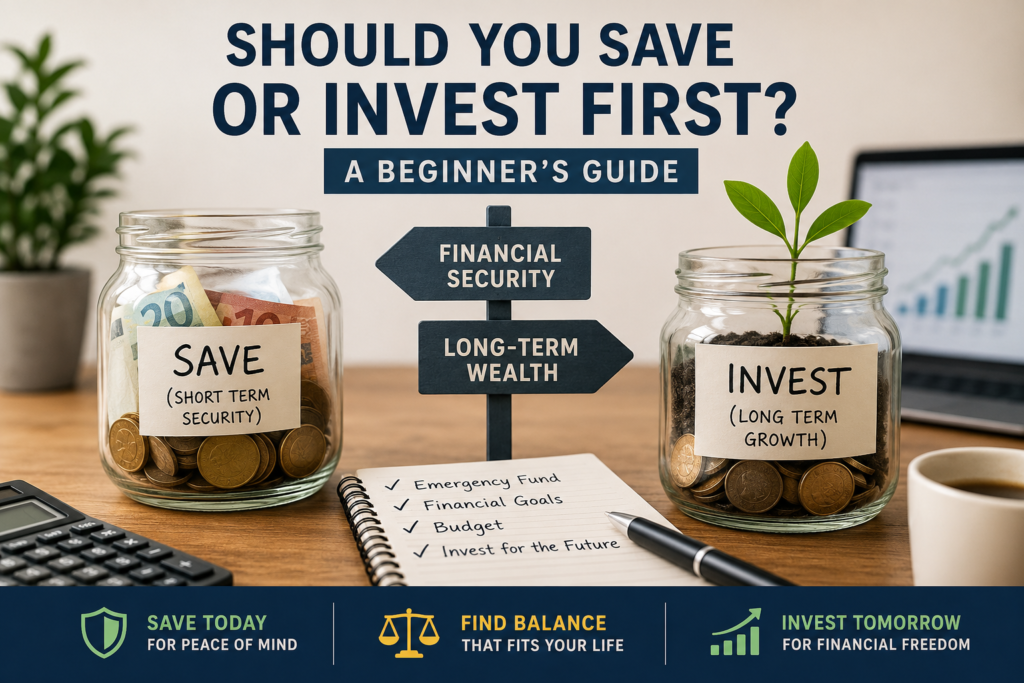
Saving and investing are not competing strategies.
They solve different problems.
Understanding those differences can help you make calmer, more confident decisions without feeling pressured to follow someone else’s financial journey.
Why So Many Beginners Feel Confused
Most beginners aren’t confused because they’re careless.
They’re confused because they’re receiving too much conflicting information.
A quick search online can produce hundreds of opinions.
Financial podcasts.
YouTube videos.
Social media creators.
Blogs.
Friends.
Family members.
Many of these sources offer useful insights.
The problem is that they often speak to very different audiences.
Someone with no savings, unstable income and high-interest debt has very different priorities from someone with an established emergency fund and stable employment.
Yet both may hear exactly the same advice.
This creates unnecessary pressure.
Instead of asking,
“What makes sense for my situation?”
people begin asking,
“Which expert is right?”
Behavioural finance teaches us that uncertainty often leads to inaction.
When every opinion sounds different, many people postpone making any decision at all.
If you’ve been delaying your financial plan because everything feels contradictory, you’re not alone.
In fact, this kind of uncertainty is similar to the decision paralysis discussed in our article on the financial cost of procrastination.
Too much information can sometimes stop progress just as effectively as too little.
Saving And Investing Solve Different Problems
One of the biggest misconceptions in personal finance is believing that saving and investing are interchangeable.
They are not.
An emergency fund is designed to protect you from unexpected events.
Investing is designed to help build long-term wealth.
Those are two very different goals.
Imagine your car suddenly needs expensive repairs.
Or your washing machine stops working.
Or you unexpectedly lose your job.
Money invested for long-term growth may not be the ideal source to cover those costs, particularly if markets have fallen and you need access immediately.
Emergency savings exist precisely to give you flexibility during situations like these.
Investing serves a different purpose.
Instead of helping with next month’s unexpected expense, it focuses on goals that may be years or even decades away.
Neither replaces the other.
One provides stability.
The other creates opportunities for long-term wealth building.
This is why our guide to building an emergency fund explains that emergency savings are less about expecting disaster and more about giving yourself choices when life becomes unpredictable.
Likewise, our article on start investing explains that investing isn’t about finding the perfect opportunity—it’s about gradually building experience and consistency over time.
Both forms of financial planning support one another.
When Saving Should Come First
There are many situations where focusing on saving first is a sensible decision.
For example, if your income changes significantly from month to month, having emergency savings can reduce financial stress during quieter periods.
Similarly, if you’re dealing with high-interest debt, paying that down and creating greater financial stability may deserve higher priority before taking additional investment risk.
Upcoming major expenses are another consideration.
Perhaps you’re planning to move home.
Expecting a child.
Replacing an essential vehicle.
Or paying for further education.
In these situations, having accessible savings can often provide more peace of mind than committing money to long-term investments.
Building emergency savings also has a psychological benefit.
Knowing that unexpected expenses won’t immediately create a financial crisis often makes investing feel much less intimidating later.
Financial stability frequently creates the confidence needed to invest successfully.
Saving first doesn’t mean abandoning long-term wealth building.
It simply means creating a stronger foundation before taking on additional uncertainty.
When Investing May Make Sense
Investing may become a more realistic priority once your finances have become reasonably stable.
For many people, that means having:
- a stable source of income
- some emergency savings
- manageable financial obligations
- a long-term perspective
- realistic expectations about investment risk
One of the biggest mistakes beginners make is believing that investing requires predicting the future.
It doesn’t.
Nobody knows exactly how markets will behave.
Successful long-term investing is usually based less on prediction and more on patience, consistency and continuing to learn.
It’s also important to understand that investing always involves risk.
The value of investments can rise or fall, and there are no guaranteed returns.
That is why investing decisions should always be considered within the context of your own financial situation rather than someone else’s.
Many beginners discover that confidence grows gradually through experience.
Rather than waiting until they feel completely certain, they begin learning while accepting that uncertainty is part of the process.
The Risk Of Treating It As An Either-Or Decision
Perhaps the biggest misunderstanding of all is believing that you must choose between saving and investing.
Real life is often far more flexible.
Some people postpone investing for years because they believe their emergency fund must be “perfect” first.
Others invest every spare euro while neglecting emergency savings altogether.
Both approaches can create problems.
If you wait forever before investing, you delay valuable experience and the opportunity to build long-term investing habits.
If you ignore emergency savings entirely, unexpected expenses may force you into difficult financial decisions later.
For many people, the answer lies somewhere in the middle.
They gradually build emergency savings while also developing the habit of investing modest amounts they are comfortable setting aside for the long term.
This balanced approach recognises that financial priorities rarely exist in isolation.
It also reduces the emotional pressure of believing every decision must be perfect.
As we’ve explored in our article on financial habits, long-term financial wellbeing is usually built through consistent routines rather than dramatic one-time decisions.
Building both saving and investing habits gradually can often be more sustainable than trying to perfect one before even considering the other.
A Real-Life Example
Sophie is a 27-year-old graphic designer living in Düsseldorf.
After receiving her first significant salary increase, she decides it’s finally time to take her finances more seriously.
Almost immediately, she encounters conflicting advice.
Some friends tell her she should invest every spare euro to maximise long-term growth.
Others insist she shouldn’t even think about investing until she has many months of expenses saved.
The more she reads, the less certain she becomes.
For several weeks she does nothing.
Eventually, Sophie steps back and looks at her own situation instead of everyone else’s.
She has stable employment, but very little emergency savings.
She also wants to begin learning about investing without feeling overwhelmed.
Rather than choosing one extreme, she creates a balanced plan.
Each month she automatically transfers money into an emergency savings account.
At the same time, she sets aside a smaller amount for long-term investing—an amount she is comfortable leaving untouched for many years, fully aware that investing carries risk.
The amounts aren’t large.
But they are consistent.
After a year, Sophie notices something surprising.
Her biggest improvement isn’t the size of either account.
It’s how much calmer she feels.
She no longer worries that every unexpected expense will become a financial emergency.
She also no longer feels intimidated by investing because she has gradually gained experience instead of waiting for perfect confidence.
Looking back, she realises that the best decision wasn’t choosing between saving and investing.
It was creating a plan that reflected her own financial reality instead of trying to copy someone else’s.
Common Mistakes Beginners Make
Most beginners don’t struggle because they lack intelligence.
They struggle because personal finance often feels more complicated than it needs to be.
Recognising a few common mistakes can help you avoid unnecessary stress.
Chasing investment returns before building stability
Seeing stories about impressive investment gains can create the feeling that every euro sitting in savings is “doing nothing.”
However, if you have no financial safety net, an unexpected expense could force you to sell investments at an inconvenient time or rely on expensive debt.
Building stability first can make long-term investing much less stressful.
Waiting forever before investing
The opposite mistake is waiting until every financial detail feels perfect.
Some people spend years researching without taking any action.
Eventually, they realise they delayed not because they lacked knowledge, but because they were waiting for certainty that never arrived.
As discussed in our guide on start investing, most investors learn far more from gradual experience than from endless preparation.
Comparing yourself with others
It’s easy to feel behind when friends talk about investments or social media celebrates financial success.
What you rarely see are the differences in income, debt, family support or financial responsibilities.
Our article on financial comparison explains why measuring your progress against someone else’s life often creates unnecessary pressure.
Expecting certainty
Many beginners believe there must be one perfect financial plan.
In reality, personal finance is personal.
Circumstances change.
Priorities evolve.
Good decisions are often reviewed and adjusted over time rather than being perfect from the beginning.
Ignoring financial habits
Saving or investing occasionally is helpful.
Developing consistent routines is far more powerful.
Automatic transfers, regular reviews and thoughtful spending habits often contribute more to long-term financial wellbeing than trying to make one brilliant financial decision.
How To Decide What’s Right For You
Rather than asking whether everyone should save or invest first, ask a different question:
“What makes the most sense for my situation today?”
Several factors can help guide that decision.
Income stability
If your income varies significantly from month to month, building stronger emergency savings may deserve greater attention before increasing long-term investments.
Financial obligations
Think about your current responsibilities.
Rent.
Family commitments.
Loan repayments.
Upcoming major expenses.
These all influence how much flexibility you may need.
Emergency savings
If an unexpected expense would immediately create serious financial pressure, strengthening your emergency fund could provide valuable peace of mind.
Comfort with risk
Everyone experiences financial uncertainty differently.
Some people sleep comfortably knowing part of their money is invested for the long term.
Others prefer building a larger financial cushion first.
Neither approach is automatically right or wrong.
Future goals
Consider what you’re trying to achieve.
Buying a home.
Changing careers.
Travelling.
Building long-term wealth.
Different goals may require different priorities at different stages of life.
There is no universal sequence that works for everyone.
Thoughtful financial planning means regularly reviewing your own circumstances instead of following someone else’s roadmap.
Why Good Financial Decisions Work Together
One of the biggest misconceptions in personal finance is that success comes from finding one perfect strategy.
In reality, financial wellbeing is usually built by combining many good habits.
An emergency fund provides resilience.
Consistent investing supports long-term wealth building.
Healthy spending habits help you keep more of what you earn.
Career development can increase future earning potential.
Thoughtful budgeting helps ensure your income supports your priorities rather than disappearing unnoticed.
These behaviours reinforce one another.
Someone who develops strong financial habits often finds it easier to save consistently.
Someone with emergency savings may feel more confident making a thoughtful career change when the right opportunity appears.
Someone who avoids lifestyle inflation after receiving a pay rise may have more flexibility to both save and invest over time.
Building wealth is rarely about choosing one perfect strategy.
It is about combining several good habits over many years.
Small improvements rarely transform your finances overnight.
Together, however, they can create remarkable long-term progress.
Frequently Asked Questions
Should I save before investing?
It depends on your financial situation.
Many people benefit from building at least some emergency savings before investing because it provides greater financial stability.
Others may choose to save and invest gradually at the same time.
The right approach depends on your income, expenses, financial obligations and long-term goals.
Can I save and invest at the same time?
Yes.
Many people find that balancing both is a practical solution.
For example, they gradually build emergency savings while also developing the habit of investing modest amounts for the long term.
This approach can support both financial security and long-term wealth building.
How much emergency savings should I have?
There is no single amount that suits everyone.
The appropriate size of an emergency fund depends on factors such as your monthly expenses, income stability, family situation and personal circumstances.
Building it gradually is often more important than reaching a specific number quickly.
Is investing without savings risky?
It can be.
Without emergency savings, unexpected expenses may leave you with fewer options during financially difficult periods.
Many beginners feel more confident investing once they know they have some financial cushion available.
Should beginners invest immediately?
Not necessarily.
Some people may first want to strengthen their emergency savings, reduce high-interest debt or improve their overall financial stability.
The best time to begin depends on your own circumstances rather than a universal timeline.
Conclusion
The question isn’t whether saving or investing is better.
It’s whether your financial plan reflects your current reality.
For many people, the answer won’t be choosing one over the other.
It will be finding a balanced approach that provides both financial security today and opportunities for long-term growth tomorrow.
You don’t need perfect certainty.
You don’t need the perfect strategy.
You simply need thoughtful decisions, consistent habits and the patience to let those habits work over time.
Building financial confidence is rarely about making one big decision.
More often, it’s about making many small, sensible ones.
My book on Gumroad:
https://ukandu0.gumroad.com/l/bteyh
Or on Amazon:
Feeling financially stuck?
When financial pressure becomes constant, long-term decisions start feeling emotionally heavy.
The Crown Altessa newsletter was created to help people rebuild clarity slowly and strategically through practical financial frameworks, long-term thinking, and structured decision-making insights.
Join the newsletter and receive:
• the free Financial Foundation Guide
• strategic financial insights
• practical tools for long-term stability
• frameworks designed to reduce financial overwhelm
Start building financial clarity one step at a time.