
One of the first decisions many new investors face isn’t when to invest.
It’s what to invest in.
After spending time learning about investing, you’ll probably come across two common options:
- Exchange-Traded Funds (ETFs)
- Individual stocks (also called individual shares)
Supporters of each approach often make strong arguments.
Some say individual stocks offer greater opportunities for higher returns.
Others believe ETFs are the smarter choice because they provide diversification with less effort.
For someone just getting started, this can quickly become confusing.
Is one objectively better?
Should beginners avoid individual stocks altogether?
Can you combine both approaches?
The truth is more balanced than many online discussions suggest.
Neither ETFs nor individual stocks are inherently “good” or “bad.”
Each comes with strengths, limitations and different types of risk.
More importantly, the right choice depends not only on markets but also on your investing knowledge, available time, financial goals and ability to stay disciplined during periods of uncertainty.
This guide explains the practical differences between ETFs and individual stocks, explores the psychology behind each approach and helps you understand why many long-term investors choose one, the other or a combination of both.
What Is An ETF?
An Exchange-Traded Fund (ETF) is an investment that holds many different assets together in a single fund.
Rather than buying shares in just one company, an ETF can provide exposure to dozens, hundreds or even thousands of companies through one investment.
An Analogy
Imagine walking through a huge international food market.
Each stall represents a different company.
One stall sells apples.
Another sells oranges.
Another sells grapes.
Buying fruit from only one stall is similar to buying one company’s stock.
If that stall has an excellent harvest, you benefit.
If something goes wrong with that particular seller, your purchase is heavily affected.
Now imagine the market manager has prepared a large basket containing fruit from hundreds of different stalls.
Some fruit may turn out better than others.
Some may disappoint.
But because your basket contains so many different choices, you’re much less dependent on any single seller.
An ETF works in much the same way.
Instead of relying on one business, your investment is spread across many.
That doesn’t guarantee profits.
Markets can still decline.
Entire industries can struggle.
However, the success of your investment no longer depends entirely on one company making the right decisions.
This idea connects closely with what diversification is. Diversification isn’t about owning more investments for the sake of it—it’s about reducing unnecessary dependence on a single outcome.
Why ETFs Became Popular
ETFs have become increasingly popular because they simplify investing.
Instead of researching dozens of individual companies, investors can gain broad market exposure through a single investment.
For many people, especially beginners, that simplicity reduces complexity and makes it easier to stay focused on long-term goals rather than constantly reacting to individual company news.
What Is An Individual Stock?
Buying an individual stock means buying a small ownership stake in one specific company.
If you purchase shares in a globally recognised business such as Apple or Microsoft, you become a shareholder in that company.
Your investment’s performance then depends largely on how that particular business performs over time.
If the company grows successfully, increases profits and continues attracting investors, its share price may rise.
If the business struggles, faces stronger competition or experiences unexpected problems, its share price may fall.
Unlike an ETF, where many companies contribute to overall performance, an individual stock concentrates your investment in one business.
This creates greater opportunity—but also greater uncertainty.
Imagine supporting one football team for an entire season.
Every victory feels rewarding.
Every defeat feels personal.
Now imagine following an entire league instead.
Individual matches still matter, but your overall experience depends on many teams rather than just one.
Individual stocks are similar.
Your investment becomes closely tied to one company’s future.
That concentration can produce excellent outcomes.
It can also produce disappointing ones.
Neither outcome is guaranteed.
Greater Responsibility
Owning individual stocks usually requires more ongoing attention.
Investors often choose to monitor:
- company earnings
- management decisions
- industry developments
- competitive pressures
- financial reports
- major business announcements
Some people genuinely enjoy this process.
Others find it stressful or time-consuming.
Neither preference is right or wrong.
It simply reflects different approaches to investing.
If you’re new to investing, our guide on why so many people never start investing explores why many beginners become overwhelmed by the belief that they must understand everything before taking their first step.
The Biggest Differences Between ETFs And Stocks
Although ETFs and individual stocks are both investment vehicles, they serve different purposes and involve different trade-offs.
The table below summarises some of the most important differences.
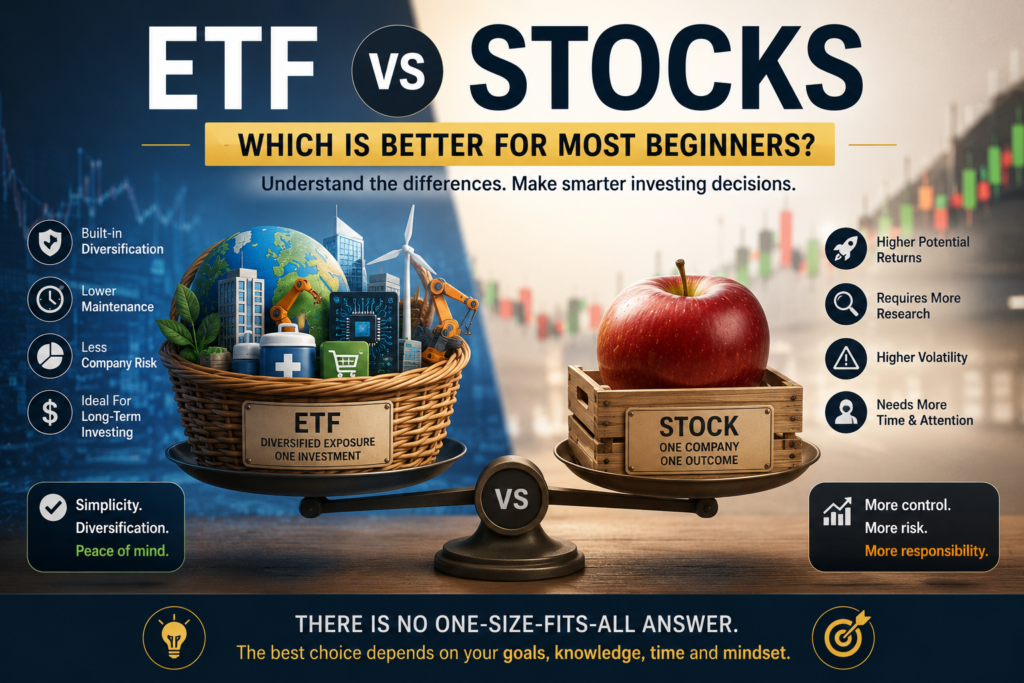
| Feature | ETFs | Individual Stocks |
|---|---|---|
| Diversification | Typically spread across many companies | Exposure to one company |
| Investment Risk | Company-specific risk is reduced, though market risk remains | Greater dependence on one business |
| Potential Return | Depends on the underlying portfolio | Can be higher or lower depending on company performance |
| Research Required | Usually less ongoing company research | Often requires regular company analysis |
| Time Commitment | Generally lower | Usually higher |
| Volatility | Often smoother because many holdings contribute | Can experience larger price swings |
| Costs | May include fund management costs depending on the ETF | Transaction costs depend on your broker and trading activity |
| Emotional Pressure | Often lower because performance is spread across many companies | Can feel more emotionally demanding during periods of volatility |
It’s important not to interpret this table as declaring one approach superior.
Instead, think of it as describing different tools designed for different investors.
Someone who enjoys researching businesses may appreciate the additional involvement of individual stocks.
Someone who prefers a simpler, lower-maintenance approach may value ETFs more highly.
Behavioural finance also reminds us that complexity isn’t always an advantage.
Sometimes the investment strategy that appears less exciting is the one that’s easiest to maintain consistently over decades.
Our article on Dollar-Cost Averaging explains why building a sustainable investing routine often matters more than making one “perfect” investment decision.
Likewise, understanding investment risk and return helps investors recognise that greater uncertainty does not automatically lead to better long-term results.
Why Many Beginners Start With ETFs
If you ask experienced investors how they began, you’ll often hear very different stories.
Some started by researching individual companies.
Others invested only in broad market funds.
Neither path is automatically right or wrong.
However, many beginners choose ETFs because they solve several common challenges at once.
Automatic Diversification
Perhaps the biggest advantage of an ETF is that diversification is built into the investment.
Instead of relying on one company’s success, your investment is spread across many businesses.
That doesn’t eliminate investment risk.
Markets can still decline.
But it reduces the chance that one disappointing company has an outsized impact on your portfolio.
For someone who is still learning about investing, this broader exposure can make the experience feel more manageable.
Simplicity Reduces Decision Fatigue
Behavioural finance teaches us that people don’t always make poor decisions because they lack intelligence.
Sometimes they simply become overwhelmed by too many choices.
Should you buy Company A or Company B?
What if another company performs better?
Should you sell after disappointing earnings?
When you own individual stocks, these questions arise regularly.
A broad ETF often reduces the number of decisions you need to make.
That simplicity can become a strength rather than a weakness.
The fewer unnecessary decisions you face, the easier it may be to stay focused on your long-term plan.
Less Company-Specific Risk
Imagine one company announces disappointing financial results.
Its share price falls sharply.
If that company represents your entire investment portfolio, the emotional impact can be significant.
In a diversified ETF, that same company may represent only a small part of the overall portfolio.
The news still matters—but it doesn’t define your entire investment experience.
This is one reason many investors value diversification even though it cannot eliminate market risk altogether.
Lower Maintenance
Owning individual stocks often means following company news, earnings reports and competitive developments.
Some investors genuinely enjoy this research.
Others simply want an investment strategy they can review periodically without monitoring individual businesses every week.
For those investors, ETFs often require less ongoing attention.
Long-Term Investing
Many ETF investors focus on participating in long-term economic growth rather than trying to identify tomorrow’s biggest winning company.
That doesn’t guarantee success.
But it reflects a mindset centred on patience rather than constant prediction.
As discussed in our guide on what is volatility, accepting temporary market fluctuations is often easier when your attention is focused on long-term goals rather than daily price movements.
When Individual Stocks Might Make Sense
Although ETFs appeal to many beginners, individual stocks also have a legitimate place in investing.
Some investors enjoy researching companies.
They like reading annual reports.
They follow industries closely.
They understand business models and enjoy evaluating management decisions.
For these investors, analysing individual companies isn’t a burden.
It’s part of the experience.
Higher Conviction
An investor may genuinely believe that a particular company has strong long-term prospects.
That belief may come from careful research rather than excitement or social media influence.
Owning an individual stock allows investors to express that conviction directly.
Of course, conviction should never be confused with certainty.
Even excellent companies experience unexpected challenges.
Greater Uncertainty
Individual stocks also involve greater concentration.
When your investment depends heavily on one company, its future becomes much more important to your portfolio.
Unexpected events can influence even highly respected businesses.
Competition changes.
Technology evolves.
Consumer preferences shift.
Strong companies today may face very different environments tomorrow.
That uncertainty is one reason concentration requires thoughtful risk management.
More Ongoing Attention
Individual stock investing is rarely a “buy once and forget forever” activity.
Investors often choose to monitor developments such as:
- financial performance
- leadership changes
- competitive pressures
- regulatory developments
- new products or services
Some people enjoy this responsibility.
Others prefer a more passive approach.
Neither preference is inherently better.
The important question is whether your investment approach matches your interests, available time and willingness to stay informed.
Common Mistakes Beginners Make
Regardless of whether someone chooses ETFs, individual stocks or both, beginners often encounter similar behavioural challenges.
Buying Only Popular Companies
Well-known companies naturally attract attention.
Popularity, however, doesn’t automatically mean an investment is suitable or appropriately priced.
Many beginners assume that because a company is famous, it must also be a good investment.
Those are two very different questions.
Following Influencers Instead Of Understanding Investments
Social media makes investing feel easy.
Short videos can create the impression that successful investing simply means copying someone else’s portfolio.
The problem is that you rarely know:
- their financial goals
- their risk tolerance
- their investment horizon
- when they actually bought the investment
- whether they still own it today
Learning to understand your own decisions is generally more valuable than copying someone else’s.
Chasing Recent Winners
A company that has risen dramatically over the last year naturally attracts attention.
Many investors assume recent success will continue indefinitely.
History repeatedly shows that market leadership changes over time.
Yesterday’s strongest performer isn’t guaranteed to remain tomorrow’s.
Ignoring Diversification
Excitement often encourages concentration.
A beginner discovers one company they admire and invests most of their portfolio in it.
Sometimes this works well.
Sometimes it doesn’t.
The important point is that concentration increases dependence on one outcome.
Diversification reduces that dependence.
Overconfidence
After one or two successful investments, it’s easy to believe you’ve discovered a winning formula.
Behavioural finance suggests otherwise.
Short-term success doesn’t necessarily prove investing skill.
Markets always contain an element of uncertainty.
Maintaining humility often becomes an advantage over long periods.
Trying To Get Rich Quickly
Perhaps the most expensive investing mistake isn’t choosing the wrong company.
It’s believing that wealth should happen quickly.
Long-term investing rarely feels dramatic.
It often looks surprisingly ordinary:
- investing consistently
- staying diversified
- controlling emotions
- remaining patient
Those habits may appear less exciting than chasing the next big opportunity, but history has repeatedly shown that consistency often matters more than excitement.
Can You Own Both?
Absolutely.
In fact, many investors do.
Rather than viewing ETFs and individual stocks as competing ideas, they treat them as complementary tools.
A common approach is to build a diversified core portfolio using ETFs while allocating a smaller portion of investments to individual companies that genuinely interest them.
This allows investors to benefit from broad diversification while still exploring individual businesses.
For example:
- A core portfolio may focus on diversified ETFs aligned with long-term goals.
- A smaller allocation may be reserved for carefully researched individual companies.
The exact balance differs from one investor to another.
Some prefer only ETFs.
Others enjoy researching businesses and therefore allocate more attention to individual stocks.
Neither approach is universally correct.
The key is ensuring that your investment strategy reflects your own objectives rather than external pressure or excitement.
Successful investing isn’t about proving that ETFs are superior to individual stocks—or vice versa.
It’s about choosing an approach you understand, can maintain consistently and that supports your long-term financial goals.
Frequently Asked Questions
Are ETFs safer than stocks?
It depends on what you mean by “safer.”
An individual stock depends on the performance of one company. If that business faces unexpected challenges, your investment may be significantly affected.
An ETF usually holds many companies, reducing company-specific risk through diversification.
However, ETFs are not risk-free. If the broader market declines, a diversified ETF may also lose value.
A more accurate way to think about it is that ETFs often reduce concentration risk, but they do not eliminate investment risk.
Can ETFs lose money?
Yes.
Like any market investment, ETFs can rise and fall in value.
An ETF that tracks a broad market index may decline during economic downturns or periods of market volatility.
This is why investing should generally be viewed with a long-term perspective rather than focusing on short-term price movements.
Should beginners buy ETFs or stocks?
There isn’t a universal answer.
Many beginners start with ETFs because they provide diversification and usually require less ongoing research.
Others enjoy analysing businesses and gradually learn through investing in individual companies.
The most suitable approach depends on your:
- financial goals
- willingness to research investments
- available time
- tolerance for uncertainty
- ability to remain disciplined during market fluctuations
The best strategy is often the one you can realistically maintain over many years.
Can I own both?
Yes.
Many investors combine a diversified ETF portfolio with a smaller allocation to individual stocks.
This approach allows them to benefit from broad diversification while also investing in businesses they have researched and understand.
There is no requirement to choose only one approach.
How many ETFs should beginners own?
There is no perfect number.
Owning more ETFs does not automatically create better diversification.
Sometimes several ETFs hold many of the same underlying companies.
The more important question is whether your portfolio provides appropriate diversification for your financial goals and remains simple enough for you to understand and manage.
As your investing knowledge grows, you can review and adjust your portfolio when appropriate.
Conclusion
The debate around ETF vs stocks often sounds like a competition.
In reality, it doesn’t have to be.
Both approaches give you a way to participate in the growth of businesses.
They simply do so in different ways.
Individual stocks offer concentrated exposure to a single company. That concentration can create both greater opportunities and greater uncertainty.
ETFs spread investments across many companies, helping reduce company-specific risk while still exposing investors to the broader movements of financial markets.
Neither approach guarantees better results.
Neither removes uncertainty.
The most important decision isn’t choosing the “perfect” investment.
It’s building an investment strategy that matches your goals, your knowledge, your available time and your ability to stay invested when markets become uncomfortable.
One useful way to think about investing is this:
Your portfolio is like a vehicle for a long journey.
Some people prefer a highly specialised sports car. Others value the reliability of a well-balanced family car.
Neither vehicle is universally better.
The right choice depends on where you’re going, how you plan to travel and whether you can comfortably stay on the road when conditions become difficult.
Investing works the same way.
Long-term success is rarely built by chasing whatever looks most exciting today.
More often, it comes from understanding the trade-offs, remaining disciplined and continuing to learn as your experience grows.
If this article leaves you with one lasting idea, let it be this:
The best investment isn’t necessarily the one that looks most impressive today. It’s the one you understand well enough to hold confidently through years of changing markets.
If you’re still building your investing knowledge, these related guides can help deepen your understanding:
- Learn why Dollar-Cost Averaging focuses on consistency rather than perfect timing.
- Explore investment risk and return to understand why higher risk doesn’t automatically lead to better results.
- Discover what diversification is and why spreading investments reduces—but never removes—uncertainty.
- Read what is volatility to better understand why market swings are a normal part of long-term investing.
Together, these concepts form the foundation of thoughtful, evidence-informed investing.
My book on Gumroad:
https://ukandu0.gumroad.com/l/bteyh
Or on Amazon:
Feeling financially stuck?
When financial pressure becomes constant, long-term decisions start feeling emotionally heavy.
The Crown Altessa newsletter was created to help people rebuild clarity slowly and strategically through practical financial frameworks, long-term thinking, and structured decision-making insights.
Join the newsletter and receive:
• the free Financial Foundation Guide
• strategic financial insights
• practical tools for long-term stability
• frameworks designed to reduce financial overwhelm
Start building financial clarity one step at a time.