

One of the biggest questions new investors ask isn’t what to invest in.
It’s when.
Imagine you’ve finally saved your first €10,000 to invest.
Should you invest the entire amount today?
Or should you spread your investments over several months?
At first glance, it sounds like there must be a correct answer.
After all, surely one strategy is objectively better than the other.
In reality, the answer is more nuanced.
It depends not only on how markets behave, but also on how people behave.
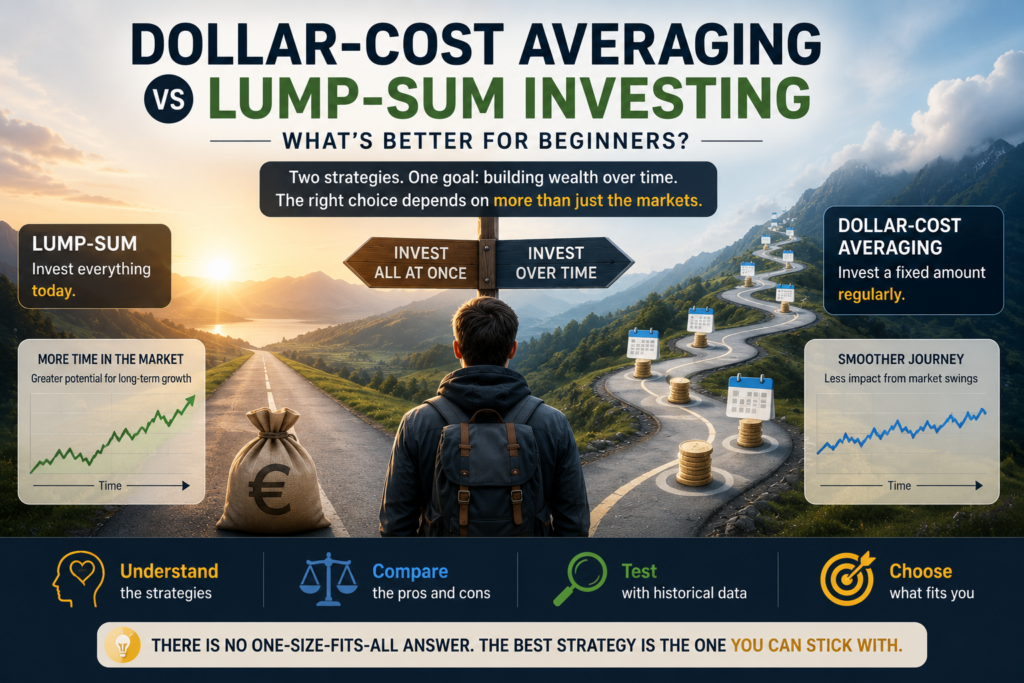
Some investors prefer to invest everything immediately because it gives their money more time in the market.
Others feel more comfortable investing gradually, reducing the fear of entering the market just before a decline.
Neither approach removes uncertainty.
Neither guarantees better returns.
Understanding the strengths and limitations of both strategies can help beginners make decisions that fit not only their financial goals but also their emotional comfort with investing.
This article explains what Dollar-Cost Averaging (DCA) is, why many investors use it, how it compares with lump-sum investing and why behavioural finance suggests that the “best” strategy is not always the one with the highest historical average return.
What Is Dollar-Cost Averaging?
Dollar-Cost Averaging (often shortened to DCA) means investing a fixed amount of money at regular intervals, regardless of whether markets are rising or falling.
Instead of investing €12,000 today, for example, an investor might choose to invest €1,000 every month for twelve months.
The key idea is consistency.
The investment schedule stays the same even when market prices change.
An Analogy
Imagine you’re hiking across unfamiliar terrain after heavy rain.
You can either leap across a fast-moving stream in one large jump or cross it using a series of carefully placed stepping stones.
Neither approach guarantees success.
The single jump may get you across immediately—but it also leaves no opportunity to adjust if conditions aren’t exactly as expected.
The stepping stones allow you to adapt as you move forward.
Each step doesn’t eliminate risk, but it spreads your commitment over time.
Dollar-Cost Averaging works in a similar way.
Instead of committing all your money on one particular day, you spread your investments across multiple dates.
That means you’ll sometimes buy when prices are relatively high.
Other times you’ll buy when prices are lower.
Over time, your purchases reflect a range of market conditions rather than relying on a single entry point.
It’s important to remember that DCA is not designed to maximise returns in every situation.
Its purpose is to create a disciplined investing process that reduces dependence on choosing the “perfect” moment to invest.
For many beginners, that discipline can be just as valuable as the investment strategy itself.
If you’re only beginning your investing journey, you may also find our guide on why so many people never start investing helpful. Many new investors delay taking their first step because they believe they need perfect timing or perfect knowledge before they begin.
Why Some Investors Prefer Lump-Sum Investing
Lump-sum investing means investing your available money immediately rather than spreading it across several future investments.
If you receive an inheritance, sell a property or accumulate savings over many years, you may eventually face this decision.
Should you invest everything today?
Or should you spread those investments over time?
One reason many investors prefer lump-sum investing is simple:
The earlier your money is invested, the longer it has the opportunity to participate in market growth.
Over very long historical periods, research has often found that lump-sum investing has outperformed Dollar-Cost Averaging when comparing identical amounts of money.
The explanation is straightforward.
Markets have historically risen more often than they have fallen.
If your money enters the market sooner, it generally spends more time participating in those long-term gains.
However, historical averages do not eliminate uncertainty.
Imagine investing your entire portfolio immediately before a major market downturn.
Even if long-term recovery eventually occurs, experiencing large short-term losses can be emotionally difficult.
History contains periods where lump-sum investing performed exceptionally well.
It also contains periods where investors who entered the market shortly before significant declines experienced long and uncomfortable recoveries.
This is why historical evidence should always be interpreted carefully.
It tells us what happened under particular circumstances.
It does not guarantee what will happen next.
Understanding investment risk and return helps place these observations into context. Higher expected returns often come with greater uncertainty, but uncertainty never guarantees a particular outcome.
Why Dollar-Cost Averaging Feels Safer
One of the strongest arguments for Dollar-Cost Averaging has very little to do with mathematics.
It has everything to do with psychology.
Fear Of Investing At The Wrong Time
Imagine investing your life’s savings today.
Tomorrow the market falls sharply.
Even if your long-term investment plan hasn’t changed, many people would immediately begin questioning their decision.
“I should have waited.”
“Why didn’t I invest next month instead?”
That emotional reaction is completely understandable.
Dollar-Cost Averaging reduces the pressure of making one single “all-or-nothing” decision.
Instead of relying on one entry date, investments are spread across many dates.
Regret Avoidance
Behavioural finance shows that people often try to avoid future regret as much as they try to maximise future gains.
A single large investment immediately before a market decline can create intense feelings of regret—even when the original investment decision was perfectly reasonable based on the information available at the time.
Dollar-Cost Averaging doesn’t eliminate regret.
But it often softens it.
If prices fall after your first investment, future scheduled investments may occur at lower prices.
If prices rise instead, at least part of your money was already invested.
Loss Aversion
Humans naturally experience losses more intensely than gains of similar size.
A temporary 20% decline often feels emotionally much larger than a 20% gain feels rewarding.
Because of this, investors frequently overreact during market downturns.
A gradual investing approach can sometimes make temporary declines feel easier to tolerate because investors are still following a structured plan rather than feeling they made one irreversible decision.
Our article on what is volatility? explores why market fluctuations often feel more frightening than they actually are from a long-term investing perspective.
Building Confidence Through Experience
Perhaps the greatest strength of Dollar-Cost Averaging is that it encourages participation.
For beginners, investing regularly creates familiarity.
Each monthly investment becomes another opportunity to learn how markets behave.
Confidence develops gradually through experience rather than waiting for complete certainty.
That’s one reason many successful long-term investors focus more on building consistent financial habits than on predicting short-term market movements.
Neither Strategy Guarantees Better Results
It is tempting to search for a definitive answer.
Should everyone invest immediately?
Or should everyone invest gradually?
The reality is far more complex.
The outcome depends on many factors beyond the investor’s control.
Market Conditions Matter
A steadily rising market may favour one approach.
A volatile or declining market may favour another.
Neither environment lasts forever.
Markets constantly change.
Your Starting Date Matters
Investing in January 2010 is not the same as investing in January 2020.
Nor is investing immediately before a major financial crisis the same as investing several years into a market recovery.
Changing only the starting date can produce surprisingly different historical outcomes.
Future Returns Remain Uncertain
Perhaps the most important lesson is this:
No historical study can tell us exactly what future markets will do.
Historical evidence provides valuable context.
It helps us understand possibilities.
It cannot eliminate uncertainty.
This is why thoughtful investing rarely depends on finding the one “perfect” strategy.
Instead, it depends on choosing an approach that matches your financial situation, your investment horizon and—perhaps most importantly—your ability to remain disciplined through changing market conditions.
For many investors, the greatest challenge isn’t selecting between Dollar-Cost Averaging and lump-sum investing.
It’s continuing to invest consistently after markets become uncomfortable.
A Historical Experiment
One of the best ways to understand the differences between Dollar-Cost Averaging and lump-sum investing is to compare them under the same historical market conditions.
Rather than debating which strategy should perform better, we can observe how each approach behaved during one specific period in history.
Using the Crown Altessa educational investment simulator, we compared a lump-sum investment with a Dollar-Cost Averaging approach using the same historical market period.
The objective was not to prove that one strategy is universally superior.
Instead, the exercise was designed to help readers understand how different investing approaches can produce different experiences, even when they begin with the same amount of money.
Strategies compared:
- Lump-Sum Investment
- Dollar-Cost Averaging (Regular Contributions)
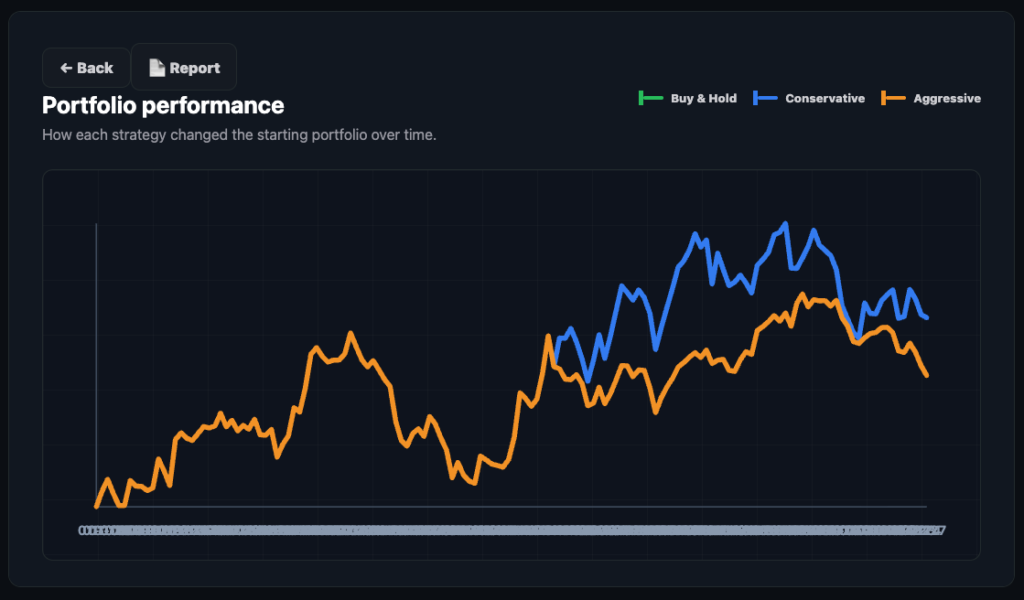
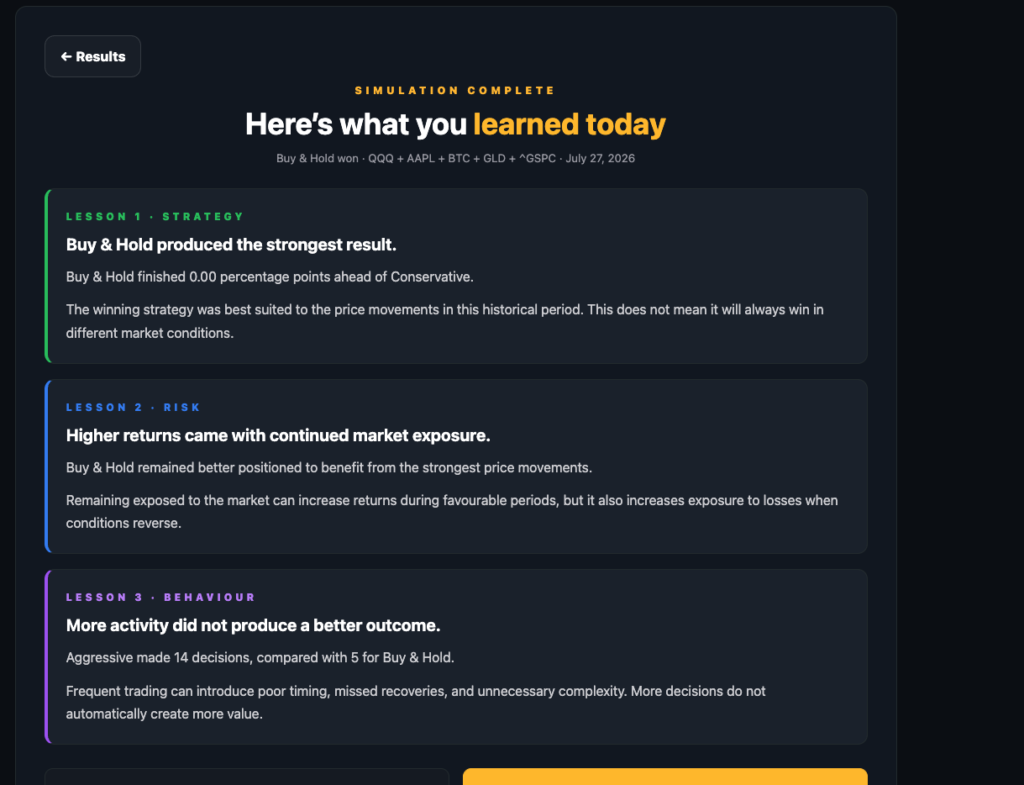
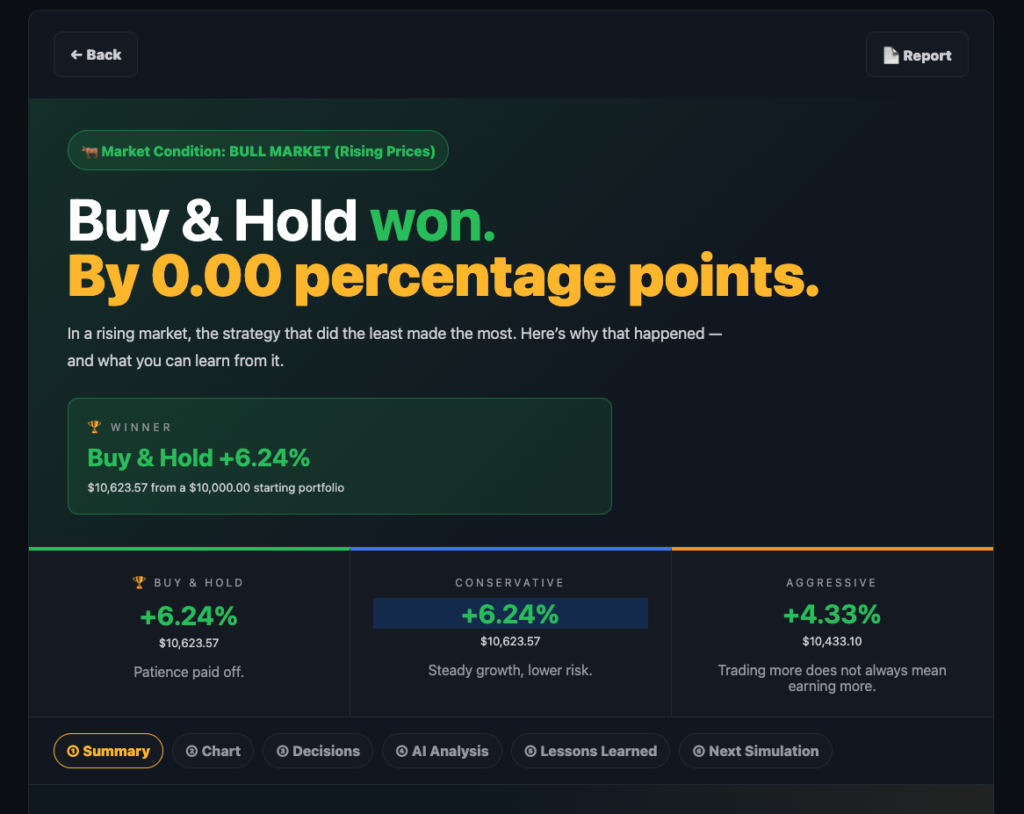
When reviewing the simulation, resist the temptation to look only at the final portfolio values.
Instead, pay attention to the journey.
Ask yourself:
- Which strategy had more money invested earlier?
- Which strategy experienced the largest temporary declines?
- How different did the emotional experience feel?
- Did one approach make it easier to remain invested during periods of market uncertainty?
- If the historical period had started one year earlier or later, would the outcome have changed?
These questions often provide more valuable lessons than simply identifying which portfolio finished with the higher value.
Imagine two people climbing the same mountain.
One begins early in the morning and encounters clear skies.
The other starts later and faces fog along the way.
They may eventually reach similar destinations, but their experiences are very different.
Investing works in much the same way.
The path you travel matters, not only the destination.
Dollar-Cost Averaging often changes the emotional experience of investing because new money continues entering the market over time.
Lump-sum investing places more money at work immediately, which can be advantageous in some historical periods but emotionally difficult in others.
Neither observation automatically proves that one strategy is always better.
It simply illustrates that investing is influenced by both market behaviour and human behaviour.
Historical simulations are particularly useful because they encourage observation instead of prediction.
Rather than asking,
“Which strategy will definitely perform best next time?”
they encourage a more thoughtful question:
“What can this historical period teach me about uncertainty, investing behaviour and my own assumptions?”
What This Experiment Does NOT Prove
One historical experiment should never become a universal investing rule.
Suppose you repeated the same comparison using:
- a different decade
- a different stock market
- different asset classes
- a different starting month
- a different ending date
The results might change significantly.
Some historical periods strongly favour lump-sum investing because markets rise steadily after the initial investment.
Other periods make Dollar-Cost Averaging appear more attractive because prices fall soon after the first investment, allowing later contributions to purchase investments at lower prices.
Neither outcome proves what future markets will do.
Markets constantly evolve.
Interest rates change.
Inflation changes.
Economic growth accelerates and slows.
Unexpected global events occur.
Investor sentiment shifts.
Every historical period reflects its own unique combination of circumstances.
This is why experienced investors avoid drawing broad conclusions from a single historical example.
Historical simulations help us understand possibilities.
They do not eliminate uncertainty.
They cannot recommend investments.
They cannot identify the “best” strategy for every investor.
Most importantly:
Past performance does not predict future performance.
That statement isn’t a disclaimer designed to discourage investors.
It’s a reminder to remain intellectually honest.
History provides valuable evidence.
The future always contains uncertainty.
The Crown Altessa educational simulator reflects this philosophy.
Its purpose is to help readers explore historical investing behaviour, question assumptions and improve financial understanding—not to predict future market performance or recommend a particular investment strategy.
Question Your Assumptions
Before looking at any historical simulation, take a moment to write down what you genuinely expect to happen.
For example:
- Which strategy do I think will perform better?
- Why do I believe that?
- If markets fell sharply soon after investing, how would I react?
- Would I continue investing every month if prices kept declining?
- Which strategy would make me feel more comfortable during market volatility?
Writing down your expectations first creates an important psychological advantage.
It separates what you expected from what actually happened.
After reviewing the historical results, ask yourself a second set of questions.
- Did the outcome match my expectations?
- What surprised me the most?
- Did I underestimate the emotional comfort provided by regular investing?
- Did I overestimate the benefits of investing everything immediately?
- Would my decision change if the historical period began at a different time?
Notice that none of these questions asks you to predict the future.
That is intentional.
The objective isn’t forecasting.
The objective is learning.
Many investing mistakes begin with assumptions that feel obvious but have never been tested.
Historical simulations provide an opportunity to compare those assumptions with evidence.
Sometimes your beliefs will be confirmed.
Sometimes they’ll change.
Either result represents progress.
The simulator simply provides a structured environment for that learning process.
It illustrates how different strategies behaved during one historical period.
It cannot predict future markets, nor should it be interpreted as investment advice.
Instead, it encourages a habit that benefits every investor:
Question your assumptions before you question the market.
Which Approach Is Better For Beginners?
After learning about both strategies, many beginners ask the same question:
“So… which one should I choose?”
The honest answer is that there isn’t a universally correct choice.
Both Dollar-Cost Averaging and lump-sum investing have strengths and limitations. The better approach depends not only on markets, but also on your financial circumstances, investment horizon and—perhaps most importantly—your behaviour.
Investing Behaviour Matters More Than Perfect Timing
Successful investing is rarely determined by a single decision.
Instead, it is shaped by hundreds of small decisions made consistently over many years.
An investor who follows a sensible plan for twenty years will often achieve better results than someone who spends years searching for the perfect moment to invest but never begins.
Behavioural finance repeatedly shows that consistency often matters more than clever predictions.
Our article on why small financial habits matter more than big goals explores this principle in greater depth.
Consider Your Investment Horizon
Someone investing for retirement in thirty years may naturally think differently from someone planning to use their money within the next three years.
Longer investment horizons have historically provided more time for markets to recover from periods of volatility, although future results remain uncertain.
Understanding your own timeline helps place short-term market movements into perspective.
Think About Your Available Cash
Dollar-Cost Averaging and lump-sum investing often arise under different circumstances.
If you’ve gradually built savings from monthly income, you may naturally invest regularly because that’s how your money becomes available.
If you receive a large inheritance, a work bonus or proceeds from selling a property, you may instead face a genuine choice between investing everything immediately or spreading investments over time.
The right approach depends on your overall financial situation—not simply on historical averages.
Emotional Discipline Is Part Of The Strategy
Sometimes the mathematically “better” strategy isn’t the one an individual can realistically follow.
Imagine an investor who chooses lump-sum investing because historical studies suggest it has often produced higher long-term returns.
Then the market falls sharply.
Fear takes over.
They sell everything.
In hindsight, the strategy didn’t fail.
Their behaviour did.
Now imagine another investor who chooses Dollar-Cost Averaging because regular investing helps them remain calm and consistent during periods of uncertainty.
Even if historical averages sometimes favour lump-sum investing, a strategy that an investor can confidently maintain may ultimately prove more valuable than one they abandon during difficult markets.
Investing success isn’t only about selecting an approach.
It’s about remaining committed to that approach when markets become uncomfortable.
Building financial confidence during uncertain times can often matter just as much as understanding investment theory.
There Is No Universal Winner
The temptation to search for one perfect investing strategy is understandable.
Human beings like certainty.
Markets rarely provide it.
Instead of asking,
“Which strategy always wins?”
consider asking,
“Which strategy helps me stay disciplined, continue learning and remain invested over the long term?”
That question is often far more useful.
Frequently Asked Questions
What is Dollar-Cost Averaging?
Dollar-Cost Averaging (DCA) is an investing strategy where you invest a fixed amount of money at regular intervals, regardless of market prices. Instead of trying to predict the best time to invest, you follow a consistent schedule over time.
Is Dollar-Cost Averaging better than lump-sum investing?
Not necessarily.
Historical research has often found that lump-sum investing outperformed Dollar-Cost Averaging over long periods because money entered the market sooner. However, historical averages do not guarantee future results, and many investors prefer Dollar-Cost Averaging because it feels more emotionally manageable.
Does Dollar-Cost Averaging reduce risk?
Dollar-Cost Averaging can reduce timing risk by spreading investments across multiple dates.
However, it does not eliminate investment risk.
Markets can still decline, and all investments involve uncertainty.
Can I lose money using Dollar-Cost Averaging?
Yes.
Like any investment strategy, Dollar-Cost Averaging cannot prevent losses.
If markets decline or investments perform poorly, your portfolio may lose value.
Its purpose is to create a disciplined investing process rather than guarantee positive returns.
Should beginners invest monthly?
Many beginners find regular investing helpful because it builds consistency and removes the pressure of constantly deciding when to invest.
Whether monthly investing is appropriate depends on your financial circumstances, available cash and long-term goals.
Conclusion
Dollar-Cost Averaging is often presented as a simple investing technique.
In reality, it represents something much deeper.
It acknowledges an important truth:
No one consistently knows the perfect moment to invest.
Rather than trying to eliminate uncertainty, Dollar-Cost Averaging provides one possible way of managing it.
Lump-sum investing follows a different philosophy.
It places money to work immediately, accepting that future market movements cannot be predicted.
Neither strategy guarantees superior results.
Both involve trade-offs.
Historical evidence can help us understand how these approaches behaved in the past.
Behavioural finance helps explain why investors often prefer one approach over another.
Neither removes uncertainty about the future.
And that’s perfectly normal.
Successful investing rarely comes from predicting every market movement correctly.
More often, it comes from developing a strategy you understand, remaining disciplined during periods of uncertainty and continuing to invest consistently over time.
If this article leaves you with one lasting thought, let it be this:
The best investment strategy isn’t necessarily the one with the highest historical average return. It’s often the one you can realistically follow through both calm and turbulent markets without abandoning your long-term plan.
That mindset is difficult to measure.
But over a lifetime of investing, it may become one of your greatest advantages.
My book on Gumroad:
https://ukandu0.gumroad.com/l/bteyh
Or on Amazon:
Feeling financially stuck?
When financial pressure becomes constant, long-term decisions start feeling emotionally heavy.
The Crown Altessa newsletter was created to help people rebuild clarity slowly and strategically through practical financial frameworks, long-term thinking, and structured decision-making insights.
Join the newsletter and receive:
• the free Financial Foundation Guide
• strategic financial insights
• practical tools for long-term stability
• frameworks designed to reduce financial overwhelm
Start building financial clarity one step at a time.