
You find a used car for €8,000.
You have the money, so it is tempting to think:
“I can afford the car.”
But €8,000 tells you what it costs to acquire the vehicle. It does not tell you what it will cost to own it.
Once the car is yours, there may also be insurance, Kfz-Steuer, fuel, inspections, maintenance, tyres, repairs, parking and depreciation. If you finance it, interest and fees can add another layer.
A better question is:
How much does this car cost me every month after everything is included?
That is the number this guide will help you calculate.
The Real Cost of Owning a Car in Germany
There are two useful ways to look at car costs.
Monthly Cash Flow
This answers:
How much money actually leaves my household each month?
For monthly cash flow:
Finance or lease payment
+ insurance
+ Kfz-Steuer
+ fuel or electricity
+ maintenance
+ repairs
+ HU/TÜV
+ tyres
+ parking
= monthly cash burden
Economic Ownership Cost
This answers:
What does owning the car really cost me economically over time?
For economic ownership cost:
Depreciation
+ financing interest and fees where relevant
+ insurance
+ Kfz-Steuer
+ fuel or electricity
+ maintenance
+ repairs
+ HU/TÜV
+ tyres
+ parking
= estimated economic ownership cost
A loan payment contains two different things: principal repayment and financing cost such as interest.
Principal repayment reduces the outstanding loan balance and pays for the vehicle asset. It is not automatically an additional economic cost on top of depreciation. Depreciation reflects how much vehicle value is consumed during ownership. Interest and financing fees, however, are additional costs.
For a car bought outright, there is no monthly finance payment, but depreciation still matters economically.
Keeping these two views separate prevents the same acquisition cost from being counted twice.
It also makes it easier to compare the car with the rest of your household expenses and your actual ability to save money in Germany.
1. Purchase Price or Financing
How you acquire the car changes your cash flow, but it does not make the vehicle free after purchase.
Buying outright
If you pay €8,000 in cash, there is no monthly loan payment.
But the €8,000 still matters economically because the vehicle will probably be worth less when you eventually sell it.
That loss is depreciation, which we will calculate later.
Financing
Financing can include:
- principal repayment;
- interest;
- possible fees;
- a down payment.
For household cash-flow planning, the entire monthly finance payment matters because that is what leaves your bank account.
For economic ownership cost, however, separate the financing into:
Principal repayment — paying down the amount borrowed to acquire the vehicle.
Interest and fees — the additional cost of borrowing.
Do not add the full monthly finance payment and full depreciation together when estimating economic cost.
Leasing
Leasing creates a recurring cash payment, but mileage limits, insurance conditions and potential end-of-contract charges may also affect total cost.
The important point remains:
Acquisition is only one component of car ownership.
2. Car Insurance in Germany
Every vehicle used on German public roads needs Kfz-Haftpflichtversicherung, or motor-vehicle liability insurance.
It covers liability for damage caused to other people or their property.
Additional coverage can include:
Teilkasko — partial comprehensive cover.
Vollkasko — broader comprehensive cover that can include certain damage to your own vehicle.
There is no reliable universal statement such as “car insurance costs €X per month in Germany.”
Premiums can vary significantly according to:
- vehicle;
- driver age and profile;
- claims history and Schadenfreiheitsklasse;
- region;
- annual mileage;
- who drives the vehicle;
- coverage selected;
- deductible.
For your monthly calculation, use the quote for the specific car and driver.
If an annual premium were €720, for example:
€720 ÷ 12 = €60 per month
That €60 is a hypothetical illustration, not an average German premium.
3. Kfz-Steuer
Germany also charges Kraftfahrzeugsteuer, commonly shortened to Kfz-Steuer.
For passenger cars first registered from July 2009, the tax calculation depends on factors including engine capacity and CO₂ emissions. Vehicles first registered from 2021 use a progressively increasing CO₂ component. Official Zoll information provides the applicable rules. (zoll.de)
You do not need to memorise the formula to build a car budget.
Take the annual tax for the actual vehicle and divide it by 12.
If a vehicle’s actual annual tax were €240:
€240 ÷ 12 = €20 per month
That €240 is illustrative.
Zoll provides an official Kfz-Steuer calculator, and the actual tax is formally established by the responsible Hauptzollamt. (zoll.de)
4. Fuel or Electricity
For petrol or diesel, use:
Monthly kilometres ÷ 100 × consumption per 100 km × fuel price = monthly fuel cost
Suppose you drive:
1,000 km per month
The vehicle consumes:
7 litres per 100 km
And, for illustration, fuel costs:
€1.75 per litre
Then:
1,000 ÷ 100 × 7 × €1.75 = €122.50 per month
The €1.75 price is intentionally illustrative. Substitute a price that reflects what you realistically expect to pay.
Electric cars
For an EV:
Monthly kilometres ÷ 100 × kWh per 100 km × electricity price
Charging cost varies depending on:
- home charging;
- workplace charging;
- public AC charging;
- fast charging;
- electricity tariff.
Use your expected charging mix rather than a supposed nationwide average.
5. Maintenance and Repairs
Car budgets often fail because they only include predictable monthly bills.
Cars generate irregular expenses.
Examples include:
- servicing;
- oil and fluids;
- brakes;
- battery;
- bulbs;
- suspension;
- replacement parts;
- unexpected repairs.
Instead of waiting for a €900 repair and treating it as a complete surprise, create a monthly maintenance and repair reserve.
Use:
Expected annual maintenance and repair budget ÷ 12 = monthly reserve
If you decide, based on your car’s age, condition and service history, to reserve €1,200 annually:
€1,200 ÷ 12 = €100 per month
That is an illustration, not a recommended German amount.
An older paid-off vehicle may have low depreciation but higher repair uncertainty. A newer one can have the opposite profile.
6. TÜV / HU and Inspections
German vehicles must undergo the Hauptuntersuchung (HU).
For a normal new passenger car, the first HU is generally due after three years. Afterward, passenger cars are generally inspected every two years. (tuev-nord.de)
Fees vary by vehicle and inspection organisation.
Suppose, hypothetically, the relevant inspection costs €150 every two years:
€150 ÷ 24 = €6.25 per month
The monthly reserve is small, but the inspection can also reveal repairs that need to be completed.
That is why HU costs and maintenance reserves should be treated separately.
7. Tyres
Tyres are another cost that disappears from monthly budgets because they are purchased infrequently.
Depending on the vehicle and driving conditions, you may need:
- summer tyres;
- winter tyres;
- all-season tyres;
- fitting and balancing;
- storage;
- replacement over time.
Germany has a situational winter-tyre requirement. In winter road conditions such as snow, slush or ice, compliant winter-capable tyres are required. Current compliant tyres used in these conditions need the Alpine symbol; M+S marking alone is no longer sufficient. (adac.de)
Financially, spread the cost across the period you reasonably expect the tyres to remain usable.
Do not wait until replacement month to acknowledge that tyres cost money.
8. Parking, Permits and Other Local Costs
This category is highly location-dependent.
Possible costs include:
- residential parking permits;
- private parking space;
- garage;
- workplace parking;
- city-centre parking;
- washing;
- roadside assistance;
- tolls abroad.
Someone in rural Germany with private parking may spend almost nothing at home.
Someone renting a parking space in Cologne, Munich, Hamburg or Berlin may face a meaningful recurring cost.
That is why car affordability should be assessed alongside your other fixed expenses rather than in isolation.
9. Depreciation: The Cost Most People Ignore
Depreciation may be the least visible car expense.
It can also be one of the largest.
Suppose you buy a car for:
€20,000
Four years later, you sell it for:
€12,000
Loss in value:
€8,000
Over 48 months:
€8,000 ÷ 48 ≈ €167 per month
That €167 never arrives as a monthly invoice.
But economically, the ownership period still consumes €8,000 of vehicle value.
This example is hypothetical.
Actual depreciation depends on the vehicle, age, mileage, condition and market.
For economic ownership cost, depreciation is the appropriate way to represent that loss in value.
If the vehicle is financed, do not then add the entire principal repayment again as though it were another separate economic loss.
Three Example Monthly Car Budgets
The following scenarios are hypothetical examples, not German averages.
Example 1 — Older Paid-Off Small Car
This car has no finance payment.
| Cost | Monthly estimate |
|---|---|
| Insurance | €50 |
| Kfz-Steuer | €10 |
| Fuel | €90 |
| Maintenance/repair reserve | €100 |
| HU reserve | €7 |
| Tyres | €20 |
| Parking | €0 |
| Depreciation | €50 |
| Estimated economic cost | €327 |
Because the car is paid off, the distinction between monthly cash flow and economic cost is simpler.
The owner does not literally transfer €50 into an account labelled “depreciation,” but the vehicle is assumed to lose approximately that amount of value over time.
Example 2 — Typical Used Car
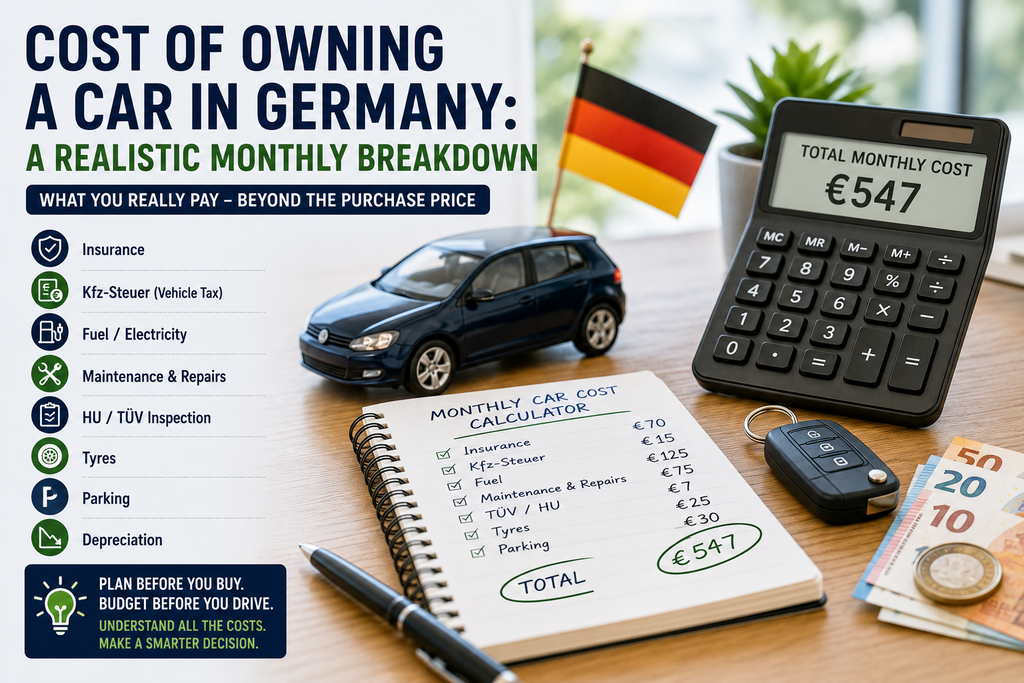
Example 2A — Monthly Cash-Flow View
| Cost | Monthly cash outflow |
|---|---|
| Finance payment | €200 |
| Insurance | €70 |
| Kfz-Steuer | €15 |
| Fuel | €125 |
| Maintenance/repair reserve | €75 |
| HU reserve | €7 |
| Tyres | €25 |
| Parking | €30 |
| Total monthly cash-flow requirement | €547 |
€200 + €70 + €15 + €125 + €75 + €7 + €25 + €30 = €547
This €547 figure answers the cash-flow question: approximately how much money leaves the household each month under this hypothetical financing arrangement.
Depreciation is deliberately not included in this cash-flow table.
Example 2B — Economic Ownership-Cost View
For the economic view, use:
| Economic cost component | Monthly amount |
|---|---|
| Estimated depreciation | €100 |
| Financing interest and fees | Unknown |
| Insurance | €70 |
| Kfz-Steuer | €15 |
| Fuel | €125 |
| Maintenance/repairs | €75 |
| HU | €7 |
| Tyres | €25 |
| Parking | €30 |
The exact economic-cost total cannot be calculated from the information given because we do not know how much of the €200 finance payment is principal repayment and how much is interest or other financing cost.
Principal repayment pays down the loan used to acquire the vehicle.
Depreciation measures the vehicle’s decline in value.
Counting both the entire principal repayment and full depreciation as separate ownership costs can double-count the acquisition cost.
Financing interest and fees, however, are genuine additional economic costs.
To calculate this precisely, separate the finance payment into principal repayment and financing cost.
Example 3 — Newer, More Expensive Car
Example 3A — Monthly Cash-Flow View
| Cost | Monthly cash outflow |
|---|---|
| Finance payment | €400 |
| Insurance | €110 |
| Kfz-Steuer | €20 |
| Fuel | €150 |
| Maintenance/repair reserve | €50 |
| HU reserve | €7 |
| Tyres | €35 |
| Parking | €80 |
| Total monthly cash-flow requirement | €852 |
€400 + €110 + €20 + €150 + €50 + €7 + €35 + €80 = €852
This €852 figure represents the hypothetical monthly cash burden, not the vehicle’s precise economic ownership cost.
Again, depreciation does not belong in this cash-flow total because it is not a separate monthly payment leaving the household.
Example 3B — Economic Ownership-Cost View
| Economic cost component | Monthly amount |
|---|---|
| Estimated depreciation | €250 |
| Financing interest and fees | Unknown |
| Insurance | €110 |
| Kfz-Steuer | €20 |
| Fuel | €150 |
| Maintenance/repairs | €50 |
| HU | €7 |
| Tyres | €35 |
| Parking | €80 |
To calculate the economic cost precisely, separate the €400 finance payment into principal repayment and financing cost.
Use depreciation to represent the vehicle’s loss in value, and add only the financing interest and fees as extra cost.
Because the interest and fee portion is not specified, an exact economic-cost total is deliberately not calculated.
That is more accurate than inventing a financing rate or adding the entire €400 payment to €250 of depreciation.
A Simple Car-Cost Calculator
Use both calculations depending on the question you are trying to answer.
Calculator A — Monthly Cash-Flow Budget
Finance or lease payment: €____
Insurance: €____
Kfz-Steuer: €____
Fuel/charging: €____
Maintenance reserve: €____
Repair reserve: €____
HU/TÜV reserve: €____
Tyres: €____
Parking: €____
Other cash expenses: €____
TOTAL MONTHLY CASH OUTFLOW
€________
This tells you how much cash the vehicle requires from your household budget.
Calculator B — Economic Ownership Cost
Estimated depreciation: €____
Financing interest and fees: €____
Insurance: €____
Kfz-Steuer: €____
Fuel/charging: €____
Maintenance: €____
Repairs: €____
HU/TÜV: €____
Tyres: €____
Parking: €____
Other ownership costs: €____
ESTIMATED MONTHLY ECONOMIC OWNERSHIP COST
€________
Do not add the full finance payment and full depreciation together when estimating economic ownership cost. The principal portion of a finance payment is repayment of the vehicle’s acquisition financing, while depreciation already captures the vehicle’s loss in value. Only financing interest and fees should be added as additional financing costs.
For an outright purchase, there is no finance payment in the monthly cash-flow calculation, but depreciation still belongs in the economic view.
Car vs Public Transport in Germany
If you are deciding whether a car is financially worthwhile, compare like with like.
Do not compare:
€120 of petrol
with
a public-transport subscription
and conclude that the difference is small.
The car side needs to include the rest of ownership.
In 2026, the Deutschlandticket costs €63 per month and covers participating local and regional public transport throughout Germany. (bundesregierung.de)
But €63 is not necessarily someone’s complete transport cost either.
They might occasionally need:
- taxis;
- car sharing;
- rental cars;
- long-distance trains.
So compare:
true monthly car cost
with
public transport + realistic additional transport costs
Then consider the non-financial differences:
- commute time;
- reliability;
- flexibility;
- family requirements;
- equipment or luggage;
- where you live.
For someone in central Cologne with strong public transport and low annual mileage, the calculation may look very different from someone living in a rural area with poor connections.
Neither answer is universally correct.
When Does Owning a Car Make Financial Sense?
A car may make more sense when:
- public transport is poor;
- commuting distances are substantial;
- several household members rely on it;
- transporting children or equipment is frequent;
- the car saves substantial time.
It may make less financial sense when:
- public transport is excellent;
- parking is expensive;
- annual mileage is very low;
- car sharing and rentals cover occasional needs.
The question is not merely whether the vehicle is useful.
It is whether its usefulness is worth the total cost relative to your alternatives and household finances.
That becomes particularly important for workers already dealing with heavy fixed costs, as discussed in Why Young Workers Feel Financially Trapped.
Common Car-Cost Mistakes
The most common mistake is treating the purchase price or finance payment as the entire cost of the car.
Other easy-to-miss errors include:
- budgeting only for fuel;
- forgetting insurance or Kfz-Steuer;
- treating repairs as unpredictable rather than reserving for them;
- forgetting tyres and HU;
- ignoring parking;
- ignoring depreciation;
- choosing financing based only on the advertised monthly payment;
- adding the full finance payment and full depreciation together when calculating economic ownership cost;
- assuming an old car must be cheap simply because depreciation is low.
A low purchase price can coexist with high maintenance.
A newer car can have modest repair costs but significant depreciation.
The complete calculation reveals the trade-off.
Frequently Asked Questions
How much does it cost to own a car per month in Germany?
There is no single reliable monthly figure.
Vehicle value, financing, depreciation, insurance, mileage, fuel, tax, repairs, tyres and parking all vary.
Calculate the actual components for the vehicle you are considering.
Is car insurance mandatory in Germany?
Kfz-Haftpflichtversicherung is mandatory.
Teilkasko and Vollkasko provide additional coverage and are not universally required by law, although financing or leasing arrangements may affect required cover.
How much is Kfz-Steuer?
It depends on the vehicle.
For many passenger cars, factors include engine capacity, fuel type, CO₂ emissions and first registration date. Zoll provides the official calculation rules and calculator. (zoll.de)
How much should I budget for maintenance?
There is no amount suitable for every car.
Estimate likely annual maintenance and repairs based on age, condition, mileage and service history, then divide that estimate by 12.
How often is TÜV required?
For an ordinary new passenger car, the first Hauptuntersuchung is generally after three years and then every two years. (tuev-nord.de)
Is owning a car cheaper than public transport?
Sometimes, but not universally.
A fair comparison includes the car’s full ownership cost rather than fuel alone, plus the realistic cost of public transport and any occasional taxis, rental cars or car sharing.
What car costs do people commonly forget?
Depreciation, irregular repairs, tyres, HU inspections, parking and annual vehicle tax are especially easy to overlook because they do not necessarily appear as regular monthly bills.
Conclusion
The purchase price is only one part of the cost of owning a car in Germany.
A vehicle can look affordable until insurance, Kfz-Steuer, fuel, maintenance, repairs, inspections, tyres, parking and depreciation are brought into the same calculation.
Use monthly cash flow to understand how much money the vehicle requires from your household budget.
Use economic ownership cost to understand how much value the car consumes over time.
If the vehicle is financed, keep those calculations separate: the full loan payment belongs in the cash-flow view, while the economic view uses depreciation plus financing interest and fees rather than counting principal repayment twice.
Before deciding whether a car fits your budget, calculate the monthly cost of owning it, not just the price of buying it.
For a broader beginner-friendly framework for decisions like this, Personal Finance Made Simple for Beginners is available on Gumroad:
https://ukandu0.gumroad.com/l/bteyh
Or on Amazon:
Feeling financially stuck?
When financial pressure becomes constant, long-term decisions start feeling emotionally heavy.
The Crown Altessa newsletter was created to help people rebuild clarity slowly and strategically through practical financial frameworks, long-term thinking, and structured decision-making insights.
Join the newsletter and receive:
• the free Financial Foundation Guide
• strategic financial insights
• practical tools for long-term stability
• frameworks designed to reduce financial overwhelm
Start building financial clarity one step at a time.