
You worked throughout the year.
Your employer deducted Lohnsteuer from every paycheck.
But during the same year, you also paid for things connected with your job:
A daily commute.
A monitor.
A professional course.
Several days working from home.
Perhaps a new laptop.
Maybe travel to a job interview.
Now tax-return season arrives.
Which of those costs actually matter?
For employees in Germany, many qualifying employment-related costs fall under Werbungskosten. German tax law broadly describes Werbungskosten as expenses incurred to acquire, secure or maintain income. But that does not mean every expense loosely connected with having a job becomes deductible.
There is another important complication.
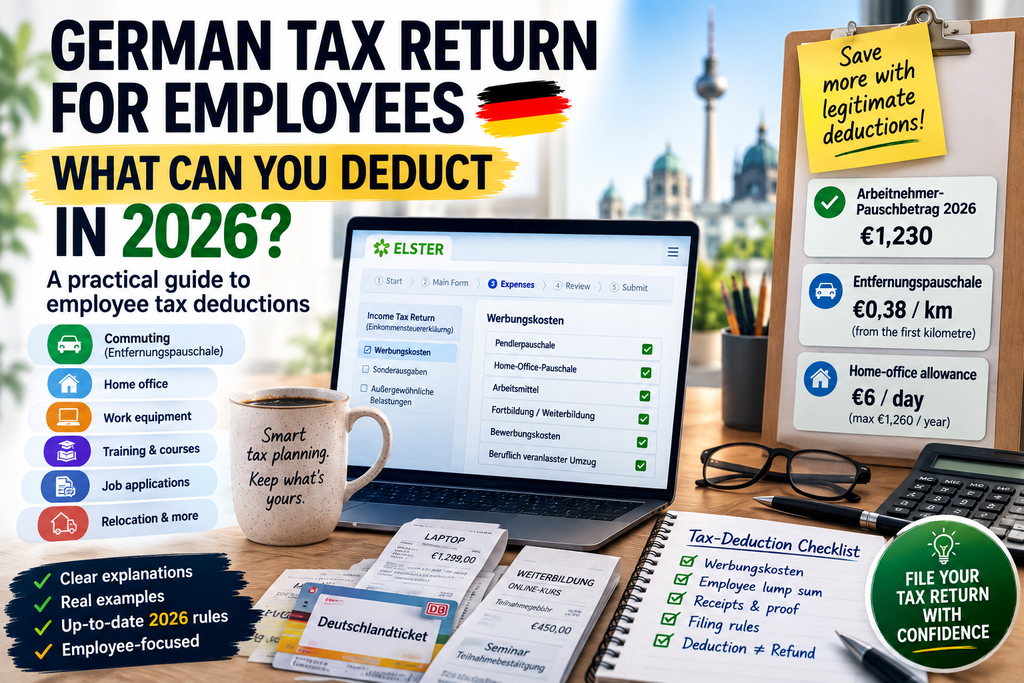
Employees already receive an automatic Arbeitnehmer-Pauschbetrag for work-related expenses. In 2026, that amount is €1,230. Higher qualifying Werbungskosten can matter when they exceed this automatic allowance.
So this article is not about finding creative ways to call ordinary life a tax expense.
It is about asking a more practical question:
Which costs did I genuinely incur because of my employment, and which of those does German tax law recognise?
First: What Are Werbungskosten?
Werbungskosten are expenses connected with earning, securing or maintaining taxable income.
For an employee, that can include categories such as:
- commuting to the first place of work;
- qualifying work equipment;
- certain professional training;
- business travel;
- professional memberships;
- job-application costs;
- qualifying work-related relocation;
- certain home-office costs.
German tax law expressly includes, among other things, commuting costs, professional-association contributions and work equipment within the Werbungskosten framework.
But two distinctions matter immediately.
Work-related does not mean “anything I use while working”
A normal lunch is still normally a personal living expense.
A business suit does not automatically become deductible simply because it is worn at the office.
Private rent does not become a work expense because you sometimes answer emails from home.
German tax rules distinguish employment expenses from ordinary personal living costs.
A deductible expense does not automatically increase your tax benefit euro for euro
Employees already receive the Arbeitnehmer-Pauschbetrag.
If total qualifying Werbungskosten remain below that allowance, listing every small employment expense may not create an additional deduction from this category.
And even when expenses exceed the allowance, a deduction is not the same thing as receiving the entire amount back from the Finanzamt.
We will return to that distinction later.
The Arbeitnehmer-Pauschbetrag in 2026
For 2026, the Arbeitnehmer-Pauschbetrag is €1,230.
It is an automatic lump-sum allowance for Werbungskosten from employment income. German law provides that the €1,230 allowance applies unless higher work-related expenses are established.
Suppose an employee has qualifying work expenses of:
€800
The €1,230 automatic allowance is already higher.
Those €800 would therefore not normally create an additional Werbungskosten deduction beyond the allowance.
Now suppose qualifying expenses total:
€2,300
The difference becomes more relevant because actual qualifying Werbungskosten exceed €1,230.
The practical question is therefore not merely:
“Did I spend money on work?”
It is:
“What are my total qualifying Werbungskosten for the year?”
One useful 2026 detail: qualifying union dues receive special treatment and are taken into account alongside the employee lump-sum allowance under the current wording of §9a EStG.
1. Commuting to Work — Entfernungspauschale
For many employees, commuting is the first major Werbungskosten category to review.
Germany uses the Entfernungspauschale for journeys between home and the employee’s first Tätigkeitsstätte, or first place of work under the tax rules.
From 2026, the statutory rate is:
€0.38 per full kilometre of one-way distance from the first kilometre.
That is a change worth noticing if you are used to older tax guides that describe different rates for the first 20 kilometres.
One-way distance, not the round trip
Suppose the workplace is:
20 km from home
The calculation uses 20 km.
Not 40 km because you travelled there and back.
Hypothetical example
One-way distance:
20 km
Days on which the first workplace was attended:
210
2026 rate:
€0.38 per kilometre
Calculation:
20 × €0.38 × 210 = €1,596
So the hypothetical Entfernungspauschale would be:
€1,596
This is only an illustration. Actual working days, the employee’s first Tätigkeitsstätte and other facts need to be correct.
Is there a maximum?
The statutory Entfernungspauschale is generally limited to €4,500 per calendar year, but a higher amount can be recognised where the employee uses their own car or a car provided for their use.
For public transport, actual annual public-transport costs may be relevant where they exceed the otherwise deductible Entfernungspauschale.
Do not add ordinary fuel, depreciation and repair costs on top of the commuting allowance as though they were separate deductions for the same commute. The Entfernungspauschale is designed to cover the commuting expense under this framework.
2. Working From Home — Home-Office Rules
Germany’s current home-office rules are no longer the temporary pandemic rules many older articles still describe.
For 2026, the Tagespauschale is:
€6 per qualifying calendar day
up to:
€1,260 per calendar year.
Under the standard rule, it applies where the professional activity is carried out predominantly in the home on that day and no first Tätigkeitsstätte outside the home is visited.
That makes record-keeping important.
A simple calendar showing actual qualifying home-office days can be useful. Official BMF guidance states that the relevant days should be recorded and credibly substantiated.
Example
Suppose an employee has:
120 qualifying home-office days
Calculation:
120 × €6 = €720
That €720 can fall within Werbungskosten.
Can you claim commuting and the home-office allowance for the same day?
Under the ordinary Tagespauschale rule, a day on which the employee travels to their first Tätigkeitsstätte generally does not simultaneously qualify in the normal way merely because some work was also completed at home.
There are additional rules for employees who permanently have no other workplace available, so unusual work arrangements need to be considered carefully rather than reduced to a universal yes/no statement.
What about an actual dedicated home office?
A qualifying häusliches Arbeitszimmer is a different concept.
Where the home office forms the centre of the employee’s overall professional activity and the legal conditions are met, actual qualifying expenses or the current €1,260 annual lump sum may be available instead.
The requirements are stricter than simply working at the kitchen table occasionally.
3. Work Equipment — Arbeitsmittel
Work equipment can qualify as Werbungskosten where it is sufficiently connected with employment.
German tax law expressly identifies Arbeitsmittel, including tools and typical occupational clothing, within the Werbungskosten provisions.
Possible examples include:
- laptop;
- monitor;
- keyboard;
- office chair;
- specialist tools;
- professional software;
- books and specialist publications;
- other equipment used for the job.
Mixed private and professional use matters
Suppose a laptop is used:
80% for work
and
20% privately
The professional-use element becomes relevant rather than automatically treating the entire purchase as an employment expense.
The facts and ability to support a reasonable allocation matter.
Does everything get deducted immediately?
No.
Tax treatment can depend on the asset and its acquisition cost.
For relevant work equipment, the 2026 Lohnsteuer guidance continues to recognise the €800 threshold used under the low-value-asset rules for qualifying assets. More expensive equipment may need to be treated over its applicable useful life.
Computer hardware and software have a specific simplification: BMF guidance allows a useful life of one year to be assumed for qualifying computer hardware and software.
That does not mean every computer bought by every employee is automatically 100% deductible.
The professional connection and private-use share still matter.
4. Professional Training and Further Education — Fortbildung / Weiterbildung
A professional course can sometimes be much more straightforward than people expect.
Qualifying employment-related further education may create Werbungskosten where it is connected with the employee’s professional activity.
Potential costs can include:
- course fees;
- professional certifications;
- seminars;
- conferences;
- examination fees;
- specialist literature;
- qualifying travel expenses.
The professional connection matters.
A cybersecurity certification for an IT professional presents a different case from a purely recreational photography course taken by someone whose job has nothing to do with photography.
First education is different
This distinction is legally important.
German tax law provides that education or study costs are Werbungskosten only where the taxpayer has already completed an initial vocational qualification or degree, or where the training/study takes place within an employment relationship.
Costs of one’s own first vocational education that do not qualify as Werbungskosten can instead fall under the Sonderausgaben rules, currently subject to a statutory maximum of €6,000 per calendar year where the legal conditions are satisfied.
So avoid treating:
first university degree
and
professional continuing education after qualification
as automatically identical for tax purposes.
5. Job Application Costs — Bewerbungskosten
Searching for another job can itself create employment-related expenses.
Potential Bewerbungskosten can include, depending on the facts:
- printing;
- postage;
- application materials;
- professional application photos where appropriate;
- portfolio preparation;
- qualifying travel to interviews;
- other directly connected costs.
The safest approach is to track actual, supportable expenses.
You may encounter websites quoting convenient flat amounts per application. Do not assume such internet figures are statutory deductions.
Keep records of what was actually spent and why it related to the job search.
This is particularly useful if several applications accumulate over the year.
6. Business Travel — Reisekosten
Business travel is not the same thing as commuting to your first Tätigkeitsstätte.
A genuine professional trip away from the first workplace can involve different tax rules.
Potential Reisekosten can include:
- transport;
- accommodation;
- meal allowances;
- certain incidental travel costs.
For qualifying domestic business travel, the statutory meal allowances include:
- €28 for a full 24-hour absence;
- €14 for qualifying arrival/departure days;
- €14 for a qualifying absence of more than eight hours without an overnight stay.
Foreign travel uses country-specific amounts, and BMF published updated tables applicable from 1 January 2026.
Employer reimbursement matters
If the employer already reimbursed an expense tax-free, the employee cannot simply deduct the same expense again as though they personally bore it.
BMF guidance explicitly recognises this principle for employee Werbungskosten.
Always compare:
actual qualifying cost
with
amount reimbursed by employer
before entering a personal deduction.
7. Work-Related Relocation — Umzugskosten
A relocation can qualify as Werbungskosten where the move is professionally motivated.
Official 2026 Lohnsteuer guidance recognises that costs arising from a professionally induced change of residence can constitute Werbungskosten.
Possible situations include:
- beginning a new job in another location;
- changing workplace;
- a move that substantially reduces the journey to work;
- a relocation overwhelmingly in the employer’s professional interest.
The exact facts matter.
Moving to a nicer apartment after taking a new job does not make every moving cost automatically deductible.
Official guidance also recognises substantial reduction of the commuting distance as a possible basis for professional motivation.
Depending on the circumstances, qualifying costs can involve actual moving expenses and certain recognised ancillary costs.
But ordinary furnishing of the new apartment is not transformed into Werbungskosten merely because the move was professionally motivated. BMF guidance specifically distinguishes personal furnishing costs from qualifying relocation expenditure.
If the move is substantial or contains mixed private and professional motives, the classification can become more complex.
8. Second Household for Work — Doppelte Haushaltsführung
Doppelte Haushaltsführung applies in a narrower situation than simply renting two places.
At a high level, it can arise where an employee:
- maintains their own main household away from the first workplace;
- also has accommodation at or near the first Tätigkeitsstätte;
- and the second household exists for professional reasons.
The law requires the employee to maintain their own household and participate financially in its living costs.
Potentially relevant expense categories can include:
- second accommodation;
- qualifying travel home;
- certain additional living costs under applicable rules;
- moving expenses associated with the double household.
For a second home within Germany, qualifying accommodation costs are currently limited to €1,000 per month under §9 EStG.
The law also provides for one qualifying family trip home per week under the relevant rules.
This is a legally detailed area. If substantial amounts or cross-border accommodation are involved, professional tax advice can be worthwhile.
9. Professional Memberships and Union Fees
Membership costs can qualify where the organisation has a genuine professional connection.
Examples can include:
- trade-union dues;
- professional associations;
- certain professional bodies.
German tax law expressly recognises contributions to professional bodies and professional associations within Werbungskosten, subject to the statutory conditions.
A private social club does not become deductible because several colleagues happen to belong to it.
There should be a real professional connection.
As noted earlier, union dues currently receive a specific favourable treatment alongside the Arbeitnehmer-Pauschbetrag under §9a EStG.
10. Work-Related Phone and Internet Costs
Employees who use personal telecommunications services professionally may be able to claim the professional portion.
Two approaches are particularly useful.
Actual professional share
An employee can substantiate the professionally caused share of telephone and internet costs.
Official 2026 Lohnsteuer guidance allows a representative three-month period to be used to establish the professional share, which can then be applied for the year where appropriate.
Administrative simplification
Where professional telecommunications expenses normally arise, the current Lohnsteuer guidance also permits, as a simplification without detailed individual evidence:
up to 20% of the invoice amount, capped at €20 per month.
That is an administrative simplification, not a declaration that 20% of everyone’s internet bill is automatically work-related.
And again, tax-free employer reimbursement reduces the amount that can be claimed personally.
11. Professional Literature
Books, journals, specialist databases and other publications can qualify where the professional relationship is sufficiently clear.
Examples might include:
- technical reference books;
- legal or accounting publications used professionally;
- specialist medical journals;
- professional databases;
- industry-specific reference material.
A general newspaper or ordinary leisure reading normally presents a different case because German tax rules exclude ordinary personal living expenses from Werbungskosten.
The title, subject and professional use should make the employment connection understandable.
12. Protective or Professional Clothing
This is one of the classic German tax myths.
“I wear my suit to work, so I can deduct it.”
Usually, that is not how the rule works.
German tax law recognises typical occupational clothing as work equipment.
Examples can include genuine:
- uniforms;
- safety footwear;
- protective clothing;
- occupation-specific clothing not normally suitable for ordinary private use.
Ordinary clothing remains a personal living expense even if an employer expects a professional appearance. The 2026 tax guidance distinguishes typical professional clothing from ordinary clothing.
So:
business suit ≠ automatically deductible
protective work uniform = potentially different
Costs of cleaning genuine qualifying occupational clothing can also be relevant under the applicable rules.
What About a Home Office Desk, Chair, Laptop and Monitor?
Consider a hypothetical employee who buys:
- desk: €350;
- chair: €500;
- monitor: €400;
- laptop: €1,300.
It is tempting to put the total into one box and call it “home-office deduction.”
The tax treatment is not necessarily that simple.
Desk and chair
If they qualify as genuine work equipment, the professional-use element and acquisition cost matter.
Monitor
Again, employment use matters.
A monitor used entirely for professional work presents a different case from one used primarily for gaming and occasionally for email.
Laptop
Computers have the one-year useful-life simplification discussed earlier, but professional versus private use still matters.
Employer reimbursement
Suppose the employer reimbursed the €400 monitor.
The employee should not then claim €400 again as though they personally bore that expense.
The correct question for each item is:
- Was it genuinely work-related?
- Was there private use?
- What did it cost?
- Did the employer reimburse any part?
- Which tax treatment applies to that item?
What Expenses Usually Are NOT Deductible Just Because You Work?
Employment creates many expenses indirectly.
German tax law does not therefore convert all everyday living costs into Werbungskosten.
Typical personal costs can include:
- ordinary everyday clothing;
- normal meals;
- private residential rent;
- household groceries;
- purely private electronics;
- holidays;
- ordinary personal fitness expenses;
- general lifestyle expenditure.
Official Lohnsteuer guidance expressly lists housing, food, clothing and other ordinary personal needs among personal living costs that are generally excluded.
There can be special exceptions in particular circumstances.
For example, qualifying meal allowances during genuine business travel are different from buying lunch on an ordinary office day.
Likewise, a qualifying double household is different from claiming normal private rent.
The tax connection needs to be real and supported by the applicable rule.
Reimbursement From Your Employer Changes the Calculation
This deserves its own section because double counting is an easy mistake.
Suppose a professional course costs:
€800
The employer reimburses:
€600
The employee personally bears:
€200
The relevant personal expense is therefore not automatically €800.
The starting question becomes whether the remaining €200 qualifies under the tax rules.
BMF guidance states that corresponding tax-free reimbursement can exclude a matching Werbungskosten deduction.
That principle applies beyond training.
Check reimbursements for:
- travel;
- telecommunications;
- work equipment;
- professional courses;
- relocation;
- other job-related costs.
A receipt showing what something cost is only half the story.
You also need to know who ultimately paid for it.
Do You Need Receipts for Everything?
Germany currently follows a Belegvorhaltepflicht rather than a general rule requiring every receipt to be submitted automatically with the tax return.
ELSTER states that taxpayers generally do not need to send receipts and separate schedules with the return. Instead, documentation should be retained so it can be provided if the Finanzamt requests it.
That does not mean receipts are unimportant.
Keep evidence for expenses you claim.
Examples might include:
- invoices;
- receipts;
- proof of payment;
- home-office-day records;
- commuting information;
- training documentation;
- employer reimbursement statements;
- membership statements.
ELSTER can also store digital receipts, although uploading a receipt to the personal ELSTER document area does not itself automatically transmit it to the Finanzamt unless it is linked or otherwise provided through the relevant process.
The practical rule is:
Do not automatically send a mountain of paperwork. Do keep enough documentation to support the return if asked.
How Long Should You Keep Tax Documents?
There is no useful one-size-fits-all retention rule that applies identically to every document held by every employee.
For ordinary tax-return evidence, keep the relevant records at least while the return is being processed and for as long as they may still be needed for questions, corrections or challenges.
ELSTER specifically instructs taxpayers to retain documents for possible enquiries rather than automatically submitting them.
Some categories of documentation can have specific statutory retention rules.
If a document relates to another legal obligation, business activity, property matter or an unusual tax situation, do not assume an ordinary employee-document rule applies.
Digital storage can make retention much easier.
What If Your Work Expenses Are Below the Employee Lump Sum?
Suppose qualifying Werbungskosten total:
€900
The automatic Arbeitnehmer-Pauschbetrag is:
€1,230
Your individually identified €900 does not exceed the allowance already provided.
That means those expenses generally would not generate an additional Werbungskosten deduction beyond the €1,230.
This does not mean filing a return is pointless.
A return can involve other tax considerations entirely:
- Sonderausgaben;
- extraordinary burdens;
- household-related tax reductions;
- other income;
- tax-class issues;
- employment changes;
- various individual circumstances.
The point is narrower:
For Werbungskosten specifically, the comparison with the automatic allowance matters.
Example: An Employee With Several Work-Related Expenses
Consider Maria, a fictional employee.
The purpose is to illustrate the mechanics, not estimate her eventual refund.
During 2026 she has the following qualifying expenses for this simplified example.
Commuting
20 km one-way distance.
180 office days.
20 × €0.38 × 180 = €1,368
Home office
80 qualifying days.
80 × €6 = €480
Professional course
Personally paid qualifying course:
€450
Work equipment
Qualifying professional share of equipment:
€300
Job applications
Documented qualifying expenses:
€120
Total hypothetical Werbungskosten:
€1,368 + €480 + €450 + €300 + €120 = €2,718
Compare that with the 2026 Arbeitnehmer-Pauschbetrag:
€1,230
Maria’s hypothetical qualifying expenses exceed the automatic allowance by:
€1,488
That does not mean Maria receives €1,488 from the Finanzamt.
It means her qualifying employment expenses in this example exceed the automatic Werbungskosten allowance by €1,488.
The actual effect on her tax depends on her complete tax position.
Tax Deduction Does NOT Mean You Get the Whole Amount Back
This misconception causes enormous confusion.
Suppose a qualifying deduction is:
€1,000
That generally does not mean:
“The Finanzamt sends me €1,000.”
A deductible expense generally reduces the income amount used in the tax calculation.
The actual tax effect then depends on factors such as:
- taxable income;
- marginal tax rate;
- other deductions;
- allowances;
- filing situation;
- other tax circumstances.
So:
€1,000 deduction ≠ €1,000 refund
Imagine, purely as a conceptual illustration, that a deduction reduces taxable income by €1,000.
The tax saved is the tax that would otherwise have applied to the relevant reduction in taxable income.
The deduction and the refund are different numbers.
Can Employees Get a Tax Refund Even If Payroll Was Correct?
Yes, potentially.
Lohnsteuer withheld through payroll is a collection mechanism for income tax.
Payroll can be perfectly correct based on the information available during the year while the final annual tax calculation still produces a different result.
Possible factors include:
- qualifying Werbungskosten;
- changing jobs;
- periods without employment;
- other allowances or deductions;
- tax-class effects;
- special expenses;
- other income or tax circumstances.
That does not mean every employee receives a refund.
Some employees may owe additional tax.
Others may have no meaningful difference.
The annual tax return considers the broader tax year rather than just one monthly payslip.
Is Filing a German Tax Return Mandatory for Employees?
Not every employee is automatically required to file an Einkommensteuererklärung.
However, Germany has a number of mandatory assessment triggers.
Current §46 EStG includes situations such as:
- certain taxable income not subject to wage-tax withholding, or income/benefits subject to the progression rule, exceeding the statutory threshold;
- receiving employment income simultaneously from multiple employers in relevant circumstances;
- certain married-couple tax-class combinations, including Class V/VI or the Class IV factor method;
- certain wage-tax allowances entered into payroll, where the statutory conditions apply.
The rules contain additional cases and exceptions.
For example, §46 currently uses €410 in several of its mandatory-assessment triggers.
This article is not a complete mandatory-filing checklist.
If there is uncertainty about whether filing is compulsory, check the current ELSTER/Finanzamt guidance or obtain tax advice.
Employees who are not required to file may still be able to submit a voluntary assessment under the applicable rules.
German Tax Return for Foreign Employees
International employees often encounter three separate questions at once:
- Why was Lohnsteuer already deducted?
- What is Werbungskosten?
- Do expenses during relocation or international employment change the tax return?
Keep those issues separate.
Lohnsteuer has already been withheld
That does not automatically mean a tax return has nothing left to calculate.
German work expenses may still matter
Commuting, qualifying work equipment, home-office days and professional training can be relevant under the same basic rules.
Starting employment partway through the year can affect the annual picture
A person who moved to Germany and began employment in August has a different annual income pattern from someone who earned the same monthly salary from January through December.
Relocation can matter
A genuinely work-related move may create Werbungskosten, subject to the conditions discussed earlier.
Foreign income requires care
This is where simple blog advice becomes dangerous.
Foreign income can involve:
- double-taxation agreements;
- German tax residence;
- progression rules;
- foreign tax paid;
- different income classifications.
Do not assume that foreign income is irrelevant merely because it was earned before or outside Germany.
Cross-border tax cases can justify professional advice from a Steuerberater or other appropriately qualified adviser.
A Practical Employee Tax-Deduction Checklist
Before filing, review the year systematically.
- Commuting: days at first Tätigkeitsstätte and one-way distance
- Home-office days: qualifying days recorded
- Work equipment: laptops, monitor, tools, chair, software
- Professional training: courses, certifications, seminars
- Job applications: materials and interview travel
- Business travel: personally borne, unreimbursed costs
- Work-related relocation: qualifying move and supporting records
- Second household: possible doppelte Haushaltsführung
- Professional memberships: qualifying associations
- Union fees
- Phone/internet: documented professional share where relevant
- Professional literature
- Protective or typical occupational clothing
- Other genuine employment-related expenses
- Employer reimbursements checked
- Receipts and supporting evidence retained
- Total Werbungskosten compared with the €1,230 Arbeitnehmer-Pauschbetrag
That last step matters.
A list of expenses becomes useful only once the total is placed in context.
Before You File: Gather These Documents
Not everyone needs every document below.
But depending on the expenses claimed, useful records can include:
- Lohnsteuerbescheinigung
- relevant payslips
- invoices and receipts
- commuting records
- work-calendar records
- home-office-day records
- training invoices
- employer reimbursement information
- relocation documentation
- job-application and interview-travel receipts
- professional-membership statements
- proof of work-related use where mixed-use items are claimed
Keeping these documents as the year progresses is much easier than trying to reconstruct twelve months of employment expenses next spring.
Frequently Asked Questions
What Can Employees Deduct From Tax in Germany?
Potential Werbungskosten include qualifying commuting costs, home-office days, work equipment, professional training, job applications, business travel, professional memberships, work-related relocation and certain other employment-related expenses.
Each category has its own conditions.
What Are Werbungskosten?
They are expenses connected with earning, securing or maintaining taxable income. For employees, they include recognised employment-related costs under German tax law.
What Is the Arbeitnehmer-Pauschbetrag in 2026?
It is €1,230 for employment income under the current statutory rule. The allowance applies automatically where relevant unless higher qualifying Werbungskosten are recognised.
Can I Deduct Commuting Costs?
Potentially, yes.
In 2026 the Entfernungspauschale is €0.38 per full kilometre of one-way distance from the first kilometre, subject to the statutory rules.
Can I Deduct Working From Home?
Qualifying home-office days can currently use a €6 Tagespauschale, up to €1,260 per year, subject to the conditions.
Can I Deduct a Laptop?
Potentially, to the extent it qualifies as work equipment and reflects professional use.
Computer hardware and software currently benefit from a one-year useful-life simplification, but that does not make private use deductible.
Can I Deduct an Office Chair?
Potentially, where it qualifies as work equipment. Professional use, acquisition cost, reimbursement and the applicable treatment all matter.
Can I Deduct Work Clothing?
Genuine typical occupational or protective clothing can qualify.
Ordinary clothing such as a normal business suit generally does not become deductible merely because it is worn to work.
Can I Deduct Job Application Costs?
Qualifying expenses directly connected with seeking employment can potentially be Werbungskosten. Keep evidence of actual expenses rather than relying blindly on unofficial flat rates found online.
Can I Deduct Professional Training?
Often, where the course is genuinely professionally connected.
First-time education has different tax treatment, so the distinction between initial training and subsequent professional development matters.
Can I Deduct Moving Costs for a New Job?
Potentially, where the move is professionally motivated. Accepting a job does not automatically turn every moving or furnishing cost into Werbungskosten.
Can I Deduct Internet Costs?
The professional portion can potentially qualify. Current Lohnsteuer guidance also contains a simplification allowing up to 20% of relevant telecommunications invoices, capped at €20 per month, where the conditions are met.
Do I Need Receipts?
You generally do not need to submit every receipt automatically with the tax return, but you should retain evidence because the Finanzamt can request it.
Does a €1,000 Deduction Mean I Receive €1,000 Back?
No.
A tax deduction generally reduces the amount used in calculating taxable income. The actual tax saving depends on the person’s broader tax position.
Do All German Employees Have to File a Tax Return?
No.
Some employees have mandatory filing obligations under specified circumstances, while others may be able to file voluntarily. §46 EStG contains several of the main employee filing triggers.
Can Foreigners Claim German Tax Deductions?
Foreign employees subject to German income tax may be able to claim qualifying employment-related expenses under the applicable rules.
Cross-border income and residence questions can become considerably more complex and may require professional advice.
Conclusion
A German employee tax return becomes easier when the year’s expenses are organised according to what they actually were.
Commuting.
Home-office days.
Work equipment.
Training.
Applications.
Travel.
Relocation.
Professional memberships.
Some may qualify as Werbungskosten.
Others may remain personal living expenses.
And even legitimate Werbungskosten need to be viewed alongside the €1,230 employee lump-sum allowance.
The goal is not to “claim everything.”
It is to identify the expenses that were genuinely connected with earning employment income, remove anything already reimbursed, retain evidence, and apply the correct current rules.
One habit makes that much easier:
keep the records when the expense occurs rather than reconstructing an entire year shortly before filing.
Good tax preparation is less about finding tricks and more about knowing which real work expenses the tax rules actually recognise.
For a broader beginner-friendly introduction to organising income, saving and financial decisions, my book Personal Finance Made Simple for Beginners is available here:
My book on Gumroad:
https://ukandu0.gumroad.com/l/bteyh
Or on Amazon:
Sources & Further Reading
For the statutory definition of Werbungskosten, the 2026 commuting allowance, work equipment and double-household rules, see §9 Einkommensteuergesetz.
For the €1,230 Arbeitnehmer-Pauschbetrag, see §9a Einkommensteuergesetz.
For the current home-office Tagespauschale and häusliches Arbeitszimmer rules, see the 2026 Lohnsteuer-Hinweise of the Bundesministerium der Finanzen.
For work-equipment treatment, computer hardware/software and telecommunications guidance, see the 2026 Lohnsteuer-Hinweise.
For current employee filing triggers, see §46 Einkommensteuergesetz.
For supporting-document procedures, see ELSTER’s official Belegvorhaltepflicht guidance.
Feeling financially stuck?
When financial pressure becomes constant, long-term decisions start feeling emotionally heavy.
The Crown Altessa newsletter was created to help people rebuild clarity slowly and strategically through practical financial frameworks, long-term thinking, and structured decision-making insights.
Join the newsletter and receive:
• the free Financial Foundation Guide
• strategic financial insights
• practical tools for long-term stability
• frameworks designed to reduce financial overwhelm
Start building financial clarity one step at a time.