
Financial Planning

for budgeting, systems, wealth building

Lost Your Job? A Financial Survival Plan for the First 90 Days

Lost Your Job? A Financial Survival Plan for the First 90 Days

Your salary stops. Your rent does not. Neither do groceries, utilities, insurance, debt payments or other essential bills. That is why the first financial question after losing a job is not: “How quickly can I find another one?” It is: “How much time can my current finances buy me?” That number is your financial runway.

Lost Your Job? A Financial Survival Plan for the First 90 Days Read More »

What Happens to Your Investments When You Die?

What Happens to Your Investments When You Die?

Suppose you own: €40,000 of ETFs €20,000 of individual stocks and some cash inside a brokerage account. Then you die. What happens to those assets? Do the investments get sold? Does the broker keep them? Do your children automatically receive them? Usually, the investments remain financial assets. What happens next depends on factors such as:

What Happens to Your Investments When You Die? Read More »

Leaving Germany: What Happens to Your Bank Account, Pension and Finances?

Leaving Germany: What Happens to Your Bank Account, Pension and Finances?

The flight is booked. The apartment handover is scheduled. The boxes are packed. But your financial life in Germany does not disappear when you cross the border. You may still have a German bank account receiving payments, a landlord holding your Mietkaution, pension contributions recorded with Deutsche Rentenversicherung, a future tax return, insurance contracts, direct

Leaving Germany: What Happens to Your Bank Account, Pension and Finances? Read More »

Renting an Apartment in Germany: How Much Money Do You Need Upfront?

Renting an Apartment in Germany: How Much Money Do You Need Upfront?

You find an apartment advertised at: €1,000 per month. You think: “Great. I need roughly €1,000 to move in.” Then the other costs appear. The landlord asks for a Kaution. Your first rent becomes due. The apartment needs electricity. You need internet. You discover that the bedroom has no lights installed. Perhaps you need furniture.

Renting an Apartment in Germany: How Much Money Do You Need Upfront? Read More »

German Employment Contract Explained: 12 Financial Terms to Check Before You Sign

German Employment Contract Explained: 12 Financial Terms to Check Before You Sign

You receive a German job offer. The salary looks good. You are excited. Then the employment contract arrives. Suddenly the document contains words such as: Bruttogehalt. Probezeit. Kündigungsfrist. Überstunden. Bonus. Urlaubsgeld. Weihnachtsgeld. And several pages of contractual language that do not feel nearly as exciting as the offer itself. It is tempting to look for

German Employment Contract Explained: 12 Financial Terms to Check Before You Sign Read More »

How Much Emergency Fund Do You Need in Germany? A Realistic 2026 Guide

How Much Emergency Fund Do You Need in Germany? A Realistic 2026 Guide

Search for: “How much emergency savings should I have?” and one answer appears almost immediately: Save three to six months. It sounds reassuringly simple. But three to six months of what? Your gross salary? Your net salary? Your normal monthly spending? Only essential expenses? And why should a permanently employed person with low fixed costs

How Much Emergency Fund Do You Need in Germany? A Realistic 2026 Guide Read More »

How To Build An Emergency Fund Without Feeling Overwhelmed

How To Build An Emergency Fund Without Feeling Overwhelmed

For many people, the phrase emergency fund sounds reassuring. Until they start calculating how much they think they need. Three months of expenses. Six months. Maybe even more. Suddenly, what seemed like a sensible financial goal starts feeling impossible. If you’re living from one payday to the next, paying rising rent, managing household bills or

How To Build An Emergency Fund Without Feeling Overwhelmed Read More »

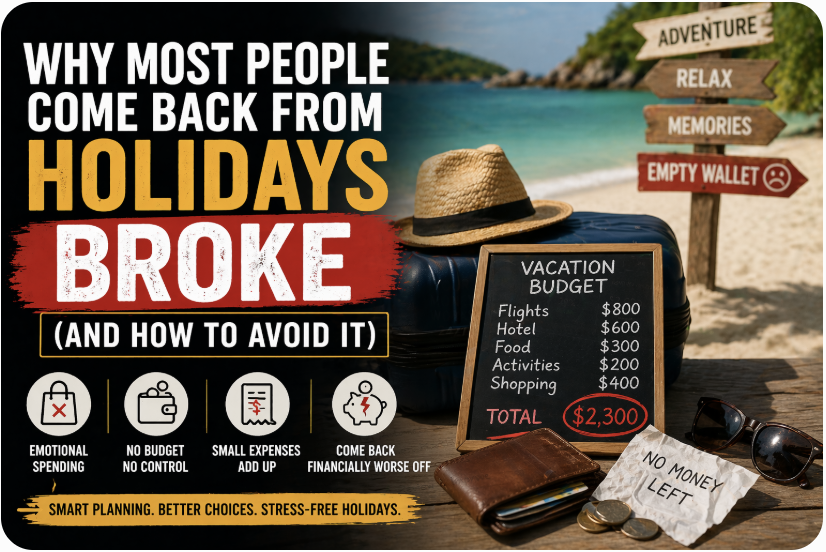
Why Most People Come Back From Holidays Broke (And How to Avoid It)

Why Most People Come Back From Holidays Broke (And How to Avoid It)

Introduction Holidays are supposed to feel like a reward. You finally get time to relax, travel, and enjoy life without pressure. But there’s a pattern most people quietly experience: They come back financially worse off. Not slightly—noticeably. Savings drop, expenses increase, and control disappears. And here’s the uncomfortable truth: it’s usually not because of income.

Why Most People Come Back From Holidays Broke (And How to Avoid It) Read More »