
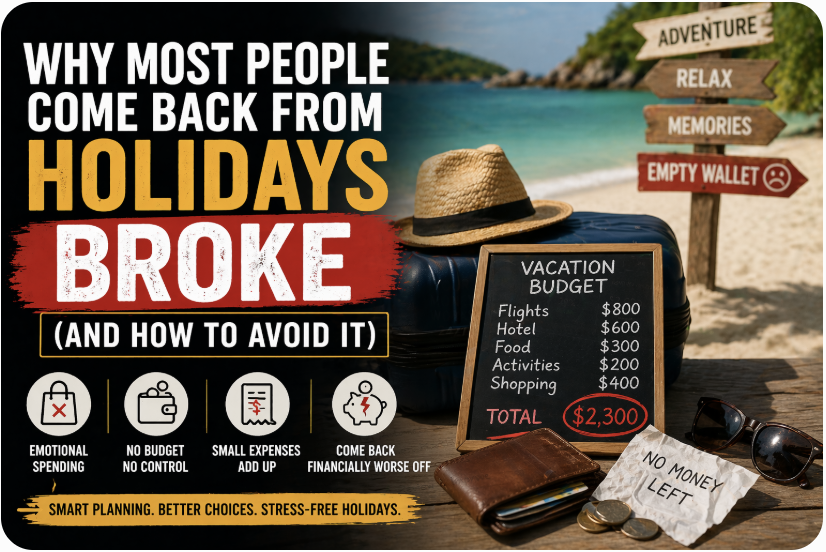
Introduction
Holidays are supposed to feel like a reward.
You finally get time to relax, travel, and enjoy life without pressure. But there’s a pattern most people quietly experience:
They come back financially worse off.
Not slightly—noticeably.
Savings drop, expenses increase, and control disappears.
And here’s the uncomfortable truth: it’s usually not because of income.
It’s behavior.
Without structure, time off turns into financial drift. And what feels like “just enjoying the moment” often leads to predictable financial mistakes.
The Real Problem: No System
Most people approach holidays without a financial plan.
They rely on willpower.
But willpower doesn’t work well when:
- you’re relaxed
- you’re in a new environment
- you’re constantly making small spending decisions
So what happens?
Spending becomes emotional and reactive.
Instead of having a clear structure, every decision becomes:
- “Should I spend this?”
- “It’s just one more thing…”
This is why having a system matters.
When you automate your finances properly, you remove the need for constant decision-making and protect yourself from these situations before they happen.
Mistake #1: Emotional Spending
Holidays trigger a specific mindset:
“I deserve this.”
And in many ways, that’s true—you worked for it.
But this mindset often leads to:
- upgrading everything (hotels, food, experiences)
- saying yes to every opportunity
- ignoring long-term consequences
The problem isn’t enjoyment.
It’s losing control.
These behaviors follow clear patterns of overspending, where short-term emotions override long-term stability.
The danger is subtle.
No single purchase feels extreme—but together, they create a financial setback.
This is where most financial plans fail—not because of income, but because of how decisions are made in the moment.
Mistake #2: No Visibility on Money
During holidays, most people stop paying attention to their finances.
They don’t check balances.
They don’t track expenses.
They don’t review spending.
This creates a dangerous gap:
You’re spending—but you don’t know how much.
And without visibility, small expenses multiply:
- daily meals
- transport
- activities
- spontaneous purchases
This is why even a simple expense tracking system makes a difference.
It doesn’t restrict you—it keeps you aware.
And awareness alone often reduces unnecessary spending.
Mistake #3: No Structure Before Spending
Most people don’t assign their money before going on holiday.
They just “see how it goes.”
But money without structure always expands.
If you don’t define:
- how much you’ll spend
- where that money comes from
- what your limits are
Then everything becomes flexible—and flexibility leads to excess.
This is where designing your financial system becomes critical.
Because once your money has a purpose, decisions become easier.
You’re no longer reacting—you’re following a plan.
Mistake #4: Breaking Financial Habits
Holidays disrupt routines.
And that includes financial routines.
During time off:
- savings pause
- spending increases
- discipline weakens
And the biggest issue?
It’s hard to restart.
Good behavior is built through repetition. When that repetition breaks, momentum disappears.
That’s why maintaining consistent financial habits matters—even during breaks.
Not perfectly—but consistently enough to stay in control.
What People Who Stay in Control Do Differently
People who return from holidays financially stable don’t rely on discipline.
They rely on structure.
They:
- prepare before leaving
- set limits in advance
- automate key decisions
- keep a basic level of awareness
Most importantly, they understand that their finances need to keep functioning—even when they don’t.
This is where financial systems make the difference.
Because systems don’t take breaks.
They keep:
- saving
- allocating
- controlling
in the background.
How to Avoid Coming Back Broke
You don’t need a complex plan.
You just need a few clear decisions before your holiday starts.
1. Set a Fixed Spending Limit
Decide in advance:
- your total budget
- your daily range
This removes uncertainty during the trip.
2. Automate Savings Before You Leave
Make sure progress continues while you’re away.
Even small automatic transfers maintain momentum.
3. Keep a Simple Tracking System
You don’t need detailed tracking.
Just enough visibility to stay aware.
4. Define Non-Negotiables
Decide what matters most:
- experiences vs luxury
- quality vs quantity
- control vs impulse
This helps you make better decisions in the moment.
Real-Life Comparison
Person A: Reactive
- no budget
- no system
- spends based on emotion
- stops tracking
Result:
- returns relaxed—but financially behind
Person B: Structured
- defines budget before leaving
- automates savings
- keeps basic awareness
- follows simple limits
Result:
- enjoys the holiday
- returns stable—or even slightly ahead
Why Holidays Make Spending Harder Than Usual
Holidays change your environment—and that directly affects your behavior.
You’re in a new place, surrounded by new experiences, and constantly exposed to opportunities to spend. This increases the likelihood of impulse decisions.
At the same time, you’re making more decisions than usual: where to eat, what to do, what to buy. This creates decision fatigue, making it harder to stay disciplined as the day goes on.
On top of that, holidays are emotional by nature. You want to enjoy the moment, avoid restrictions, and make the most of your time. That emotional context lowers your natural resistance to spending.
All of this makes financial control harder—not because you lack discipline, but because the environment is designed to push you toward spending.
Frequently Asked Questions
Why do people overspend on holidays?
Because they rely on emotion instead of structure. Without limits or systems, spending becomes reactive and harder to control.
How can I control spending while traveling?
Set a clear budget, track your spending simply, and decide your priorities before the trip. Structure reduces unnecessary decisions.
Should I stop tracking money during holidays?
No. You don’t need detailed tracking, but basic awareness helps you stay in control and avoid surprises.
Final Thoughts
Holidays are not the problem.
Relaxation is not the problem.
The problem is what happens when your financial structure disappears.
👉 The problem is not that people relax—it’s that their finances relax too.
When you rely only on discipline, control fades.
But when you rely on systems, your money continues moving in the right direction—even when you’re not thinking about it.
My book on GumRoad: How Personal Finance Made Simple Can Transform Your Future
Or on Amazon:
Build Financial Clarity
Join the Crown Altessa newsletter and receive:
• the free Financial Foundation Guide
• practical financial frameworks
• strategic decision-making insights
• tools designed to help you think long term about money and stability
If you want calmer, more structured financial thinking in an uncertain world, subscribe below.