
Almost everyone makes financial mistakes.
Some are small, like forgetting to cancel an unused subscription. Others feel much heavier: buying a car you couldn’t comfortably afford, investing at the wrong time, accumulating debt, quitting a job without a financial cushion or simply ignoring your finances for years.
When these moments happen, it’s easy to believe you’ve permanently damaged your future.
In reality, financial mistakes rarely define a person’s financial life.
How they respond afterwards often matters much more.
Many people who eventually become financially secure can look back and identify at least one decision they wish they had handled differently. What separates them isn’t perfection—it’s their willingness to learn, adapt and continue moving forward.
If you’re reading this because you regret a recent money decision, know this:
You cannot change yesterday’s decision.
You can still influence tomorrow’s outcome.
Financial recovery is rarely dramatic. More often, it happens through dozens of small decisions that gradually restore stability, confidence and control.
Why Financial Mistakes Feel So Personal
Money is deeply emotional.
It influences where we live, the opportunities available to us, our relationships and our sense of security.
That’s why financial mistakes often feel far more personal than mistakes in other areas of life.
Many people experience:
- embarrassment
- shame
- regret
- anxiety
- self-doubt
They replay the decision repeatedly, wondering what they “should have done.”
Social comparison often makes these feelings even stronger.
Scrolling through social media can create the illusion that everyone else is buying homes, investing successfully and building wealth effortlessly.
As discussed in our article about feeling financially behind, comparison rarely shows the full picture. People usually share financial milestones—not financial setbacks.
The truth is that money mistakes often feel like personal failures even though they are usually decisions made with limited information at the time.
Perhaps you trusted advice that later proved wrong.
Perhaps inflation changed your circumstances.
Perhaps you simply hadn’t yet developed the financial knowledge you have today.
Judging your past decisions using today’s knowledge is rarely fair.
The Psychology Of Financial Recovery
The hardest part of financial recovery is often emotional rather than mathematical.
Many people delay taking action because they feel ashamed.
Ironically, shame often makes the original mistake more expensive.
Bills remain unopened.
Budgets are avoided.
Investments are ignored.
Debt continues growing.
Recovery usually begins with one important shift in mindset:
Stop trying to erase the mistake. Start building from where you are today.
That distinction changes everything.
Imagine taking a wrong turn during a long road trip.
You don’t spend the next five hours wishing you had chosen a different exit.
You simply recalculate your route from your current location.
Financial recovery works the same way.
Your starting point has changed.
Your destination doesn’t have to.
Self-forgiveness is not about pretending the mistake didn’t matter.
It’s about accepting reality without allowing guilt to control future decisions.
Many people also make a second mistake after the first one: panic.
Selling investments during market declines.
Taking out expensive loans to solve short-term problems.
Trying to “win everything back” through risky investments.
These reactions usually come from emotion rather than careful financial planning.
Patience often feels less exciting than dramatic action, but it is frequently the wiser choice.
Building financial confidence during uncertain times often begins with accepting that recovery is a process rather than a single event.
Common Financial Mistakes People Make
Financial mistakes come in many forms.
Some happen because of limited financial knowledge. Others happen because life changes unexpectedly. Many occur simply because we’re human.
The important thing is to understand what happened—not to label yourself as “bad with money.”
Some of the most common financial mistakes include:
Living Beyond Your Means
As income increases, spending often rises alongside it.
A larger apartment.
A newer car.
More subscriptions.
Frequent restaurant meals.
Premium services.
None of these purchases is necessarily wrong. The challenge comes when every increase in income is immediately absorbed by higher expenses, leaving little room to build wealth.
Our article about modern financial success explains why looking financially successful and becoming financially secure are often two very different things.
Relying Too Much On Debt
Debt can sometimes be useful, but relying heavily on high-interest borrowing can make recovery significantly harder.
Credit cards, personal loans and buy-now-pay-later services may solve today’s problem while creating tomorrow’s.
When repayments consume a growing share of your income, rebuilding savings becomes increasingly difficult.
Emotional Investing
Markets naturally rise and fall.
Unfortunately, emotions often encourage people to buy when prices are high because everyone feels optimistic, then sell after prices have fallen because fear takes over.
This cycle can turn temporary market declines into permanent financial losses.
Leaving A Job Without A Plan
Sometimes leaving a difficult job is the healthiest decision.
However, resigning without understanding your financial position can create unnecessary stress, especially if finding new employment takes longer than expected.
Having a financial buffer provides options during periods of transition.
Ignoring Savings
Many people intend to start saving “next month.”
Months become years.
Unexpected expenses eventually arrive, forcing them to rely on debt instead of savings.
Even small emergency funds can reduce financial stress far more than many people expect.
Lifestyle Creep
As careers develop, lifestyles often become more expensive.
What once felt like a luxury gradually becomes normal.
Without noticing, higher income begins funding higher spending instead of greater financial resilience.
If you’d like to explore this topic further, our guide on why lifestyle creep keeps even high earners broke explains how this pattern quietly develops over time.
A Real-Life Example
Sophie is a 29-year-old marketing professional living in Frankfurt.
After several successful years in her career, she received a substantial promotion.
Feeling confident about her future income, she financed a new car, moved into a more expensive apartment and began travelling more frequently.
Around the same time, she also invested a significant amount of money into several popular technology stocks after seeing enthusiastic discussions online.
Then circumstances changed.
The market declined sharply.
Some investments lost considerable value.
At the same time, rising living costs meant her monthly budget became increasingly difficult to manage.
For the first time in years, Sophie felt embarrassed about money.
She stopped checking her investment account.
Ignored her budget.
Avoided conversations about finances with friends because she felt everyone else seemed to be doing better.
Eventually, she realised avoiding the situation wasn’t making it disappear.
Instead of trying to recover her investment losses quickly through riskier investments, she chose a different approach.
She listed every monthly expense.
Reduced several subscriptions she no longer used.
Created a realistic spending plan.
Started rebuilding an emergency fund one month at a time.
When her emergency savings reached a comfortable level, she resumed investing—but this time through regular, diversified monthly contributions rather than emotional decisions.
The biggest change wasn’t her bank balance.
It was her confidence.
She no longer expected perfection from herself.
She expected consistency.
A few years later, Sophie wasn’t dramatically wealthy.
But she had something she valued even more:
A financial system she trusted.
That confidence made future decisions far less stressful.
A Practical Recovery Plan
Recovering from financial mistakes rarely happens through one perfect decision.
It usually happens through a series of small, practical improvements that gradually restore stability.
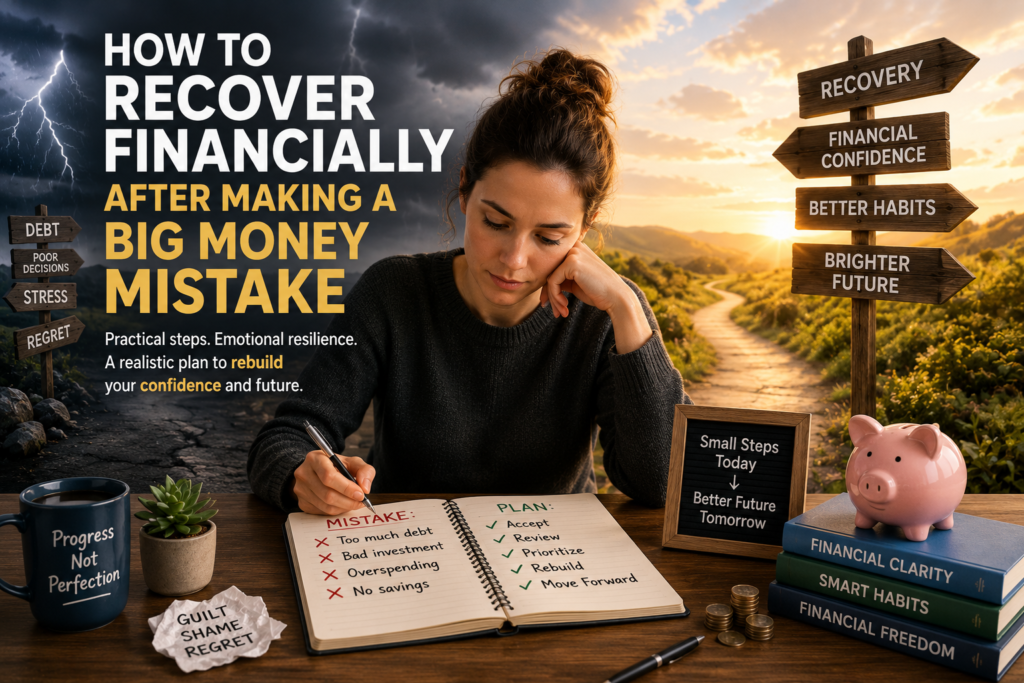
1. Accept The Situation
Acceptance isn’t giving up.
It’s choosing to work with reality instead of wishing it were different.
You don’t have to like what happened.
You simply need an honest understanding of where you stand today.
2. Review The Numbers
Many people avoid looking at their finances because they’re afraid of what they’ll find.
Ironically, uncertainty is often more stressful than the truth.
Write down:
- monthly income
- essential expenses
- outstanding debt
- savings
- investments
- regular subscriptions
Clarity creates better decisions.
3. Prioritise Essential Expenses
Before focusing on investing or lifestyle upgrades, ensure your essential financial needs are covered.
Housing.
Utilities.
Food.
Insurance.
Transportation.
These form the foundation of financial stability.
Trying to build wealth without first stabilising your finances is like building a house before pouring the foundation.
4. Rebuild Your Savings
Emergency savings don’t eliminate problems.
They reduce the financial impact of future ones.
Even small monthly contributions can gradually create meaningful security.
Our article on saving money in Germany shares practical ways many people begin rebuilding their financial safety net despite rising living costs.
5. Create A Financial System
Recovery becomes easier when good decisions require less daily willpower.
Automating savings.
Scheduling regular budget reviews.
Tracking recurring expenses.
Investing consistently rather than emotionally.
Good money management is often the result of good systems rather than perfect discipline.
6. Learn From The Experience
Every financial mistake contains information.
Ask yourself:
- What warning signs did I miss?
- What would I do differently next time?
- Which habits protected me?
- Which habits created unnecessary risk?
The goal isn’t to become someone who never makes mistakes.
It’s to become someone who recovers more effectively each time.
Why Small Improvements Matter More Than Perfect Decisions
Many people believe financial recovery depends on finding one brilliant solution.
A higher-paying job.
The perfect investment.
A flawless budget.
In reality, lasting financial recovery usually looks much less dramatic.
It comes from making slightly better decisions consistently over time.
Imagine steering a large ship across the ocean.
If the captain changes the course by just one degree, nobody on board notices the difference immediately.
The sea looks the same.
The horizon looks the same.
The destination, however, becomes completely different after hundreds of kilometres.
Financial recovery works in much the same way.
Paying a little extra towards debt each month.
Saving a small amount consistently.
Reviewing your spending once a month.
Pausing before making major purchases.
Learning one new personal finance concept every few weeks.
None of these actions feels life-changing on its own.
Together, they gradually redirect your financial future.
This is one of the most encouraging truths about money:
You don’t have to make perfect financial decisions to build a better financial life. You simply need your good decisions to outnumber your bad ones over time.
Progress compounds.
So do habits.
Every small improvement becomes a little easier to repeat.
Eventually, those habits become part of how you naturally manage money rather than something you constantly have to think about.
How To Rebuild Financial Confidence
Confidence doesn’t return because your bank balance reaches a particular number.
It returns because you begin trusting yourself again.
That trust is earned through consistency.
Each time you follow your budget for another month…
Each time you add a little more to your emergency fund…
Each time you avoid an impulse purchase…
Each time you continue investing despite temporary market uncertainty…
…you prove to yourself that you’re capable of making thoughtful financial decisions.
Another important step is resisting the temptation to compare your recovery with someone else’s progress.
Everyone starts from a different place.
Some people receive family support.
Others begin their careers with debt.
Some face unexpected medical expenses.
Others encounter unemployment or rising living costs.
Comparing financial journeys without understanding the full story is rarely helpful.
If you’ve ever felt pressured because it seems everyone else is moving ahead faster, our article on young workers feeling financially trapped explores why many young professionals experience exactly the same emotions—even when they’re doing many things right.
Patience also matters.
Financial recovery often takes longer than we would like.
Debt usually isn’t eliminated in a few months.
Savings rarely grow overnight.
Investments naturally experience periods of growth and decline.
Rather than focusing only on how far you still have to go, take time to recognise the progress you’ve already made.
Perhaps six months ago you weren’t budgeting.
Today you are.
Perhaps last year you had no emergency savings.
Today you’ve built your first €1,000.
Those victories deserve recognition.
They are evidence that your financial habits are changing.
And habits—not isolated decisions—are what create long-term financial resilience.
Frequently Asked Questions
Can I recover from financial mistakes?
Yes.
Many people recover from significant financial mistakes over time.
The recovery process depends on factors such as your income, expenses, debt and personal circumstances, but consistent financial planning and realistic goals can steadily improve your situation.
How long does financial recovery take?
There is no universal timeline.
Recovering from a small budgeting mistake may take weeks.
Recovering from substantial debt or investment losses may take several years.
The important thing is to focus on steady progress rather than expecting immediate results.
Should I invest after losing money?
Losing money doesn’t automatically mean you should stop investing.
Many people benefit from reviewing their investment strategy, improving diversification and ensuring future investments match their long-term goals and risk tolerance.
If you’re uncertain, consider seeking guidance from a qualified financial professional.
How do I stop feeling guilty about money mistakes?
Guilt becomes less powerful when it is replaced with learning.
Acknowledge what happened, understand why it happened and focus your energy on making better decisions going forward.
Your past decisions do not have to determine your future financial life.
How do I rebuild financial confidence?
Financial confidence grows through consistent action.
Creating a budget, rebuilding savings, managing debt responsibly and celebrating gradual progress all help restore trust in your ability to manage money well.
Remember that confidence is usually the result of repeated good habits—not perfect decisions.
Conclusion
Making a significant financial mistake can feel overwhelming.
It can shake your confidence, create uncertainty and leave you wondering whether you’ll ever fully recover.
But one decision—even a costly one—doesn’t define your financial future.
Recovery isn’t about proving you never made a mistake.
It’s about responding to that mistake with honesty, patience and practical action.
Every budget you follow.
Every debt payment you make.
Every euro you save.
Every thoughtful financial decision you repeat.
These small actions gradually build something far more valuable than perfection:
Financial resilience.
Over time, you’ll likely discover that your biggest money mistake also became one of your greatest financial teachers.
Not because it was enjoyable.
But because it helped you develop habits and perspectives that will serve you for the rest of your life.
The goal isn’t to build a perfect financial story.
It’s to build one that keeps moving forward.
My book on Gumroad:
https://ukandu0.gumroad.com/l/bteyh
Or on Amazon:
Feeling financially stuck?
When financial pressure becomes constant, long-term decisions start feeling emotionally heavy.
The Crown Altessa newsletter was created to help people rebuild clarity slowly and strategically through practical financial frameworks, long-term thinking, and structured decision-making insights.
Join the newsletter and receive:
• the free Financial Foundation Guide
• strategic financial insights
• practical tools for long-term stability
• frameworks designed to reduce financial overwhelm
Start building financial clarity one step at a time.