
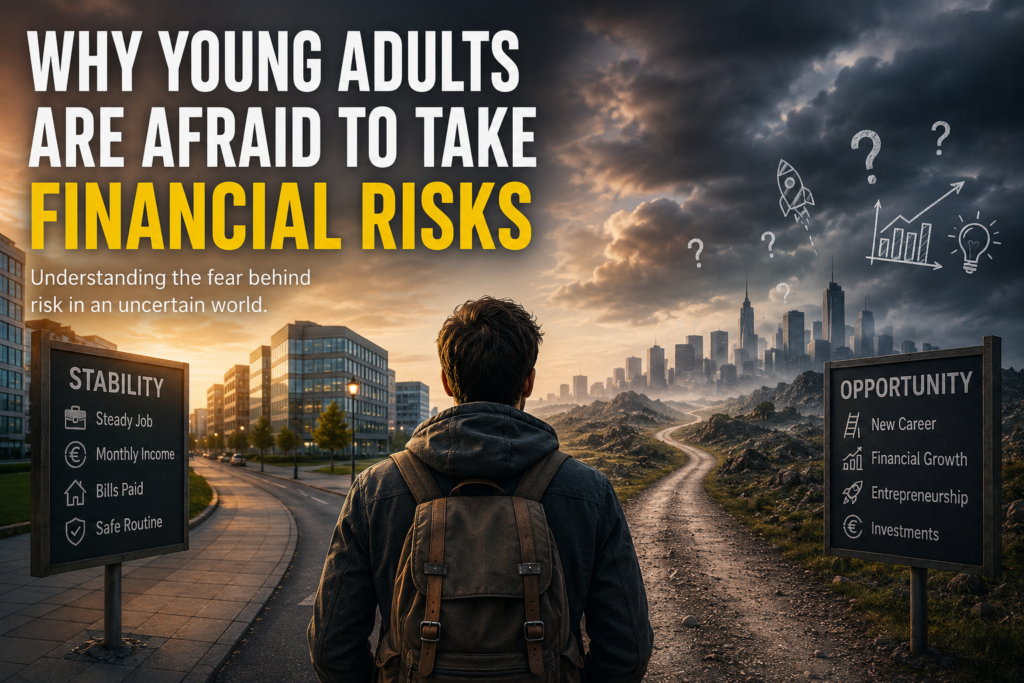
For many young adults in Germany and across Europe, financial decisions no longer feel straightforward.
Rising living costs, unstable jobs, and frequent economic disruptions have made it harder to feel secure.
The idea of taking a risk—quitting a job, investing, starting a business, or changing careers—often feels less like an opportunity and more like a potential threat.
This article explores why financial risk feels so dangerous today, how economic and emotional factors intersect, and how young people can evaluate risks more realistically.
Why Financial Risk Feels More Dangerous Today
Financial risk has always existed.
What has changed is how expensive mistakes can feel.
In cities such as Berlin, Hamburg, Cologne, and Munich, housing costs have risen significantly while competition for affordable apartments has become increasingly intense. Many renters face long waiting lists, multiple applicant viewings, and strict requirements from landlords before securing housing.
At the same time, inflation and rising living costs have reduced financial breathing room for many households. Rent, groceries, transportation, insurance, and energy bills consume a larger share of income than many people expected a few years ago. For many households dealing with rising rent and financial stress, even small setbacks can feel more dangerous.
Even workers earning around €2,500–€3,000 net monthly may still feel financially stretched after covering essential expenses.
The job market can also feel less predictable.
Many young adults begin their careers on probation periods or fixed-term contracts. Others work in industries experiencing rapid technological change, restructuring, or periodic layoffs. When employment feels uncertain and young workers feel financially trapped, taking additional risks becomes harder to justify emotionally.
The result is a growing feeling that there is less room for mistakes than previous generations may have experienced.
The Fear Of One Expensive Mistake
Leaving a steady income or investing savings can feel like jumping without a safety net.
Quitting a job to retrain, moving cities, starting a business, investing money, or returning to education may all lead to long-term opportunities.
Yet many young adults focus on a different question:
“What happens if it doesn’t work?”
Changing careers often involves giving up income temporarily. Moving cities may require paying deposits, navigating competitive rental markets, and facing higher living costs. Starting a business can involve months or years before generating reliable income.
Investing for beginners can also feel intimidating, particularly during periods of market volatility.
When financial uncertainty already exists in daily life, mistakes can feel disproportionately expensive.
Many young adults are not necessarily afraid of growth.
They are afraid of instability.
Why Losing Stability Feels Worse Than Missing Opportunities
For many people, the fear of financial risk is not really about the opportunity itself.
It is about what could be lost.
A stable paycheck.
Reliable rent payments.
The ability to cover groceries.
Keeping up with energy bills.
Affording transportation to work.
Maintaining financial obligations without falling behind.
When these basic forms of stability take years to build, protecting them becomes emotionally important.
Many young adults are not avoiding opportunities because they lack ambition.
They are protecting the stability they worked hard to build.
Someone who has finally secured stable housing after months of apartment searches may hesitate before accepting a risky career move. A worker who recently completed a probation period may think twice before leaving for a startup. Someone who spent years rebuilding savings may feel reluctant to invest aggressively.
The emotional calculation often goes beyond money.
Rebuilding stability takes time.
Recovering from a mistake can take months or even years.
As a result, uncertainty naturally encourages caution.
Sometimes the fear is not failure itself. It is the thought of having to rebuild everything from the beginning. After years of paying down debt, creating savings, securing housing, or finding stable employment, the idea of losing that progress can feel emotionally heavier than the opportunity being considered.
For some people, uncertainty eventually turns into decision paralysis, where even small long-term choices begin feeling emotionally overwhelming. The more potential outcomes someone analyzes, the harder it becomes to move forward confidently.
There is also an important psychological factor that often gets overlooked: emotional safety.
Predictable routines provide a sense of control. Knowing when income arrives, understanding monthly expenses, and having familiar responsibilities can create emotional comfort during uncertain times.
People often remain in familiar situations because certainty itself has value.
Even when a new opportunity may offer long-term benefits, leaving something predictable can feel emotionally risky.
In this context, avoiding risk is often less about fear and more about protecting stability.
Why Many People Stay In Situations They Dislike
It is common to stay in a comfortable but unfulfilling job, postpone relocating, or leave a business idea on the back burner.
Often this reluctance is not laziness.
It is self-preservation.
With high fixed costs and limited financial buffers, many people fear losing what stability they currently have.
Housing shortages, rising rents, and increasingly competitive rental markets can make relocation particularly intimidating.
Finding affordable housing in many German cities has become difficult enough that some people remain in jobs or locations simply because they already have secure accommodation.
Many young adults also remain with family longer than they originally expected because independent living no longer feels financially realistic. This can create an emotional conflict between wanting greater independence and wanting the financial stability that comes from lower living costs. For some, staying at home is not a preference but a practical response to housing affordability challenges.
Economic uncertainty also discourages mobility.
Leaving a stable position voluntarily may feel risky when future opportunities are unclear.
As a result, many people choose predictability over possibility.
That decision may not always maximize growth, but it often feels rational given current conditions.
How Social Media Distorts Risk
Social media is filled with startup success stories, investing influencers, and entrepreneurship content.
While these stories can be inspiring, they can also distort how risk is perceived.
Most people see the successes.
Few see the failures.
A startup founder may share the moment their company succeeds but rarely discuss years of uncertainty, failed projects, financial stress, or abandoned ideas.
Investment influencers often highlight gains while giving less attention to losses.
This creates survivorship bias.
The people who succeed become highly visible, while the much larger group who struggled remains largely unseen.
Many people who already feel financially exhausted or are uncertain about the future notice that fear of risk becomes stronger during periods of economic instability. Comparing everyday reality to carefully curated online success stories can make thoughtful decision-making feel unnecessarily inadequate.
The Difference Between Reckless Risk And Calculated Risk
Not all risks are equal.
Reckless risks are usually emotional and impulsive.
Examples include:
- gambling significant amounts of money
- emotional investing without research
- quitting a job without preparation
- taking on debt without understanding the consequences
Calculated risks look very different.
They involve:
- planning
- research
- emergency funds
- realistic expectations
- gradual transitions
Someone considering a career change may first develop skills part-time.
A future entrepreneur may start a side project before leaving full-time employment.
An investor may begin with small amounts while learning how markets work.
Calculated risks reduce the chance that one setback becomes financially devastating.
The goal is not eliminating risk entirely.
The goal is managing risk intelligently.
Signs Fear Is Holding You Back
Financial caution can be healthy.
However, excessive risk aversion may limit opportunities.
Some common signs include:
- overthinking decisions repeatedly
- constantly delaying goals
- avoiding opportunities despite preparation
- fear of investing
- fear of changing jobs
- excessive need for certainty
- waiting for the “perfect time”
- repeatedly imagining worst-case scenarios
- postponing important life decisions indefinitely
Recognizing these patterns can help create a healthier balance between caution and progress. Many people who feel financially behind discover that external economic pressures contribute far more to their situation than personal failure.
How To Evaluate Risk More Realistically
Young adults cannot eliminate uncertainty completely.
However, they can reduce unnecessary risk.
Practical strategies include:
- building an emergency fund
- reducing high-interest debt
- developing valuable skills
- researching opportunities carefully
- testing ideas gradually
- creating multiple income sources where realistic
- strengthening professional networks
The stronger your financial foundation becomes, the easier it is to evaluate opportunities objectively.
Preparation often reduces fear because uncertainty becomes easier to manage.
Why Small Risks Often Matter More Than Big Risks
Many people assume success comes from one major breakthrough.
In reality, progress often comes from small risks repeated consistently over time.
Examples include:
- learning new skills
- networking professionally
- starting side projects
- asking for promotions
- applying for better jobs
- improving financial literacy
These actions may feel less dramatic than launching a company or making a large investment.
Yet they often create meaningful long-term opportunities.
Small risks allow people to build confidence gradually while limiting potential downside.
Over time, those small decisions can lead to much larger changes.
Frequently Asked Questions
Why are young adults afraid of financial risk?
Rising living costs, unstable employment, financial insecurity, and economic uncertainty make mistakes feel more expensive. Many people feel they have less room for error financially.
Is fear of investing normal?
Yes.
Investment anxiety is extremely common, especially for beginners. Starting gradually and focusing on long-term goals can help reduce emotional stress.
How do I know if a risk is worth taking?
Evaluate both the potential benefits and the possible downsides. Consider your savings, income stability, obligations, and ability to recover if things do not go as planned.
What is the difference between risk and recklessness?
Risk involves uncertainty that is managed through planning and preparation. Recklessness ignores preparation and relies primarily on emotion or hope.
How can I become more financially confident?
Building financial confidence usually comes from improving knowledge, strengthening savings, developing valuable skills, and taking small calculated risks over time.
Conclusion
Many young adults feel that uncertainty is no longer the exception but the rule.
Inflation, housing costs, job insecurity, and economic volatility reduce financial breathing room and make major decisions feel emotionally heavier.
However, risk does not have to be reckless.
Thoughtful, gradual steps—building reserves, upgrading skills, testing ideas—can turn fear into measured confidence.
Modern financial pressure may make bold moves intimidating, but small, deliberate actions can create momentum.
Over time, these choices build resilience and offer a more sustainable way to grow, even when the future feels unpredictable.
My book on Gumroad:
https://ukandu0.gumroad.com/l/bteyh
Or on Amazon:
Build Financial Clarity
Join the Crown Altessa newsletter and receive:
• the free Financial Foundation Guide
• practical financial frameworks
• strategic decision-making insights
• tools designed to help you think long term about money and stability
If you want calmer, more structured financial thinking in an uncertain world, subscribe below.