
Search for:
“How much emergency savings should I have?”
and one answer appears almost immediately:
Save three to six months.
It sounds reassuringly simple.
But three to six months of what?
Your gross salary?
Your net salary?
Your normal monthly spending?
Only essential expenses?
And why should a permanently employed person with low fixed costs and a second household income hold exactly the same emergency reserve as a freelancer whose income changes every month?
They probably shouldn’t.
There is no magical emergency-fund number that works for everyone in Germany, and German authorities do not prescribe one universal personal emergency-fund amount.
A more useful starting point is:
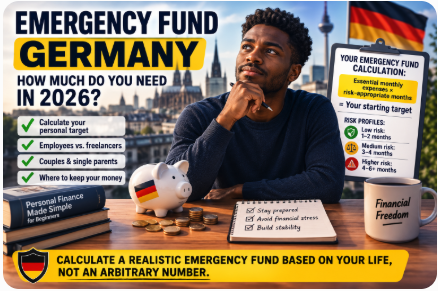
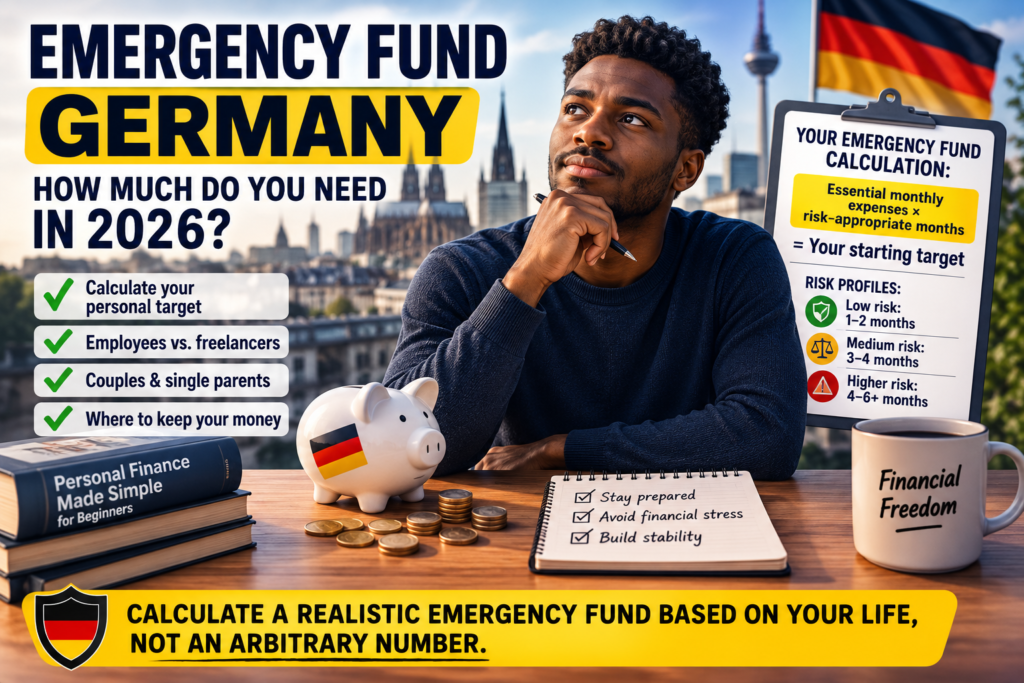
Essential monthly expenses × a risk-appropriate number of months = starting emergency-fund target
The first number tells you how much money your household needs to keep functioning.
The second reflects how vulnerable that household is to financial disruption.
Put those together and the familiar “three-to-six-month rule” becomes something much more useful: a personal calculation rather than an internet slogan.
Your emergency-fund target should reflect the financial risks in your life, not an arbitrary number copied from somebody else’s.
What Is an Emergency Fund?
An emergency fund—or Notgroschen in German—is liquid money reserved for unexpected and financially disruptive events.
That can include:
- temporary loss of income;
- delayed salary or client payments;
- urgent repairs;
- necessary emergency travel;
- unexpected essential expenses;
- insurance deductibles;
- other genuine financial shocks.
It is not the same as money saved for a holiday, Christmas, a new car, retirement or ordinary investing.
The defining characteristic is unexpected necessity.
Crown Altessa already discusses the emotional value of financial buffers in its guide to building financial confidence during uncertain times.
The harder question is how large your buffer should actually be.
How Much Emergency Fund Do You Actually Need?
There is no universally correct euro amount.
€3,000 could be a substantial reserve for one household and dangerously small for another.
The useful starting formula is:
Essential monthly expenses × appropriate number of months = emergency-fund target
Suppose your essential expenses are €1,900 per month.
Different reserve periods would produce:
| Reserve | Calculation | Emergency-fund target |
|---|---|---|
| 1 month | €1,900 × 1 | €1,900 |
| 2 months | €1,900 × 2 | €3,800 |
| 3 months | €1,900 × 3 | €5,700 |
| 4 months | €1,900 × 4 | €7,600 |
| 6 months | €1,900 × 6 | €11,400 |
The arithmetic is easy.
The difficult part is deciding whether your circumstances justify two months, four months, six months or something else.
That decision should reflect risk.
Ask:
- How secure is my income?
- How quickly could I realistically replace it?
- Does somebody else in my household earn an income?
- Do people depend financially on me?
- How high are my unavoidable monthly costs?
- What insurance protection do I have?
- What state or employment protections might apply?
- Do I own essential assets that could generate expensive surprises?
- Could family or household support realistically help?
- Is my income predictable or irregular?
The answer is therefore not:
“Everybody needs six months.”
It is:
“Calculate the cost of keeping your life functioning, then decide how much interruption you realistically need to withstand.”
Calculate Your Essential Monthly Expenses First
Your emergency fund is primarily designed to preserve essential financial functioning.
That makes essential expenses a more useful starting point than total lifestyle spending.
Go through your monthly costs and identify what would still need to be paid if your income suddenly stopped.
Typical essentials might include:
- rent or mortgage;
- utilities;
- basic groceries;
- necessary healthcare costs;
- essential insurance;
- transportation needed for work or everyday life;
- minimum required debt payments;
- childcare;
- phone and internet where necessary;
- other unavoidable household obligations.
Now separate discretionary expenses.
These might include:
- holidays;
- restaurants;
- entertainment;
- luxury shopping;
- optional subscriptions;
- non-essential upgrades.
The distinction is not moral.
A restaurant meal is not “bad spending.”
It simply performs a different job from rent.
During an emergency, you are trying to calculate the cost of keeping the financial engine running, not maintaining every aspect of your normal lifestyle.
A Hypothetical Example
Imagine your essential monthly expenses are:
| Essential expense | Monthly amount |
| Rent | €900 |
| Utilities | €200 |
| Groceries | €350 |
| Transportation | €100 |
| Insurance and essential commitments | €150 |
| Other essentials | €200 |
| Total | €1,900 |
Your emergency-fund base number is therefore approximately €1,900 per month.
This example is hypothetical. Your number may be considerably lower or higher.
But now you have something useful.
Instead of asking:
“Should I have €5,000 or €10,000?”
you can ask:
“How many months of my €1,900 essential cost base should I be prepared to cover?”
That is a much better financial question.
One Month, Three Months or Six Months? Use Your Risk Level
This is where generic emergency-fund advice often breaks down.
Imagine emergency savings as the runway in front of an aircraft.
The runway is not valuable because longer is always better.
It is valuable because it gives the aircraft enough room for the conditions it faces.
A small, lightly loaded aircraft in favourable conditions may not require the same runway as a much heavier aircraft facing more demanding conditions.
Emergency savings work similarly.
You are trying to build enough financial runway for your risks.
Not the longest runway imaginable.
Lower Financial Risk
Characteristics might include:
- stable permanent employment;
- relatively low fixed expenses;
- two reliable household incomes;
- no dependants;
- strong relevant insurance protection;
- meaningful household or family support;
- skills that make replacing employment comparatively realistic.
A person in this position may reasonably decide that a smaller emergency reserve provides sufficient protection.
That does not mean everyone fitting this description should hold exactly one, two or three months.
It means their financial system contains several layers of redundancy.
If one thing goes wrong, other resources remain.
Medium Financial Risk
Characteristics might include:
- a single household income;
- moderate fixed costs;
- limited outside financial support;
- some uncertainty around employment;
- a car or other essential asset capable of creating unexpected expenses;
- dependants or commitments that cannot easily be reduced.
This household has less redundancy.
A larger reserve may therefore be reasonable.
Higher Financial Risk
Characteristics might include:
- self-employment or freelancing;
- highly variable income;
- irregular contracts;
- financially dependent children or relatives;
- one household income;
- high essential monthly expenses;
- income that would be difficult to replace quickly;
- limited relevant insurance protection.
Here, a larger emergency reserve may be justified because income interruption could last longer or create greater consequences.
The principle is:
The less predictable your financial life, the more valuable liquidity becomes.
This is one reason young workers with unstable contracts can feel financially trapped even while earning a reasonable income. The issue is not always the salary itself. Sometimes it is the absence of room for disruption.
Emergency Fund Examples: What Different People Might Need
The ranges below are Crown Altessa educational illustrations based on the risk factors discussed above. They are not official German emergency-fund recommendations and should not be treated as universal targets.
They show how the same framework can produce different answers when household risks change.
Anna — Stable Employee
Anna’s essential expenses are €1,600 per month.
She has:
- permanent employment;
- no dependants;
- relatively low debt;
- modest fixed expenses.
For illustration, Anna decides to evaluate roughly 2–4 months of essential expenses as a possible working range.
That produces:
€3,200–€6,400
Why might she lean toward the lower end?
Her income is relatively predictable and her financial obligations are limited.
Why might she still prefer the higher end?
Perhaps she works in a specialised field where replacing her job would take time, or simply values additional liquidity.
The framework informs the decision.
It does not dictate it.
Daniel — Freelancer
Daniel’s essential personal expenses are €2,000 per month.
His income varies substantially.
Some months are excellent.
Others are quiet.
Clients occasionally pay late.
Losing one major contract could significantly reduce his income.
For educational purposes, Daniel might evaluate a wider range—such as 4–8 months of personal essential expenses—depending on the stability of his client base, other resources and personal comfort with uncertainty.
That would represent:
€8,000–€16,000
This is not an official recommendation for freelancers.
It simply demonstrates why applying Anna’s working range mechanically to Daniel would make little sense.
His income behaves differently.
Lisa and Marco — Dual-Income Couple
Lisa and Marco have combined essential household expenses of €2,800 per month.
Both work.
If one loses a job, the other’s income could cover a substantial part of their household essentials.
Their emergency-fund decision should therefore consider the income redundancy created by having two earners.
However, they should also ask:
- Could either income cover the household alone?
- Are both employed by the same company?
- Do they work in the same vulnerable industry?
- Could one recession or local shock affect both jobs?
- Do they have children?
- How high are their fixed housing costs?
Two incomes can reduce risk.
They do not automatically eliminate it.
Sarah — Single Parent
Sarah’s essential household expenses are €2,400 per month.
She has one income and childcare responsibilities.
If her income disappears, the consequences extend beyond her alone.
A larger liquidity reserve may therefore make sense because she has fewer sources of household redundancy and less flexibility to cut certain expenses.
As an educational illustration, she might evaluate something like 4–6 months or more, depending on her employment security, insurance and other protections.
At €2,400 per month:
4 months = €9,600
6 months = €14,400
Again, those figures are not German government, BaFin or Verbraucherzentrale targets.
They simply illustrate how risk characteristics can change the size of the reserve someone might reasonably consider.
Is €1,000 Enough for an Emergency Fund?
If you currently have no emergency savings, €1,000 can be an excellent first milestone.
It could absorb many smaller shocks:
- an urgent repair;
- an insurance deductible;
- necessary travel;
- replacement of an essential appliance;
- an unexpectedly expensive month.
That matters.
But there is a useful distinction between a:
starter emergency fund
and a:
fully funded emergency reserve.
If your essential expenses are €2,000 per month, €1,000 represents half a month of essential costs.
It could solve a broken washing machine.
It probably cannot finance several months without income.
So the better answer is:
€1,000 can be enough for your first emergency-fund milestone without necessarily being enough for your final target.
And if you currently have €100 rather than €1,000, that does not make the framework useless.
Your calculation tells you where you are heading.
It does not turn today’s balance into a judgment about your financial competence.
Should Your Emergency Fund Be Based on Salary or Expenses?
Usually, essential expenses are more useful than gross salary for calculating an emergency fund.
Consider two people.
Both receive €5,000 net per month.
Person A needs €2,000 to cover essential monthly costs.
Person B needs €4,500.
If both lose their income, they have very different short-term survival requirements.
Salary tells you how much money normally enters your household.
Essential expenses tell you how much money needs to keep leaving it during disruption.
That is the job your emergency fund is trying to perform.
This is particularly important in Germany because gross salary can differ substantially from actual take-home pay after payroll deductions. If you are unsure what your contractual salary means for monthly finances, Crown Altessa’s guide to gross vs net salary in Germany explains the difference.
Do You Need a Bigger Emergency Fund in Germany?
Germany changes the emergency-fund calculation, but not in a way that produces one universal German number.
Eligible employees may have access to Arbeitslosengeld if they lose their job, but qualification depends on the current legal requirements and an individual’s insurance history and circumstances. Benefit duration and amount also vary rather than being identical for everyone. The Bundesagentur für Arbeit currently explains that eligibility generally depends on meeting conditions including the required insurance period, while the duration can depend on factors such as prior insured employment and age.
The important emergency-fund point is not a particular replacement percentage.
It is this:
Unemployment protection can reduce the financial impact of losing a job without necessarily replacing a person’s previous take-home income or providing the same flexibility as cash already sitting in their account.
Germany also has statutory health insurance and other employment-related protections that can reduce some risks compared with a system where individuals must finance those risks entirely through private savings.
But public protection and private liquidity are not interchangeable.
Eligibility requirements exist.
Benefit amounts and duration vary.
Some circumstances can affect when benefits are paid.
Your rent and other fixed costs do not automatically shrink when your employment changes.
And freelancers and self-employed people may have substantially different protection depending on their insurance arrangements.
The nuanced conclusion is:
Germany’s social protections can influence how much private liquidity someone needs, but they do not eliminate the usefulness of accessible emergency savings.
Your calculation should account for protections that genuinely apply to you without assuming the public safety net makes private cash unnecessary.
For the latest eligibility, benefit and duration rules, check the Bundesagentur für Arbeit rather than relying on an emergency-fund article to remain a permanent substitute for current benefit guidance.
Employees vs Freelancers: The Target Should Not Be the Same
A salaried employee and a freelancer earning the same annual income do not necessarily face the same liquidity risk.
Consider an employee receiving €3,500 net each month.
Income arrives predictably.
Now consider a freelancer averaging the same €3,500.
Their year might look like:
€6,000.
€4,500.
€1,800.
€5,200.
€900.
€4,000.
The average may be similar.
The experience is not.
Freelancers can face:
- irregular client payments;
- loss of contracts;
- unpaid downtime;
- seasonal fluctuations;
- business expenses;
- tax obligations;
- gaps between projects;
- less access to some employee protections.
That creates an important distinction between:
personal emergency savings
and
business cash reserves.
If Daniel runs a freelance design business, the €2,000 he needs personally each month is not necessarily the same as the amount his business needs for software, contractors, tax obligations, equipment and other operating expenses.
Combining both into one vague “emergency fund” can make the business appear safer than it is.
A freelancer may therefore reasonably maintain:
- a personal emergency fund for household disruption; and
- a separate business liquidity reserve appropriate to the business.
The exact amounts depend on circumstances.
The principle does not:
More variable cash flow generally increases the value of accessible liquidity.
What About Couples?
Couples introduce another variable: income diversification.
Two incomes can make a household more resilient.
But “dual-income household” should not automatically be translated into “small emergency fund.”
Ask:
Could either income cover essential household costs temporarily?
If one partner earns €3,000 and another earns €2,800 while essential household expenses are €2,500, losing one salary may be uncomfortable but manageable.
Now imagine essential expenses are €5,000.
The same two-income household has much less redundancy.
Also ask:
Do both partners work in the same industry?
Two airline employees, automotive workers or technology contractors may both be vulnerable to the same industry downturn.
Are there children?
Dependants can increase essential costs and reduce flexibility.
Is one income temporary?
A dual-income household where one partner has irregular contracts may not have the same stability as two permanent incomes.
The correct question is therefore not:
“How many months should couples save?”
It is:
“How much household income redundancy do we actually have?”
Where Should You Keep an Emergency Fund in Germany?
Emergency money has a different job from long-term investment capital.
Its priorities are generally:
- liquidity
- accessibility
- capital stability
- separation from ordinary spending
For many people in Germany, a separate savings account or Tagesgeldkonto can perform that role.
A Tagesgeld account is generally an interest-bearing savings account where money remains accessible rather than being locked away for a predetermined term.
That can make it useful for emergency savings because the money is separated from everyday spending while remaining available.
Do not choose an account based only on the highest advertised promotional interest rate.
Also consider:
- accessibility;
- whether rates are temporary;
- account conditions;
- fees;
- the institution;
- applicable deposit protection.
For deposits covered by Germany’s statutory deposit-guarantee schemes, the standard protection is generally up to €100,000 per customer per institution if the provider fails. BaFin describes this as the regular statutory protection limit.
Emergency funds for most ordinary households will be far below that figure, but understanding deposit protection remains part of sensible cash management.
The larger principle is:
Emergency money should be easy to access without being easy to accidentally spend.
Keeping the entire fund in the same current account used for restaurants, subscriptions and shopping may make the boundary psychologically weaker.
Keeping it somewhere inaccessible for weeks defeats its emergency purpose.
The middle ground is deliberate accessibility.
Should You Invest Your Emergency Fund?
Generally, the primary purpose of emergency money is availability and stability, not maximum long-term return.
Imagine losing your job during a severe stock-market decline.
Your emergency fund is invested.
You need €8,000 for living expenses.
But your investments have fallen significantly.
Now the emergency forces you to sell precisely when you would have preferred not to.
That creates two problems at once:
financial disruption + investment loss crystallisation.
This does not mean investing is bad.
It means different pools of money have different jobs.
Think of your finances like a football team.
Your goalkeeper is not failing because they score fewer goals than the striker.
They have a different job.
Your emergency fund is the goalkeeper.
Long-term investments are expected to pursue growth while accepting uncertainty and market fluctuations.
Emergency cash is expected to be there when you need it.
Judging both by investment return misunderstands their roles.
Once your emergency reserve reaches an appropriate level, additional long-term money may have a different purpose. That is where the question of cash versus investing becomes more relevant.
When Should You Actually Use Your Emergency Fund?
People sometimes become so proud of building an emergency fund that they become afraid to use it.
That defeats the purpose.
Before withdrawing money, ask four questions:
- Is the expense unexpected?
- Is it necessary?
- Is it financially urgent?
- Would not paying it create a more serious problem?
The more strongly the answer is yes across those questions, the stronger the case for using emergency savings.
Potential examples include:
- an essential car repair when the vehicle is required for work;
- unexpected necessary health-related costs not otherwise covered;
- temporary interruption of income;
- urgent essential home repairs;
- unavoidable emergency travel.
Situations generally better planned through other savings include:
- an annual holiday;
- Christmas presents;
- replacing a working phone because a newer model launched;
- normal restaurant spending;
- planned furniture purchases;
- speculative investment opportunities.
Real life is not always neat.
An emergency may contain both predictable and unpredictable elements.
Use the test as a decision framework rather than an inflexible rule.
What Happens After You Use It?
Use → stabilise → rebuild.
That is the emergency-fund cycle.
Suppose you have €8,000 saved.
An unavoidable emergency costs €2,500.
Your balance falls to €5,500.
You have not “lost progress.”
Your financial system worked.
You deliberately accumulated money for a serious unexpected expense, and when the expense arrived, you did not need to finance the entire problem through expensive debt.
Once the immediate situation stabilises, rebuild gradually.
That does not necessarily mean directing every spare euro into the fund immediately.
Your budget still needs to function.
A reasonable rebuilding process might involve restoring your previous automated savings contribution and increasing it temporarily where affordable.
An emergency fund that has been used successfully is evidence of usefulness—not evidence of failure.
Emergency Fund vs Paying Off Debt: Which Comes First?
This question has no responsible universal answer.
Imagine somebody with expensive consumer debt but zero savings.
Putting every available euro toward debt may reduce interest costs faster.
But it can also leave them with no liquidity.
Then a €600 emergency arrives.
Without savings, they may borrow another €600.
The debt-repayment strategy has accidentally recreated the debt.
At the opposite extreme, accumulating a very large cash reserve while paying extremely expensive interest on debt can also be inefficient.
A more nuanced framework is:
First: consider establishing some starter liquidity.
Then: assess the cost and urgency of the debt.
Then: balance debt reduction with building greater resilience.
High-interest debt and lower-cost debt should not automatically be treated identically.
Nor should a person with €0 in cash be treated the same as someone already holding several months of essential expenses.
This is why financial planning works better as a system than as a collection of isolated rules.
When Is Your Emergency Fund Big Enough?
This question is underrated.
Emergency savings can become psychologically addictive.
You save one month.
Then three.
Then six.
You finally reach your target.
But uncertainty remains.
So you think:
“Maybe I need nine.”
Then twelve.
Then eighteen.
At some point, the emergency fund can stop being a calculated reserve and become an attempt to purchase certainty.
No amount of cash can eliminate every financial risk.
Once you reach a target appropriate to your:
- essential expenses;
- income stability;
- household structure;
- dependants;
- insurance;
- employment circumstances;
- realistic financial protections;
you can reassess what the next euro should do.
It may belong to:
- debt reduction;
- retirement;
- long-term investing;
- education;
- a planned purchase;
- another short-term goal.
Your emergency fund is not a competition to accumulate the largest possible cash balance.
It is a financial tool.
Its job is to create enough runway for disruption.
Once the runway is appropriately long, endlessly extending it may not be the best use of every additional euro.
Your Emergency Fund Should Change When Your Life Changes
Your emergency-fund target is not a number you calculate at 27 and preserve until retirement.
Recalculate when your financial structure changes materially.
Examples include:
- moving out of your parents’ home;
- marriage;
- separation or divorce;
- having a child;
- buying a home;
- becoming self-employed;
- changing careers;
- moving countries;
- a substantial salary change;
- a major change in fixed expenses;
- becoming a single-income household.
Suppose your emergency target is €6,000 while living alone.
Later you have a child and household essentials rise significantly.
The old target may no longer reflect the consequences of income disruption.
The reverse can happen too.
Perhaps you move in with a partner, reduce housing costs and now have two independent incomes.
Your required private buffer may change.
Reviewing the target once or twice a year—or after a major life event—is usually more useful than obsessively recalculating it every month.
A Simple Emergency Fund Calculator
You can now calculate your own starting target.
This calculator provides a working planning estimate, not an official German recommendation or a universally correct financial answer.
Step 1: Calculate Essential Monthly Expenses
Add the costs required to keep your household functioning.
Do not automatically include every euro you normally spend.
Hypothetical example: €1,900
Step 2: Assess Your Financial Risk
Consider:
- employment stability;
- income variability;
- household income redundancy;
- dependants;
- insurance;
- fixed expenses;
- ability to replace income;
- realistic financial protections.
Step 3: Choose a Working Target Range
Do not begin by assuming the answer must be three or six months.
Ask how much financial runway your circumstances justify.
For this hypothetical example, assume the person chooses four months as a working planning target.
Step 4: Calculate the Target
€1,900 × 4 = €7,600
Illustrative target:
€7,600
Step 5: Subtract Existing Dedicated Emergency Savings
Suppose they already have:
€2,500
Then:
€7,600 − €2,500 = €5,100
Remaining amount toward the illustrative target:
€5,100
That does not mean they need to find €5,100 immediately.
Nor does it mean four months is the correct target for everyone.
It means they have transformed a vague concern into a measurable working plan.
Instead of thinking:
“I should probably save more.”
they can say:
“Based on my current essential expenses and the risk assumptions I have chosen, my working target is €7,600. I already have €2,500, so the remaining gap is €5,100.”
That is much more actionable.
Frequently Asked Questions
How Much Emergency Fund Should I Have in Germany?
There is no universal amount.
A useful starting framework is:
essential monthly expenses × a number of months appropriate to your financial risk.
Consider employment stability, household income, dependants, fixed costs, insurance and realistic financial protections.
Is €1,000 Enough for an Emergency Fund?
€1,000 can be a valuable starter emergency fund.
Whether it is enough as your fully funded reserve depends on your essential expenses and financial risks.
For someone spending €2,000 per month on essentials, €1,000 would cover only half a month.
Should an Emergency Fund Be 3 or 6 Months?
Neither figure is universally correct, and neither should be treated as an official German requirement.
A stable dual-income household with low fixed costs may reasonably assess risk differently from a single parent or freelancer with variable income.
Treat three to six months as a commonly discussed planning range, not a law.
Should I Calculate My Emergency Fund Using Salary or Expenses?
Essential expenses are generally more useful.
The purpose of emergency savings is to keep essential financial commitments functioning when income is disrupted.
Gross salary does not tell you how much money your household actually needs each month.
Where Should I Keep My Emergency Fund in Germany?
Look for liquidity, accessibility, capital stability and separation from everyday spending.
A suitable separate savings account or Tagesgeld account may perform this role.
For covered bank deposits, Germany’s statutory deposit protection generally protects up to €100,000 per customer per institution.
Should I Invest My Emergency Fund?
Emergency savings and investments have different purposes.
Emergency money prioritises availability and stability.
Long-term investing generally accepts market uncertainty in pursuit of potential growth.
Investing emergency money can create the risk that you need to sell during a market decline.
How Much Emergency Savings Should a Freelancer Have?
There is no universal freelancer amount.
Variable income, client concentration, payment delays, unpaid downtime and business costs can justify a larger liquidity reserve than a stable employee might choose.
Freelancers should also distinguish personal emergency savings from business cash reserves.
Do Couples Need Separate Emergency Funds?
Not necessarily.
The more important question is how resilient the household is.
Consider whether either income could temporarily cover essentials, whether both partners work in the same industry, and whether children or high fixed costs increase vulnerability.
Does Germany’s Social Safety Net Mean I Need Less Emergency Savings?
Potentially, but not automatically.
Eligible employees may receive Arbeitslosengeld, and Germany has other social and employment protections. But qualification requirements, benefit amounts and duration depend on individual circumstances. Public protection may reduce some financial risks without replacing the flexibility of private emergency cash.
When Should I Use My Emergency Fund?
Ask:
Is it unexpected?
Is it necessary?
Is it urgent?
Would not paying it create a more serious problem?
If the answers strongly point toward yes, that is exactly the kind of situation the fund exists to handle.
Conclusion
There is no magical emergency-fund number for Germany.
And that is useful to understand.
You do not need to force your financial life into somebody else’s three-to-six-month rule.
Instead, calculate the amount required to keep your household functioning.
Then evaluate the risks surrounding that number:
- How stable is your income?
- How quickly could you replace it?
- Does your household have another income?
- Who depends on you?
- What insurance protection exists?
- What realistic employment or public protections apply?
- How much financial flexibility do you already have?
Your emergency fund should be large enough to give you meaningful financial runway without becoming an endless attempt to eliminate uncertainty.
The goal is not to accumulate cash forever.
The goal is to have enough accessible money that an unexpected disruption does not immediately become a financial crisis.
And once you reach that point, you can give your next euro a different job.
If you want a broader beginner-friendly framework for organising savings, spending and long-term financial decisions, my book Personal Finance Made Simple for Beginners covers those foundations in plain language.
My book on Gumroad:
https://ukandu0.gumroad.com/l/bteyh
Or on Amazon:
Sources & Further Reading
For current eligibility, calculation and duration rules for Arbeitslosengeld, see the Bundesagentur für Arbeit. The agency explains that entitlement, duration and benefit amount depend on the applicable conditions and the claimant’s circumstances.
For German statutory deposit protection, see BaFin’s deposit-protection guidance. BaFin states that statutory schemes generally protect deposits up to €100,000 per customer per institution.
Feeling financially stuck?
When financial pressure becomes constant, long-term decisions start feeling emotionally heavy.
The Crown Altessa newsletter was created to help people rebuild clarity slowly and strategically through practical financial frameworks, long-term thinking, and structured decision-making insights.
Join the newsletter and receive:
• the free Financial Foundation Guide
• strategic financial insights
• practical tools for long-term stability
• frameworks designed to reduce financial overwhelm
Start building financial clarity one step at a time.