
One of the most common pieces of investing advice is:
“Don’t put all your eggs in one basket.”
You’ve probably heard it countless times.
But what does it actually mean when investing?
Does diversification simply mean buying lots of different investments?
Does owning more investments automatically make a portfolio safer?
Can diversification prevent losses during difficult markets?
These are important questions because diversification is often misunderstood.
Some people believe it completely removes investment risk.
Others assume it means buying as many investments as possible.
Neither is true.
Diversification is better understood as a way of managing uncertainty, not eliminating it.
It recognises a simple reality:
No investor consistently knows which company, industry or asset will perform best in the future.
Rather than trying to predict the single winner, diversification accepts uncertainty and builds a portfolio designed to avoid relying on only one outcome.
This article explains what diversification really means, why experienced investors use it, how behavioural finance influences concentration decisions and how historical comparisons can help challenge investing assumptions without pretending to predict the future.
What Is Diversification?
Diversification means spreading your investments across different assets instead of relying heavily on just one.
The goal isn’t to guarantee profits.
The goal is to reduce the impact that any single investment can have on your overall portfolio.
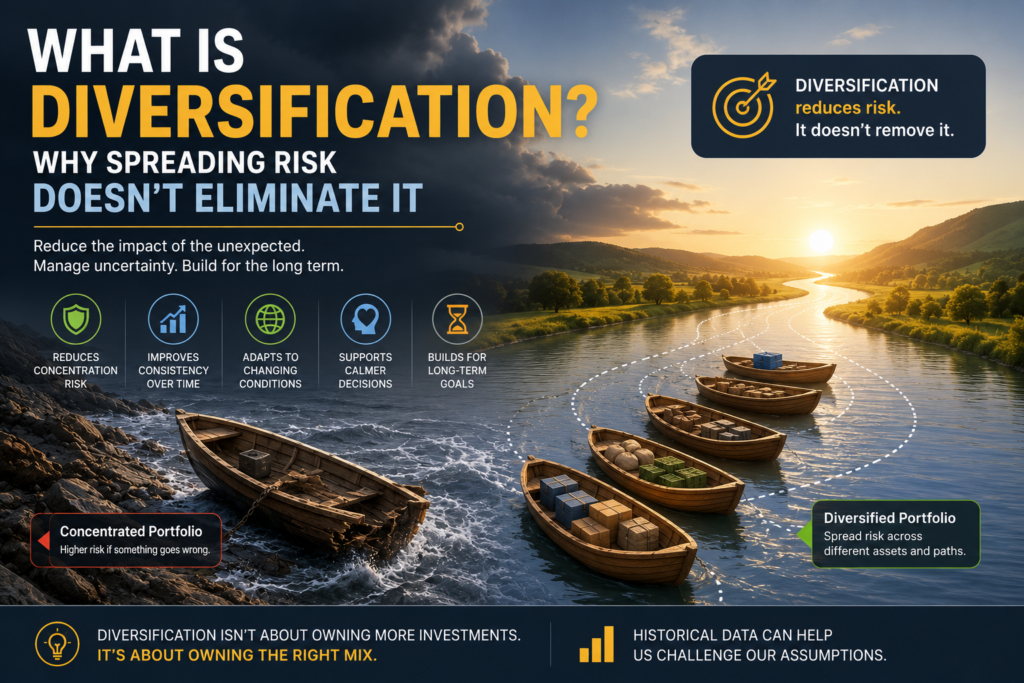
Imagine you’re moving your family’s most valuable possessions across a wide river.
You have two options.
The first is to load everything onto one large boat.
The second is to divide everything between several different boats travelling along different routes.
If every boat arrives safely, both approaches work.
But imagine one boat encounters unexpected problems.
If everything was loaded onto that single boat, the consequences could be severe.
If your belongings were spread across several boats, the disruption would likely be much smaller.
Diversification works in much the same way.
Instead of relying on one company, one industry or one type of investment, you spread your exposure across several different opportunities.
That doesn’t eliminate uncertainty.
It reduces the likelihood that one poor outcome determines your entire financial future.
Importantly, diversification is not about collecting as many investments as possible.
Owning twenty companies that all operate in the same industry may still expose you to many of the same risks.
Effective diversification is about owning investments that may respond differently when economic conditions change.
Understanding these principles becomes much easier when they’re part of a broader financial plan. Building a personal finance system that actually works can help ensure investing decisions support your long-term goals rather than short-term emotions.
Why Investors Diversify
The future is uncertain.
That simple fact sits at the heart of diversification.
Nobody consistently knows:
- which company will become tomorrow’s market leader
- which industry will grow fastest
- how interest rates will change
- how governments or economies will evolve
- which unexpected global events may influence markets
Because these outcomes remain uncertain, experienced investors often avoid relying too heavily on any single prediction.
Instead, they spread risk across different parts of the market.
Different Businesses
Companies operate under different circumstances.
A healthcare company faces different opportunities and challenges than an automotive manufacturer.
A technology company may respond differently to economic changes than a utility provider.
Owning different businesses reduces dependence on the success of just one.
Different Industries
Entire industries experience cycles.
Sometimes technology leads markets.
Sometimes energy.
Sometimes healthcare.
Sometimes consumer goods.
Diversification recognises that leadership changes over time.
Different Asset Classes
Many diversified portfolios contain more than shares alone.
Depending on an investor’s objectives, they may also include bonds, cash or other asset classes that behave differently under changing market conditions.
Different assets often respond differently to the same economic event.
Different Economic Environments
No investment performs best under every condition.
Periods of rapid economic growth create different opportunities than periods of recession, high inflation or changing interest rates.
Diversification acknowledges that future conditions cannot be predicted with certainty.
Rather than asking,
“Which investment will definitely win?”
experienced investors often ask,
“How can I build a portfolio that remains resilient across many different possibilities?”
That shift in thinking is subtle but powerful.
It moves investing away from prediction and towards preparation.
Successful investing is often less about chasing the highest possible returns and more about understanding the uncertainties you’re choosing to accept.
Diversification Reduces Risk—It Doesn’t Remove It
One of the biggest misconceptions about diversification is that it makes investing safe.
It doesn’t.
Every investment still carries uncertainty.
Diversification simply changes the type of risk you’re exposed to.
A useful way to think about this is to separate two broad categories of risk.
Risks That Affect Individual Companies
Imagine a company loses an important customer.
Its management makes poor decisions.
A new competitor enters the market.
Its products become less popular.
These events primarily affect that specific business.
If your portfolio depends heavily on one company, these problems can have a major impact.
Diversification helps reduce this type of company-specific risk because the success of your portfolio no longer depends on one business alone.
Risks That Affect Almost Everyone
Some events influence much larger parts of the market.
Economic recessions.
Global financial crises.
Major geopolitical uncertainty.
Sharp changes in interest rates.
These events often affect many companies simultaneously.
Even well-diversified portfolios may decline during these periods.
This is why diversification reduces risk but does not eliminate it.
Think of an umbrella during heavy rain.
An umbrella won’t stop the storm.
It helps reduce how much the storm affects you.
Diversification works in much the same way.
Markets will still experience volatility.
Economic uncertainty will still exist.
Unexpected events will still occur.
Diversification simply aims to reduce the damage that any single investment can cause.
Understanding what volatility is helps reinforce this idea. Diversified portfolios can still experience significant market swings because broad market volatility affects many investments at the same time.
Why Concentrated Portfolios Feel So Tempting
If diversification offers important benefits, why do many investors prefer concentrating their money in just a few investments?
Behavioural finance provides several explanations.
Overconfidence
When an investment performs well, it’s natural to believe we recognised something that others missed.
Success increases confidence.
Sometimes it also increases the willingness to take larger risks.
The danger is that confidence often grows faster than certainty.
Markets remain uncertain regardless of how successful our previous investments have been.
Recent Winners Feel Safer
Humans naturally expect recent trends to continue.
If one company has performed exceptionally well over the last few years, it becomes easy to assume that future success is almost inevitable.
History repeatedly shows that market leadership changes over time.
Yesterday’s strongest performer isn’t guaranteed to remain tomorrow’s.
Familiarity Bias
People often prefer investing in businesses they already know.
Perhaps it’s a company they work for.
A household brand.
A business whose products they use every day.
Familiarity creates comfort.
Comfort, however, isn’t the same as diversification.
Knowing a company well doesn’t remove the uncertainty surrounding its future.
Success Stories
Financial news naturally highlights extraordinary winners.
A small investment that multiplied tenfold attracts headlines.
The thousands of concentrated portfolios that quietly underperformed rarely receive the same attention.
This is known as survivorship bias.
We mainly hear about the exceptional successes, not the many unsuccessful attempts.
Fear Of Missing Out
Watching friends discuss enormous gains or reading stories about investors becoming wealthy through one stock can make diversification feel boring.
It can create the impression that concentrating your investments is the fastest route to success.
In reality, investing isn’t only about maximising potential returns.
It’s also about managing uncertainty.
Our article on why smart people still make bad money decisions explains why intelligent people are just as vulnerable to emotional decision-making when excitement and fear influence financial choices.
Likewise, the hidden cost of constant financial comparison explores why comparing your investment journey with carefully selected success stories can encourage unnecessary risk-taking.
A Historical Experiment
One of the best ways to understand diversification is to compare different portfolios under the same historical market conditions.
Instead of debating which strategy “should” perform better, we can observe how different approaches actually behaved during a specific period in history.
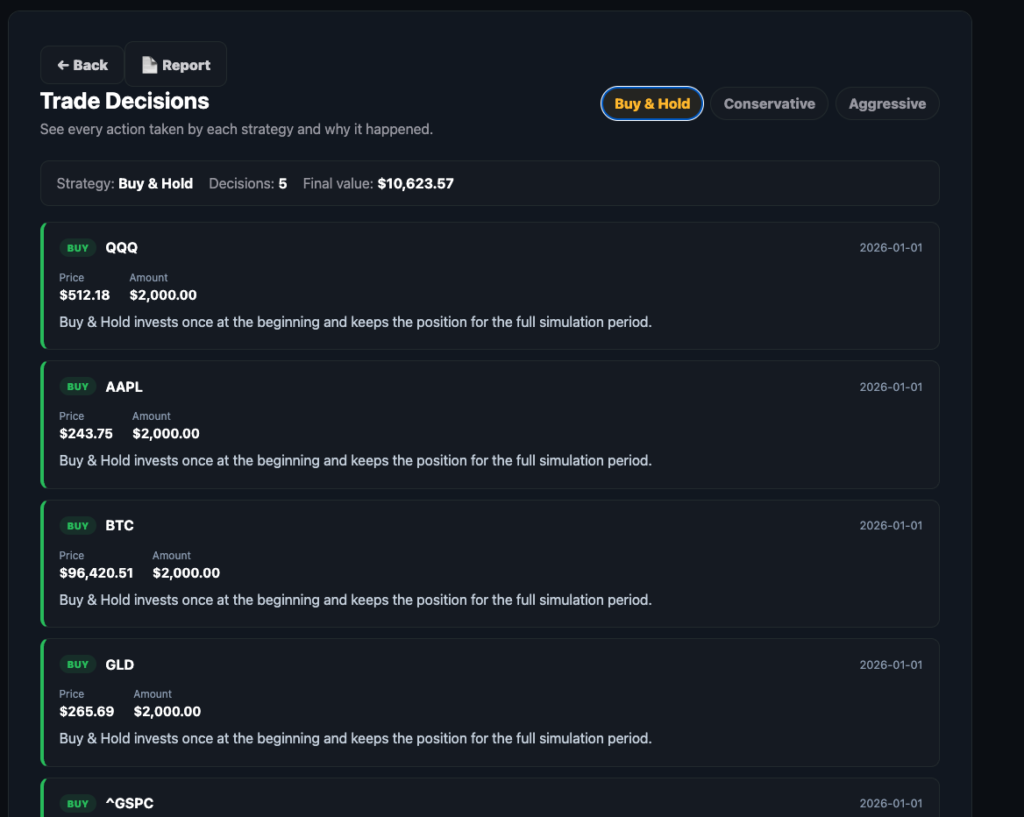
Using the Crown Altessa educational investment simulator, we compared a concentrated portfolio with a more diversified portfolio using the same historical market period.
The purpose was not to declare a winner.
The objective was to examine how diversification influenced the investing experience when both portfolios were exposed to identical market conditions.
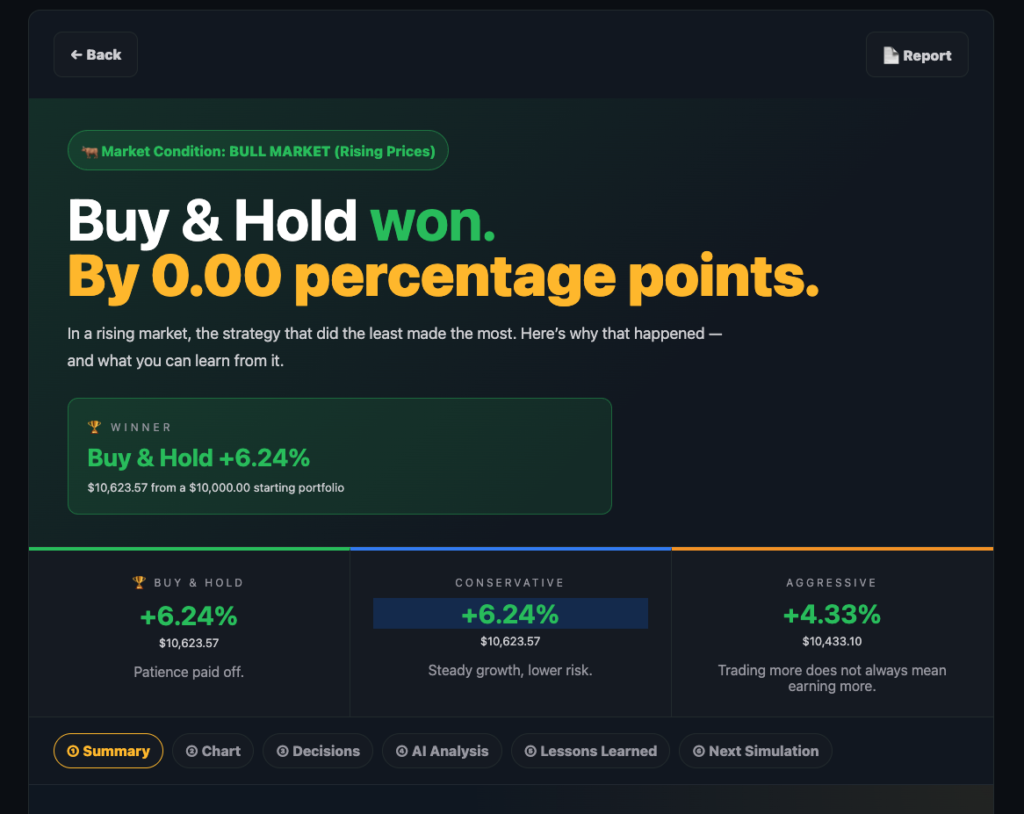
When reviewing the simulation, avoid looking only at the final portfolio values.
Instead, pay attention to the journey.
Ask questions such as:
- Which portfolio experienced the largest temporary declines?
- Which portfolio recovered more steadily after difficult market periods?
- How different did the day-to-day experience feel?
- Did diversification reduce the size of market swings?
- Did one portfolio require significantly more emotional discipline to stay invested?
These observations often provide deeper investing lessons than a single return percentage.
Imagine two investors reaching similar destinations after a long journey.
One travelled along a smooth motorway.
The other crossed winding mountain roads during heavy storms.
Even if they arrived at roughly the same place, the experience of getting there was very different.
Investing can feel exactly the same.
A concentrated portfolio may occasionally deliver outstanding performance.
It may also experience much larger fluctuations along the way.
A diversified portfolio may sometimes lag the strongest-performing individual investment, but it may also provide a smoother experience during periods of uncertainty.
Neither observation automatically proves one strategy is universally better.
It simply illustrates that diversification changes how investors experience risk—not just how portfolios perform.
Historical simulations are particularly valuable because they encourage observation instead of prediction.
Rather than asking, “Which strategy will win next time?”, readers are encouraged to ask, “What can I learn about risk, uncertainty and investor behaviour from what actually happened?”
Why This Experiment Doesn’t Prove Diversification Always Wins
One historical comparison should never be treated as proof that diversification always outperforms concentrated investing.
History is far more complicated than that.
Suppose you repeated the same comparison using a different starting year.
Or a different ending date.
Or a different group of companies.
The outcome could change considerably.
Some historical periods strongly favour concentrated portfolios.
Others reward broader diversification.
Economic conditions constantly evolve.
Inflation changes.
Interest rates rise and fall.
Technological innovation creates new industries while older ones decline.
Consumer behaviour shifts.
Markets adapt.
Because of these changes, no single historical period can represent every future environment.
Another important consideration is asset selection.
Two diversified portfolios are not necessarily similar.
One may contain investments spread across multiple industries, countries and asset classes.
Another may hold many companies that are all influenced by the same economic forces.
Likewise, concentrated portfolios can vary enormously depending on which investments they contain.
This is why careful interpretation matters.
Historical results tell us what happened under one specific set of circumstances.
They do not tell us what must happen next.
This is also why financial professionals frequently remind investors that:
Past performance does not predict future performance.
Historical evidence can improve understanding.
It cannot remove uncertainty.
The Crown Altessa educational simulator reflects this philosophy.
Its purpose is not to recommend investments or identify “winning” portfolios.
Instead, it allows readers to examine historical evidence, question assumptions and better understand how different strategies behaved under real market conditions.
That distinction is essential.
Education helps improve decision-making.
It does not eliminate uncertainty.
Question Your Assumptions
Many investing decisions begin with assumptions that feel completely obvious.
Diversification is one example.
Some investors assume diversified portfolios always outperform.
Others assume concentrated portfolios always produce better long-term returns.
Both assumptions deserve to be tested rather than accepted.
Before running a historical simulation, write down your expectations.
For example:
- Which portfolio do I think will perform best?
- Why do I believe that?
- Which portfolio do I expect to experience the largest declines?
- Which portfolio would make me feel less anxious during market volatility?
- If my concentrated portfolio lost a large percentage of its value, would I realistically remain invested?
Only after writing your answers should you examine the historical results.
Then ask yourself a second set of questions.
- Did the historical outcome match my expectations?
- Which result surprised me the most?
- Did diversification reduce the emotional ups and downs more than I expected?
- If I experienced those historical declines in real life, would I have stayed invested?
- Which assumption about investing changed after seeing the historical evidence?
Notice that none of these questions asks you to predict future markets.
That is intentional.
Successful investing depends less on forecasting and more on understanding uncertainty.
Historical simulations are educational because they encourage critical thinking.
They invite readers to compare beliefs with evidence.
Sometimes those beliefs are reinforced.
Sometimes they change.
Either outcome represents valuable learning.
Most importantly, remember that a historical simulation illustrates how portfolios behaved during one specific period in the past.
It cannot predict how future markets will behave, nor should it be interpreted as investment advice.
Instead, it provides a structured way to think more carefully about diversification, uncertainty and long-term investing.
How Beginners Can Diversify More Thoughtfully
For many beginners, diversification can feel overwhelming.
Should you own ten investments?
Twenty?
One hundred?
Should you invest across every industry?
Every country?
Every asset class?
These questions often make investing seem far more complicated than it needs to be.
In reality, thoughtful diversification isn’t about owning more investments.
It’s about avoiding unnecessary dependence on too few.
The goal is to build a portfolio that supports your financial objectives while recognising that the future is uncertain.
Consider Broad Market ETFs
Many beginners start with exchange-traded funds (ETFs) because they provide exposure to numerous companies through a single investment.
Rather than relying on the fortunes of one business, an ETF can spread exposure across many companies, sectors or even countries.
This doesn’t guarantee positive returns.
If the broader market declines, many ETFs may decline as well.
However, they can reduce the impact of problems affecting any single company.
For someone beginning their investing journey, this can be a practical way to achieve diversification without needing to research dozens of individual businesses.
If you’re still building your investing knowledge, you may also find our guide on why so many people never start investing helpful. It explores many of the emotional barriers that prevent beginners from taking their first steps.
Diversify Across Different Sectors
Even if you choose individual companies, consider whether they all depend on similar economic conditions.
Imagine owning shares in several technology companies.
Although you own multiple businesses, they may still respond similarly to changes in interest rates, consumer spending or industry trends.
A portfolio that includes companies from different sectors—such as healthcare, consumer goods, industrials and utilities—may respond differently as economic conditions change.
Again, this doesn’t eliminate risk.
It simply avoids placing all your expectations on one part of the economy.
Think About Your Time Horizon
Diversification should reflect your financial goals.
Someone investing for retirement over the next thirty years may approach diversification differently from someone saving for a home deposit within five years.
Longer investment horizons have historically provided more time for markets to recover from periods of volatility, although future outcomes remain uncertain.
Understanding your time horizon helps you build a portfolio that matches your objectives rather than your emotions.
Our article on should you save or invest first? explains why your broader financial situation should influence your investment decisions.
Avoid Overconcentration
One of the simplest questions you can ask yourself is:
“What would happen if my largest investment performed very poorly?”
If the answer is that your entire financial plan would suffer, your portfolio may be more concentrated than you realise.
Overconcentration isn’t limited to individual companies.
It can also occur if your investments are heavily exposed to one country, one industry or one type of asset.
Diversification encourages resilience rather than dependence.
Match Diversification To Your Risk Tolerance
Diversification should support your ability to remain invested through changing market conditions.
If your portfolio regularly causes anxiety or tempts you to abandon your long-term plan, it may be worth reassessing whether your investment strategy truly reflects your personal risk tolerance.
Investing is not a competition.
A portfolio that allows you to remain disciplined through market uncertainty is often more valuable than one that constantly pushes you beyond your emotional comfort.
Keep Your Portfolio Understandable
A common mistake is assuming that more complexity automatically creates better diversification.
It doesn’t.
Owning investments you don’t understand simply to increase the number of holdings rarely improves decision-making.
Instead, aim for a portfolio you can clearly explain.
Ask yourself:
- Why do I own this investment?
- How does it contribute to my overall portfolio?
- Does it genuinely increase diversification, or is it simply another version of something I already own?
A portfolio you understand is generally easier to maintain during uncertain markets.
Ultimately, diversification isn’t about creating the largest collection of investments.
It’s about creating a portfolio that supports your long-term goals while accepting that uncertainty can never be completely removed.
Frequently Asked Questions
What is diversification?
Diversification is the practice of spreading investments across different companies, sectors or asset classes to reduce reliance on any single investment. Its purpose is to manage investment risk, not eliminate it.
Does diversification eliminate investment risk?
No.
Diversification reduces certain types of risk—particularly those affecting individual companies—but it cannot eliminate broader market risks. Even diversified portfolios can lose value during periods of widespread market decline.
Can diversified portfolios lose money?
Yes.
Diversification lowers dependence on individual investments, but it does not protect against every market event. During economic recessions or major financial crises, diversified portfolios may still experience temporary losses.
How many investments should beginners own?
There is no universal number.
The objective isn’t to own as many investments as possible but to avoid unnecessary concentration. Many beginners achieve broad diversification through well-diversified ETFs, while others build diversified portfolios using carefully selected individual investments.
Should beginners diversify?
For many beginners, diversification can provide a practical way to reduce dependence on any single investment while they continue learning about financial markets.
However, diversification should always support your financial goals, investment horizon and personal risk tolerance rather than simply increasing the number of investments you own.
Conclusion
Understanding what diversification is goes far beyond the familiar advice of “not putting all your eggs in one basket.”
At its core, diversification is an acknowledgement of uncertainty.
It recognises that no investor can consistently predict which company, sector or asset will perform best in the future.
Rather than relying on perfect predictions, diversification encourages preparation.
It aims to reduce dependence on any single outcome while accepting that investment risk can never be completely removed.
That perspective requires humility.
Markets will continue to surprise investors.
Unexpected events will continue to occur.
Periods of strong performance will be followed by periods of uncertainty.
Diversification doesn’t prevent these realities.
It helps investors navigate them more thoughtfully.
Equally important is discipline.
A diversified portfolio only provides value if you’re able to remain committed to your long-term investment plan during periods of market volatility.
History suggests that emotional decisions often cause more damage than temporary market declines themselves.
Diversification cannot eliminate uncertainty.
But it can help create a portfolio that’s better prepared to face it.
If you finish this article with one key insight, let it be this:
Diversification isn’t about owning more investments. It’s about reducing unnecessary dependence on any single outcome while building a portfolio that supports your long-term goals.
Historical evidence can help challenge assumptions.
Behavioural finance can help explain why those assumptions exist.
Neither can predict the future.
And that’s precisely why thoughtful diversification remains one of the most enduring principles of long-term investing.
If you’d like to explore these concepts in more depth, my beginner-friendly book covers the foundations of personal finance and investing in a practical, easy-to-follow way.
My book on Gumroad:
https://ukandu0.gumroad.com/l/bteyh
Or on Amazon:
Feeling financially stuck?
When financial pressure becomes constant, long-term decisions start feeling emotionally heavy.
The Crown Altessa newsletter was created to help people rebuild clarity slowly and strategically through practical financial frameworks, long-term thinking, and structured decision-making insights.
Join the newsletter and receive:
• the free Financial Foundation Guide
• strategic financial insights
• practical tools for long-term stability
• frameworks designed to reduce financial overwhelm
Start building financial clarity one step at a time.