
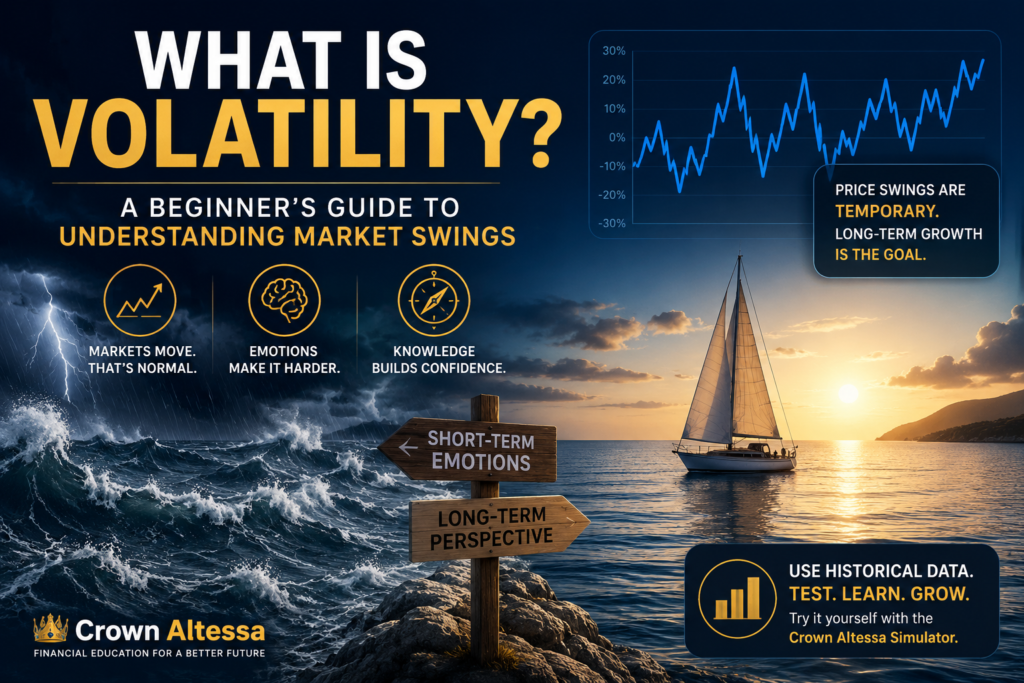
If you’ve ever looked at a stock market chart and wondered why prices seem to rise one day only to fall the next, you’re not alone.
For many beginners, volatility is one of the most confusing parts of investing.
One day the news reports that markets are soaring.
The following week, headlines warn of billions being wiped from the stock market.
It can make investing feel unpredictable, risky and even frightening.
Yet volatility is neither unusual nor necessarily a sign that something has gone wrong.
In fact, market volatility has always been part of investing.
Learning what it is—and just as importantly, what it isn’t—can help you make calmer, more informed financial decisions.
This article explains volatility in simple language, explores why markets move, examines the psychology behind market swings and shows how historical simulations can help investors test assumptions without risking real money.
What Is Volatility?
Volatility describes how much prices move over time.
Some investments experience relatively small price changes.
Others rise and fall much more dramatically.
The greater these price fluctuations, the higher the volatility.
You don’t need complex mathematical formulas to understand the idea.
Imagine walking through a forest.
One path is smooth, with only gentle hills.
Another climbs steeply, drops suddenly and twists around large rocks.
Both paths may eventually lead to the same destination.
The difference is how uneven the journey feels.
Volatility is similar.
It describes how bumpy the journey is—not whether you’ll ultimately reach your destination.
A highly volatile investment experiences larger price movements.
A less volatile investment generally moves more gradually.
One important misunderstanding is worth correcting immediately:
Volatility measures movement—not success or failure.
Prices can move sharply upward.
They can also move sharply downward.
Volatility simply tells us that prices have been changing significantly.
Understanding this distinction helps separate market movement from investment outcomes.
Many new investors assume that large price swings automatically mean something has gone terribly wrong.
Often, that’s simply how markets behave.
Building a solid understanding of personal finance before investing can make these movements much easier to understand. Our article on creating a personal finance system that actually works explains why having a clear financial foundation often makes investing emotionally easier.
Why Does Market Volatility Happen?
Markets constantly process new information.
Every day, millions of investors evaluate news, company results, economic data and global events before deciding whether to buy or sell.
When expectations change, prices often change too.
Some common reasons include:
Economic News
Inflation reports.
Employment figures.
Economic growth.
Consumer spending.
These can influence expectations about the future economy.
Company Earnings
Public companies regularly publish financial results.
If profits exceed expectations, prices may rise.
If results disappoint investors, prices may fall.
Importantly, markets often react not to whether results are “good” or “bad,” but to whether they are better or worse than investors expected.
Interest Rates
Changes in interest rates influence borrowing costs, business investment and consumer spending.
As expectations about future interest rates change, many asset prices move with them.
Fear And Optimism
Markets are driven by people.
People experience emotions.
Optimism can encourage investors to pay higher prices because they expect stronger future growth.
Fear can encourage selling, even when little has fundamentally changed.
Behavioural finance repeatedly shows that markets are influenced by psychology as well as economics.
Uncertainty
Markets dislike uncertainty more than they dislike bad news.
A difficult situation with clear information is often easier for investors to evaluate than an uncertain situation where nobody knows what comes next.
This is one reason why prices sometimes recover even while headlines remain negative: uncertainty begins to decrease.
Understanding uncertainty is an important part of developing financial confidence during uncertain times. Confidence doesn’t come from predicting every market movement. It comes from understanding that uncertainty has always been part of investing.
Volatility Does NOT Automatically Mean Loss
This is perhaps the single most important lesson in this article.
Many beginners assume that falling prices automatically mean they have lost money.
That isn’t always true.
Imagine buying shares in a company for €100.
A month later, the market price falls to €85.
On paper, your investment is worth less than when you bought it.
Has the money permanently disappeared?
Not necessarily.
If you still own the investment, its value may continue changing.
The price could recover.
It could fall further.
Or it could remain around the same level for some time.
The future remains uncertain.
Now imagine a different situation.
An investor becomes frightened by falling prices and immediately sells at €85.
In this case, the temporary decline has become a realised loss.
These two situations are very different.
Temporary price movement is not automatically the same as permanent financial loss.
This distinction helps explain why experienced long-term investors often react differently to market volatility than beginners.
They understand that market prices fluctuate continuously.
The value of an investment on any single day represents only one point in a much longer journey.
Of course, not every investment eventually recovers.
Some companies fail.
Some industries decline.
Some investments never return to previous levels.
This is why diversification and careful investment planning matter.
Volatility should never be ignored.
But neither should it automatically be feared.
Why Volatility Feels Worse Than It Really Is
If volatility is such a normal part of investing, why does it feel so uncomfortable?
The answer lies largely in human psychology.
Our brains evolved to notice threats quickly.
Financial losses often trigger similar emotional responses.
Behavioural economists describe one important concept called loss aversion.
Simply put, people usually experience the pain of losing money more strongly than the pleasure of gaining the same amount.
Imagine two investors.
One gains €1,000.
Another loses €1,000.
Although the financial amounts are identical, the emotional experience often isn’t.
The loss typically feels much more significant.
Another common psychological tendency is recency bias.
People naturally assume that recent events will continue.
After several days of falling markets, it becomes easy to believe prices will keep falling forever.
Likewise, after long periods of rising markets, people often expect gains to continue indefinitely.
Reality is rarely that simple.
Media coverage can amplify these emotions.
Calm markets rarely make front-page news.
Sharp declines do.
Dramatic headlines attract attention, even if the underlying market movements are well within historical norms.
Social media adds another layer.
Investors see screenshots of large losses.
Predictions spread rapidly.
Confident opinions often receive more attention than balanced explanations.
This environment can make temporary market swings feel like permanent crises.
Our article on why smart people still make bad money decisions explores how intelligent people can still make emotional financial decisions—not because they lack knowledge, but because emotions often influence judgment during uncertainty.
Likewise, the hidden cost of constant financial comparison explains why comparing your investment journey with others can make normal market volatility feel far more stressful than it really is.
A Historical Example
One of the most effective ways to understand volatility is to study history rather than relying on headlines.
Instead of asking, “What will happen next?”, ask:
“What happened when different investors experienced the same market?”
Using the Crown Altessa educational simulator, we compared several investment strategies across the same historical market period.
The objective was not to discover the “best” strategy.
Instead, it was to observe how different approaches experienced the same market conditions.
Historical period: [Insert selected historical date range]
Strategies compared:
- Conservative Portfolio
- Balanced Portfolio
- Growth Portfolio
- User Buy & Hold Portfolio
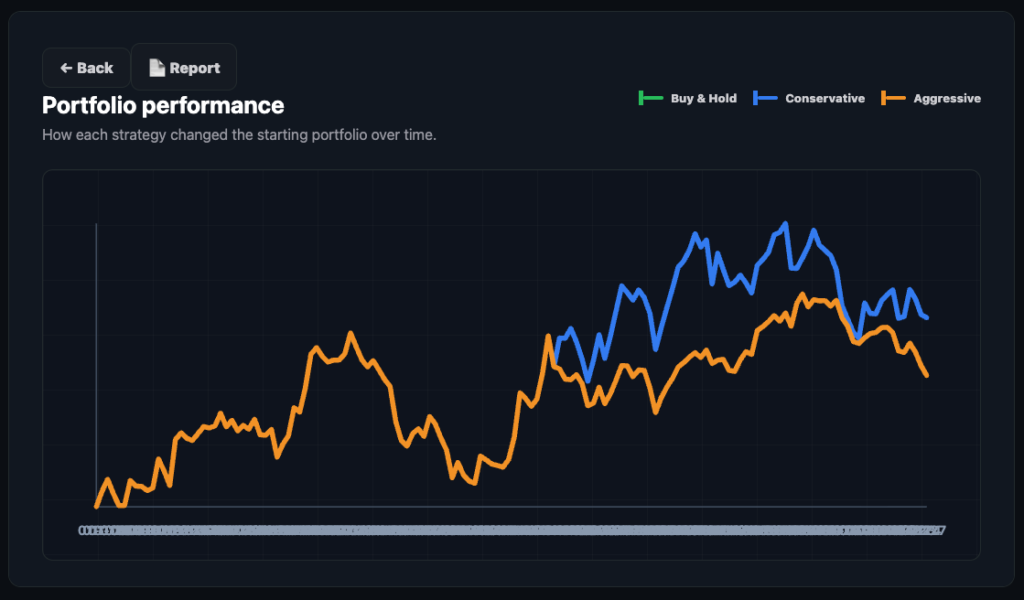
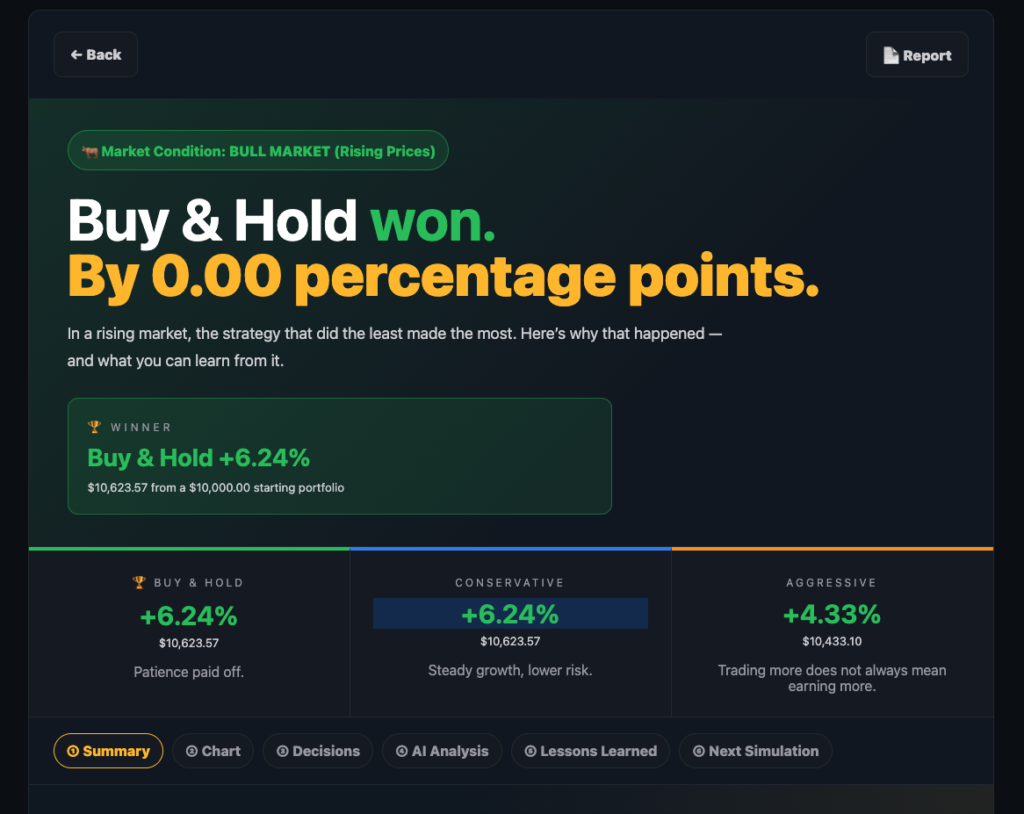
Rather than focusing only on which strategy finished with the highest final value, notice several broader patterns:
- Which portfolio experienced the largest short-term declines?
- Which one recovered more steadily?
- Which strategy appeared emotionally easier to stay invested in?
- How frequently did prices fluctuate?
- How different did the journeys feel even if the long-term outcomes were relatively close?
These observations often teach more than a single percentage return ever could.
The exercise encourages investors to think beyond simple questions like “Which strategy won?” and instead consider how volatility influences behaviour, decision-making and long-term discipline.
What This Historical Example Does NOT Prove
Historical simulations can be valuable educational tools, but it’s important to understand their limitations.
A single simulation should never be treated as evidence that one investment strategy is objectively better than another.
Changing the start date by just a few months can produce very different results.
Selecting a different historical period may change which portfolio appears to perform best, which experiences the largest declines or which feels easiest to hold during periods of uncertainty.
This is why experienced investors avoid drawing broad conclusions from isolated examples.
Instead, they ask broader questions.
- How did different strategies respond under different market conditions?
- Which approach best matched the investor’s tolerance for risk?
- How much volatility was experienced along the way?
- Would I realistically have stayed invested during those periods?
Another important reminder is that past performance does not predict future results.
History provides useful lessons.
It does not provide certainty.
Economic conditions change.
Interest rates change.
Technology changes.
Businesses change.
Investor behaviour changes.
Markets constantly evolve.
Historical simulations are therefore best viewed as learning exercises rather than forecasting tools.
They can improve understanding.
They cannot eliminate uncertainty.
That uncertainty is not a flaw in investing.
It is part of investing.
Learning to become comfortable with uncertainty is often just as important as learning how markets work.
Try It Yourself
One of the best ways to understand volatility is to replace assumptions with observation.
Instead of reading about market swings, explore how different investment approaches behaved during a real historical period.
Using the Crown Altessa educational simulator, choose a historical period and compare several investment strategies using exactly the same dates.
Before running the simulation, write down your expectations.
Ask yourself:
- Which strategy do I think will perform best?
- Which portfolio do I expect to experience the largest price swings?
- Which strategy would I personally feel most comfortable holding during a market decline?
- If markets become volatile, would I be tempted to sell?
Then compare your expectations with the historical results.
Afterwards, reflect on a second set of questions.
- Did the results match what I expected?
- Which portfolio surprised me the most?
- Did I underestimate how often prices fluctuate?
- Would I realistically have stayed invested during the most volatile periods?
Notice that none of these questions asks you to predict the future.
The objective isn’t to become better at forecasting markets.
The objective is to better understand your own assumptions, emotions and reactions.
That kind of self-awareness can become just as valuable as understanding financial terminology.
Remember that historical simulations are educational exercises.
They help illustrate how different strategies behaved in the past.
They do not predict how markets or portfolios will perform in the future.
How Beginners Can Deal With Volatility
Understanding volatility is only the first step.
The next challenge is learning how to respond to it.
Think Long Term
Daily price movements often receive enormous attention.
Long-term investors usually pay more attention to years than days.
The longer your investment horizon, the less important individual market swings often become.
That doesn’t mean volatility disappears.
It means temporary fluctuations generally become a smaller part of the overall picture.
Diversify Your Investments
Different investments rarely behave in exactly the same way at the same time.
Diversification helps reduce the impact that any single investment can have on an overall portfolio.
It doesn’t eliminate investment risk.
But it can reduce the likelihood that one poor-performing investment determines your entire outcome.
Avoid Emotional Decisions
One of the most common investing mistakes isn’t choosing the wrong investment.
It’s making emotional decisions during periods of market stress.
Buying because everyone else appears excited.
Selling because everyone else appears frightened.
Both reactions are understandable.
Neither is guaranteed to lead to better long-term results.
Our article on how to recover financially after making a big money mistake explores why emotional recovery and thoughtful decision-making often matter more than trying to erase past mistakes quickly.
Know Your Risk Tolerance
Every investor is different.
Some people are comfortable seeing large short-term price movements if they believe in their long-term plan.
Others sleep better with investments that fluctuate less, even if long-term returns may differ.
Neither approach is inherently right or wrong.
The important question is whether your investment strategy matches both your financial goals and your emotional comfort with risk.
Build Your Financial Foundation First
Investing becomes easier when your broader financial life is stable.
A realistic budget.
Emergency savings.
Manageable debt.
Clear financial goals.
These foundations can reduce the pressure to react emotionally whenever markets become volatile.
A strong financial foundation often makes it easier to remain patient when investments fluctuate.
Frequently Asked Questions
What is volatility?
Volatility describes how much an investment’s price changes over time.
Higher volatility means larger price movements, while lower volatility generally means prices change more gradually.
Is volatility good or bad?
Volatility itself is neither good nor bad.
It simply describes price movement.
Some investors welcome volatility because it creates opportunities.
Others prefer more stable investments.
The right approach depends on individual goals, time horizons and risk tolerance.
Does volatility mean I will lose money?
Not necessarily.
Volatility measures price fluctuations, not permanent losses.
An investment may experience temporary declines before recovering, although future outcomes are never guaranteed.
Can low-volatility investments still lose money?
Yes.
Lower volatility does not eliminate investment risk.
Investments with relatively stable prices can still decline in value or fail to meet an investor’s expectations.
How should beginners react during volatile markets?
Rather than reacting immediately to market headlines, beginners often benefit from reviewing their long-term investment plan, understanding why markets are moving and avoiding decisions driven purely by fear or excitement.
Conclusion
Volatility is one of the most visible parts of investing, but it is also one of the most misunderstood.
Price movements can feel uncomfortable.
Headlines can make ordinary market fluctuations seem extraordinary.
Emotions can tempt us to confuse temporary uncertainty with permanent outcomes.
The more you understand volatility, the less mysterious it becomes.
Instead of asking whether markets will move tomorrow—a question nobody can answer with certainty—you can focus on questions that are far more useful.
Do I understand why prices move?
Does my investment strategy reflect my goals?
Am I reacting to evidence, or to emotion?
Successful investing is rarely about predicting every market swing.
More often, it’s about developing enough understanding and perspective to remain thoughtful when those swings inevitably arrive.
Knowledge doesn’t remove uncertainty.
But it can make uncertainty much easier to live with.
My book on Gumroad:
https://ukandu0.gumroad.com/l/bteyh
Or on Amazon:
Feeling financially stuck?
When financial pressure becomes constant, long-term decisions start feeling emotionally heavy.
The Crown Altessa newsletter was created to help people rebuild clarity slowly and strategically through practical financial frameworks, long-term thinking, and structured decision-making insights.
Join the newsletter and receive:
• the free Financial Foundation Guide
• strategic financial insights
• practical tools for long-term stability
• frameworks designed to reduce financial overwhelm
Start building financial clarity one step at a time.