
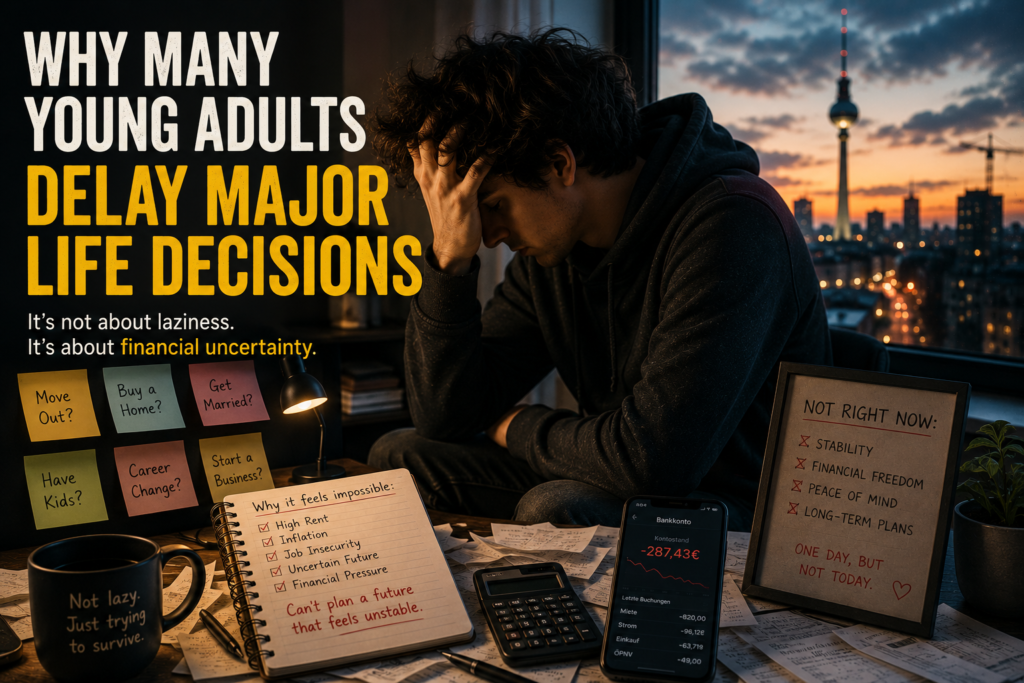
For many young adults today, adulthood no longer follows a clear timeline.
Major life decisions that once felt normal by a certain age — moving out, getting married, having children, buying property, or changing careers — now often feel financially risky or emotionally overwhelming.
Across Germany and much of Europe, many people are not avoiding responsibility. They are trying to navigate an unstable economy while managing rising living costs, financial uncertainty, and emotional exhaustion at the same time.
As a result, delayed adulthood has quietly become part of modern life.
Many young adults are not asking how to become wealthy quickly. They are simply trying to reach a level of stability where long-term decisions feel safe again.
Many young adults also remain with family longer than expected because independent living no longer feels financially realistic.
Why Adulthood Feels Delayed Today
One of the biggest reasons adulthood feels delayed is that financial stability has become harder to build.
In cities like Berlin, Hamburg, Cologne, and Munich, rent prices have increased significantly while salaries often struggle to keep pace with everyday expenses.
Housing costs alone can consume a large percentage of monthly income, especially for people living independently.
At the same time, inflation has increased the cost of groceries, transportation, insurance, and utilities. Even people with full-time jobs may still feel financially insecure despite working consistently.
Temporary contracts, layoffs, unstable industries, and economic instability across Europe have also made long-term planning feel more uncertain.
Many young adults no longer feel confident making major commitments because the future feels difficult to predict financially.
Some people postpone important milestones not because they lack ambition, but because maintaining stability already requires most of their emotional and financial energy.
This creates a growing feeling that adulthood itself keeps moving further away financially.
Why Financial Pressure Delays Important Decisions
Financial pressure affects far more than bank accounts.
It quietly shapes personal decisions, relationships, confidence, and long-term planning.
Many young adults delay moving out because rent prices feel unrealistic compared to their income. Others postpone relationships, marriage, or children because they fear financial instability could place additional stress on their lives later.
Career decisions are also affected.
Some people stay in jobs they no longer enjoy because changing careers feels financially dangerous. Others avoid relocating, pursuing education, or starting businesses because uncertainty feels too risky.
The pressure often comes from fear of making one expensive mistake.
A failed move.
A sudden rent increase.
A job loss.
Unexpected expenses.
Debt accumulation.
Over time, this fear can create emotional hesitation around nearly every major life decision.
Articles discussing financial exhaustion or future insecurity among young adults often explore how economic pressure slowly affects emotional confidence and long-term planning.
The Emotional Weight Of Feeling “Behind”
Modern life constantly exposes people to comparison.
On social media, it often appears that everyone else is progressing faster:
- buying homes
- traveling frequently
- building successful careers
- getting married
- living independently
- achieving financial freedom
In reality, much of online success is carefully curated.
Still, repeated exposure to these images can create emotional pressure and self-doubt.
Many young adults quietly feel:
- financially behind
- emotionally behind
- professionally behind
- socially behind
Even when they are progressing normally under difficult economic conditions.
This emotional pressure can slowly turn into shame, hopelessness, or emotional exhaustion.
Some people begin questioning whether they are failing at adulthood entirely, even though many others around them are experiencing the same financial stress privately.
Articles about why young adults feel financially behind or the hidden financial cost of loneliness resonate strongly today because emotional comparison and financial pressure are deeply connected in modern life.
Why Stability Feels Harder To Build
Building stability today often feels more complicated than previous generations expected.
Saving money has become harder while everyday costs continue increasing steadily.
Many people now balance:
- rent increases
- subscription costs
- transportation expenses
- insurance payments
- groceries
- side hustle pressure
- unstable work conditions
Even workers earning around €2,500–€3,000 net monthly may still struggle to build savings consistently in major German cities after paying rent and essential expenses.
This financial pressure often creates mental overload.
People spend large parts of the day calculating expenses mentally, comparing prices, checking banking apps, budgeting constantly, or worrying about future emergencies.
At the same time, modern culture encourages constant productivity.
Some people feel pressure to monetize hobbies, develop multiple income streams, or continuously improve themselves simply to maintain financial stability.
Over time, this combination of financial stress, emotional spending, subscription culture, and burnout can make stability feel emotionally distant.
Many people are not simply tired physically.
They are mentally exhausted from continuously managing uncertainty.
How Economic Uncertainty Changes Relationships
Economic instability also affects relationships more than many people realize.
Financial pressure can create anxiety around commitment, shared responsibilities, and future planning.
Some couples delay moving in together or postpone marriage because they feel financially unprepared. Others delay having children due to housing costs, unstable employment, or fear of long-term financial insecurity.
In some situations, people remain in shared housing arrangements longer than expected because independent living feels financially unrealistic.
Money concerns can also create emotional tension inside relationships:
- fear of unequal financial responsibility
- anxiety about future expenses
- different spending habits
- uncertainty about long-term stability
Even dating itself can feel emotionally complicated when people already feel financially overwhelmed individually.
This does not mean relationships are failing because people care less about commitment.
Often, people simply feel more cautious because modern financial pressure affects long-term decisions so heavily.
For some people, constant uncertainty eventually turns into decision paralysis, where even small long-term choices begin feeling emotionally overwhelming.
Signs You May Be Living In Survival Mode
Sometimes people adapt to stress so gradually that they stop recognizing how overwhelmed they have become.
Here are some common signs of survival mode:
- difficulty planning ahead
- constant money anxiety
- checking bank balances repeatedly
- emotional exhaustion
- delaying important life goals
- avoiding long-term decisions
- fear of financial emergencies
- guilt around spending money
- difficulty relaxing fully
- mental fatigue from constant budgeting
- feeling emotionally “stuck”
Recognizing these patterns can help people better understand why long-term decisions currently feel emotionally difficult.
Practical Ways To Rebuild Stability Slowly
Rebuilding stability usually happens gradually, not dramatically.
For many people, emotional recovery starts by reducing financial chaos wherever possible.
This may include:
- building a realistic budget
- reducing invisible spending
- limiting unnecessary subscriptions
- simplifying financial routines
- organizing bills clearly
- building small emergency savings slowly
- tracking expenses consistently
Articles discussing how young adults can become financially stable or why young adults in Germany can’t save money often focus on improving financial awareness gradually rather than chasing unrealistic financial perfection.
Reducing comparison culture also helps emotionally.
Not every person online is financially secure.
Not every lifestyle shown online is sustainable.
Not every delay in life means failure.
Sometimes stability itself is progress.
Creating more predictable routines can also reduce emotional overload significantly over time.
Why Slow Progress Is Still Progress
Modern life often creates unrealistic expectations around adulthood.
Online, success is frequently presented as fast, effortless, and highly visible.
In reality, stability usually develops slowly.
For many people, adulthood today involves rebuilding confidence gradually while navigating an unstable economy, rising costs, and emotional uncertainty.
That process can take time.
Slow progress does not mean failure.
Emotional resilience often grows through consistency, realistic expectations, and small improvements repeated over long periods.
Many young adults are learning that realistic adulthood may look very different from what previous generations expected.
And that does not make their progress less valid.
Frequently Asked Questions
Why are young adults delaying adulthood?
Many young adults face rising living costs, financial uncertainty, unstable work conditions, and economic pressure that make long-term planning feel difficult.
Is it normal to feel financially behind?
Yes. Many people across Germany and Europe currently feel financially pressured due to inflation, housing costs, and modern economic instability.
Why is it hard to move out today?
Housing costs in many cities have increased significantly while salaries often struggle to keep pace with rent and essential living expenses.
Why are many people delaying relationships or children?
Financial insecurity, housing concerns, job instability, and fear of long-term financial pressure often influence major relationship and family decisions today.
How can I regain financial stability slowly?
Focus on practical improvements:
- budgeting consistently
- reducing unnecessary expenses
- building emergency savings gradually
- simplifying finances
- reducing comparison culture
- creating more predictable routines
Small realistic improvements often create more sustainable stability over time.
Conclusion
For many young adults today, uncertainty has become part of everyday life.
Financial pressure, rising costs, unstable work, and emotional exhaustion have changed how people think about adulthood and long-term decisions.
But delayed progress does not mean failure.
Many people are slowly rebuilding stability through realistic habits, emotional resilience, and more sustainable expectations for modern life.
Reducing comparison culture, simplifying finances, and focusing on gradual progress can help create a stronger sense of stability over time.
For many people, rebuilding confidence today happens slowly through stability, consistency, and reducing unnecessary pressure over time.
My book on Gumroad:
https://ukandu0.gumroad.com/l/bteyh
Or on Amazon:
Feeling financially stuck?
When financial pressure becomes constant, long-term decisions start feeling emotionally heavy.
The Crown Altessa newsletter was created to help people rebuild clarity slowly and strategically through practical financial frameworks, long-term thinking, and structured decision-making insights.
Join the newsletter and receive:
• the free Financial Foundation Guide
• strategic financial insights
• practical tools for long-term stability
• frameworks designed to reduce financial overwhelm
Start building financial clarity one step at a time.