
Introduction
There is a moment that almost everyone has experienced recently.
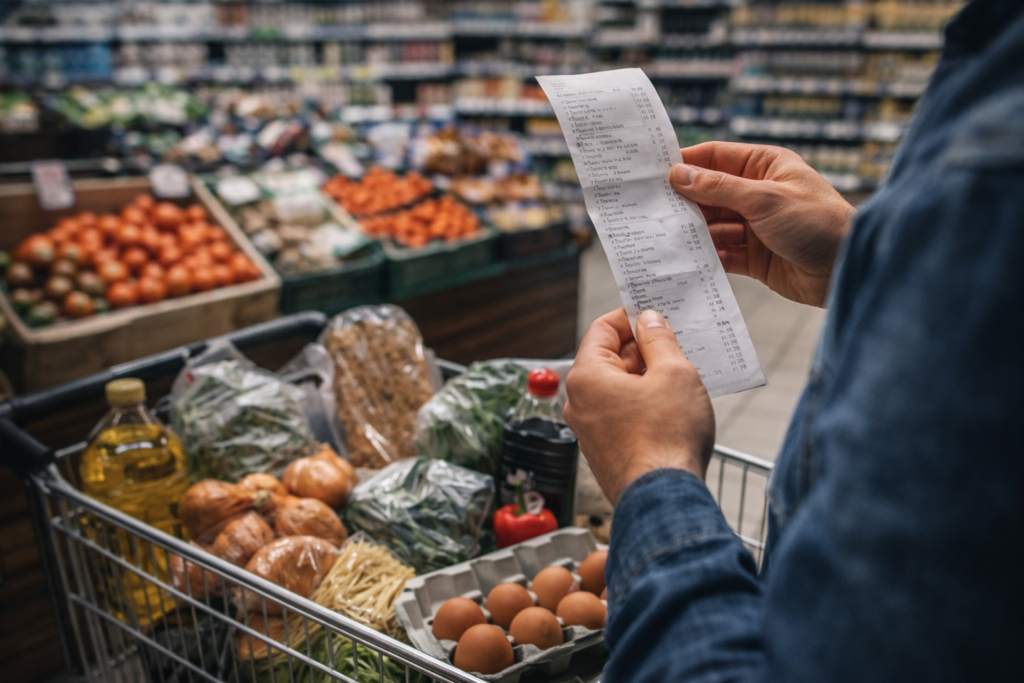
You stand at the checkout, glance at the total, and for a brief second you hesitate—not because you bought anything extravagant, but because what used to feel normal now feels excessive. The same routine, the same habits, the same types of products… yet the outcome has changed.
And that creates a dangerous illusion.
Most people begin to believe the problem is external only: inflation, supply chains, global instability. While all of that is true, it is only half of the story. The other half—the part that determines whether you struggle or adapt—is how you respond to that new reality.
Because when prices rise, unstructured behavior becomes expensive behavior.
This article is not about cutting coupons or chasing discounts. It is about understanding the deeper mechanics of grocery spending—why it spirals out of control, and how to rebuild it into something stable, predictable, and efficient.
What Most People Don’t Realize About Grocery Spending
The uncomfortable truth is that most grocery bills are not high because food is expensive.
They are high because the process of buying food is chaotic.
People do not enter a grocery store with a clear framework. They enter with vague intentions—“I need food,” “I’ll figure it out,” “I’ll just grab a few things”—and that lack of structure creates an environment where every decision is made in real time.
And real-time decisions are almost always emotional.
You see something you like, you remember something you might need, you react to promotions, you respond to hunger, to stress, to convenience. By the time you reach the checkout, your basket is not the result of a plan—it is the result of dozens of small, uncoordinated decisions.
This is what most people fail to understand:
Your grocery bill is not a spending problem. It is a decision-making problem.
And until that is addressed, no amount of “tips” will fix it.
Step 1: Separate Survival From Comfort (This Changes Everything)
One of the most powerful shifts you can make is also one of the simplest—but almost no one does it.
You must stop treating all groceries as equal.
Because they are not.
When you break down what you actually buy, three distinct categories emerge:
- Survival food — ingredients that provide real nutrition and can sustain you (rice, eggs, vegetables, legumes, basic proteins)
- Convenience food — items that save time but cost more (pre-cooked meals, packaged foods, ready-to-eat options)
- Emotional food — purchases driven by craving, reward, or impulse (snacks, sweets, unnecessary extras)
The mistake people make is trying to reduce spending across all categories equally.
That approach fails because it creates frustration without creating control.
A more intelligent strategy is this:
- Protect survival food (never compromise here)
- Control convenience food (use it deliberately, not habitually)
- Restrict emotional food (this is where most waste happens)
Once you see your grocery bill through this lens, something changes. You stop asking, “Why is everything expensive?” and start asking, “What am I choosing to pay for?”
That shift alone can reduce spending significantly—without feeling deprived.
Step 2: Build a Grocery System (Instead of Relying on Willpower)
Most people try to fix their grocery spending with discipline.
That is the wrong approach.
Discipline is unreliable. Systems are not.
If every week you have to decide what to buy, what to cook, what to prioritize, and how to adjust, you are setting yourself up for inconsistency. And inconsistency leads to overspending.
Instead, you need to build a repeatable structure—a system that reduces decision-making and creates predictability.
Start with something simple but powerful:
Define 3–5 core meals that you rotate every week.
Not because you lack creativity, but because repetition creates efficiency.
When meals share ingredients, when preparation becomes familiar, when quantities become predictable, something important happens:
- You stop overbuying
- You stop wasting food
- You stop improvising under pressure
This is the same principle behind financial stability systems —consistency removes chaos.
And chaos is expensive.
Step 3: The Store Is Designed to Beat You — Prepare Accordingly
Here is something most people underestimate:
A grocery store is not a neutral environment.
It is engineered.
Every product placement, every promotion, every visual cue is designed to influence your behavior. Items with higher margins are placed at eye level. Essentials are placed far apart to increase exposure. Discounts are framed to create urgency.
If you walk into that environment unprepared, you are not making independent decisions—you are reacting.
Preparation is not optional. It is protection.
Before entering the store, you should already know:
- What you are buying
- What you are not buying
- What you will do if something is unavailable or overpriced
You are not there to explore.
You are there to execute.
This may sound rigid, but it is precisely this level of clarity that separates controlled spending from reactive spending.
Step 4: Stop Thinking in Prices — Start Thinking in Cost Structures
One of the most subtle but damaging habits is focusing only on the visible price of an item.
Something “looks cheap,” so it feels like a good decision.
But cheap compared to what?
A ready-made meal may cost less upfront than buying ingredients—but it may provide fewer portions, less nutrition, and no flexibility. A branded product may seem “worth it,” but over time, those small differences accumulate into a significant financial gap.
You need to train yourself to think differently.
Not in terms of price—but in terms of structure:
- How many meals does this create?
- How long will this last?
- What alternatives exist at lower cost?
This is how experienced individuals approach spending—not transaction by transaction, but in terms of long-term efficiency.
And once you begin to see purchases this way, impulsive decisions become harder to justify.
Step 5: Waste Is the Silent Destroyer of Your Budget
There is something deeply inefficient about throwing food away—but most people don’t fully grasp the financial impact of it.
Every item that expires, every leftover that is ignored, every ingredient that is bought with good intentions but never used—these are not minor mistakes.
They are direct losses.
And unlike visible spending, waste is invisible enough that people rarely correct it.
The solution is not to buy less.
The solution is to become more deliberate in how you use what you buy.
This means:
- Planning meals based on what you already have, not just what you want
- Freezing food early instead of “hoping” you’ll use it later
- Cooking in realistic quantities, not aspirational ones
Waste is not just about food.
It reflects a deeper issue: a lack of alignment between intention and action.
Fix that—and your grocery bill changes automatically.
Step 6: Adapt Your Identity — Not Just Your Habits
Most people approach rising costs as a temporary inconvenience. They tell themselves that prices will stabilize, that things will “go back to normal,” and that their current habits can remain unchanged if they simply endure the pressure long enough.
That assumption is where the problem begins.
Because when the environment changes in a sustained way—as it has with food prices—continuing to behave as if nothing has changed creates a growing gap between reality and behavior. And that gap is exactly where financial pressure builds.
The issue is not just what you buy. It is how you think about buying.
If groceries become significantly more expensive, but your mindset remains anchored in a cheaper environment, you will constantly feel friction. Every purchase will feel heavier, every decision more frustrating, and over time, this leads either to avoidance or to careless spending driven by fatigue.
This is why adaptation must happen at the level of identity, not just behavior.
You are no longer someone casually navigating prices. You are someone operating in a constrained environment where every decision carries more weight than it used to. That requires a different standard of awareness.
It means pausing before buying—not out of fear, but out of clarity.
It means planning ahead—not because you enjoy structure, but because structure removes unnecessary loss.
It means prioritizing long-term stability—not as a theory, but as a daily practice reflected in small, repeated decisions.
This is not about becoming restrictive or denying yourself everything that brings comfort. That approach rarely lasts and often leads to rebound spending.
It is about alignment.
When your behavior reflects your current reality, something important happens: the internal resistance disappears. You are no longer “trying” to save money, constantly negotiating with yourself, constantly feeling like you are giving something up.
Instead, your actions begin to feel consistent with your situation.
And once that alignment is in place, discipline is no longer something you force—it becomes something you naturally operate within.
What This Really Teaches You
At first glance, this entire discussion appears to be about something simple—groceries, food, everyday spending.
But that surface-level interpretation misses the real value.
Because what you are actually learning here is how to operate when conditions become less favorable than they used to be.
Most people never develop this skill.
When pressure increases—whether through higher prices, reduced income, or unexpected expenses—their response is reactive. They cut randomly, they stress continuously, and they move from one short-term adjustment to another without ever addressing the underlying structure.
That is why the same problems tend to repeat.
But there is another way to respond—one that is less emotional and more deliberate.
You step back.
You observe what has changed.
You identify where inefficiencies exist.
And then you restructure your behavior accordingly.
This is not just a financial skill. It is a decision-making framework.
It is the same principle that applies to investing, to income management, to long-term planning. In every case, the individuals who maintain stability are not those who avoid pressure—they are those who know how to operate within it without losing clarity.
This is why financial discipline is so often misunderstood. It is not about rigid control or constant restriction.
It is about maintaining the ability to think clearly when circumstances would normally push you toward reaction.
Because once you develop that ability—even in something as ordinary as grocery spending—you begin to notice a shift.
You are no longer adjusting blindly to external changes.
You are responding with structure, intention, and awareness.
And that is what ultimately separates temporary survival from long-term stability.
Conclusion
Food is one of the most basic parts of life.
And yet, it is also one of the clearest reflections of how we manage complexity, uncertainty, and change.
Rising grocery prices are not just a financial challenge.
They are a test.
A test of whether you continue operating on habit—or whether you evolve into someone who builds systems, thinks strategically, and acts with intention.
Because once you gain control over something as constant as food spending, something shifts.
You stop feeling like things are happening to you.
And start realizing that, even in a changing system, you still have control over how you operate within it.
Related Resources
- How to Track Your Expenses Effectively
- The 50/30/20 Rule: A Simple Budgeting Strategy
- How to Create a Savings Plan Step-by-Step
My book on GumRoad: How Personal Finance Made Simple Can Transform Your Future
Or on Amazon:
Build Financial Clarity
Join the Crown Altessa newsletter and receive:
• the free Financial Foundation Guide
• practical financial frameworks
• strategic decision-making insights
• tools designed to help you think long term about money and stability
If you want calmer, more structured financial thinking in an uncertain world, subscribe below.