
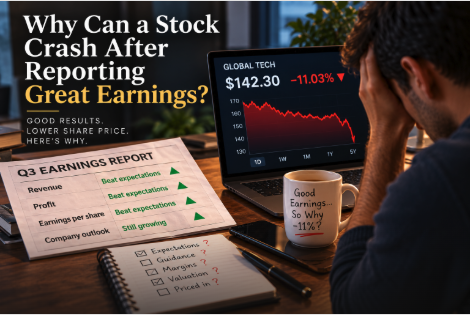
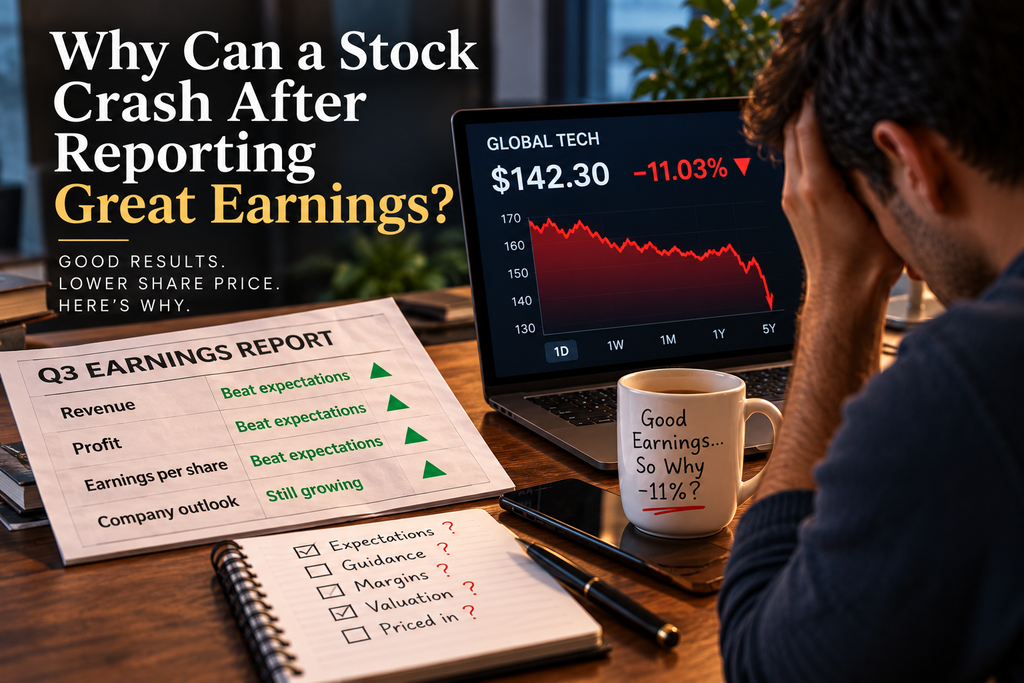
Revenue:
Beat expectations.
Profit:
Beat expectations.
Earnings per share:
Beat expectations.
The company is still growing.
You check the stock the next morning:
-11%.
What exactly did investors want?
At first, the reaction looks absurd. But the market is not asking only:
“Were the results good?”
It is also asking:
“Were they better or worse than what investors had already expected, and what do they tell us about the future?”
That distinction explains many of the strangest post-earnings moves.
The Short Answer: Good Is Not the Same as Better Than Expected
Stocks trade partly on expectations about the future.
By the time an earnings report arrives, investors may already expect:
- strong revenue;
- rapid growth;
- improving margins;
- higher profits;
- optimistic guidance.
If those expectations are already reflected in the stock price, merely delivering good numbers may not be enough to push it higher.
A company can beat last year and still disappoint tomorrow’s expectations.
This is also why a stock’s reaction should not be confused with the performance of the broader market. Your individual holdings can behave very differently from a headline index.
The Market Is Comparing Two Different Numbers
Consider two numbers.
Number 1: What the company actually reported.
Number 2: What investors expected before the report.
The gap between them can matter more to the immediate stock reaction than whether the business improved compared with last year.
Take a hypothetical company.
Last year’s quarterly EPS:
€1.70
This year’s EPS:
€2.10
That is substantial growth.
But suppose investors expected:
€2.25
The company improved considerably and still disappointed.
Now reverse the situation.
Last year’s EPS:
€2.00
This year’s EPS:
€1.80
Profit fell.
But suppose investors expected only:
€1.50
The stock could potentially rise because the result was less bad than feared.
Good results can still be disappointing results.
But What If the Company Actually Beat Analyst Expectations?
This is where the puzzle becomes more interesting.
Suppose:
Analyst consensus EPS: €2.00
Company reports: €2.10
Beat.
Yet the stock falls.
How?
Because published analyst consensus is not necessarily the entire expectation embedded in the market price.
Some investors may have expected an even larger beat. Large institutional investors may use their own forecasts. Expectations may also have changed after the consensus estimate was calculated.
And the EPS number is only one part of the report.
A company can beat the published EPS estimate while disappointing investors on revenue, margins, cash flow, an important business segment or its outlook for the next quarter.
Consensus is a useful reference point. It is not a complete map of everything investors expect.
Why Guidance Can Matter More Than the Earnings Beat
An earnings report mostly tells investors what has already happened.
Guidance tells them what management currently expects to happen next.
Imagine a company reports quarterly revenue of:
€10.2 billion
Analysts expected:
€10.0 billion
Beat.
But management then says it expects next-quarter revenue of:
€9.5 billion
Investors had been expecting:
€10.5 billion
The historical quarter was strong.
The new information about the future was disappointing.
The stock can fall.
This makes more sense once you remember what investors are buying. They are not purchasing last quarter’s profits. They are purchasing an ownership interest whose value depends partly on what the business may earn in the future.
The earnings report looks backward. Guidance points forward.
What Does “Priced In” Actually Mean?
“Priced in” is often used without explanation.
Suppose a stock trades at:
€60
Investors become increasingly optimistic about an upcoming product launch and earnings report.
Over several weeks, buyers push the stock to:
€80
before earnings are announced.
That €80 price may already reflect expectations of excellent results.
Then the company reports excellent results.
But they are roughly as excellent as investors expected.
There may be no new reason for buyers to suddenly pay €85 or €90. Some existing shareholders may also decide that the event they were waiting for has happened and take profits.
The stock can therefore fall despite objectively good results.
“Priced in” does not mean everyone somehow knew the exact earnings numbers beforehand.
It means expectations about favourable outcomes were already influencing what investors were willing to pay.
The Stock May Have Rallied Before Earnings
Imagine:
Three months before earnings:
€50
Day before earnings:
€70
After earnings:
€64
The headline says:
STOCK FALLS 8.6% AFTER STRONG RESULTS
Correct.
But zoom out.
The stock is still:
28% above €50.
The post-earnings fall may partly reflect how much optimism accumulated before the announcement.
Good news can arrive too late to surprise anyone.
That does not mean every pre-earnings rally ends in a selloff. It means the price immediately before earnings matters when interpreting what happens afterward.
For a longer-term perspective, Crown Altessa’s analysis of whether a middle-class worker can build real wealth over 10 years illustrates a very different approach from judging an investment by a single trading session. Crown Altessa
Revenue Can Beat While Something More Important Disappoints
“Revenue beat expectations” sounds comprehensive.
It isn’t.
Depending on the business, investors may also care about:
- earnings per share;
- profit margins;
- free cash flow;
- customer growth;
- subscriber numbers;
- orders or backlog;
- same-store sales;
- individual business segments.
A streaming company may be judged heavily on subscribers.
A retailer may be scrutinised for same-store sales.
A software company might report excellent total revenue while growth in its most important product line disappoints.
“Revenue beat” does not mean “every important number beat.”
Margins Can Turn Great Revenue Into a Disappointment
Consider another hypothetical company.
Last year
Revenue:
€10 billion
Operating profit:
€2 billion
Operating margin:
20%
This year
Revenue:
€12 billion
Operating profit:
€1.8 billion
Operating margin:
15%
Revenue grew by 20%.
That sounds excellent.
But operating profit actually fell.
The company is selling more while generating less operating profit from those sales.
Perhaps labour costs increased. Maybe the company is discounting aggressively to maintain growth. Expansion may have become expensive, input costs may have risen, or competition may be forcing prices down.
The revenue headline looks great.
The economics underneath it look less impressive.
One Important Business Segment Can Ruin the Party
Imagine a large technology company reports an overall revenue beat.
But its cloud division comes in below expectations.
If investors value the company largely because they expect rapid cloud growth, that one disappointment may matter more than a modest overall revenue beat.
The same principle can apply to:
- vehicle deliveries;
- advertising revenue;
- subscriptions;
- bookings;
- store sales;
- orders.
Investors often focus heavily on the part of a business expected to drive its future growth.
That is why reading only the headline EPS and revenue figures can leave you wondering why the market reacted the “wrong” way.
Record Profits Can Still Disappoint
Suppose a company earns:
€5 billion
It is the highest quarterly profit in the company’s history.
Record result.
But investors expected:
€5.8 billion
The company achieved a record and still underperformed expectations.
Or perhaps €5 billion exceeded expectations, but management now expects profit growth to slow sharply.
Record describes the comparison with the past.
The market is also comparing the result with expectations about the future.
Record does not mean unexpected.
Valuation Changes the Reaction
Imagine two companies report identical 20% revenue growth.
Company A trades at a demanding valuation because investors expect exceptional growth for years.
Company B trades at a lower valuation because expectations are modest.
The same 20% growth can produce very different reactions.
If investors were already paying a price that assumed Company A would grow 30%, a 20% result may force them to reconsider those assumptions.
This does not mean highly valued stocks automatically fall after earnings.
It means valuation can tell you something about how much success investors may already be assuming.
It is also one reason relying too heavily on a single company introduces risks that do not disappear merely because the company has performed well historically. Crown Altessa’s broader discussion of building financial stability through diversified long-term investing explains the role diversification can play in reducing dependence on a single investment outcome. Crown Altessa
Imagine Two Companies Reporting Exactly the Same Growth
Company A
Expected growth:
25%
Actual growth:
20%
Company B
Expected growth:
10%
Actual growth:
20%
Both grew 20%.
Yet Company A disappointed expectations while Company B dramatically exceeded them.
Their stock reactions could therefore be completely different.
The result itself did not change.
The starting expectation did.
Management’s Words Can Move the Stock Too
Numbers are only part of an earnings release.
Management may discuss:
- weakening demand;
- higher costs;
- delayed customer orders;
- stronger competition;
- lower future margins;
- regulatory concerns.
The published quarter might look excellent.
Then management says customers are becoming more cautious and the sales pipeline is slowing.
Investors update their expectations.
The stock falls.
This is one reason reacting emotionally to a headline can be misleading. Crown Altessa’s guide to building financial confidence during uncertain times discusses the broader value of making financial decisions from a structured process rather than reacting to every new piece of information. Crown Altessa
Why Can the Stock Fall Before Management Even Speaks?
Because investors do not necessarily have to wait for the earnings call.
The initial release may already contain:
- EPS;
- revenue;
- margins;
- guidance;
- segment results;
- other important metrics.
Algorithmic systems and human investors can respond rapidly to that information.
Management’s later commentary can then change the interpretation again, causing another price movement.
That is why an after-hours reaction and the following day’s closing price can sometimes tell different stories.
Are Investors Just Taking Profits?
Sometimes.
Suppose an investor bought at:
€40
The stock rises to:
€70
before earnings.
The company reports strong results.
The investor decides the outcome they were waiting for has occurred and sells part of the position.
If enough shareholders do that while new buyers are unwilling to pay higher prices, selling pressure can contribute to a decline.
But “profit taking” should not become a lazy explanation for every post-earnings fall.
The broader question is still what the new information did to investors’ expectations and, consequently, what buyers and sellers are now willing to pay.
Why Can a Stock Rise After Terrible Earnings?
The same mechanism works in reverse.
Suppose company profit falls:
30%
That sounds terrible.
But investors expected a:
50% decline
Or perhaps management says conditions are beginning to improve.
The stock may rise.
Bad can be bullish when investors expected worse.
A falling business metric and a rising share price therefore do not automatically contradict each other.
The Stock Price Is Reacting to New Information
Before earnings, investors have one set of expectations.
Then the report arrives.
Those expectations change.
Some buyers are no longer willing to pay the previous price. Others may be willing to pay more. Sellers change the prices they will accept.
The stock moves as those orders interact.
That is the basic price-discovery mechanism behind the reaction. Crown Altessa’s separate article Why Do Stock Prices Move Every Second? goes deeper into bids, asks, trades, liquidity and how those changing orders become the price shown on your screen. This earnings article deliberately focuses on why the information can change expectations, rather than repeating those market mechanics. Pasted text
Does a Post-Earnings Crash Mean the Company Is Bad?
No.
A falling stock can mean:
- expectations were too high;
- guidance disappointed;
- valuation changed;
- margins weakened;
- one important metric disappointed;
- investors revised future assumptions.
It does not automatically mean the company suddenly became financially weak.
Likewise, a rising stock after earnings does not prove the company is excellent.
Separate:
BUSINESS PERFORMANCE
from:
STOCK-PRICE REACTION
They are related.
They are not identical.
Keeping that distinction in mind is part of a broader financial decision-making process. Crown Altessa’s guide to managing your personal finances with a structured system explores how having a plan can reduce reactive financial decisions. Crown Altessa
A Full Earnings-Reaction Example
Consider a fictional company: Alpha Tech.
Three months before earnings:
Stock: €80
Immediately before the report:
Stock: €105
Investors are already optimistic.
Reported quarter
Revenue expected:
€5.0 billion
Actual:
€5.2 billion
Beat.
EPS expected:
€1.50
Actual:
€1.57
Beat.
Everything appears positive.
Then comes the outlook.
Next-quarter revenue expected by investors:
€5.5 billion
Company guidance:
€5.1–€5.2 billion
Expected operating margin:
24%
Company guidance:
21%
After the report:
Stock: €94
What happened?
- Revenue beat.
- EPS beat.
- The stock had already rallied substantially.
- Future revenue guidance disappointed.
- Expected profitability weakened.
- Investors revised their assumptions.
- Sellers became willing to accept lower prices.
Good quarter. Bad reaction. No contradiction.
What Should You Look At Besides “Beat” or “Miss”?
When reading an earnings headline, check:
- Revenue
- EPS or profit
- Year-over-year growth
- Margins
- Free cash flow where relevant
- Important segment metrics
- Guidance
- Changes to previous guidance
- Management commentary
- How far the stock had already moved before the report
The purpose is not to predict what the stock will do next.
It is to understand what investors may be reacting to.
For a broader framework that keeps investing decisions connected to the rest of your finances, Crown Altessa’s personal finance system guide covers how savings, investments and spending can fit within one structure. Crown Altessa
Three Earnings Reactions That Look Strange but Make Sense
Scenario 1: Good Results, Bad Guidance
Revenue:
Beat
EPS:
Beat
Guidance:
Below expectations
Stock:
Falls
Reason: new information weakened the future outlook.
Scenario 2: Record Profit, Expectations Were Even Higher
Profit:
Company record
Market expectation:
Even higher
Stock:
Falls
Reason: record performance still disappointed expectations.
Scenario 3: Bad Results, Less Bad Than Feared
Revenue:
Down
Profit:
Down
Results:
Better than feared
Guidance:
Improving
Stock:
Rises
Reason: investors had prepared for something worse.
Common Misconceptions
“Good earnings always make a stock rise.”
No. Results are interpreted relative to expectations.
“If a company beats analyst estimates, the stock should rise.”
Not necessarily. Published consensus does not capture every expectation reflected in the share price.
“A falling stock means the earnings report was bad.”
No. Guidance, margins or an important business segment may have disappointed.
“Record profit guarantees a positive reaction.”
Record performance can still fall short of expectations.
“Revenue growth means the whole business improved.”
Margins, cash flow and individual segments can tell a different story.
“If the stock falls, investors misunderstood the report.”
The price may be reacting to information beyond the headline numbers.
“Bad earnings always make a stock fall.”
Poor results can still be better than investors feared.
Frequently Asked Questions
Why Do Stocks Fall After Good Earnings?
Because investors compare reported results with expectations. Strong results may already have been reflected in the stock price, while guidance, margins or other important metrics can still disappoint.
Why Does a Stock Fall After Beating Analyst Expectations?
Published consensus may not capture every expectation embedded in the price. Investors might have expected a larger beat, stronger guidance or better performance from an important part of the business.
What Does “Priced In” Mean?
It means expectations about an outcome were already influencing what investors were willing to pay before the news arrived. It does not mean investors knew the exact results beforehand.
Why Does Guidance Affect Stock Prices?
Guidance gives investors information about management’s expectations for future periods. A strong completed quarter can therefore be overshadowed by a weaker outlook.
Can Record Earnings Make a Stock Fall?
Yes. A record result can still fall short of what investors expected, or it can arrive alongside weaker future guidance.
Why Do Stocks Sometimes Rise After Bad Earnings?
Because the results may be less bad than expected, or new information may suggest conditions are improving.
Does a Post-Earnings Drop Mean the Company Is a Bad Investment?
No. A short-term stock-price reaction and the quality or value of the underlying business are separate questions. A post-earnings decline alone is not enough to answer whether an investment is attractive.
Conclusion
Revenue:
Beat.
Profit:
Beat.
EPS:
Beat.
Stock:
-11%.
That reaction no longer looks quite as contradictory once you understand what the market is comparing.
Investors are not simply asking:
“Was the quarter good?”
They are asking:
“Was it better than what we had already expected, and what does it tell us about the future?”
For readers who want a broader foundation in saving, investing and financial decision-making, Personal Finance Made Simple for Beginners is available on Gumroad and Amazon.
The market does not grade earnings against zero. It grades them against expectations.
Feeling financially stuck?
When financial pressure becomes constant, long-term decisions start feeling emotionally heavy.
The Crown Altessa newsletter was created to help people rebuild clarity slowly and strategically through practical financial frameworks, long-term thinking, and structured decision-making insights.
Join the newsletter and receive:
• the free Financial Foundation Guide
• strategic financial insights
• practical tools for long-term stability
• frameworks designed to reduce financial overwhelm
Start building financial clarity one step at a time.