
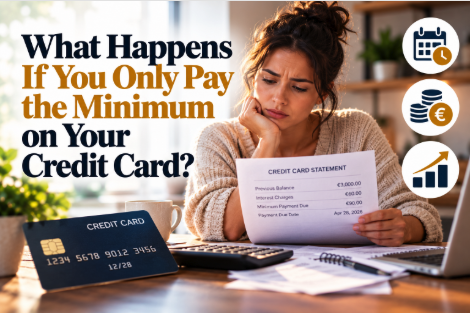
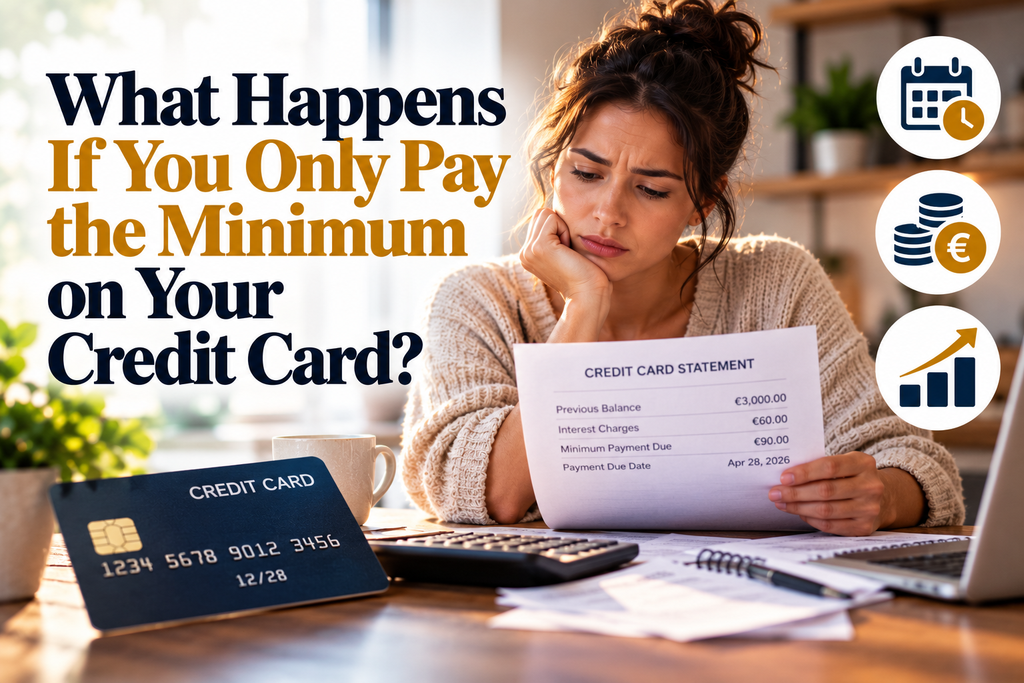
You have €3,000 outstanding on your credit card.
The card charges 24% annual interest, and your latest statement says the minimum payment is €90.
“€90 isn’t too bad,” you think. “I can manage that.”
You make the payment and check your balance a month later.
It’s still around €2,970.
Where did the other €60 go?
In a simplified example, a 24% nominal annual interest rate corresponds to 2% monthly interest. On €3,000, that’s €60 for the first month. Of your €90 payment, only €30 reduces the original debt.
The calculation is illustrative. Actual cards may calculate interest daily, use different annual-rate conventions and charge additional fees.
So what happens if you only pay the minimum on your credit card?
If you pay the required amount on time, your account generally remains current for that payment obligation. But interest can continue accumulating, your balance may decline slowly, and repayment can take years.
Making the minimum payment is not the same as missing a payment. It simply doesn’t guarantee that you’re reducing your debt efficiently.
The real cost depends on your interest rate, repayment terms, fees and whether you continue making purchases.
1. What Is a Credit-Card Minimum Payment?
The minimum payment is the amount your card issuer requires you to pay for a particular billing period.
It is not necessarily the amount needed to repay your debt within a reasonable timeframe.
Different card issuers use different formulas. A minimum might be calculated as a percentage of your balance, a fixed amount, or a combination of interest, fees and a portion of the principal.
Some agreements also specify a minimum monetary floor.
For example, a card might require 3% of the outstanding balance, subject to a €30 minimum.
On a €3,000 balance, 3% equals €90.
But the €90 isn’t entirely repayment of the money borrowed.
Part may cover interest, leaving only the remainder to reduce the balance.
The minimum payment shown on your statement is determined by your actual agreement. There is no universal 3% rule.
In the United States, credit-card statements generally include repayment disclosures showing the potential consequences of making only minimum payments. The Consumer Financial Protection Bureau explains these disclosures.
2. How Credit-Card Interest Actually Works
Credit-card interest is the cost of borrowing money from the issuer.
Your outstanding balance is the amount you owe. The interest rate determines how much additional cost accumulates while that balance remains unpaid.
APR stands for annual percentage rate. The precise way annual rates are expressed and compared depends on the market and product.
Many revolving credit cards calculate interest using daily balances rather than applying one simple monthly percentage.
For example, a card with a 24% nominal annual rate might use a daily periodic rate derived from the annual figure.
That means payment dates, new purchases and changes in the daily balance can affect the interest charged.
The CFPB explains how daily credit-card interest calculations work.
What happens to your interest-free period?
Many cards offer a grace period on purchases when the statement balance is paid in full by the due date.
If you carry a balance, you may lose that benefit. Depending on the agreement, new purchases can begin accumulating interest immediately.
This is one reason a card can become more expensive even when you continue paying every month.
The CFPB’s guidance on credit-card grace periods explains why paying the full statement balance matters.
3. The €3,000 Credit-Card Experiment: Three Repayment Strategies
How much difference can a larger monthly payment make?
Consider three hypothetical people with identical credit-card balances and interest rates.
Each starts with €3,000 in debt. None makes additional purchases.
The only difference is how much they repay.
The assumptions
| Simulation parameter | Assumption |
|---|---|
| Starting balance | €3,000 |
| Nominal annual interest | 24% |
| Monthly interest | 2% |
| New purchases | None |
| Additional fees | None |
| Interest calculation | Monthly |
| Payment timing | End of month |
| Rate changes | None |
Every month, interest is calculated on the opening balance. The payment is then deducted from the balance plus that month’s interest.
All three strategies use the same model, with full-precision calculations and a smaller final payment where necessary. Displayed totals are rounded to cents.
These are educational simulations, not actual card offers or forecasts of an individual agreement.
Strategy A: Pay only an illustrative minimum
The minimum is 3% of the opening balance, subject to a €30 floor. The final payment cannot exceed the remaining amount due.
The first payment is €90.
As the balance declines, the percentage-based payment also declines until the €30 floor applies.
This makes the monthly obligation smaller, but the debt lasts much longer.
Strategy B: Pay a fixed €90
Instead of letting the payment shrink, you continue paying €90 every month until the debt is cleared.
The payment stays consistent even when the required minimum would have fallen.
More of each later payment can therefore go toward reducing principal.
Strategy C: Pay a fixed €150
You commit to paying €150 monthly.
The higher payment reduces the balance more quickly, leaving less principal on which future interest can accumulate.
The repayment results
| Strategy | Repayment time | Total paid | Total interest |
|---|---|---|---|
| Minimum-style | 165 months (13 years, 9 months) | €7,664.33 | €4,664.33 |
| Fixed €90 | 56 months (4 years, 8 months) | €4,993.25 | €1,993.25 |
| Fixed €150 | 26 months (2 years, 2 months) | €3,869.62 | €869.62 |
How much interest could the faster strategies save?
| Compared with minimum-style | Interest saved |
|---|---|
| Fixed €90 | €2,671.08 |
| Fixed €150 | €3,794.71 |
The minimum-style strategy costs more in interest than the original €3,000 borrowed.
By keeping payments fixed at €150, the hypothetical borrower finishes repayment 139 months earlier and saves €3,794.71 in interest.
The comparison doesn’t mean €150 is affordable for everyone. It demonstrates how repayment speed changes borrowing costs.
4. Why Minimum Payments Can Keep You in Debt for Years
Percentage-based minimum payments create an unusual pattern.
As the balance falls, the amount you’re required to pay may fall too.
At first, that feels helpful. A smaller payment leaves more money available for other expenses.
But it can also extend the repayment period.
Imagine someone whose required payment falls from €90 to €75, then €60, and eventually €30.
If they always pay only the required amount, their payments decline just as the outstanding debt becomes smaller.
The result is a long repayment tail.
Interest continues to accumulate on the remaining balance, even when the amount owed seems modest.
This doesn’t mean minimum payments are inherently irresponsible. For someone facing a difficult month, paying the required amount may be the most realistic option.
The problem is treating that temporary payment level as a long-term repayment strategy without examining its cost.
5. What Happens If You Keep Using the Card?
Repayment becomes more complicated when new purchases are added.
Suppose you pay €90 toward your credit card but then charge €100 in new purchases.
Even before accounting for interest, you’ve added more debt than you’ve repaid.
With the earlier example, approximately €60 of the first €90 payment covers interest. Only €30 reduces the principal.
Adding €100 in purchases would leave the balance approximately €70 higher than it was before the payment cycle.
Actual timing and interest treatment may differ, but the underlying problem remains.
You can make payments every month without meaningfully reducing your debt.
A larger balance also means less available credit and potentially more interest.
One practical approach is to stop using the card temporarily while paying down the existing balance.
That makes progress easier to measure because new borrowing no longer offsets repayments.
For people who regularly reach the end of the month with little money remaining, Crown Altessa’s article No Money Left After Bills? Here’s What to Do offers a way to examine the household budget before adding further borrowing.
6. Does Paying Only the Minimum Hurt Your Credit Score?
Making the required minimum payment on time is not the same as missing a payment.
However, maintaining a large revolving balance may still affect creditworthiness, depending on the country and scoring system.
United States
US credit-scoring systems commonly consider payment history and credit utilization.
Credit utilization describes how much of your available revolving credit you’re using.
For example, owing $3,000 on a card with a $4,000 credit limit means using 75% of that limit.
Paying only the minimum may keep your account current, but it can leave utilization elevated.
That may affect your credit score even without a late payment.
The effect depends on the scoring model and your broader credit file. There is no reliable universal prediction of how many points a particular payment will change.
The CFPB’s credit-reporting resources explain how credit information is used.
Germany
Germany’s SCHUFA system operates differently from US credit-scoring models.
You should not assume that US credit-utilization percentages produce the same effects on a German SCHUFA score.
Credit products, outstanding obligations, account history and repayment problems can be relevant to lending decisions, but the impact depends on the information available and the lender’s assessment.
A timely minimum payment should not automatically be described as a negative SCHUFA entry.
The more important distinction is between managing an agreed repayment arrangement and failing to meet contractual obligations.
7. Germany vs. the United States: Not Every Card Works the Same Way
Much online advice about credit-card minimum payments assumes a US-style revolving credit card.
German consumers may have a different arrangement.
Charge cards
A charge card generally collects the statement balance in full according to its billing schedule.
The user receives a short payment delay but does not ordinarily carry the balance forward through a standard revolving repayment arrangement.
Revolving credit cards
A revolving card allows eligible balances to be repaid over time.
In Germany, this is often described as Teilzahlung or Teilzahlungsfunktion.
The issuer may collect a selected percentage of the balance, subject to a minimum amount.
Interest is generally charged on the unpaid balance under the agreement.
Some cards allow users to change their repayment percentage or switch to full settlement.
Debit cards
A debit card typically deducts purchases from a linked bank account rather than creating an interest-bearing revolving balance.
An overdraft on that account is a separate borrowing arrangement with its own terms.
Germany’s Verbraucherzentrale explains charge cards, revolving credit cards, debit cards and the interest costs of partial repayment. Germany’s financial regulator, BaFin, also explains how revolving credit cards with a Teilzahlungsfunktion can make borrowing expensive.
Before deciding how much to repay, check your card agreement.
Does it automatically collect the full statement balance? Is partial repayment enabled? What interest rate applies, and can the repayment setting be changed?
Those details determine whether the minimum-payment problem applies to your card at all.
8. Five Ways to Pay Off Credit-Card Debt Faster
There are several ways to reduce repayment time without assuming that everyone can suddenly double their monthly payment.
1. Pay more than the required minimum
Even a modest additional amount can reduce principal and future interest.
The €3,000 simulation shows how maintaining a higher payment can substantially shorten repayment.
Choose an amount that doesn’t prevent you from covering essential expenses.
2. Stop adding new purchases temporarily
Using a debit card or another payment method funded by available money can make it easier to avoid increasing the revolving balance.
The aim is to prevent new borrowing from cancelling out your repayments.
3. Set a fixed repayment amount
If your required minimum decreases as the balance falls, consider keeping your payment fixed.
A consistent €90 payment can repay the illustrative debt much faster than a declining percentage-based minimum.
For a broader approach to organizing bills and repayment commitments, see Crown Altessa’s guide to building a personal finance system that keeps you in control.
4. Choose between the debt avalanche and debt snowball
If you have multiple debts, two common strategies are:
Debt avalanche: Make required payments on every debt, then direct additional money toward the highest-interest balance.
Debt snowball: Make required payments on every debt, then direct additional money toward the smallest outstanding balance.
The avalanche method generally minimizes interest when other relevant conditions are equal.
The snowball method can provide earlier account closures, which some people find easier to maintain.
Neither guarantees success. The right approach must fit your actual cash flow.
5. Consider refinancing or a balance transfer carefully
Moving expensive credit-card debt to a lower-interest product may reduce borrowing costs.
But compare the full terms, not just the advertised rate.
Balance-transfer fees, introductory-rate expiration, repayment periods and eligibility can change the result.
A new loan also doesn’t solve the underlying problem if additional credit-card borrowing continues.
9. Should You Use Savings to Pay Off Credit-Card Debt?
Paying 24% annual interest while earning a much lower return on savings can be financially expensive.
Using some savings to reduce high-interest debt may therefore make sense.
But emptying every savings account creates another risk.
If an unexpected medical bill, urgent repair or job interruption occurs, you may need to borrow again.
The decision depends on income stability, essential expenses, the debt’s interest rate and how much emergency cash remains.
Someone with secure income and substantial reserves faces a different situation from someone whose employment is uncertain.
Crown Altessa’s guide to creating a savings plan that actually works can help readers distinguish emergency savings from money available for other goals.
For a broader discussion of why accessible reserves matter during financial disruptions, see Building Stability When the System Shifts.
The aim is to reduce expensive debt without creating an immediate cash-flow emergency.
10. What If You Cannot Afford More Than the Minimum?
Sometimes the minimum payment is genuinely all a household can manage.
In that situation, meeting the contractual obligation may be the most practical short-term choice.
Start by reviewing essential expenses: housing, food, utilities, transport and other necessary commitments.
Identify whether any spending can be reduced without jeopardizing those essentials.
Avoid additional borrowing where possible.
If you believe you’ll struggle to make the next required payment, contact the issuer before the due date.
Ask whether hardship assistance, a repayment arrangement or another contractual option is available.
Approval is not guaranteed, and changes may affect interest, account access or repayment terms.
If debts are becoming unmanageable, seek independent advice.
In Germany, recognized Schuldnerberatung services are available through municipalities, welfare organizations and consumer centers. The Verbraucherzentrale explains how to identify reputable debt counseling.
US readers can consult the CFPB’s debt collection and repayment guidance and reputable nonprofit credit-counseling services.
Be cautious about companies promising instant debt elimination or demanding substantial upfront fees.
Debt repayment needs to be sustainable, not merely impressive on a spreadsheet.
11. The Crown Altessa Credit-Card Repayment Check
Before making your next payment, review these eight questions.
- What is my current outstanding credit-card balance?
- What annual interest rate applies to that balance?
- How does my issuer calculate the minimum payment?
- How much of my last payment went toward interest rather than principal?
- Am I continuing to make new purchases on the card?
- What fixed monthly payment could I realistically afford?
- How many months would repayment take at that amount?
- Do I need professional assistance managing my debts?
You can find most of the information on your latest credit-card statement and in your card agreement.
Once you know the balance, interest rate and affordable payment, use a repayment calculator or spreadsheet to estimate how long clearing the debt could take.
If you need help establishing a complete picture of your income and expenses, Crown Altessa’s guide to managing your personal finances explains how to organize your budget and financial commitments.
Review the estimate whenever your interest rate, payment amount or financial circumstances change.
12. Frequently Asked Questions
Is it bad to pay only the minimum on a credit card?
Not necessarily. Paying the required minimum on time generally keeps you current on that payment obligation. However, repeatedly paying only the minimum can make repayment slower and increase total interest costs.
Does paying the minimum avoid late fees?
Generally, paying at least the required minimum by the due date avoids a late-payment fee for that billing cycle, provided you meet the applicable terms. Other fees or charges may still apply.
Will my credit-card balance eventually reach zero if I only pay the minimum?
It can, provided the payments are sufficient to cover accruing interest and reduce principal, and you stop adding new debt.
Some minimum-payment formulas can result in extremely long repayment periods. The outcome depends on the agreement, interest rate and additional charges.
Why is my credit-card balance barely decreasing?
A substantial portion of your payment may be covering interest. New purchases, fees or changes in the interest rate can also offset progress.
Review your statement to see how payments and interest are being applied.
Does paying the minimum affect my credit score?
An on-time minimum payment is not equivalent to a missed payment.
In the United States, carrying a high balance relative to available credit can affect credit utilization and scoring. German credit assessments use different systems and should not be assumed to follow identical rules.
Is it better to pay €50 extra or save that money?
It depends on the interest rate, emergency savings, income stability and upcoming essential expenses.
An additional €50 toward high-interest debt may save substantial interest over time, but keeping sufficient emergency cash can reduce the need for future borrowing.
Can I change my credit-card repayment percentage in Germany?
Some German revolving credit cards allow customers to change their Teilzahlung percentage or select full repayment.
Others have different contractual arrangements. Check your issuer’s app, account settings or card agreement before making changes.
Conclusion
Think back to the €3,000 credit-card balance from the beginning.
A €90 minimum payment initially seemed manageable.
But with 24% nominal annual interest, approximately €60 of that first payment went toward interest in our simplified example.
The repayment comparison shows why the long-term consequences matter.
Under the illustrative assumptions, declining minimum-style payments stretched repayment to 165 months and generated €4,664.33 in interest.
A fixed €150 monthly payment reduced repayment to 26 months and interest to €869.62.
The difference was not the original amount borrowed. It was how quickly the balance declined.
Before making your next payment, check your actual interest rate, repayment terms and outstanding balance. Then consider what repayment amount is sustainable without putting essential expenses at risk.
The most useful question isn’t simply, “Can I afford this month’s minimum?”
It’s, “How much will this debt cost me if I continue paying this way?”
The minimum payment tells you what you must pay this month. It doesn’t tell you what the debt will cost you in the end.
Continue Building Your Financial Foundation
Understanding credit-card interest is an important step toward making better financial decisions. If you want a practical introduction to budgeting, saving, managing debt and building stronger money habits, explore Personal Finance Made Simple for Beginners.
Get the book:
Feeling financially stuck?
When financial pressure becomes constant, long-term decisions start feeling emotionally heavy.
The Crown Altessa newsletter was created to help people rebuild clarity slowly and strategically through practical financial frameworks, long-term thinking, and structured decision-making insights.
Join the newsletter and receive:
• the free Financial Foundation Guide
• strategic financial insights
• practical tools for long-term stability
• frameworks designed to reduce financial overwhelm
Start building financial clarity one step at a time.