
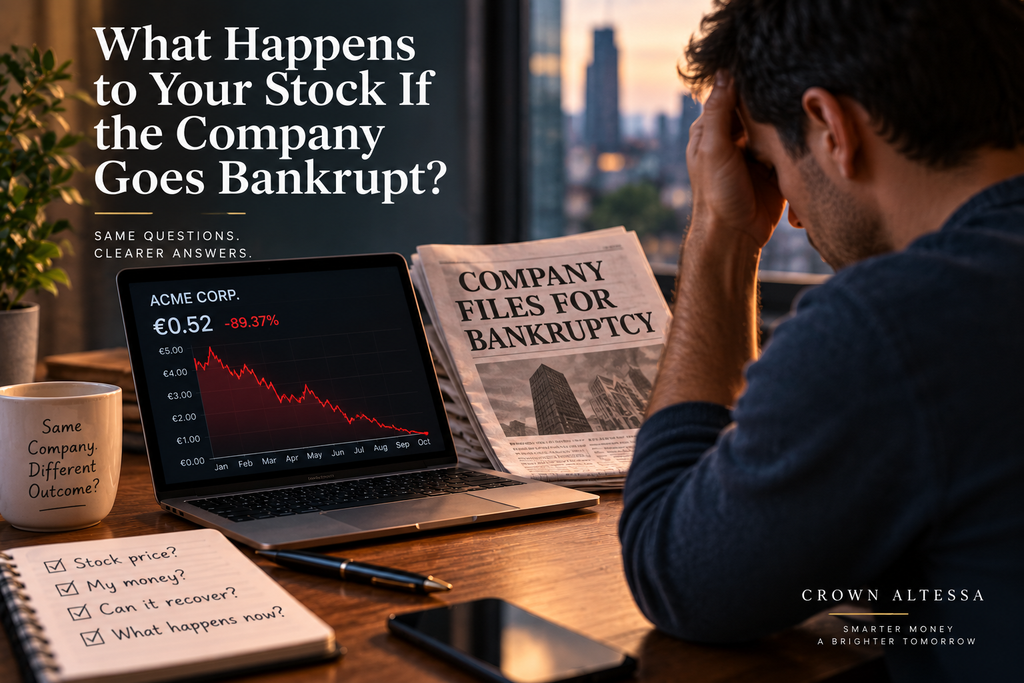
You bought €5,000 of a company’s stock.
A few months later, the headline appears:
COMPANY FILES FOR BANKRUPTCY
The stock is already down 90%.
Your €5,000 position is now worth roughly €500.
What happens next?
Is the remaining €500 still yours? Can the shares recover? Does bankruptcy immediately send the stock to zero? What if the company survives?
The uncomfortable but important answer is:
A company can survive bankruptcy while its old shareholders lose most or all of their investment.
Understanding why requires separating the business from the old equity.
The Short Answer
If a company enters bankruptcy, common shareholders are generally among the lowest-priority groups entitled to whatever value remains after higher-priority claims are addressed.
Creditors come first.
If there is not enough value to satisfy those claims, common shareholders may receive nothing.
In the United States, the SEC warns that common stock in a bankrupt public company is likely to be worthless because equity sits behind creditors in the bankruptcy process. Even a successful reorganisation often cancels the existing common shares. Investor
The stock may nevertheless continue trading for some time. It can be delisted, trade over the counter, become severely illiquid, be heavily diluted, or eventually be cancelled.
The precise process varies by country and case. U.S. Chapter 7 and Chapter 11 rules, for example, should not be assumed to apply identically elsewhere.
Bankruptcy Does Not Always Mean the Company Disappears
Bankruptcy and business disappearance are not the same thing.
Depending on the jurisdiction and legal process, a distressed company might:
- liquidate and cease operating;
- sell some assets;
- restructure debt;
- renegotiate obligations;
- continue operating while reorganising;
- emerge with different owners and a different capital structure.
Under current U.S. law, Chapter 11 is primarily a reorganisation process designed to allow a debtor to propose a plan while often continuing its business. Chapter 7 generally involves liquidation. United States Courts
That distinction produces one of the strangest outcomes for new investors:
The business can survive while the old stock does not.
Factories may remain open. Employees may still go to work. Customers may continue buying products.
Yet the shares you owned before the restructuring can still end up worthless.
Why Shareholders Are Near the Bottom of the Line
A share makes you an owner.
A bond or loan makes the holder a creditor.
That difference becomes crucial when a company no longer has enough value to satisfy everyone.
In a highly simplified U.S.-style illustration, claims may broadly be addressed in an order resembling:
- secured creditors;
- administrative expenses and certain priority claims;
- unsecured creditors, which can include many bondholders and suppliers;
- preferred equity;
- common shareholders.
Actual priority depends on the jurisdiction, security interests, claim type, restructuring plan and individual case. This is not a universal bankruptcy waterfall.
The principle is what matters:
Common shareholders own the residual value.
They receive value only after higher-ranking claims have been dealt with.
The SEC puts the distinction clearly: bondholders are creditors and have priority over shareholders in bankruptcy. Investor
This is also why diversification matters when investing. A company-specific failure can be devastating when one stock represents a large percentage of your portfolio, even though diversification cannot remove all investment risk. Crown Altessa
A Simple Bankruptcy Example
Imagine a company is liquidated.
Assets available after the relevant process:
€100 million
Creditor claims:
€140 million
There is not even enough value to repay creditors in full.
Common shareholders are therefore unlikely to receive anything.
Now imagine a different restructuring.
Estimated reorganised business value:
€200 million
Higher-ranking claims and restructuring obligations:
€170 million
At first glance, it looks as though €30 million remains.
But that does not automatically mean old shareholders receive €30 million.
The restructuring plan, legal priorities, valuation disputes, new financing and other terms determine what happens to the old equity.
The example only illustrates why the value left after other claims is what matters to shareholders.
Can the Stock Keep Trading During Bankruptcy?
Yes, sometimes.
This often surprises investors.
A company can file for bankruptcy and still have shares changing hands.
In U.S. markets, the SEC notes that bankrupt-company shares may continue trading after the filing. Companies in bankruptcy often fail to meet major-exchange listing standards, but shares can sometimes continue trading over the counter after delisting. Investor
Why would anyone still trade them?
Possible reasons include:
- speculation about shareholder recovery;
- uncertainty about the restructuring;
- short covering;
- rumours;
- traders attracted by the extremely low share price;
- misunderstanding of what the bankruptcy plan may do to the old equity.
Continued trading is not evidence that the shares are financially healthy.
Trading does not mean safety.
What Does Delisting Mean?
Delisting means the stock is removed from an exchange such as Nasdaq or the NYSE.
It does not necessarily mean the shares instantly cease to exist.
Depending on the market and circumstances, they may:
- trade in an OTC market;
- become much less liquid;
- develop wider bid-ask spreads;
- become difficult to sell;
- eventually be cancelled.
FINRA notes that companies seeking bankruptcy protection are among the securities that may end up trading over the counter after failing exchange listing requirements. FINRA
Poor liquidity can also make execution much less predictable. That matters because an apparent market price does not guarantee that a large position can actually be sold at that price.
Can Your Shares Become Worthless Even If the Company Survives?
Yes.
This is the central paradox.
A company may emerge from restructuring with:
- less debt;
- new financing;
- new owners;
- new shares.
Meanwhile, the old shares are cancelled.
The SEC specifically warns that successful reorganisation does not mean old common shareholders survive with the business; reorganisation plans frequently cancel the existing equity. Investor
Imagine a heavily indebted airline.
After restructuring:
The aircraft still fly.
The brand still exists.
Employees remain.
Customers still book flights.
But creditors may now own much of the reorganised business through newly issued equity.
Someone who owned the pre-bankruptcy shares may own nothing.
The business can survive while the old stock does not.
Why Would Old Shares Be Cancelled?
Because the company may owe more than its old capital structure can support.
Creditors might agree to restructure their claims in exchange for:
- new shares;
- new debt;
- cash;
- a combination of these.
That can effectively transfer ownership from the old shareholders to creditors or new investors.
Existing equity may also be massively diluted rather than completely eliminated.
Either way, what matters is not simply whether the company continues operating.
It is whether enough residual value remains for the old common equity after the restructuring claims are resolved.
What Happens If the Company Issues New Shares?
A reorganised company may issue an entirely new class of common stock.
Those shares can belong primarily to:
- creditors receiving equity as part of the restructuring;
- investors providing new capital;
- other restructuring participants.
The new company may even trade under a new ticker.
Owning the pre-bankruptcy stock does not automatically give you an equivalent stake in those new shares.
The SEC notes that creditors frequently become owners of newly issued stock when a company emerges from U.S. bankruptcy, while old common stock is often cancelled. SEC
Sometimes old shareholders receive something.
Sometimes they receive nothing.
The restructuring plan determines the treatment.
What About Preferred Shareholders?
Preferred shares generally rank ahead of common shares in a liquidation hierarchy, but behind debt claims.
Investor.gov confirms that preferred shareholders generally have priority over common shareholders if a company’s assets are liquidated. Investor
That does not guarantee recovery.
If insufficient value remains after creditor claims, preferred shareholders can still suffer substantial or complete losses.
What About Bondholders?
Bondholders are creditors rather than owners.
That generally gives them a stronger claim than common shareholders.
But bondholders are not automatically protected from loss either.
Different bonds can have different:
- seniority;
- collateral;
- contractual protections;
- recoveries.
A restructuring can leave bondholders receiving less than the amount originally owed or receiving new securities instead of cash. SEC
Why Can a Bankrupt Stock Still Go Up 100%?
This is where percentages become misleading.
Suppose a stock falls from:
€20
to:
€0.20
Then it doubles to:
€0.40
The headline says:
STOCK SOARS 100%
Sounds spectacular.
But relative to the original €20:
€0.40 represents a 98% decline.
A 100% bounce from a tiny base does not mean the business or old equity has recovered.
Such moves can be driven by speculation, rumours, thin liquidity or traders betting on uncertain restructuring outcomes.
The same behavioural pressures that encourage investors to chase apparently extraordinary opportunities are explored in Crown Altessa’s guide to why smart people still make bad money decisions. Crown Altessa
A 100% bounce can still leave you down 98%.
Why “It’s Only €0.20” Is Not a Good Reason to Buy
A share price tells you the price of one share.
It does not tell you whether the equity is cheap.
A €0.20 stock may be economically expensive if the existing equity is likely to be cancelled.
A €200 stock may represent a financially strong company with substantial earnings and assets.
Cheap-looking is not the same as cheap.
This is especially dangerous when financial distress creates a feeling that a stock “cannot fall much further.”
It can.
€0.20 can become €0.
That is also why starting with a smaller amount of investment capital does not mean you need to compensate by taking extreme risks. A sustainable investment plan is very different from betting on a distressed share because the nominal price looks accessible.
What Happens to Dividends?
Dividends are particularly vulnerable when a company is in serious financial distress.
A company trying to conserve cash may reduce or suspend distributions.
In a formal restructuring, payments to shareholders may also be constrained by the company’s financial circumstances, financing arrangements or legal process.
The exact treatment varies, but a shareholder should not assume historical dividends will continue unchanged simply because they were paid before the financial crisis.
What Happens to Options or Other Securities?
Options, warrants and other derivatives can be affected by:
- delisting;
- restructuring;
- corporate actions;
- contract adjustments;
- broker rules;
- exchange or clearing procedures.
Their treatment can be very different from ordinary shares.
If you hold derivatives on a distressed company, check the specific contract, broker and relevant exchange or clearing-house documentation rather than assuming the common-stock outcome applies automatically.
What If You Own the Company Through an ETF?
This changes the scale of the problem.
Imagine two investors.
Investor A holds €20,000 entirely in one company’s shares.
Investor B holds €20,000 in a broad ETF owning hundreds of companies, and the bankrupt company represents only 0.2% of the fund.
If that company’s equity becomes worthless, Investor A can face a devastating loss.
For Investor B, the effect from that single failure may be far smaller because the exposure is spread across many holdings.
The ETF itself may later remove or replace the company according to its index or portfolio rules.
That does not mean ETFs cannot lose money. Broad market declines can affect many holdings simultaneously.
It illustrates the distinction explained in Crown Altessa’s guide to diversification and company-specific risk: spreading exposure can reduce dependence on one company’s survival without eliminating investment risk. Crown Altessa
It is also why long-term wealth building is usually a different exercise from trying to identify one distressed stock that might rebound. Crown Altessa’s long-term wealth-building example focuses on repeated contributions and diversified exposure rather than relying on one company. Crown Altessa
How Much Can You Actually Lose?
For an ordinary investor who buys shares outright without leverage:
the investment in those shares can fall to zero.
Suppose you invest:
€5,000
The old equity is eventually cancelled with no recovery.
Final value:
€0
Loss:
€5,000
This maximum-loss description applies to an ordinary long-only stock purchase.
It should not be generalised to:
- margin borrowing;
- short selling;
- options;
- leveraged derivatives.
Those structures can create different and potentially larger risks.
Having cash and investments perform separate roles can also prevent one speculative position from becoming money needed for immediate expenses. Crown Altessa’s guide to cash versus investing explains that separation in more detail. Crown Altessa
Can You Claim a Tax Loss?
Potentially, but this is highly jurisdiction-specific.
A worthless investment or a sale at a loss may affect taxes differently depending on:
- your country;
- tax residence;
- account type;
- when the loss is recognised;
- whether the stock was sold or became legally worthless.
Do not assume the tax loss occurs on the bankruptcy filing date.
Do not assume another country’s rules apply to you.
Check the tax guidance applicable to your jurisdiction or seek qualified tax advice where the amount is material.
Should You Sell Before the Bankruptcy Is Finished?
There is no universal answer.
Relevant considerations can include:
- current market value;
- remaining liquidity;
- the restructuring plan;
- potential recovery;
- tax consequences;
- legal status of the existing equity;
- whether your broker still supports trading.
Waiting can produce one outcome.
Selling can produce another.
Neither should be presented as universally correct without knowing the actual security and investor circumstances.
The important distinction is between analysing the recovery prospects and simply refusing to sell because the stock has already fallen substantially. Loss aversion and hope can influence decisions long after the original investment thesis has changed. Crown Altessa’s discussion of financial confidence and making decisions under uncertainty is relevant to that behavioural side of investing. Crown Altessa
Bankruptcy vs Insolvency vs Restructuring
These terms are related but not interchangeable.
Insolvency broadly refers to serious inability to meet financial obligations, although precise legal definitions vary.
Bankruptcy can refer to a formal legal proceeding, with terminology and procedures varying by jurisdiction.
Restructuring means changing obligations or capital structure and may occur inside or outside a formal bankruptcy process.
A headline saying a company is “restructuring” therefore does not automatically tell you what will happen to its shares.
Three Shareholder Scenarios
Case A: One Bad Quarter
A healthy diversified company reports weak results.
Stock falls:
20%
There is no bankruptcy.
That is ordinary business and investment risk, not insolvency.
Case B: Company Enters Reorganisation
The company enters a formal restructuring process.
Stock still trades at:
€0.80
The fact that shares continue trading does not tell you what eventual recovery will be.
Old equity may survive, be diluted or eventually be cancelled.
Case C: Old Equity Is Cancelled
The restructuring is completed.
The company emerges with reduced debt and newly issued shares.
Its stores remain open.
Employees keep working.
But the old common stock is cancelled and the pre-bankruptcy shareholders receive nothing.
The company survived. The investment did not.
Common Bankruptcy Investing Mistakes
Watch for these assumptions:
- bankruptcy means the company instantly disappears;
- company survival means the old shares survive;
- a €0.20 stock must be cheap;
- a 100% bounce proves recovery;
- shareholders are paid before creditors;
- continued trading means financial health;
- restructuring rumours guarantee a payout;
- one distressed stock deserves a large portfolio allocation;
- delisting does not affect liquidity.
There is also a behavioural danger in trying to recover losses quickly. If a bankrupt share falls 90%, doubling down simply because you want to “get back to even” changes the size of the bet, not the bankruptcy economics.
A Simple Checklist If You Own Shares in a Bankrupt Company
- Confirm which legal process the company has entered
- Read official company and regulatory filings
- Check exchange and delisting notices
- Check whether existing shares may be cancelled
- Read available restructuring documents
- Understand where common equity sits relative to creditor claims
- Check broker trading restrictions
- Consider local tax consequences
- Avoid relying on social-media rumours
- Separate “company survives” from “old equity survives”
For U.S.-listed companies, current Form 8-K disclosures can be particularly useful. Investor.gov notes that bankruptcy or receivership must be disclosed and later filings may describe reorganisation or liquidation plans, including whether common shares are expected to be cancelled. Investor
Frequently Asked Questions
What Happens to Stock When a Company Goes Bankrupt?
The shares may continue trading temporarily, become delisted, be heavily diluted, receive some recovery, or ultimately be cancelled. Common shareholders generally rank behind creditors.
Do Shareholders Lose Everything in Bankruptcy?
They can, but total loss is not guaranteed in every case. Whether shareholders receive anything depends on the company’s value, higher-priority claims, applicable law and restructuring terms.
Can Bankrupt Stocks Still Trade?
Yes. In the U.S., bankrupt companies’ shares can sometimes continue trading, including through OTC markets after exchange delisting. Continued trading does not guarantee eventual shareholder recovery. Investor
What Happens If the Company Survives Bankruptcy?
The operating business may continue, but old shares can still be cancelled or diluted. A reorganised company can emerge with a different capital structure and new owners.
Do Old Shares Automatically Become New Shares?
No. Old shareholders may receive new shares in some restructurings, but there is no automatic one-for-one conversion. In many U.S. reorganisations, old common stock is cancelled. Investor
Are Shareholders Paid Before Bondholders?
Generally no. Bondholders are creditors and typically have priority over common shareholders. Exact claim priority depends on the specific debt and jurisdiction. Investor
Can a Bankrupt Stock Recover?
Its market price can rise while bankruptcy proceedings are ongoing, sometimes dramatically. That does not guarantee the old shares will retain value after restructuring.
Conclusion
A company can survive bankruptcy.
Its old shares may not.
That is the central point.
Shareholders own the residual value of a business after higher-priority claims are addressed. If the company’s value is insufficient, common equity can be eliminated even while the underlying business reorganises, reduces its debt and continues operating.
That is why a share trading at €0.20 is not automatically a bargain, why a 100% bounce does not necessarily mean recovery, and why continued trading should never be confused with financial safety.
For readers building a broader investment foundation, Personal Finance Made Simple for Beginners is available on Gumroad and Amazon.
Bankruptcy can save a business without saving the stock you originally bought.
Feeling financially stuck?
When financial pressure becomes constant, long-term decisions start feeling emotionally heavy.
The Crown Altessa newsletter was created to help people rebuild clarity slowly and strategically through practical financial frameworks, long-term thinking, and structured decision-making insights.
Join the newsletter and receive:
• the free Financial Foundation Guide
• strategic financial insights
• practical tools for long-term stability
• frameworks designed to reduce financial overwhelm
Start building financial clarity one step at a time.