

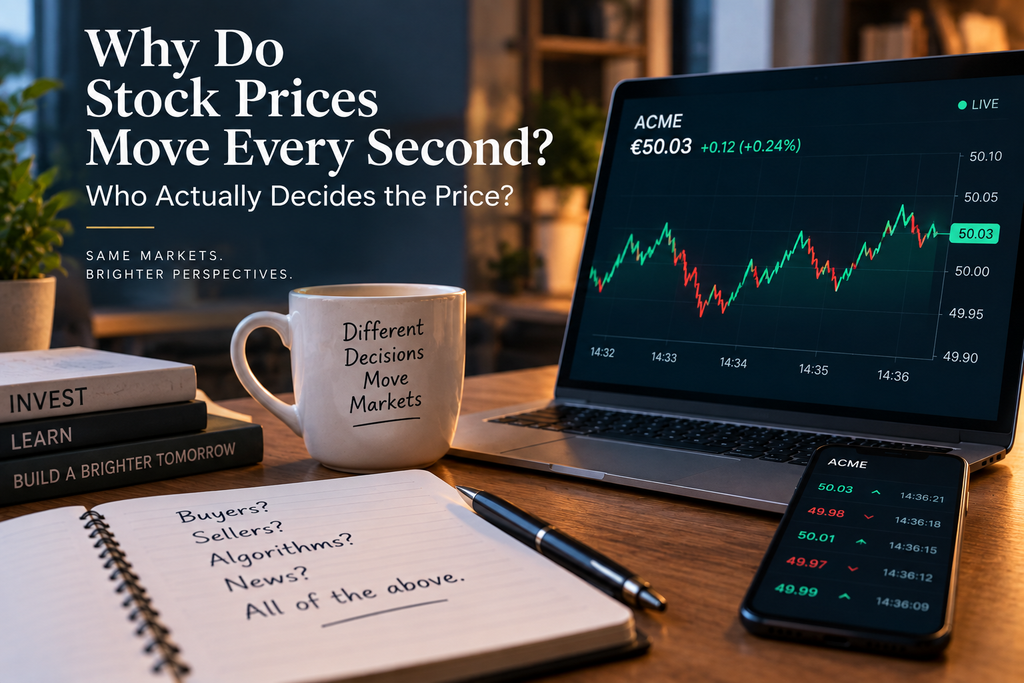
You open your trading app.
A stock is:
€50.00
You look away for three seconds.
Now:
€49.98
Another second later:
€50.03
Who changed it?
Was it the company?
The stock exchange?
Your broker?
Some algorithm sitting in a data centre?
The answer is more interesting:
Nobody simply chooses the stock price.
The number moves because buyers and sellers continuously submit, change, cancel and execute orders. The price you see is a snapshot of that process.
The Short Answer: Nobody Sets the Price by Hand
A stock’s market price emerges from trading.
Buyers are effectively saying:
“I am willing to pay this much.”
Sellers are saying:
“I am willing to accept this much.”
When compatible orders meet, a trade occurs.
The price of that completed trade becomes the latest traded price.
Then another trade can happen milliseconds later at a different price.
The market does not need someone behind a desk to announce:
“The new official price is €50.03.”
Orders move. Prices follow.
What Does the Price on Your Screen Actually Mean?
The number displayed by your app may be:
- the latest traded price;
- the current bid;
- the current ask;
- a midpoint;
- a delayed quote;
depending on the platform and data feed.
Suppose you see:
Last trade: €50.00
Best bid: €49.98
Best ask: €50.02
Those are three different pieces of information.
The €50.00 last price means a trade most recently occurred at €50.00.
The €49.98 bid tells you the highest currently displayed price at which a buyer is offering to buy the relevant quantity.
The €50.02 ask tells you the lowest currently displayed price at which a seller is offering to sell. Investor.gov defines bid and ask in essentially these terms. (Investor)
So €50.00 is not some perfect or permanent statement of what the company is “really worth.”
It is simply the price of the most recent completed transaction.
Meet the Buyers and Sellers
Imagine the market currently looks like this:
Buyer A: willing to pay €49.90
Buyer B: willing to pay €49.98
Seller A: willing to sell for €50.02
Seller B: willing to sell for €50.10
The highest current buy offer is:
€49.98
That is the bid.
The lowest current sell offer is:
€50.02
That is the ask.
Between them sits a €0.04 gap.
What Is the Bid?
The bid is the highest currently available price a buyer is offering for a specified quantity.
Example:
Best bid: €49.98
If someone wants to sell immediately using an order that accepts the available market price, they may transact against buyers on that side of the market.
What Is the Ask?
The ask is the lowest currently available price at which a seller is offering shares.
Example:
Best ask: €50.02
Someone wanting to buy immediately may interact with that side.
The difference between bid and ask is called the spread. (Investor)
The Bid-Ask Spread
Using our example:
Bid: €49.98
Ask: €50.02
Spread: €0.04
The spread is one visible form of trading friction and can also tell you something about liquidity.
A narrow spread often appears in heavily traded securities with many competing buyers and sellers.
A wider spread can appear when trading interest is thinner.
The practical consequences become especially clear when choosing how to place a trade. Crown Altessa’s guide to market orders versus limit orders discusses why execution price and available liquidity matter when markets are moving quickly.
How Does the Price Actually Move?
Suppose the current best ask is:
€50.02
There are:
100 shares available at €50.02
A buyer arrives and purchases all 100 shares.
Those shares are now gone.
The next cheapest seller may be asking:
€50.04
The best ask has therefore moved from €50.02 to €50.04.
If another trade executes at €50.04, the latest traded price can become:
€50.04
That is how a price can change without anyone “recalculating” the company.
Available orders are constantly being:
- executed;
- added;
- changed;
- cancelled.
Nasdaq’s description of market depth reflects this same structure: an order book contains outstanding buy and sell orders at multiple price levels, including the quantity available at each level. (Nasdaq)
A Tiny Order Book Example
Imagine this simplified order book.
| Sellers | Price |
|---|---|
| 100 shares | €50.02 |
| 300 shares | €50.04 |
| 500 shares | €50.06 |
| Buyers | Price |
|---|---|
| 200 shares | €49.98 |
| 400 shares | €49.96 |
| 700 shares | €49.94 |
Now suppose someone wants to buy immediately.
They buy 100 shares
The 100 shares at €50.02 are consumed.
The next available seller is at €50.04.
They buy 500 shares
They may consume:
- 100 at €50.02;
- 300 at €50.04;
- another 100 at €50.06.
One order has now traded across several price levels.
A seller lowers their price
Suppose the seller asking €50.04 changes the order to €50.01.
The best ask can fall even before another trade occurs.
This is price discovery in miniature.
So Who Decides Whether the Stock Goes Up?
No single participant.
A stock tends to move upward when buyers become willing to pay higher prices, when lower-priced sell orders are consumed, or when sellers demand more.
It tends to move downward when sellers become willing to accept lower prices or buyers reduce what they are willing to pay.
That process can involve thousands of market participants, funds, institutions, retail investors, market makers and automated systems.
Why Does the Price Move When There Is No News?
Markets do not need a headline every time the price changes.
Orders can change because:
- investors rebalance portfolios;
- funds receive inflows or withdrawals;
- traders enter or exit positions;
- algorithms update quotes;
- large investors execute transactions;
- currencies move;
- interest-rate expectations change;
- overseas markets move;
- investors simply change their willingness to buy or sell.
A portfolio manager reducing one position to maintain a target allocation can create selling pressure without any new company announcement.
That is why disciplined long-term portfolio management looks very different from interpreting every short-term move as important information. (Crown Altessa)
Every price movement does not require a news article.
Why Can Good News Make a Stock Fall?
Because markets trade expectations, not just headlines.
Suppose analysts publicly expected a company to report:
€1 billion profit
The company reports:
€1.1 billion
That sounds positive.
But perhaps investors had quietly begun expecting €1.3 billion.
Or management announces weaker future guidance.
The result may be a falling stock price despite apparently “good” results.
The market is comparing:
what happened
with
what participants expected to happen.
Good news can already be priced in.
Why Can Bad News Make a Stock Rise?
The reverse can happen too.
Suppose a company reports weak earnings.
But investors feared something much worse.
If the actual result is less bad than expected, buyers may become more optimistic and bid the shares higher.
A stock price reflects changing expectations about the future, not simply whether today’s headline sounds pleasant or unpleasant.
Does the Company Decide Its Stock Price?
Not during normal secondary-market trading.
Once shares are publicly trading, the company’s management does not sit in headquarters changing the quote every few seconds.
But the company can heavily influence what investors are willing to pay through:
- earnings;
- guidance;
- dividends;
- buybacks;
- share issuance;
- acquisitions;
- major product or business developments.
The company affects the information.
Market participants decide what they are willing to pay for the shares based on that information.
Does the Stock Exchange Set the Price?
An exchange provides infrastructure and rules for trading and matching orders.
It does not normally decide:
“This company should now be worth €50.12.”
Participants send orders into the marketplace, and those orders interact according to the venue’s rules.
Market structures also differ across exchanges and countries, so the exact matching mechanics should not be assumed to be identical everywhere. Investor.gov likewise notes that markets outside the U.S. can operate differently from major U.S. markets. (Investor)
Does Your Broker Set the Price?
Generally, your broker does not decide what the company is worth.
The broker receives your order and routes or executes it according to its systems and obligations.
In U.S. markets, Investor.gov explains that a broker may route an order to an exchange, another exchange, a market maker, an ECN, or potentially internalise the trade. Where and how the order is executed can influence the price received. (Investor)
That also explains why the price you saw before pressing Buy may differ from the eventual execution price.
If you want the execution mechanics themselves, Crown Altessa’s discussion of market risk, liquidity and trading under stress explores why access to liquidity can matter as much as having the right view.
What Do Market Makers Actually Do?
Market makers are not mysterious entities choosing the “correct” price of a company.
They are market participants that stand ready to buy and sell securities at quoted prices.
Investor.gov describes a market maker as a firm willing to buy or sell a stock at publicly quoted prices. (Investor)
By continuously quoting bids and asks, market makers can contribute to liquidity.
They also manage their own inventory and risk and may attempt to earn from the spread or other aspects of their activity.
They do not unilaterally determine a company’s fundamental value.
Are Algorithms Moving the Price?
Yes, algorithms are heavily involved in modern markets.
They can:
- submit orders;
- cancel orders;
- adjust quoted prices;
- react to new information;
- arbitrage price differences;
- manage inventories;
- provide or remove liquidity.
But an algorithm is still a market participant or tool acting within the market.
It does not independently announce one official stock price.
If many algorithms and investors simultaneously revise what they are willing to pay, the order book changes rapidly.
That is why prices can move in milliseconds.
Why Large Orders Can Move the Market
Suppose sellers are offering:
100 shares at €50.00
200 at €50.05
500 at €50.10
Now someone sends a market order to buy:
800 shares
That order may consume all three levels.
The buyer does not necessarily pay €50.00 for every share.
Part of the order may execute at €50.00, part at €50.05 and the rest at €50.10.
Investor.gov specifically warns that portions of a larger market order may execute at different prices when insufficient liquidity exists at one price. (Investor)
This effect is commonly described as market impact.
Why Highly Traded Stocks Usually Move Differently From Illiquid Stocks
A highly liquid stock may have:
- many buyers;
- many sellers;
- narrow spreads;
- substantial quantity available near the current price.
An illiquid stock may have:
- fewer active orders;
- wider spreads;
- less market depth.
Investor.gov defines liquidity partly in terms of how easily a security can be bought or sold without substantially affecting its price. (Investor)
That means the same-size order may barely affect one stock but move another much more noticeably.
Liquidity does not prevent large moves.
It changes how easily transactions can occur around existing prices.
Why Stock Prices Can Move After Hours
Some markets allow trading outside their main session.
These periods often have:
- fewer participants;
- lower liquidity;
- wider spreads;
- greater price uncertainty.
Investor.gov specifically warns that reduced trading interest during extended hours can produce larger bid-ask spreads and less favourable execution. (Investor)
Not every market or broker offers identical after-hours access, and order-handling rules can differ.
What Happens Overnight?
A stock closes at:
€50
The next morning it opens at:
€47
How did it move through €49, €48 and €47 if the market was closed?
It may not have.
While the main trading session is closed:
- companies release news;
- foreign markets trade;
- currencies move;
- economic data arrives;
- interest-rate expectations change;
- investors enter new orders.
When trading resumes, buyers and sellers may now agree at a very different level.
That creates a gap.
The stock did not necessarily need to trade at every price in between.
Why One Stock Can Move While the Whole Market Is Flat
Company-specific information can change expectations independently of the broader market.
Examples include:
- earnings;
- a lawsuit;
- management changes;
- a new product;
- analyst revisions;
- sector news;
- takeover speculation.
The market can be flat while one company’s expected future changes sharply.
Why the Whole Market Can Move Together
Sometimes many companies move in the same direction because the same factors affect almost everyone.
Examples include:
- interest-rate expectations;
- inflation;
- economic-growth expectations;
- geopolitical shocks;
- currency movements;
- broad changes in risk appetite.
This is one reason diversification reduces some company-specific risks without eliminating market-wide risk. Crown Altessa’s guide to building financial stability through diversification and long-term investing explores that distinction in a broader portfolio context. (Crown Altessa)
Is the Stock Price the Same Thing as the Company’s Value?
No.
The market price tells you what shares are currently trading for.
It does not prove what the company is intrinsically or “truly” worth.
Different investors can look at the same company and reach very different conclusions about fair value.
That disagreement is one reason trading exists at all.
Choosing whether an individual company deserves a place in a portfolio is therefore a different question from understanding why its quote moves every second. Crown Altessa’s long-term wealth-building article approaches investing from the broader perspective of allocation and diversification rather than short-term price movements. (Crown Altessa)
A Simple Price-Movement Story
Imagine this four-minute sequence.
9:00
The stock trades at €50.00.
9:01
A large buyer enters. Available sell orders are consumed and trades occur up to €50.10.
9:02
A company-guidance headline appears. Sellers become more aggressive. The price falls to €49.70.
9:03
Other investors decide the reaction was excessive. Buyers return. The price moves to €49.90.
Nobody manually selected those four prices.
They emerged from changing orders and changing expectations.
Common Misconceptions
“The company changes its own stock price.”
No. The secondary-market price emerges from trading.
“The exchange decides what the stock is worth.”
No. It provides a marketplace and matching infrastructure.
“The last traded price is guaranteed for my order.”
No. Investor.gov explicitly warns that a market order may execute at a different price from the last trade. (Investor)
“Every price move must have a news story.”
No. Ordinary trading activity can move prices.
“Algorithms control one official price.”
No. They participate in the market alongside other participants.
“Market makers simply choose any price they want.”
No. They quote prices and compete within the relevant market structure.
“Good news means the stock must rise.”
No. Expectations matter.
Frequently Asked Questions
Who Actually Decides a Stock Price?
No single person does. The market price emerges from the interaction of buyers and sellers. The latest completed trade becomes the latest traded price.
Why Do Stock Prices Change Every Second?
Orders are continuously being submitted, cancelled, modified and executed. As available bids and asks change, trades can occur at different prices.
What Makes a Stock Price Go Up?
A stock generally moves higher when buyers become willing to pay more and available lower-priced sell orders are consumed.
Why Does a Stock Price Fall?
Prices can fall when sellers accept lower prices, buyers lower their bids, expectations deteriorate or selling pressure consumes available demand.
Why Can a Stock Fall After Good News?
Because the news may be worse than investors expected, even if it sounds positive in isolation. Markets react to the difference between expectations and reality.
What Is the Price Shown in My Trading App?
It may be the latest trade, bid, ask, midpoint or another quote depending on the platform. Check how your broker labels the figure.
Do Algorithms Control Stock Prices?
Algorithms influence markets by submitting and changing orders, but they do not independently determine one official value for a stock.
Conclusion
The next time you watch a stock move:
€50.00
€49.98
€50.03
remember that nobody is sitting behind a screen choosing those numbers one by one.
Each number is the visible result of buyers and sellers changing what they are willing to pay or accept, orders being added or removed, and trades being completed.
The company influences expectations.
The exchange provides infrastructure.
The broker routes or executes orders.
Market makers add liquidity.
Algorithms participate at enormous speed.
But the price itself emerges from the market.
For readers building a broader, repeatable framework around saving and investing rather than reacting to every market move, Crown Altessa’s personal finance system guide explains why structured decisions often matter more than constant monitoring. (Crown Altessa)
For a broader beginner-friendly introduction to personal finance and investing, Personal Finance Made Simple for Beginners is available on Gumroad and Amazon.
A stock price is not a number someone announces. It is the latest agreement between buyers and sellers.
Feeling financially stuck?
When financial pressure becomes constant, long-term decisions start feeling emotionally heavy.
The Crown Altessa newsletter was created to help people rebuild clarity slowly and strategically through practical financial frameworks, long-term thinking, and structured decision-making insights.
Join the newsletter and receive:
• the free Financial Foundation Guide
• strategic financial insights
• practical tools for long-term stability
• frameworks designed to reduce financial overwhelm
Start building financial clarity one step at a time.