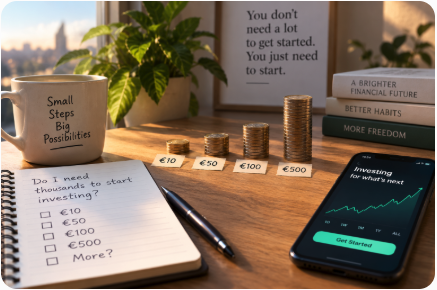
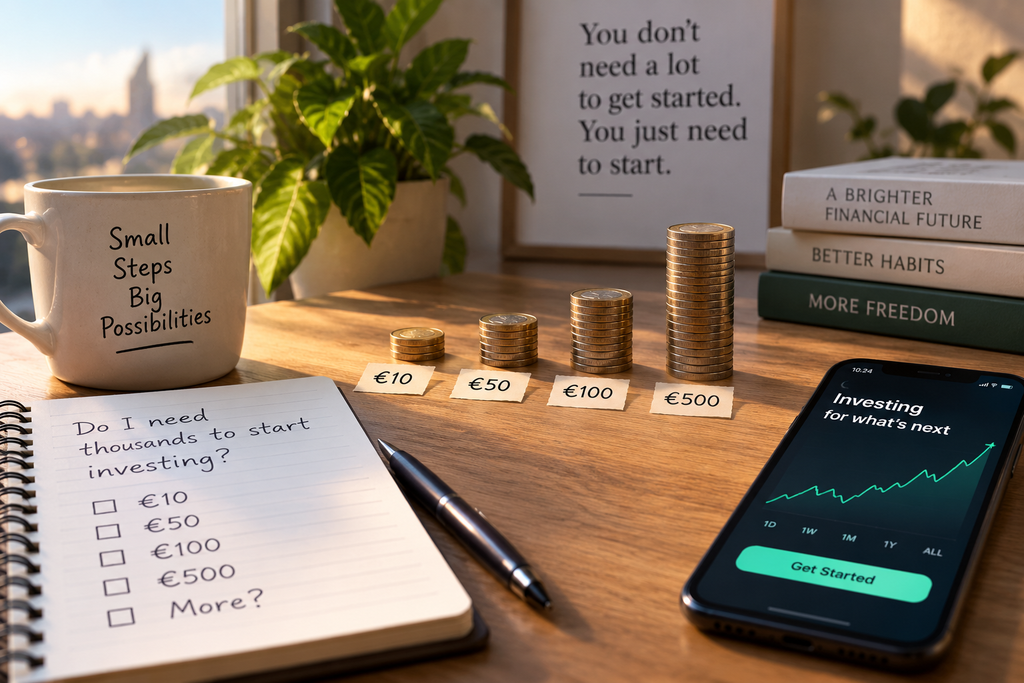
You have €100 left over.
You think about investing it.
Then another thought arrives:
“€100? What’s the point? I probably need a few thousand before investing even makes sense.”
That assumption stops many beginners before they start.
There is no universal minimum amount you need before investing.
Depending on the broker and investment, it is now possible in some cases to begin with €10, €50, €100 or another relatively small amount. Fractional shares, low account minimums and recurring-investment features have lowered some of the old barriers. FINRA notes that fractional-share availability has become more widespread, although not every brokerage offers it and eligible securities vary.
What matters more than making the first deposit look impressive is whether:
- the money is genuinely spare;
- your short-term finances are reasonably stable;
- the fees make sense relative to the amount;
- you can leave the money invested;
- you have a realistic plan for contributing over time.
Small does not mean pointless.
But spare cash has to be genuinely spare.
The Short Answer: You May Need Less Than You Think
A beginner may be able to start with:
€10
€50
€100
or another relatively small amount.
Some modern brokerage platforms permit fractional-share transactions in very small dollar amounts. For example, current U.S. broker offerings demonstrate that fractional investing can begin from around $1 at some firms. That does not mean every broker, country, account or security has the same minimum.
ETFs can also have relatively low entry points because individual ETF shares trade on exchanges, and fractional ETF purchases are available at some platforms. Investor.gov notes that ETFs often have relatively low minimum investment requirements.
So the question is usually no longer:
“Have I saved enough to be allowed to invest?”
It is:
“Is this particular amount actually available for long-term investing?”
That is a much more useful test.
Why People Think They Need Thousands
The belief is not irrational.
Historically, investing could present larger entry barriers.
Individual shares had to be bought whole in many situations. If one share cost €500, you needed roughly €500 before you could buy it.
Mutual funds could also carry initial investment minimums, and some still do. Investor.gov notes that minimums vary between funds and share classes.
Trading commissions mattered more too. Paying a large fixed fee to invest a tiny amount could make small transactions inefficient.
Technology has changed access considerably.
But easier access does not mean every small investment automatically makes financial sense.
Can You Really Start With €10 or €50?
Potentially, yes.
But two questions need to be separated:
Can I invest €50?
and:
Will €50 alone make me wealthy?
The answer to the first can be yes.
The second requires much more perspective.
€50 is unlikely to transform your finances by itself. Its usefulness may be that it lets you:
- begin learning;
- become comfortable with market fluctuations;
- create a recurring habit;
- participate in long-term compounding;
- increase contributions later as income grows.
Fractional shares make this easier because an investor may be able to buy part of a higher-priced share instead of waiting until they can afford the full security. FINRA also notes that fractional shares can help smaller accounts diversify more easily, although availability, transferability and order execution can differ by brokerage.
What Happens If You Invest €50 Per Month?
The starting amount matters.
Consistency can matter much more over a long period.
Consider a purely hypothetical example.
Assume:
- monthly investment: €50
- time: 20 years
- hypothetical annual return: 6%
- monthly compounding for illustration
- no taxes or fees included
Total contributed:
€50 × 240 months = €12,000
Approximate ending value:
€23,102
Now increase the contribution.
| Monthly investment | Total contributed over 20 years | Approximate value at hypothetical 6% |
|---|---|---|
| €50 | €12,000 | €23,102 |
| €100 | €24,000 | €46,204 |
| €250 | €60,000 | €115,510 |
These are not forecasts.
Markets do not return exactly 6% every year. Investments can fall in value, returns may be lower or higher, and real results will be affected by fees and taxes.
The point is simply mathematical:
Repeated contributions can eventually matter more than whether the first deposit was €50 or €500.
This is also why Crown Altessa’s longer-term look at building wealth through regular investing focuses heavily on contribution consistency rather than one dramatic starting deposit.
Starting Amount vs Monthly Habit
Consider two hypothetical people.
Person A
Starts with €5,000.
Never invests again.
Person B
Starts with €100.
Then contributes €200 every month.
Person A clearly begins with more capital.
But over a sufficiently long period, Person B’s repeated contributions can become far more important than the original €100.
That does not mean Person B will always finish with more money. Market returns, timing, investment choices and the length of the period all matter.
The broader idea is that investment progress is not determined only by how much money you have on Day 1.
Your ability to keep adding capital matters too.
A structured approach helps here. Crown Altessa’s guide to managing your personal finances as a system explains how recurring saving and investing can be organised rather than left to motivation.
When €100 Is NOT Really Available to Invest
Having €100 in your bank account does not automatically mean you have €100 of investment capital.
Suppose that money is needed next week for:
- rent;
- groceries;
- electricity;
- transportation;
- an insurance payment;
- a minimum debt payment.
Then it is not truly spare money.
Investments can fluctuate.
If you invest €100 today and need it for rent next month, you may be forced to sell at whatever price the market offers.
That turns a long-term investment into short-term emergency funding.
A useful definition of spare money is:
Money you do not reasonably expect to need for essential short-term expenses.
That definition matters more than the size of the number.
Should You Build an Emergency Fund First?
Some emergency liquidity can reduce the chance that an unexpected bill forces you to sell investments during a market decline.
That does not mean you need to finish every savings goal before investing a single euro.
The objective is simply to avoid investing money that may be needed tomorrow.
Crown Altessa’s article on building financial stability before pursuing growth explores why liquidity and long-term investing perform different jobs.
Starting and being ready to start are not quite the same thing.
What About High-Interest Debt?
Debt deserves context.
If someone is paying very high interest on consumer debt, aggressively investing while that expensive balance continues growing may not improve their overall financial position.
But “pay off every debt before investing” is also too simplistic.
The decision can depend on:
- the interest rate;
- available liquidity;
- whether an employer match exists in a workplace plan;
- repayment terms;
- personal circumstances.
The purpose here is not to create a debt-repayment hierarchy.
It is to recognise that having €200 available while carrying extremely expensive revolving debt is a different financial situation from having €200 available with no expensive debt.
Fees Matter More When Your Investment Is Small
Imagine investing €50.
Your broker charges a fixed €5 transaction fee.
That fee equals:
€5 ÷ €50 = 10%
You would begin needing an 11.1% gain on the remaining €45 just to get back to the original €50 before considering any other costs.
Now invest:
€500
with the same €5 charge.
The fee is:
1%
Same fee.
Completely different impact.
This is why small investors should pay attention to:
- transaction commissions;
- platform charges;
- currency-conversion fees;
- bid-ask spreads;
- recurring fund expenses.
Some platforms now offer commission-free or low-cost trading arrangements, but “commission-free” should not automatically be interpreted as “free in every respect.”
If your available amount is small, fees deserve proportionally more attention.
Fractional Shares Changed the Game
Suppose one share of a company or ETF costs:
€300
In a traditional whole-share-only setup, someone with €50 cannot buy it.
With fractional investing, a platform might allow the investor to put €50 into part of the share instead.
That has materially reduced the entry barrier for some investors.
FINRA gives the example of a $1,000 stock where a $100 fractional investment could represent 0.1 shares. It also stresses several limitations: some brokers do not offer fractions, eligible securities differ, order execution may work differently and fractional positions may not transfer easily between brokers.
So fractional shares are useful infrastructure.
They are not a reason to ignore investment quality or risk.
Do You Need €1,000 Before Buying an ETF?
Not necessarily.
ETF shares trade on exchanges, and Investor.gov notes that ETF shares can often be purchased for relatively low amounts.
Depending on:
- the ETF’s share price;
- the broker;
- whether fractional ETF trading is supported;
someone may be able to buy either one full share or part of one.
There is no universal €1,000 threshold.
And whether an ETF or individual company better fits someone’s plan is a different question from whether they have enough money to place the first trade.
What If You Only Have €10 a Month?
€10 a month is unlikely to generate large wealth quickly.
That is simply the scale of the numbers.
But it can still serve a purpose.
It can help establish a recurring investment habit, teach someone how their brokerage works, and give them experience seeing an investment move up and down without placing a large amount at risk.
The contribution can later rise.
Someone who starts with €10 while learning and eventually increases to €50, €100 or more is in a different position from someone who assumes anything below €1,000 is pointless and therefore never begins.
€10 is still money.
What If You Have €10,000?
Having more capital does not automatically mean all of it belongs in the market.
Suppose someone has €10,000 but:
- €4,000 is their emergency reserve;
- €5,000 is needed for a home deposit next year;
- €1,000 is genuinely long-term money.
The investable number may be closer to €1,000 than €10,000.
A larger bank balance does not remove the need to think about:
- emergency liquidity;
- upcoming purchases;
- debt;
- investment horizon;
- risk tolerance.
The amount visible in the account and the amount available for investing can be very different.
The Real Question: How Much Can You Invest Consistently?
Beginners often ask:
“What is the minimum amount I need?”
A more useful follow-up is:
“How much can I invest without needing the money back next month?”
For one person, that could be €25.
For another, €300.
Someone investing €50 consistently may build a more functional long-term habit than someone forcing themselves to invest €500 once and then stopping because the amount was unsustainable.
That does not make €50 universally “better.”
It means the investment needs to fit the rest of the financial system.
If high living costs are limiting what is genuinely available, Crown Altessa’s guide to saving money when your budget already feels tight explores the cash-flow side separately.
A Simple Beginner Investing Test
Before investing, ask five questions:
- Is this money needed for essential expenses soon?
- Do I have at least some emergency liquidity?
- Am I carrying very expensive debt?
- Are the fees reasonable relative to the amount?
- Can I leave this money invested for years?
There is no automatic score that guarantees someone is ready.
The questions simply expose the main conflicts.
If the money belongs to next month’s rent, the investment decision is very different from money that has no foreseeable short-term purpose.
Three Starting Scenarios
Case A: €50 Available, No Emergency Savings, Credit-Card Debt
Technically, this person may be able to place a €50 investment.
But the fact that the transaction is possible does not mean it should automatically become the immediate financial priority.
Liquidity and expensive debt may deserve attention first.
Case B: €100 Per Month Available, Basic Cash Buffer, No Expensive Debt
A small recurring investment may be reasonable to consider.
The person does not need to wait until €100 becomes €5,000 simply to satisfy an arbitrary minimum.
They still need to choose an investment appropriate to their goals and risk tolerance.
Case C: €5,000 Available, Needed for a Home Deposit Next Year
The amount is much larger than in Case B.
But the time horizon is dramatically shorter.
Money needed next year may be unsuitable for investments capable of falling substantially before the purchase date.
Bigger does not automatically mean more investable.
Common Beginner Mistakes
Common errors include:
- waiting years because they believe investing requires thousands;
- investing rent or emergency cash;
- ignoring transaction fees on tiny purchases;
- chasing extreme returns because the starting amount feels “too small”;
- putting everything into one speculative asset;
- expecting €50 to become a fortune quickly;
- quitting because early growth looks unimpressive;
- comparing themselves with people who started with much more capital.
Feeling behind can itself push people toward unnecessary risk. Crown Altessa’s article on why people feel financially behind looks at that comparison problem more directly.
Investing a small amount does not need to be compensated for by taking a huge risk.
How Much Should You Start With?
There is no fixed number.
A reasonable starting amount is money that:
- does not interfere with essential expenses;
- is not required for an immediate financial goal;
- can remain invested through normal market fluctuations;
- does not become uneconomical because of fees;
- ideally fits into an amount you can continue contributing over time.
That could be:
€25
€50
€100
€500
Different numbers can all be valid in different financial situations.
The starting amount matters less than understanding what role that money is supposed to play.
Frequently Asked Questions
How Much Money Do You Need to Start Investing?
There is no universal minimum. Depending on the broker and investment, someone may be able to begin with a relatively small amount, particularly where fractional shares or low-minimum products are available.
Can I Start Investing With €50?
Potentially, yes. First check that €50 is genuinely spare, that fees are reasonable, and that the investment can be held for an appropriate time horizon.
Is €100 Enough to Start Investing?
It can be. €100 does not need to create a large portfolio immediately to be useful. It can be a starting contribution that is supplemented over time.
Should I Save €1,000 Before Investing?
There is no universal €1,000 requirement. The more relevant question is whether you have enough liquidity for near-term needs and financial shocks before committing money to volatile investments.
Can You Make Money Investing Small Amounts?
Small amounts can grow and compound, but outcomes depend on returns, time, fees, taxes and continued contributions. Tiny investments should not be portrayed as a guaranteed path to large wealth.
Should I Pay Off Debt Before Investing?
It depends on the type and cost of the debt, liquidity, employer benefits where applicable and personal circumstances. Very high-interest debt can materially change the calculation.
Is It Better to Start Small or Wait Until I Have More Money?
If the money is genuinely available, costs are reasonable and the investment fits your time horizon, there may be no need to wait merely to reach an arbitrary larger number. Waiting can make sense when short-term financial needs are not yet secure.
Conclusion
You do not necessarily need thousands before you can begin investing.
A small amount can be enough to start.
What matters more is whether:
- the money is genuinely available;
- your short-term finances are stable enough;
- fees are reasonable;
- your time horizon is long enough;
- you can build consistency over time.
€50 invested responsibly can make more sense than €5,000 invested with money you will need next year.
For a broader beginner-friendly foundation covering saving, investing and everyday financial decisions, Personal Finance Made Simple for Beginners is available on Gumroad and Amazon.
The first investment does not need to be impressive. It needs to fit your finances.
Feeling financially stuck?
When financial pressure becomes constant, long-term decisions start feeling emotionally heavy.
The Crown Altessa newsletter was created to help people rebuild clarity slowly and strategically through practical financial frameworks, long-term thinking, and structured decision-making insights.
Join the newsletter and receive:
• the free Financial Foundation Guide
• strategic financial insights
• practical tools for long-term stability
• frameworks designed to reduce financial overwhelm
Start building financial clarity one step at a time.