
Your employment contract says €4,000 per month.
Payday arrives.
Your bank account receives considerably less than €4,000, and your employer sends you a document filled with unfamiliar abbreviations:
LSt. KV. RV. PV. AV. SolZ. StKl. Nettoentgelt. Auszahlungsbetrag.
If this is your first job in Germany, the page can look far more complicated than the simple question you actually want answered:
Where did my salary go?
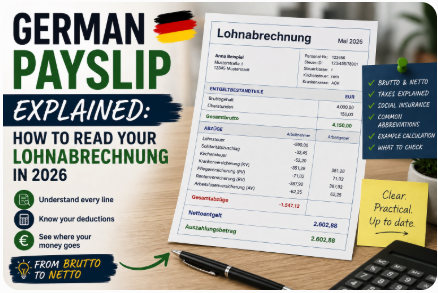
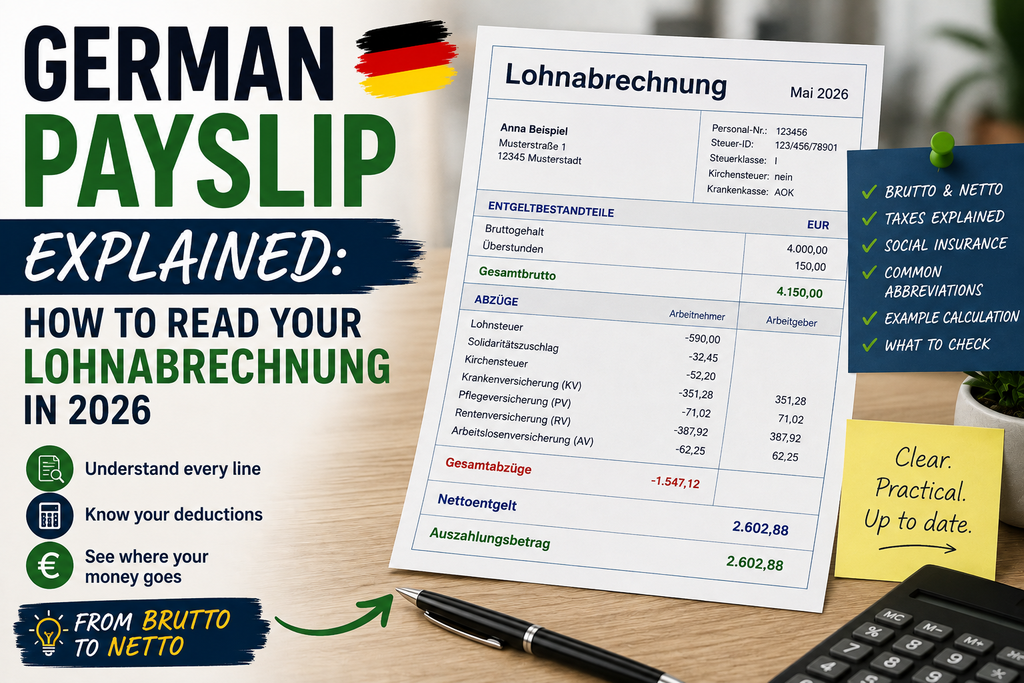
The document is commonly called a Lohnabrechnung, Gehaltsabrechnung or Entgeltabrechnung.
Layouts differ between employers and payroll systems, but the underlying logic is usually recognizable:
Gross pay → taxes → social insurance → other payroll items → final payment
This guide follows that path from the top of a German payslip to the amount ultimately transferred to your bank account.
What Is a Lohnabrechnung?
A Lohnabrechnung is a payroll statement showing how your employment income was calculated for a particular payroll period.
You may also see:
Gehaltsabrechnung
Salary statement.
Entgeltabrechnung
Remuneration/payroll statement.
In everyday use, these terms are often used for broadly the same type of document, although individual employers and payroll systems may prefer one term over another.
German law requires employers to provide employees with a remuneration statement in text form when wages are paid, containing at least the payroll period and composition of remuneration, including relevant additions and deductions. An exception can apply where the information has not changed from the previous proper statement.
At its simplest, the document answers two questions:
What did I earn?
and
How did that amount become the payment I received?
The first important distinction is:
Brutto = gross pay before applicable employee deductions.
Netto = pay remaining after applicable taxes and employee social-security deductions.
This article concentrates on reading the payslip itself. If you want the broader explanation of why German gross and net salaries differ, that is a separate personal-finance question.
German Payslip at a Glance
Imagine a fictional employee named Anna Beispiel with a monthly contractual gross salary of €4,000.
We will not assign her an exact net salary yet because that would require assumptions about tax class, health insurer, church-tax status, children and other payroll characteristics.
Instead, first look at the structure.
| Payslip item | What it means |
|---|---|
| Bruttogehalt | Gross salary |
| Lohnsteuer / LSt | Wage tax withheld through payroll |
| Solidaritätszuschlag / SolZ | Solidarity surcharge, where applicable |
| Kirchensteuer / KiSt | Church tax, where applicable |
| Krankenversicherung / KV | Health-insurance contribution |
| Pflegeversicherung / PV | Long-term care-insurance contribution |
| Rentenversicherung / RV | Pension-insurance contribution |
| Arbeitslosenversicherung / AV | Unemployment-insurance contribution |
| Nettoentgelt | Net remuneration after applicable payroll deductions |
| Auszahlungsbetrag | Final amount actually paid after any further net additions or deductions |
A real German payslip will usually contain more fields.
There may be year-to-date figures, taxable gross amounts, social-insurance gross amounts, contribution-group codes, employer data and other technical payroll information.
You don’t need to understand every code on your first reading.
Start with the main flow of money.
The Top Section: Your Personal and Employment Information
Before looking at deductions, check the identification section.
Depending on the payroll provider, you may see fields such as:
- employee name;
- address;
- employee or personnel number;
- employer;
- payroll month;
- employment start date;
- tax identification number;
- social-security number;
- tax class;
- health insurer;
- church-tax information;
- child allowances or other tax characteristics where applicable.
The layout is not standardized across every employer.
One payroll system may place the tax class near the top.
Another may use a small data table on the side.
Another may abbreviate almost everything.
What matters is whether the personal and payroll information corresponds to your circumstances.
Check the payroll period
Make sure you are looking at the correct month.
This sounds obvious until you receive a correction statement, bonus statement or retroactive payroll adjustment.
Check the tax class
A wrong tax class can materially affect monthly wage-tax withholding.
Check your health insurer
If you are in statutory health insurance, the listed insurer can matter because the additional contribution rate varies between funds.
Check personal data
If something appears incorrect, ask payroll to verify it rather than assuming the deduction itself is wrong.
Sometimes the calculation is working correctly from incorrect input data.
Bruttogehalt: Your Gross Salary
Bruttogehalt is the starting point.
If your contract states €4,000 gross per month and there are no unusual adjustments, you may expect to see approximately that amount as your basic monthly gross salary.
But your total gross pay can contain more than base salary.
Possible additional items include:
- overtime compensation;
- bonus payments;
- commission;
- allowances;
- shift supplements;
- taxable benefits;
- other contractual payments.
Not every item is necessarily treated identically for tax and social-insurance purposes.
That is why some payslips show several different types of “gross” totals.
You may encounter terms such as:
Gesamtbrutto — total gross remuneration.
Steuerbrutto — gross amount relevant to wage-tax calculation.
SV-Brutto — gross amount relevant to social-insurance calculation.
These numbers can be identical in a simple salary month.
They do not have to be identical in every payroll situation.
The important beginner point is:
Gross salary is the starting figure, not the amount that should arrive in your bank account.
If your displayed gross amount itself does not match what you expected from your employment arrangement, investigate that before trying to analyse every deduction underneath it.
Lohnsteuer: Wage Tax
Lohnsteuer, often abbreviated LSt, is wage tax withheld from employment income through payroll.
It is not a completely separate tax from German income tax.
The Federal Ministry of Finance describes Lohnsteuer as a particular method of collecting income tax from employment income. The employer withholds it when wages are paid and transfers it to the tax authorities.
The amount deducted depends on factors including:
- taxable employment income;
- tax class;
- payroll tax characteristics;
- applicable allowances;
- other individual circumstances.
This is one reason two employees earning the same gross salary may not necessarily see identical wage-tax deductions.
Why the number can look surprisingly large
German wage tax is calculated through payroll using annualized rules.
The employer does not simply multiply your monthly salary by one universal tax percentage.
Official payroll calculations take the relevant tax characteristics into account.
So if your payslip says:
LSt: €___
read that as:
“This is the wage-tax amount payroll calculated for this pay period based on the tax information available.”
It does not tell you your entire tax situation on its own.
Steuerklasse: Why Your Tax Class Appears on the Payslip
Steuerklasse, often shown as StKl, is your wage-tax class.
Germany currently uses tax classes I, II, III, IV, V and VI for wage-tax withholding. The official tax rules assign employees to these classes according to their circumstances.
For someone reading a payslip, the key idea is simple:
Tax class affects monthly payroll withholding.
It should not be interpreted as a personal final tax rate.
That distinction matters.
Someone may see a colleague earning the same gross salary but receiving a different net amount and conclude:
“They pay less tax than I do.”
The monthly withholding may indeed differ.
But monthly payroll withholding and the employee’s eventual complete annual income-tax position are not always the same thing.
Do not compare net salaries without understanding the tax circumstances behind them.
Solidaritätszuschlag: Why Many Employees Pay Little or None
The Solidaritätszuschlag, commonly abbreviated SolZ, is a surcharge related to income tax.
It has not disappeared entirely.
But many ordinary employees do not pay it because the applicable exemption thresholds were significantly increased.
For 2026, the relevant assessment threshold is €20,350 in the standard individual case and €40,700 in the specified joint-assessment cases before the surcharge applies under the statutory rules, followed by a transition zone. These thresholds relate to the relevant income-tax assessment base, not directly to someone’s gross salary.
That is why your payslip may show:
SolZ: €0.00
even though the line itself is present.
So neither of these statements is accurate:
“Everyone in Germany pays Soli.”
or:
“Soli was abolished.”
The correct answer is:
It still exists, but whether it appears as a deduction depends on the applicable tax calculation.
Kirchensteuer: Church Tax
Kirchensteuer, often abbreviated KiSt, will not appear as a deduction for everyone.
It can apply to members of religious communities entitled to levy church tax.
The amount is generally calculated as a percentage of the relevant income or wage tax rather than as a percentage of your gross salary.
Depending on the federal state, the rate is generally 8% or 9%.
For example, this does not mean:
“9% of my €4,000 salary disappears as church tax.”
It means the church-tax calculation uses the relevant tax amount as its base.
If your payslip contains KiSt and you were not expecting it, verify the religious-status information payroll received.
The line should not be assumed to apply universally.
Krankenversicherung: Health Insurance
Krankenversicherung, usually abbreviated KV, is health insurance.
For employees covered by statutory health insurance, the 2026 general contribution rate is 14.6%.
Statutory health insurers also charge an additional contribution called the Zusatzbeitrag.
The official average additional contribution rate for 2026 is 2.9%, but your actual health insurer can set a different rate.
That variation is important.
Two employees with:
- the same salary;
- the same tax class;
- otherwise similar circumstances;
can still have slightly different health-insurance deductions if they belong to different statutory funds.
You do not usually pay the entire contribution yourself
Employer and employee generally share the statutory contribution, including the insurer-specific additional contribution.
So if you see an employee KV deduction on your payslip, that amount is not necessarily the entire health-insurance contribution associated with your employment.
The employer generally contributes separately.
Contribution ceiling
For 2026, the health- and long-term-care insurance contribution ceiling is:
€5,812.50 per month
or:
€69,750 per year.
Income above that ceiling is not used to calculate further statutory health and long-term-care contributions.
That matters mostly for higher earners; you do not need to apply the ceiling manually when checking an ordinary payslip.
Private health insurance works differently, so a privately insured employee should not expect their payroll section to look identical to a statutory-insurance example.
Pflegeversicherung: Long-Term Care Insurance
Pflegeversicherung, abbreviated PV, is Germany’s long-term care insurance.
It is separate from ordinary health insurance even though both appear alongside each other in payroll.
The standard contribution rate in 2026 is 3.6%.
For childless insured people subject to the childless surcharge, the total rate can be 4.2%.
The employee share can vary according to circumstances.
Relevant factors can include:
- whether the employee has children;
- the number and age of eligible children under the current rules;
- whether the childless surcharge applies;
- the special contribution split in Saxony.
This explains why PV is one of the deductions where comparing your payslip casually with a colleague’s can be misleading.
If you see a different PV deduction from somebody earning the same salary, that does not automatically indicate an error.
Rentenversicherung: Pension Insurance
Rentenversicherung, usually abbreviated RV, is statutory pension insurance.
The 2026 contribution rate is 18.6%.
For an ordinary employee subject to statutory pension insurance, employer and employee generally split the contribution, making the standard employee share 9.3% on earnings subject to contributions.
For 2026, the contribution ceiling for general pension insurance is:
€8,450 per month
or:
€101,400 per year.
Again, the important payslip distinction is:
The amount deducted from you is not the entire pension contribution associated with your employment.
Your employer generally contributes separately.
Arbeitslosenversicherung: Unemployment Insurance
Arbeitslosenversicherung, abbreviated AV, is unemployment insurance.
The total contribution rate in 2026 is 2.6%.
For a standard employee, employer and employee generally split it equally, so the ordinary employee share is 1.3% of earnings subject to contributions.
The 2026 contribution ceiling is the same as for general pension insurance:
€8,450 per month
or:
€101,400 per year.
The contribution helps finance Germany’s unemployment-insurance system.
Paying AV contributions does not by itself mean that every person will automatically qualify for the same unemployment benefit later. Benefit eligibility has separate legal conditions.
For reading your payslip, however, you only need to recognize:
AV = employee contribution to unemployment insurance.
Your Employer Pays More Than You See Deducted
This part of a German payslip is easy to misunderstand.
Suppose you see:
RV: €372
and think:
“€372 is the entire pension cost for my employment.”
It usually isn’t.
For major branches of German social insurance, your employer generally pays its own contribution separately.
The basic structure is:
Your contractual gross salary
↓
employee taxes and social contributions
↓
your net salary
Meanwhile, separately:
gross salary + employer-side social contributions + possible other employment costs
↓
employer’s broader cost of employing you
Your payslip concentrates on your remuneration and deductions.
It is not designed as a complete employer cost-of-labour statement.
That distinction explains why a €4,000 contractual gross salary can cost an employer more than €4,000 without the additional amount becoming money paid into your bank account.
2026 Social-Insurance Rates at a Glance
You do not need to memorize this table to read your payslip, but it helps put KV, PV, RV and AV into context.
| Insurance | 2026 overall rate | Typical employee position |
| Health insurance (KV) | 14.6% + insurer-specific Zusatzbeitrag | Generally shared with employer |
| Average Zusatzbeitrag for 2026 | 2.9% | Actual insurer rate may differ |
| Long-term care (PV) | 3.6% standard | Employee share varies with circumstances; childless surcharge can apply |
| Pension (RV) | 18.6% | Standard employee share 9.3% |
| Unemployment (AV) | 2.6% | Standard employee share 1.3% |
Contribution ceilings in 2026 are:
- KV/PV: €5,812.50 monthly / €69,750 annually;
- RV/AV: €8,450 monthly / €101,400 annually.
These figures describe the statutory framework.
Your individual deduction can still differ according to your circumstances.
Nettoentgelt vs Auszahlungsbetrag: Why These Can Be Different
You have reached what looks like the end of the payslip.
You see:
Nettoentgelt
Then, several lines later:
Auszahlungsbetrag
The numbers are not identical.
Why?
Nettoentgelt generally reflects remuneration after the main tax and social-insurance deductions.
Auszahlungsbetrag is the final amount being transferred after any additional net additions or deductions processed through payroll.
Possible reasons for a difference can include:
- expense reimbursements;
- salary advances;
- company-pension deductions;
- certain employer benefits;
- garnishments where applicable;
- other payroll-specific net adjustments.
Imagine:
Nettoentgelt: €2,650
Travel-expense reimbursement: +€120
Other net deduction: −€20
Auszahlungsbetrag: €2,750
The €2,750 is the figure you would generally expect to see transferred to your bank account.
The exact labels and placement differ between payroll systems.
Do not assume Nettoentgelt must always equal the bank transfer.
Common German Payslip Abbreviations
German payroll software loves abbreviations.
Here are some of the most common ones you may encounter.
| Abbreviation | German term | English meaning |
| Brutto | Bruttogehalt / Bruttoentgelt | Gross pay |
| Netto | Nettoentgelt | Net remuneration |
| LSt | Lohnsteuer | Wage tax |
| KiSt | Kirchensteuer | Church tax |
| SolZ | Solidaritätszuschlag | Solidarity surcharge |
| KV | Krankenversicherung | Health insurance |
| PV | Pflegeversicherung | Long-term care insurance |
| RV | Rentenversicherung | Pension insurance |
| AV | Arbeitslosenversicherung | Unemployment insurance |
| StKl | Steuerklasse | Tax class |
| SV | Sozialversicherung | Social insurance |
| AN | Arbeitnehmer | Employee |
| AG | Arbeitgeber | Employer |
You may also see:
SV-Brutto — social-insurance gross.
St-Brutto / Steuerbrutto — wage-tax-relevant gross.
Gesamtbrutto — total gross remuneration.
Pers.-Nr. — personnel number.
Abrechnungsmonat — payroll month.
This is not a universal dictionary.
German payroll providers do not all use exactly the same abbreviations or layout.
If you encounter an unfamiliar code, look for the payroll provider’s legend or ask payroll what that specific abbreviation means.
Why Your Net Salary Can Change Even When Your Gross Salary Doesn’t
Suppose your contractual gross salary is €4,000 every month.
January:
€2,650 paid
February:
€2,622 paid
You did not receive a pay cut.
What happened?
There are several possibilities.
Your health insurer’s Zusatzbeitrag changed
Statutory insurers can have different additional contribution rates, and changes can alter the employee’s health-insurance deduction.
Your payroll characteristics changed
Tax-class or other electronic payroll-tax characteristics can affect wage-tax withholding.
You received a one-off payment
A bonus, overtime payment or taxable benefit can change the month’s calculations.
Social-insurance rates or thresholds changed
Annual payroll rules can change, particularly at the beginning of a new calendar year.
Your church-tax circumstances changed
If payroll receives different religious-status information, the deduction may appear or disappear.
A payroll correction was processed
Employers sometimes correct a previous payroll period.
A company-pension contribution changed
Salary conversion or other occupational-pension arrangements can alter the final payment.
What should you do?
Do not immediately assume an error.
Compare:
- this month’s gross salary with last month’s;
- tax deductions;
- KV/PV/RV/AV;
- any new bonus or benefit;
- tax class and personal payroll data;
- net adjustments near the bottom.
Often the changed line reveals the explanation.
If not, ask payroll.
Example: Reading a German Payslip Step by Step
Let’s use a fictional employee:
Daniel Beispiel
Assumptions:
- employee in North Rhine-Westphalia;
- €4,000 monthly contractual gross salary;
- Tax Class I;
- no church tax;
- statutory health insurance;
- health insurer assumed to use the official 2026 average Zusatzbeitrag of 2.9% purely for illustration;
- childless and over 23;
- no bonus;
- no company pension;
- no unusual net adjustments.
This is an educational example, not a universal €4,000 salary calculation.
Step 1: Gross salary
Daniel begins with:
Bruttogehalt: €4,000
This is below all relevant 2026 contribution ceilings, so his full €4,000 is within the contribution base for the statutory social-insurance categories in this simplified example.
Step 2: Pension insurance
The total pension rate is 18.6%.
Daniel’s ordinary employee share is 9.3%.
€4,000 × 9.3% = €372
So his payslip could show approximately:
RV: €372
His employer generally contributes separately as well.
Step 3: Unemployment insurance
Employee share:
1.3%
Calculation:
€4,000 × 1.3% = €52
Possible payslip line:
AV: €52
Step 4: Statutory health insurance
For illustration, we are using:
14.6% general rate + 2.9% assumed average Zusatzbeitrag
= 17.5% total
With the contribution generally shared equally:
8.75% illustrative employee share
Calculation:
€4,000 × 8.75% = €350
Possible line:
KV: approximately €350
Daniel’s real deduction could differ if his actual health insurer charges a different Zusatzbeitrag.
Step 5: Long-term care insurance
Daniel is childless and over 23.
Under the 2026 framework, the standard care rate is 3.6% and the childless surcharge is 0.6 percentage points, borne by the employee under the applicable rules.
Outside Saxony, an illustrative employee contribution of 2.4% applies in this simplified scenario.
€4,000 × 2.4% = €96
Possible line:
PV: €96
Step 6: Wage tax
Now payroll calculates Daniel’s Lohnsteuer using the official wage-tax rules and his Tax Class I characteristics.
Rather than inventing an exact euro figure, the important reading skill is to identify the LSt line and understand that it is separate from social insurance.
Step 7: Solidarity surcharge
At this income level and under the stated ordinary assumptions, Daniel may see no Solidaritätszuschlag, depending on the payroll calculation.
The line may still appear with zero.
Step 8: Church tax
Daniel is assumed not to be liable for church tax.
His payslip therefore has no KiSt deduction.
Step 9: Nettoentgelt
Payroll subtracts the applicable employee deductions from the relevant remuneration.
This gives Daniel’s net remuneration.
Step 10: Auszahlungsbetrag
Because we assumed no reimbursements, advances, pension deductions or other net adjustments, his Auszahlungsbetrag may be the same as the Nettoentgelt.
That is the amount sent to his bank account.
The purpose of this example is not to give every €4,000 employee a promised take-home figure.
It is to show you how to trace the salary:
€4,000 Brutto → LSt + KV + PV + RV + AV → Netto → final bank payment
Once you can follow those lines, the document becomes much less mysterious.
Gross Salary, Net Salary and Employer Cost: Three Different Numbers
These three numbers are often confused.
Gross salary
This is the contractual salary before employee payroll deductions.
Your employment contract may say:
€48,000 annual gross
or:
€4,000 monthly gross
Net salary
This is what remains after applicable employee taxes and social-insurance deductions.
It is closer to what you can actually use for everyday personal finances.
Employer cost
The employer’s overall cost can exceed your contractual gross salary because employers generally have their own social-security contributions and potentially other employment costs.
A €4,000 gross salary therefore does not mean:
employee receives €4,000
and it also does not mean:
employer’s total cost is exactly €4,000.
Three different perspectives.
Three different numbers.
If this distinction still feels confusing, financial confidence often improves when you separate what a number measures from what you assume it means.
Your Payslip vs Your Employment Contract
Your employment contract and your payslip answer different questions.
The contract records what was agreed.
The payslip shows how remuneration was processed for a particular payroll period.
Compare them when relevant.
For example:
Base salary
Does the payslip reflect the contractual monthly salary?
Bonus
Was a contractual or expected bonus processed in the correct period?
Commission
Does the amount correspond with the applicable commission arrangement?
Overtime
If paid overtime was approved, does the payroll contain the expected compensation?
Allowances
Were agreed allowances included?
Benefits
Were taxable or reimbursable benefits processed as expected?
Do not assume a discrepancy automatically means wrongdoing.
There may be timing rules, payroll cut-offs or information you have not considered.
Start by asking payroll or HR for clarification.
The same principle applies when evaluating your career more broadly: young workers can feel financially trapped when compensation, job security and living costs interact in ways that aren’t obvious from salary alone.
What Should You Check Every Month?
You do not need to audit every payroll field line by line forever.
A useful routine takes only a few minutes.
- Check gross salary.
Does it match what you expected for the month? - Check bonus, overtime and allowances.
Were any expected additional payments included? - Scan deductions for unusual changes.
Compare LSt, KV, PV, RV and AV with the previous month. - Check tax class and important personal information.
Particularly after marriage, separation, changing jobs or other relevant changes. - Check Nettoentgelt and Auszahlungsbetrag.
- Compare the final amount with your bank transfer.
- Keep the statement.
This is especially useful when you’re trying to understand why saving money in Germany feels different from what your gross salary initially suggested.
What If You Think Your German Payslip Is Wrong?
Start with evidence, not confrontation.
1. Compare it with the previous payslip
Which specific line changed?
2. Check your contractual salary
Does the gross amount correspond with the agreed salary?
3. Look for one-off items
Bonus?
Overtime?
Sick-pay adjustment?
Benefit?
Correction?
4. Check personal payroll information
Tax class.
Health insurer.
Church-tax status where relevant.
Payroll period.
5. Check the final bank payment
Does it match the Auszahlungsbetrag?
6. Ask payroll or HR
A useful question is:
“Could you please explain why this deduction changed compared with last month?”
That usually gets further than:
“My salary is wrong.”
7. Escalate only if necessary
If a material issue remains unresolved, qualified payroll, tax or legal advice may be appropriate depending on the problem.
This article provides general educational information, not individual tax or legal advice.
German Payslips for Foreign Workers: What Often Causes Confusion?
A German payslip can be particularly surprising if your previous country’s payroll system worked differently.
Several things commonly cause confusion.
The job offer was gross
Your recruiter said:
€48,000 salary
That usually means gross contractual compensation.
It is not the amount arriving in your account.
Several deductions are social insurance, not income tax
Seeing KV, RV, PV and AV together can make it appear that Germany has several different salary taxes.
Those four lines are social-insurance contributions.
Lohnsteuer is the main payroll income-tax line.
Tax class appears prominently
Someone unfamiliar with German Steuerklassen may mistake the class for a tax percentage.
It isn’t.
Health insurance appears on the payslip
In some countries, healthcare is funded in a very different way.
German employees covered by statutory insurance usually see their employee share through payroll.
Church tax can be unexpected
This line does not apply to everyone.
Employer contributions do not become additional net salary
If an employer contributes toward statutory pension or health insurance, that contribution is not extra spending money transferred to you.
Nettoentgelt and bank transfer can differ
Further net adjustments can sit between the two.
None of these features means the payroll is inherently good or bad.
They are simply features of the German system that become easier to interpret once you know what each line is doing.
Financial pressure can still feel significant even after you understand the calculation. That broader issue is explored in why young adults feel financially behind.
How Your Payslip Fits Into Your Personal Finances
A payslip is useful beyond answering:
“How much did I get paid?”
It gives you a record of your reliable employment income and its components.
That can help with:
- budgeting from net rather than gross income;
- checking whether bonuses were actually paid;
- tracking changes in deductions;
- comparing employment offers;
- documenting income for rental applications;
- planning savings from the amount that actually reaches your account.
If you are trying to build financial stability, use the final payment amount rather than gross salary as the starting point for ordinary monthly cash-flow planning.
And avoid assuming every month will look identical if your compensation includes bonuses, overtime or other variable income.
The distinction between stable and variable income is one reason choosing stability over ambition can sometimes become a financial decision rather than purely a career preference.
Frequently Asked Questions
What Is a German Payslip Called?
Common terms include:
Lohnabrechnung
Gehaltsabrechnung
and
Entgeltabrechnung
Employers and payroll providers may use different terminology.
What Is Lohnabrechnung in English?
A natural English translation is payslip, pay statement or payroll statement.
What Is the Difference Between Lohnabrechnung and Gehaltsabrechnung?
In everyday employment use, both generally refer to payroll statements showing salary and deductions.
Traditionally, Lohn and Gehalt could describe different remuneration structures, but employees will often encounter the terms more loosely today.
The actual payroll content matters more than the label.
What Does Brutto Mean on a German Payslip?
Brutto means gross.
It is your remuneration before applicable employee taxes and social-security deductions.
What Does Netto Mean?
Netto is the remuneration remaining after applicable payroll deductions.
It may still differ from the final Auszahlungsbetrag if additional net adjustments are processed.
Why Is So Much Deducted From My Salary in Germany?
Your payslip can contain several separate deductions:
- Lohnsteuer;
- health insurance;
- pension insurance;
- unemployment insurance;
- long-term care insurance;
- church tax where applicable;
- solidarity surcharge where applicable;
- other individual payroll items.
The exact amount depends on your circumstances.
What Are KV, PV, RV and AV?
KV = Krankenversicherung = health insurance.
PV = Pflegeversicherung = long-term care insurance.
RV = Rentenversicherung = pension insurance.
AV = Arbeitslosenversicherung = unemployment insurance.
What Is Lohnsteuer?
Lohnsteuer is wage tax withheld by your employer from employment income.
It is a method of collecting German income tax through payroll, not a completely separate tax from income tax.
Why Am I Paying Kirchensteuer?
Church tax can apply if payroll records indicate membership in a religious community entitled to levy it.
It is generally 8% or 9% of the relevant income/wage tax depending on the federal state, not 8% or 9% of gross salary.
If the information appears wrong, ask payroll or the relevant authority to clarify the underlying record.
Does Everyone Pay Solidaritätszuschlag?
No.
The solidarity surcharge still exists, but current exemption thresholds mean many employees pay none.
Whether it applies depends on the relevant tax calculation.
Why Did My Net Salary Change This Month?
Possible reasons include:
- bonus or overtime;
- health-insurance contribution changes;
- payroll tax-characteristic changes;
- social-insurance changes;
- church tax;
- company-pension deductions;
- one-off benefits;
- payroll corrections.
Compare the changed lines with your previous payslip.
What Is Auszahlungsbetrag?
Auszahlungsbetrag is the final payment amount after payroll has processed the relevant deductions and net adjustments.
It is generally the figure you expect to match the amount transferred to your bank account.
Does My Employer Also Pay Social-Security Contributions?
Generally, yes, for major statutory social-insurance categories.
The employee deduction on your payslip is not necessarily the full contribution associated with your employment.
The employer usually pays an employer-side share separately.
How Can I Tell Whether My German Payslip Is Correct?
Check:
- gross salary;
- payroll period;
- tax class;
- health insurer;
- bonus/overtime/allowances;
- major deductions;
- final Auszahlungsbetrag;
- matching bank transfer.
If something remains unclear, ask payroll or HR for an explanation.
Conclusion
The first German payslip can look like a wall of abbreviations.
Once you know where to look, the structure is much simpler:
Gross pay → taxes → social insurance → other payroll items → final payment
Start with your Bruttogehalt.
Identify Lohnsteuer.
Find KV, PV, RV and AV.
Check whether KiSt or SolZ applies.
Then follow the document down to Nettoentgelt and finally the Auszahlungsbetrag.
You do not need to memorize every contribution rate.
You do need to recognize what each major line represents and notice when something changes unexpectedly.
Your payslip isn’t simply proof that you were paid.
It is a monthly record of how your employment income moves through Germany’s tax and social-security system.
If you want a broader beginner-friendly foundation for organising income, saving and everyday financial decisions, my book Personal Finance Made Simple for Beginners covers those fundamentals in plain language.
My book on Gumroad:
https://ukandu0.gumroad.com/l/bteyh
Or on Amazon:
Sources & Further Reading
For German payroll-statement requirements, see §108 Gewerbeordnung and the official Entgeltbescheinigungsverordnung.
For official information on Lohnsteuer, payroll withholding and tax classes, see the Bundesministerium der Finanzen.
For 2026 statutory health-insurance rates, the average Zusatzbeitrag and the health/care contribution ceiling, see the Bundesministerium für Gesundheit.
For 2026 pension and unemployment contribution rates and ceilings, see Deutsche Rentenversicherung.
For 2026 long-term care-insurance contribution rules, see the Bundesministerium für Gesundheit.
For current Solidaritätszuschlag rules, see the Bundesministerium der Finanzen 2026 wage-tax guidance.
For general church-tax treatment and the 8%/9% state-dependent rates, see the Federal Ministry of Finance’s tax guidance.
Feeling financially stuck?
When financial pressure becomes constant, long-term decisions start feeling emotionally heavy.
The Crown Altessa newsletter was created to help people rebuild clarity slowly and strategically through practical financial frameworks, long-term thinking, and structured decision-making insights.
Join the newsletter and receive:
• the free Financial Foundation Guide
• strategic financial insights
• practical tools for long-term stability
• frameworks designed to reduce financial overwhelm
Start building financial clarity one step at a time.