
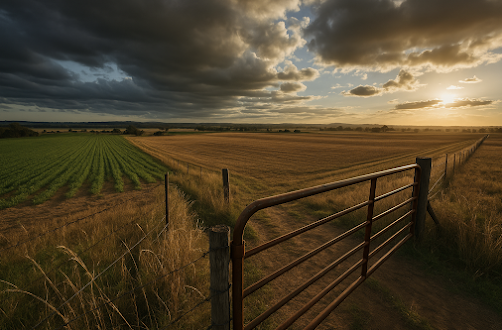

Introduction
This is the second article in The Mirage Investments Series, where we examine strategies that appear protective on the surface — yet often reveal deeper vulnerabilities.
In Part One, we looked at the bunker obsession: the belief that concrete walls equal control. Today, we turn to something more socially acceptable — and far more widespread.
Land.
Over the years, I’ve noticed something interesting. Whenever uncertainty rises — economic tension, political instability, social unrest — people with money instinctively move toward something that feels tangible. They want something solid. Something physical. Something they can point to and say, “At least we own this.”
But ownership and security are not the same thing.
And seasoned capital understands the difference.
The Emotional Appeal of Remote Land
Land feels permanent.
It doesn’t disappear in a market crash.
It doesn’t default like a bond.
It doesn’t evaporate like a tech startup.
Remote acreage promises:
- Privacy.
- Escape.
- Self-sufficiency.
- Psychological relief.
For newer or recently wealthy buyers, the logic sounds simple:
“If everything collapses, we’ll go there.”
It’s a powerful narrative. Especially in a world where trust in institutions fluctuates and headlines amplify instability.
But here is the quiet truth experienced investors understand:
Land can symbolize safety — without actually delivering it.
What Experienced Capital Sees That Others Miss
The issue is not land itself.
The issue is isolated land purchased under emotional pressure.
There are three major blind spots that rarely get discussed openly.
1. Isolation Is Not Protection
Remote land lacks infrastructure by design.
No proximity to logistics.
No integrated security systems.
Limited rapid response.
In moments of instability, isolation does not always equal invisibility. It can become exposure.
A large property with resources — water, storage, livestock — can attract attention rather than deter it.
Security does not come from distance.
It comes from structure.
2. Land Without Systems Is Just Liability
I’ve observed that newer wealth often buys symbols before building frameworks.
Owning 500 acres sounds impressive.
But without:
- Operational staff
- Supply chains
- Legal structuring
- Maintenance planning
- Productive output
It becomes a cost center, not a resilience asset.
Land requires:
Management.
Integration.
Purpose.
Otherwise, it is simply expensive scenery that demands constant upkeep.
This is the same principle we discussed when breaking down the illusion that ownership alone equals protection in other asset classes. Structure matters more than possession.
3. Jurisdiction Risk Doesn’t Disappear With Distance
Many assume remote land escapes political exposure.
It doesn’t.
In times of crisis:
- Governments tax aggressively.
- Zoning laws shift.
- Eminent domain expands.
- Capital controls appear.
If your “safe haven” sits inside a fragile jurisdiction, distance from the city doesn’t reduce exposure to policy.
Experienced capital diversifies across legal systems — not just geography.
There’s a difference.
How Seasoned Elites Actually Use Land
Here’s where the conversation becomes more nuanced.
Those with long-term wealth don’t reject land.
They just don’t romanticize it.
Land is acquired when it is:
- Productive (agriculture, energy, water rights).
- Integrated into broader portfolios.
- Positioned within diversified legal structures.
- Connected to functioning networks.
It is never purchased as a panic bunker substitute.
It is treated as one instrument within a larger system.
This mindset mirrors the broader discipline behind structured asset protection strategies — where liquidity, jurisdiction, and diversification work together rather than emotionally.
Land is leverage when embedded in a system.
Land is illusion when bought in isolation.
The Broader Lesson (Even Without Millions)
You don’t need private acreage to apply this principle.
The same logic applies to:
- Buying property.
- Concentrating investments in one region.
- Overcommitting to one “safe” asset class.
- Mistaking physical ownership for financial resilience.
Security is never about the object.
It’s about the ecosystem around the object.
If the system fails, the asset is exposed.
Why the Fantasy Persists
IPart of the appeal is psychological.
When uncertainty rises, people crave something visible and controllable.
Land feels ancestral.
Primal.
Grounded.
But wealth that survives generations is rarely built on emotion.
It is built on integration, redundancy, and calculated positioning.
This is the difference between reacting to fear and designing for stability.
What Comes Next
In Part Three, we’ll examine a modern version of the same illusion:
The AI Savior Myth — the belief that automation and machines will guarantee resilience in an unstable world.
Technology, like land, can be powerful.
But only when used deliberately — not desperately.
For Readers Strengthening Their Position
If you’re building real stability rather than symbolic ownership, revisit:
- the discipline of structured budgeting through the 50/30/20 framework
- how to think through downturn protection strategically
- the importance of building an emergency buffer before pursuing complex assets
And if you want a clear foundation that simplifies all of this:
📘 Personal Finance Made Simple for Beginners