
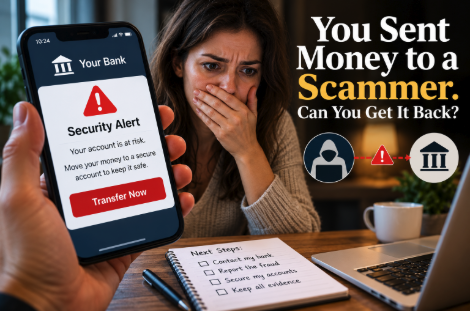
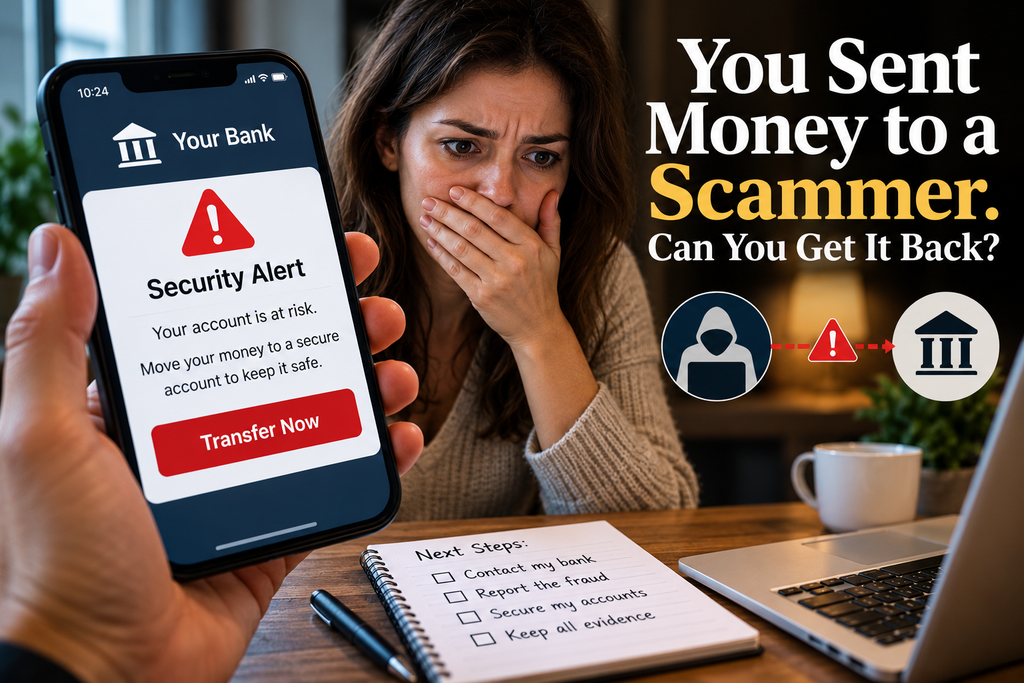
A message arrives that appears to come from your bank. It warns that your account is at risk and instructs you to move your money to a secure account.
The message looks convincing. You follow the instructions and transfer €2,000.
Twenty minutes later, you discover the truth.
It was a scam.
Is the money gone forever?
Not necessarily. Recovering money after a scam may be possible, but it depends on how you paid, whether you authorized the transaction, how quickly you act, your payment provider and the laws that apply.
Some payments can be disputed. Others may be recalled if the money has not moved beyond reach. Certain jurisdictions provide reimbursement protections for specific types of fraud.
None of these possibilities guarantees that the money will return.
What you do next matters.
The Short Answer: Sometimes, but Speed and Payment Method Matter
If you have just sent money to a scammer, contact your bank or payment provider immediately.
Do not wait until you have collected every piece of evidence or spoken to the police. You can do those things afterward.
There are three different outcomes worth understanding:
- Reversal: A transaction is canceled or reversed through an available payment process.
- Recovery: Money is retrieved from the recipient or another institution.
- Reimbursement: A bank, payment provider or another responsible party compensates you under applicable law, policy or dispute rules.
These are not interchangeable.
A bank might be unable to retrieve money from a scammer’s account but still have a legal obligation to reimburse a qualifying unauthorized transaction. Conversely, a bank may attempt to recall a transfer without being required to refund an authorized scam payment.
The distinction becomes important when you ask what happens next.
The First Hour: Six Actions That Can Improve Your Chances
- Contact your bank or payment provider immediately. Use its official app, website or a telephone number you already trust, not contact details supplied in the scammer’s message.
- Report the fraud and request urgent action. Ask about any available payment recall, transaction dispute, fraud investigation, account restriction or reimbursement process.
- Secure affected accounts. Change compromised passwords and authentication methods, and check whether your device or email account was accessed.
- Preserve evidence. Keep payment receipts, transaction identifiers, screenshots, messages, URLs and telephone numbers.
- Report the incident. Contact the appropriate police or national fraud-reporting authority.
- Watch for follow-up scams. Ignore anyone offering guaranteed recovery in exchange for an advance payment.
When speaking to your bank, explain that you suspect fraud and ask which recovery process applies to your particular transaction.
For a bank transfer, that might mean requesting an urgent fraud notification or recall. For a card payment, it might involve a disputed transaction or chargeback procedure.
If you shared login credentials or approved access to your device, tell the bank. Ask whether accounts, cards or online-banking access should be restricted.
A transfer recall is a request, not a guarantee that the payment will be returned.
The sending institution is usually your first point of contact. If another bank is involved, your provider can explain how the receiving institution should be notified.
The US Federal Trade Commission’s guidance on what to do after paying a scammer also emphasizes contacting the payment provider promptly and using the recovery procedure appropriate to the payment method.
Did Someone Steal Your Money, or Did They Trick You Into Sending It?
This is one of the most important distinctions in financial-fraud cases.
Unauthorized transaction: Someone initiates a payment without your valid authorization. For example, a criminal obtains your banking credentials and independently transfers €2,000 from your account.
Authorized payment scam: You personally initiate the €2,000 transfer because someone deceives you into believing the destination is legitimate.
Fraudulent merchant payment: You approve a card payment for a product or service, but the seller turns out to be fraudulent, or the goods never arrive.
These situations may lead to different recovery procedures.
Complicated cases also exist. A criminal might persuade you to reveal a verification code, take remote control of your device or manipulate you into approving something you did not understand.
Do not assume that entering a PIN or using two-factor authentication automatically eliminates your rights.
For example, the US Consumer Financial Protection Bureau’s Regulation E guidance explains that certain transfers initiated by criminals using credentials obtained through fraud can qualify as unauthorized electronic fund transfers.
The precise classification depends on the facts and applicable law. When reporting the incident, describe exactly who initiated the payment and what you personally did.
Your rights depend on where the payment happened
European Union
Under the EU’s Payment Services Directive (PSD2), qualifying unauthorized payments generally require prompt reimbursement, subject to statutory conditions and exceptions.
Article 73 of Directive (EU) 2015/2366 addresses reimbursement for unauthorized transactions. Article 72 also makes clear that recorded use of a payment instrument does not, by itself, necessarily prove authorization or serious misconduct by the customer.
These protections should not be confused with an automatic refund for every transfer a victim was tricked into authorizing.
The legal treatment of an authorized scam payment can differ from that of a payment initiated by a criminal without valid authorization.
United Kingdom
Since 7 October 2024, qualifying authorized push-payment scams involving covered UK payment systems have been subject to mandatory reimbursement rules.
The scheme applies to eligible payments made through Faster Payments and CHAPS, subject to its scope, eligibility requirements and exclusions. It is not a universal protection for international transfers, card payments or cryptocurrency transactions.
The published maximum reimbursement amount is £85,000 per qualifying claim. Firms may apply an excess of up to £100, but not to qualifying vulnerable consumers under the scheme’s vulnerability provisions.
These figures and conditions should be read alongside the UK Payment Systems Regulator’s APP scam reimbursement requirements.
Not every payment or claimant is covered. The applicable rules also address matters such as reporting periods, customer conduct and eligibility.
United States
Regulation E provides protections for qualifying unauthorized electronic fund transfers.
A transfer initiated by a criminal using credentials obtained through fraud may qualify as unauthorized. By contrast, a consumer who personally instructs their bank to send money to a scammer may not receive the same statutory protection merely because the decision was induced by deception.
The distinction depends on who initiated the transfer, the authority involved and the circumstances.
The CFPB’s official Regulation E FAQs address these differences, including fraudulently obtained account credentials and person-to-person payments.
These are different legal systems, not interchangeable refund guarantees.
Can You Reverse a Bank Transfer Sent to a Scammer?
Bank transfers are particularly stressful because the money may move quickly.
If the transfer is still pending, your bank may have an opportunity to stop or cancel it. Once the transfer has been executed and settled, recovery becomes more complicated.
Your bank may attempt to contact the receiving institution, send a fraud notification or initiate an available recall process.
But a recall is not the same as reversing a card charge.
The receiving account might already be empty. The funds might have been transferred elsewhere. The recipient’s cooperation, the payment system’s rules and the receiving institution’s procedures may affect the outcome.
SEPA transfers, SEPA Instant payments, domestic transfers and international wires do not all operate under identical rules. An instant payment may reach the recipient within seconds, leaving little opportunity to stop it before execution. A subsequent recall or fraud-recovery request is a separate process and does not guarantee repayment.
If you sent a bank transfer to a scammer, ask your bank to attempt recovery immediately, even if the transaction appears completed.
The FTC’s guidance for victims who paid scammers advises contacting the sending bank or wire-transfer provider promptly and asking whether the transaction can be reversed or the funds recovered.
For covered UK authorized push-payment scams, reimbursement may also be available under the applicable regulatory scheme, independently of whether the original funds can be retrieved.
What If You Paid the Scammer With a Credit or Debit Card?
Card payments may provide additional dispute mechanisms, but the reason for the dispute matters.
If someone used your card without authorization, report it as an unauthorized transaction.
If you deliberately paid an online seller who never delivered the promised goods, explain that it is a merchant dispute involving suspected fraud.
A chargeback may be available through the relevant card network and card issuer, depending on the transaction, supporting evidence and applicable rules.
A chargeback is not a universal legal entitlement to recover every payment. It is a dispute process governed by card-network procedures, while separate consumer-protection laws may create additional rights.
Credit and debit cards may also be subject to different statutory protections. For example, US debit-card electronic fund transfers may fall under Regulation E, while credit-card billing disputes can involve separate federal protections.
Do not wait until an unspecified deadline approaches. Ask the card issuer which reporting and dispute deadlines apply to your transaction.
The FTC’s official recovery guidance recommends contacting the card issuer promptly when a scammer has received a credit- or debit-card payment.
What If You Used PayPal, a Payment App, Cryptocurrency or Gift Cards?
The recovery process becomes more dependent on the provider and the way the payment was made.
PayPal: Eligible purchases may fall under Buyer Protection, subject to the applicable terms. However, personal payments, including Friends and Family transfers, are excluded from that programme. Unauthorized account activity should be reported separately.
PayPal confirms these exclusions in its official explanation of Buyer Protection eligibility.
Payment apps: Report the fraudulent transaction through the provider’s official support process. If a linked bank account or card was involved, ask that institution whether an additional dispute process applies. In the US, certain unauthorized transfers through payment apps may qualify for Regulation E protections even when the app’s own terms describe transfers as final.
Cryptocurrency: A completed blockchain transfer generally cannot simply be canceled. Contact the exchange or service used, preserve wallet addresses and transaction hashes, and report the fraud. A provider may sometimes assist if funds remain under its control, but recovery is difficult.
Gift cards: Contact the issuer immediately, provide the card details and retain the receipt. There may be an opportunity to stop misuse or recover remaining value.
Cash: Recovery can be especially difficult once the recipient has collected it. If physical cash was sent through a delivery service, contact the carrier immediately to ask whether delivery can be intercepted.
The FTC’s payment-specific scam recovery instructions provide further guidance for several of these situations.
Which Payment Methods Offer the Best Chance of Recovery?
There is no reliable universal ranking because the outcome depends on authorization, provider rules, local law, timing and whether the money remains accessible.
| Payment method | Possible recovery route | Key limitation |
|---|---|---|
| Bank transfer | Urgent recall, fraud investigation, applicable reimbursement rules | Completed transfers may be difficult to retrieve |
| Credit card | Unauthorized-charge dispute or merchant chargeback | Eligibility, evidence and deadlines |
| Debit card | Unauthorized-transfer protections or card dispute | Rights vary by jurisdiction and circumstances |
| PayPal purchase | Eligible Buyer Protection or unauthorized-payment claim | Exclusions and claim conditions |
| Payment app | Provider dispute, bank or card investigation | Authorized transfers may have limited remedies |
| Cryptocurrency | Exchange cooperation, investigation or asset recovery | Confirmed blockchain transfers generally cannot be reversed |
| Gift card | Issuer investigation or unused-value recovery | Value may already have been redeemed |
| Cash | Delivery interception or law-enforcement recovery | Often difficult after collection |
The useful question is not simply which payment method is safest. It is which recovery process applies to the payment you actually made.
What Should You Say to Your Bank?
You do not need to know the correct legal terminology before calling.
Describe what happened, provide the transaction information and ask the bank to identify the available procedures.
Subject: Urgent fraud report and request for payment recovery
Hello,
I need to report a suspected fraudulent transaction and request an urgent investigation.
On [date] at approximately [time], a payment of [amount] was made from my account to [recipient details or transaction reference].
I believe the payment was connected to a scam because [brief factual explanation].
[State accurately whether you personally initiated and approved the payment, or whether someone else made it without your authorization.]
Please confirm whether the transaction can be stopped, recalled or disputed, and whether any fraud reimbursement or other recovery process applies.
Please also provide a case reference number, explain what evidence you require and confirm the next steps in writing.
Thank you.
Do not falsely claim that a transfer was unauthorized if you personally approved it. A truthful explanation gives the institution the information needed to assess the correct recovery route.
What If the Bank Refuses to Refund You?
A refusal does not necessarily mean that every available process has been exhausted.
Ask for a written explanation identifying why the claim was rejected, what rules or terms were applied and whether the institution completed any available recovery attempts.
Then check the appropriate complaint route.
In the UK, eligible disputes may be referred to the Financial Ombudsman Service after the firm’s complaint process, subject to applicable requirements.
In EU countries, the relevant financial ombudsman, alternative dispute-resolution body or national supervisory authority may be able to explain complaint options. The exact institution varies by country. The European Commission’s FIN-NET network can help consumers identify relevant out-of-court financial dispute-resolution bodies.
In the United States, consumers may be able to submit complaints through the Consumer Financial Protection Bureau or the appropriate banking regulator.
For substantial losses or disputed legal responsibility, independent legal advice may be worthwhile.
Keep the distinction clear: filing a complaint can trigger further review, but it does not guarantee a different result.
What Evidence Should You Keep?
Evidence can help your bank understand what happened and support a police report or later complaint.
Preserve the following where available:
- Payment confirmation, amount, date, time and transaction reference.
- Recipient account information, wallet address or merchant details.
- Screenshots of messages, emails, websites and payment instructions.
- Telephone numbers, usernames, social-media profiles and website URLs.
- A timeline showing when you were contacted, when you paid and when you discovered the fraud.
- Copies of your correspondence with the bank, including case numbers and decisions.
- Police report or fraud-reporting reference numbers.
Store copies securely. Do not publish full bank statements, identity documents, passwords or authentication codes online.
If the scammer used a website that later disappears, saved screenshots may help establish what was presented to you at the time.
Beware of Recovery Scams
After losing money, you may receive another message.
Someone claims to be a lawyer, investigator, cryptocurrency specialist, government official or recovery agent.
They say your stolen money has been located.
But first, you must pay a tracing fee, tax, verification charge or unlocking fee.
This can be a second scam targeting the same victim.
The FTC’s guidance on refund and recovery scams warns that criminals may impersonate legitimate organizations and demand additional payments from people who have already lost money.
Be particularly suspicious of anyone who contacts you unexpectedly, claims guaranteed success or says recovered funds cannot be released until you send more money.
A genuine professional may charge for legitimate legal services, but that is not evidence they can recover stolen funds. Independently verify their identity, qualifications and authority before engaging them.
Never provide remote access to your device or disclose banking credentials to a supposed recovery specialist.
What If the Money Cannot Be Recovered?
Sometimes the money cannot be retrieved and no reimbursement obligation applies.
That can be financially painful, especially if the loss affects rent, essential bills or debt repayments.
Once the urgent recovery attempts are underway, assess whether the scammer still has access to any accounts, documents or devices. Check for additional unauthorized transactions and notify affected institutions.
Then establish which expenses need attention first.
If the loss has left you unable to cover immediate obligations, contact relevant creditors or service providers before payments become overdue. Ask about legitimate hardship arrangements or payment options.
Crown Altessa’s guide to what to do when there is no money left after bills provides a broader framework for handling an immediate cash shortfall.
If the incident has depleted your savings, the next priority may be rebuilding accessible reserves. Our article on building financial stability during uncertain circumstances explains why emergency liquidity matters when unexpected financial shocks occur.
For a longer-term recovery plan, it may help to review how to manage your personal finances and establish how essential expenses, debt payments and savings will be managed while you recover.
Financial recovery and payment recovery are different things. Even when stolen funds cannot be returned, it is possible to work toward restoring financial stability.
Frequently Asked Questions
Can My Bank Get My Money Back After a Scam?
Possibly. The bank may attempt a recall, investigate an unauthorized transaction or assess whether reimbursement protections apply. The outcome depends on the payment method, authorization, timing and applicable law.
Can I Reverse a Bank Transfer I Authorized?
Sometimes recovery can be attempted, but a completed authorized transfer generally cannot simply be canceled on demand. Certain jurisdictions, including the UK for qualifying payments, provide specific reimbursement protections for authorized payment scams.
How Long Does a Scam Refund Take?
There is no universal timeframe. It depends on the payment method, the provider’s investigation and applicable legal rules.
For example, under the UK’s qualifying APP scam reimbursement scheme, firms generally have five business days to resolve a claim, although they may pause the clock for permitted information-gathering. They must reach an outcome within 35 business days. These are scheme-specific requirements, not worldwide deadlines. The UK Payment Systems Regulator explains these timeframes in its consumer guidance.
Payment Systems Regulator
Can I Recover Money Sent Through PayPal?
Potentially. Eligible purchase transactions may qualify for Buyer Protection, and unauthorized transactions have separate reporting procedures. Friends and Family payments are not covered by PayPal Buyer Protection.
Can I Recover Stolen Cryptocurrency?
Recovery is difficult because completed blockchain transfers generally cannot be reversed. Report the incident to the exchange or provider involved and the relevant authorities. Recovery may depend on whether identifiable funds can be frozen or retrieved through lawful processes.
What If My Bank Says I Authorized the Transfer?
Ask for a written explanation and which recovery or reimbursement rules were considered. Explain accurately how the scam occurred, including any deception, account compromise or disputed consent. Check whether an appropriate complaint or independent review process is available.
Should I Pay Someone Who Claims They Can Recover My Money?
Be extremely cautious, particularly if they contacted you unexpectedly or demand advance payments to release supposedly recovered funds. Independently verify any professional you consider engaging. Never assume that a recovery promise is genuine.
Conclusion
You believed you were moving your money to safety. Instead, the payment went to a scammer.
The next step is not to assume the money is gone forever, nor to trust someone who promises they can retrieve it.
Contact your payment provider immediately. Give an accurate account of what happened. Ask which recall, dispute, investigation or reimbursement procedures apply. Preserve evidence and follow the appropriate reporting and complaint routes.
The result will depend on the facts and the rules governing the payment.
Recovering from a financial setback can also mean rebuilding your financial foundation. For a beginner-friendly guide to managing money, saving and making financial decisions, Personal Finance Made Simple for Beginners is available on Gumroad and Amazon.
A scam payment is not always recoverable. But acting quickly, reporting it accurately and understanding your payment method gives you the best available chance.
Feeling financially stuck?
When financial pressure becomes constant, long-term decisions start feeling emotionally heavy.
The Crown Altessa newsletter was created to help people rebuild clarity slowly and strategically through practical financial frameworks, long-term thinking, and structured decision-making insights.
Join the newsletter and receive:
• the free Financial Foundation Guide
• strategic financial insights
• practical tools for long-term stability
• frameworks designed to reduce financial overwhelm
Start building financial clarity one step at a time.