
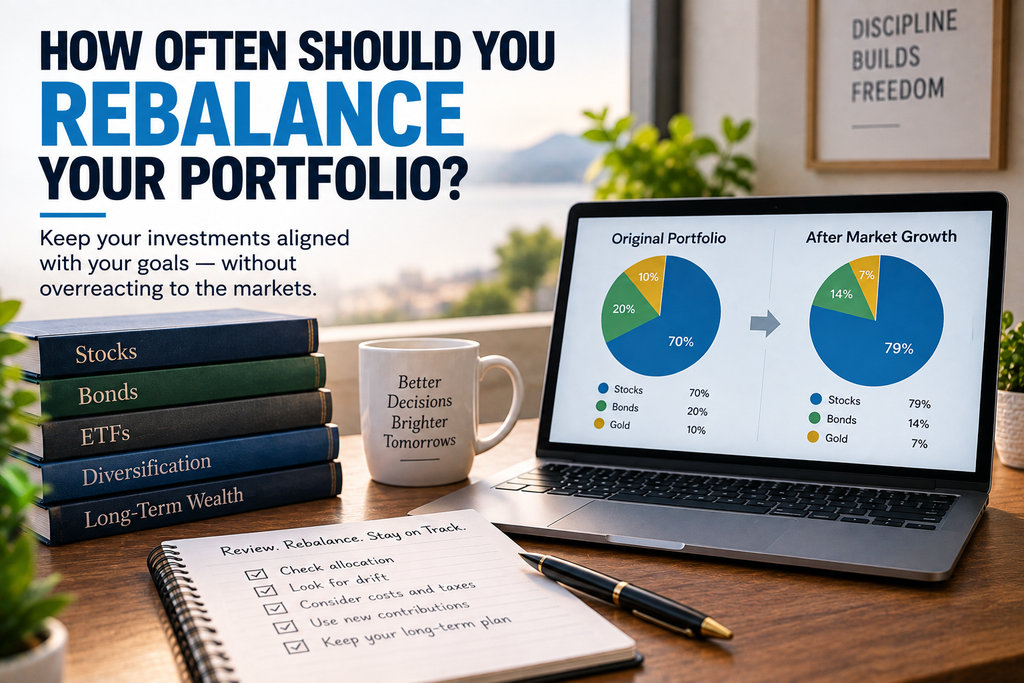
You built a portfolio with:
70% stocks
20% bonds
10% gold
A year later, after strong stock-market performance, it looks like this:
79% stocks
14% bonds
7% gold
You still own the same types of investments. But the portfolio no longer has the same balance of risk.
That is the problem rebalancing is designed to solve.
Rebalancing is mainly a form of risk control. It brings a portfolio back toward the allocation you deliberately chose rather than trying to predict which asset will perform best next. Vanguard describes the purpose similarly: maintaining the intended risk profile, rather than maximising returns.
So how often should you rebalance?
There is no universal schedule. Calendar reviews, allocation thresholds, or a combination of the two can all work. The right trigger depends on your chosen system, the amount of drift, taxes, costs and whether new contributions can correct the imbalance without selling.
What Does Rebalancing Actually Mean?
Rebalancing means adjusting your investments so their weights move back toward your target portfolio allocation.
Take the opening example:
| Target | Current | |
|---|---|---|
| Stocks | 70% | 79% |
| Bonds | 20% | 14% |
| Gold | 10% | 7% |
Stocks are overweight relative to the original plan. Bonds and gold are underweight.
One possible rebalance would reduce the stock allocation and add to bonds and gold.
That does not automatically mean selling stocks.
New contributions, dividends or even planned withdrawals can sometimes be directed in ways that move the portfolio back toward its targets. Fidelity and Vanguard both identify portfolio cash flows as potential rebalancing tools.
Why Portfolios Drift
Drift happens quietly.
Different investments grow at different rates.
If stocks rise strongly while bonds rise slowly and gold remains flat, stocks gradually represent a larger percentage of the total portfolio even if you never make another trade.
Over time, that can change the portfolio’s:
- volatility;
- downside exposure;
- diversification;
- concentration in particular asset classes.
The portfolio may still contain exactly the same funds and securities. The proportions have changed.
That matters because your original allocation presumably had a reason behind it. Broader long-term wealth building depends not only on owning investments, but on understanding how risk and allocation interact over time.
The Real Purpose of Rebalancing
Suppose an investor chose 60% stocks because that level of equity exposure suited their goals and comfort with risk.
After a long bull market, stocks grow to 78% of the portfolio.
A 78% stock allocation is not automatically wrong.
But it may expose the investor to substantially more equity risk than the 60% allocation they originally selected.
Rebalancing is designed to correct that drift.
It should not be assumed to improve returns. In fact, rebalancing can sometimes mean trimming the asset that has recently performed best and adding to assets that have lagged. Its primary job is to keep portfolio risk reasonably aligned with the investment plan. Vanguard explicitly frames rebalancing as risk management rather than return maximisation.
Perfect alignment is not the goal.
A portfolio moving slightly away from target does not automatically require a trade.
Method 1: Calendar-Based Rebalancing
Calendar rebalancing uses a fixed schedule.
You might review the portfolio:
- quarterly;
- every six months;
- annually.
The attraction is simplicity. You know when the review happens and do not need to watch allocation percentages constantly.
Fidelity lists periodic calendar rebalancing as one of the three main approaches, while Vanguard discusses quarterly or yearly reviews as examples. Neither makes one schedule a universal requirement.
The weakness is equally simple.
Your scheduled date might arrive when the portfolio has barely moved.
Or a major market move could create substantial drift months before your next scheduled rebalance.
A calendar gives you a review date. It does not tell you whether a trade is actually necessary.
Method 2: Threshold-Based Rebalancing
Threshold rebalancing ignores fixed dates as the main trigger and focuses on how far an asset has moved from its target.
Suppose your target stock allocation is:
60%
You decide, purely as an example, to use a tolerance band of 5 percentage points.
That would create a range of:
55% to 65%
If stocks move outside that range, you consider rebalancing.
The 5-percentage-point figure is a heuristic, not a universal rule. Fidelity uses a five-point deviation as an example of threshold rebalancing, while other Fidelity guidance discusses a 10% drift trigger as another possible choice. This variation itself shows why there is no single mathematically perfect threshold for every investor.
Thresholds can prevent needless trading over tiny changes, although they require some way of monitoring the portfolio.
A 1% deviation and a 15% deviation are not the same problem.
Method 3: Calendar + Threshold
A hybrid method combines the two.
For example:
Review the portfolio twice a year.
But:
Only rebalance if an asset class has moved beyond your chosen tolerance.
This separates checking from trading.
Fidelity and Vanguard both identify this combination of scheduled reviews and drift thresholds as a recognised rebalancing approach.
For investors who do not want to monitor their portfolios constantly, the hybrid approach can provide structure without requiring a trade every time a calendar reminder appears.
Can You Rebalance Without Selling?
Yes.
This is particularly useful for investors who are still contributing regularly.
Suppose stocks have become overweight while bonds are underweight.
Instead of immediately selling stocks, future contributions could be directed toward bonds.
Dividends or other portfolio cash flows can sometimes be used similarly.
Fidelity notes that using new contributions may restore target allocations without selling existing positions. Vanguard also discusses directing dividends, interest and withdrawals toward the parts of the portfolio that need adjustment.
This can reduce unnecessary turnover and may reduce tax or transaction friction.
It can be especially effective when the portfolio is still small relative to the investor’s ongoing contributions.
A Simple Example of Rebalancing With Contributions
Consider a €50,000 portfolio.
Target:
70% stocks
20% bonds
10% gold
Current holdings:
€39,500 stocks
€7,000 bonds
€3,500 gold
That equals:
79% stocks
14% bonds
7% gold
Now the investor contributes another €5,000, taking the portfolio to €55,000.
Instead of buying more stocks, suppose the entire €5,000 is split between the underweight assets:
€3,500 to bonds
€1,500 to gold
The portfolio becomes:
€39,500 stocks
€10,500 bonds
€5,000 gold
New weights are approximately:
71.8% stocks
19.1% bonds
9.1% gold
No stocks were sold.
The portfolio is now much closer to its 70/20/10 target simply because new money was directed where it was needed.
What About Taxes?
Taxes can complicate rebalancing.
Selling an appreciated investment in a taxable account may create a taxable capital gain depending on the jurisdiction and the investor’s circumstances.
That can make other methods worth considering first, such as:
- directing new contributions to underweight assets;
- redirecting dividends;
- using planned withdrawals strategically;
- rebalancing within tax-advantaged accounts where applicable.
Fidelity specifically warns that selling appreciated positions during rebalancing in a taxable brokerage account can create capital-gains consequences.
Tax rules vary substantially by country and account type.
The sensible trade-off is between keeping portfolio risk reasonably aligned and avoiding unnecessary tax friction. Tax considerations should not automatically prevent a needed rebalance, but neither should they be ignored.
What About Trading Costs and Spreads?
Taxes are not the only friction.
Frequent rebalancing can involve:
- commissions where charged;
- bid-ask spreads;
- slippage;
- administrative effort.
Some modern investment platforms have eliminated many explicit trading commissions, but that does not mean every transaction is economically costless.
Fidelity specifically cautions that excessive rebalancing can create unnecessary transaction costs and fees.
Another trade over a tiny deviation may therefore solve very little.
Can You Rebalance Too Often?
Yes.
Imagine your target is 60% stocks.
Today you check and find:
60.8% stocks.
That is not automatically an emergency.
If you attempt to force the portfolio back to precisely 60.00% every time markets move, you can create unnecessary trading, taxes, costs and complexity.
Market prices change continuously. Perfect alignment would therefore require constant intervention.
That is not the purpose of portfolio rebalancing.
A rebalance should have a reason.
Is Rebalancing the Same as Market Timing?
No, provided the investor is actually rebalancing to an existing plan.
Rebalancing says:
“My portfolio has moved away from the allocation I already chose, so I am bringing it back.”
Market timing says something closer to:
“I think stocks are about to fall, so I am reducing stocks because of that prediction.”
The distinction disappears if an investor repeatedly changes the target allocation because of forecasts, social-media commentary or financial headlines.
At that point, they may no longer be maintaining a portfolio.
They may be making tactical market predictions.
That difference matters because rebalancing is meant to maintain a predetermined risk structure rather than guess what markets will do next. Vanguard explicitly distinguishes rebalancing from market timing on this basis.
Crown Altessa’s discussion of betting against the market explores why prediction-driven investing introduces a very different set of risks.
When You Should NOT Rebalance
Sometimes doing nothing is reasonable.
That may be the case when:
- drift is tiny;
- trading friction outweighs the practical benefit;
- taxable consequences would be significant relative to the imbalance;
- upcoming contributions can correct the drift naturally;
- the original target itself needs reconsideration.
The last point is different from the others.
Sometimes the portfolio has not merely drifted.
Sometimes the plan has become outdated.
When Your Target Allocation Should Change
A target allocation may deserve review when something meaningful changes in the investor’s life, such as:
- investment horizon;
- risk tolerance;
- financial circumstances;
- major goals.
For example, a portfolio designed around a distant goal may no longer be appropriate when that goal is approaching.
Changing the target is not the same thing as rebalancing back to the old target.
Fidelity similarly recommends revisiting the investment plan when goals or circumstances materially change.
The broader role of financial flexibility during changing circumstances is also explored in Crown Altessa’s guide to building financial stability.
A Simple Rebalancing Decision Framework
When reviewing a portfolio:
- Check the current allocation.
- Compare it with the target.
- Measure the amount of drift.
- Decide whether the drift exceeds your chosen tolerance.
- If action is justified, use the least disruptive practical method.
That might mean new contributions, dividends, partial selling or a fuller rebalance.
The framework deliberately starts with measurement rather than trading.
How Often Should You Check Your Portfolio?
Checking and rebalancing are different activities.
Many long-term investors may find periodic reviews, perhaps a few times per year or annually, sufficient for monitoring allocation. Actual trades can then depend on whether the chosen calendar, threshold or hybrid rule has been triggered.
Vanguard discusses annual rebalancing as suitable for many investors based on its research, while Fidelity presents annual, threshold-based and hybrid approaches without making one frequency mandatory.
Constant checking can also tempt investors into reacting to short-term movements. Fidelity specifically cautions that monitoring too closely can encourage excessive or reactive trading.
Choose a review system you can follow consistently.
Three Rebalancing Scenarios
Case A: 60% Target, 61% Current
Drift: 1 percentage point
There may be little reason for urgent action. New contributions or ordinary market movements could easily change the percentage again.
Case B: 60% Target, 67% Current
Drift: 7 percentage points
This may breach the investor’s chosen threshold and justify a closer look.
Whether a trade is appropriate still depends on the investor’s rule, taxes, costs and available cash flows.
Case C: 60% Target, 75% Current
Drift: 15 percentage points
The portfolio now has materially more equity exposure than its original target.
If the 60% target still reflects the investor’s intended risk level, this is a much stronger case for considering rebalancing than Case A.
Proportionality matters.
Common Rebalancing Mistakes
Common problems include:
- rebalancing over every tiny movement;
- never checking allocations;
- confusing rebalancing with market timing;
- ignoring taxes and trading costs;
- assuming a target allocation can never change;
- selling immediately when contributions could correct the imbalance;
- changing targets because of headlines;
- chasing whichever asset has recently performed best.
A disciplined portfolio process helps separate planned decisions from reactions. Crown Altessa’s guide to managing personal finances as a system applies the same principle more broadly: structure makes financial decisions easier to evaluate consistently.
Portfolio Rebalancing Checklist
- Know your target allocation
- Check your current allocation
- Measure the drift
- Check your chosen tolerance
- Review possible tax consequences
- Review transaction costs
- Use new contributions if practical
- Rebalance only when justified
- Review whether the target itself still makes sense
- Record the reason for any target change
Frequently Asked Questions
How Often Should I Rebalance My Portfolio?
There is no mandatory frequency. Common approaches include calendar-based, threshold-based and hybrid rebalancing. Many long-term investors may review periodically and only trade when their chosen method indicates that drift is meaningful.
Should I Rebalance Every Year?
Annual rebalancing can be a reasonable approach, and Vanguard’s research supports it as a practical method for many investors. It is not a universal requirement. A portfolio may have barely drifted when the annual date arrives.
What Percentage Drift Should Trigger Rebalancing?
There is no universally optimal threshold. Five percentage points is one commonly illustrated example, but investors can choose different tolerances based on their strategy.
Should I Sell Stocks to Rebalance?
Not automatically. Selling an overweight asset is one method, but contributions, dividends and planned withdrawals may sometimes move the portfolio toward its target without requiring a sale.
Can I Rebalance Using New Contributions?
Yes. Directing new money toward underweight asset classes can reduce portfolio drift without selling existing investments.
Does Rebalancing Improve Returns?
It should not be treated as a return-maximisation strategy or a guarantee of better performance. Its primary purpose is to maintain the portfolio’s intended risk profile.
Is Rebalancing Market Timing?
Not when it simply returns the portfolio toward a predetermined target allocation. Repeatedly changing the target because of market forecasts or headlines is different and can become market timing.
Conclusion
A portfolio does not need to be perfectly aligned every day.
Markets move. Some assets will grow faster than others, and small deviations from target are inevitable.
The reason to rebalance is to stop those movements from gradually turning the portfolio into something materially riskier or fundamentally different from what you originally intended.
That can mean an annual review. It can mean using a threshold. It can mean combining both. And sometimes it can mean directing the next contribution toward an underweight asset and making no sale at all.
For readers building the wider system around their investments, Personal Finance Made Simple for Beginners is available on Gumroad and Amazon.
Rebalance when the portfolio has moved far enough to matter—not simply because the market moved.
Feeling financially stuck?
When financial pressure becomes constant, long-term decisions start feeling emotionally heavy.
The Crown Altessa newsletter was created to help people rebuild clarity slowly and strategically through practical financial frameworks, long-term thinking, and structured decision-making insights.
Join the newsletter and receive:
• the free Financial Foundation Guide
• strategic financial insights
• practical tools for long-term stability
• frameworks designed to reduce financial overwhelm
Start building financial clarity one step at a time.