
Why You Don’t Need Insider Tips to Spot Opportunities
Have you ever watched your portfolio swing wildly and felt like a powerless spectator? That sinking feeling—like you’re at a poker table without seeing your own cards—is real. I remember thinking there must be a secret room where deals are made and the rest of us are left guessing. The truth is more empowering. Many so‑called mysteries of the market aren’t hidden at all. These early investment signals are simply patterns in public data that hint at where serious money is moving. They won’t make you rich overnight—markets are always uncertain—but they can help you stop chasing gossip and start thinking like an informed investor. Public filings and government budgets routinely reveal where major institutions are putting their capital. Once you learn to read them, you’ll feel far less at the mercy of sensational headlines and more like you’re reading the rulebook yourself.
Where to Find Clues: Types of Early Signals
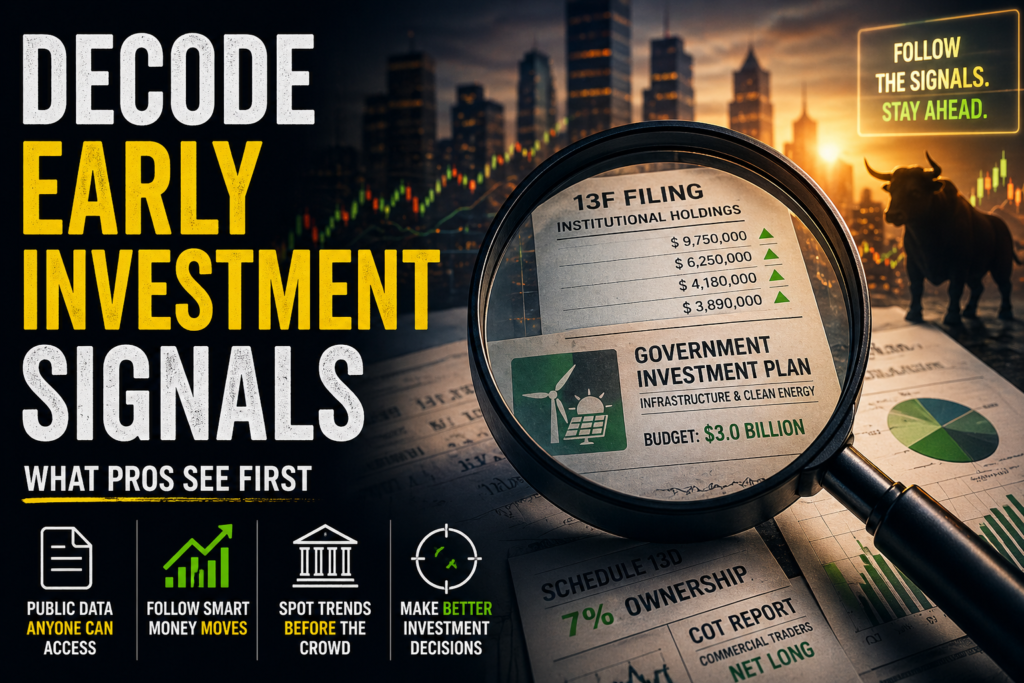
Early investment signals come from public disclosures—official documents or reports that companies, investors and governments are legally required to publish. Don’t worry if the form names sound obscure; the ideas are straightforward:
- Corporate event filings – When a U.S. company signs a big deal or buys another business, it must tell everyone within four business days. These notices, called Form 8‑K, can tip you off to strategic moves before analysts start talking.
- Big stake disclosures – If someone quietly buys more than 5 % of a company, they have five days to file a notice. These filings reveal when hedge funds or activists are getting serious, and they’re surprisingly easy to look up.
- Quarterly fund snapshots – Large funds (over $100 million) must report what they own every quarter. The lists show each stock and how many shares they held. The data arrives 45 days after the quarter ends, so it’s not real‑time, but seeing multiple funds pile into the same name can be useful.
- EU shareholding alerts – In Europe, when investors cross certain ownership levels, they must announce it. These notifications show who’s building or trimming a position and are often published quickly.
- Futures market positioning – Every week, the U.S. CFTC publishes a report showing how big players and speculators are positioned in futures markets. If commercial hedgers (often called “smart money”) turn bullish while speculators are bearish, that may hint at a shift in sentiment.
- Government spending and funding programmes – Public budgets can foreshadow industry booms. Germany’s energy infrastructure fund plans to invest around €0.9 billion in 2025, rising to €3 billion in 2029. The EU Innovation Fund has committed €7.1 billion to 120 projects in areas like clean hydrogen and energy storage. When governments commit billions, private investors often follow.
What I love about these disclosures is how democratic they are: anyone willing to read can access them. It still amazes me how much information is out there if you know where to look; most people never take advantage of it.
A Beginner’s Roadmap: Spotting Signals Early
You don’t need a Bloomberg terminal or any fancy tools to start; just curiosity and a willingness to look beyond headlines. Here’s a structured approach I’ve found helpful:
1. Choose your focus
Begin by deciding what you’re looking for—an individual company, a sector (like renewable energy), or a broader theme (such as digital infrastructure). You’ll drown in information if you try to watch everything at once, so pick a lane that genuinely interests you. In my experience, curiosity makes the research feel less like homework and more like discovery.
2. Monitor event filings
Search for Form 8‑K filings on the SEC’s EDGAR database when a company you follow announces a major contract, acquisition or strategic pivot. Don’t be intimidated by the jargon—these are just notices. If a tech firm suddenly invests in quantum computing, for instance, that could hint at a long‑term bet. In Europe, keep an eye on corporate news releases and stock‑exchange announcements; many companies publish similar “ad‑hoc” updates under market‑abuse rules.
3. Track ownership changes
Use tools like EDGAR (U.S.) and your national regulator’s website (EU) to see who owns what. When a hedge fund files a notice showing it has taken a 7 % stake in a mid‑cap industrial company, it may be planning to influence strategy. Conversely, if multiple institutions cut their positions below threshold levels, that could be a warning sign. Keep in mind that Form 13F snapshots are delayed; I view them as confirmation, not as a real‑time trigger.
4. Read government signals
Government investment plans can be some of the clearest early signals. Germany’s commitment to spend billions on sustainable infrastructure and the EU Innovation Fund’s multi‑billion‑euro support for net‑zero projects reveal sectors likely to benefit from policy support. Monitor national budgets, public‑sector fund announcements and tender databases to spot trends. In my view, following the money at a policy level beats chasing rumours on social media.
Tip: When reading about large budgets in the news, dig deeper. Look for details on project timelines, funding amounts and targeted industries. This will help you distinguish between political promises and actual allocations.
5. Combine multiple signals
One data point can mislead; patterns matter. Suppose a clean‑energy stock appears in several funds’ 13F filings, its executives file Form 4 showing insider purchases, and the government pledges new subsidies for that sector. When multiple clues line up, it’s worth digging deeper. Combine these signals with your own analysis—look at the company’s fundamentals, business model and competitive position. Personally, I think of it like triangulating: the more angles you have, the clearer the picture becomes.
6. Be cautious with timing
Most public data is backward‑looking. By the time a big‑stake disclosure is filed, the stock price may have moved. Quarterly fund snapshots come out 45 days after the quarter ends. Even weekly futures positioning reflects last Tuesday. Treat these signals as filters to narrow your focus and as context, not as trading triggers. I can’t stress this enough: don’t chase yesterday’s news.
7. Cross‑check with fundamentals
Early signals can point you to interesting opportunities, but they don’t replace due diligence. Study the company’s financials, industry trends and competitive landscape. Avoid buying simply because “smart money” did; institutional investors often hedge or have different risk tolerances. Remember your investment plan is personal. In my experience, fundamentals matter more than any filing.
Example: Spotting an Early Investment Signal in Real Life
Let’s walk through a realistic example to show how these early investment signals come together. Imagine you’re interested in the renewable‑energy sector and you want to spot an opportunity before it becomes mainstream:
- Notice the event filing: You see a Form 8‑K where a midsized energy company announces a partnership with a state government to build a new wind farm. This catches your eye because large infrastructure projects often attract follow‑on capital.
- Check the ownership filings: A few weeks later, several respected funds disclose new positions in the same company in their Form 13F filings. This suggests the partnership isn’t a one‑off; institutions see potential.
- Look at public budgets: You confirm that the national budget includes billions earmarked for clean‑energy infrastructure. That means supportive policy is in place, which is an early investment signal that demand could rise.
- Cross‑check with fundamentals: Finally, you review the company’s financials and find a strong balance sheet and growing cash flows. The alignment of a strategic event, institutional buying, supportive government spending and solid fundamentals makes the opportunity stand out. You still don’t rush to buy, but you’ve turned disparate data into a concrete, early investment signal you can keep monitoring.
This scenario isn’t about copying trades; it shows how to stitch together multiple clues to form a coherent story. The keyword is alignment. A single filing rarely tells you much, but when signals line up, you’re no longer guessing.
What Experienced Investors Actually Look For
Beginners often latch onto a single headline or filing and expect a stock to pop. Seasoned investors view signals very differently. For them, one signal is never enough. A 13F filing might show a fund buying a stake, but without complementary evidence—insider purchases, government backing or a strong balance sheet—it can be meaningless noise. What matters is alignment: when several independent signals point in the same direction, a pattern starts to emerge. Experienced investors think in patterns and probabilities, not isolated events. They are less interested in hot tips than in seeing the same story echoed across filings, budgets and price action. That’s why they spend time connecting dots rather than chasing the first clue they find.
Pitfalls New Investors Fall Into
- Chasing hype: Don’t assume every big investment leads to a stock boom. Government funds can be delayed or redirected. Corporate announcements may be optimistic. Be sceptical. I’ve seen too many people leap on a news headline and regret it.
- Acting too late: If a trend is already mainstream, the market might have priced it in. Look for signals in emerging sectors, but be ready for volatility.
- Misreading motives: A large sale may simply reflect rebalancing. Hedge funds often hedge; their long positions might be offset elsewhere. Understand context before drawing conclusions. Don’t read malice or secret knowledge into every move.
- Overconfidence: Public filings provide clues, not certainties. Maintain diversification and risk management. In my opinion, humility is an underrated investing skill.
Why Signals Alone Aren’t Enough
Relying on public data has clear limits. Many disclosures are delayed, meaning that you see what institutions were doing weeks or months ago. Major funds often use derivatives and short positions, which aren’t fully captured in 13F filings. Public funding signals may be postponed or watered down by politics. Moreover, interpreting these signals correctly requires practice and context. Always remember: no system guarantees profits, and market conditions can change rapidly.
Quick Checklist: How to Spot Early Investment Signals
If you’re short on time, use this simple checklist to build your own view of early investment signals:
- Pick your focus – Choose a company, sector or theme you care about. Narrowing your scope makes the research manageable.
- Scan recent event filings – Look at Form 8‑K or similar announcements for major contracts, partnerships or acquisitions.
- Check ownership changes – Review Schedule 13D filings or EU shareholding notifications for new stakes.
- Confirm institutional interest – Look for clusters of institutional buying in Form 13F reports.
- Verify policy support – See whether government budgets or funds allocate money to the sector.
- Cross‑check fundamentals – Don’t skip the basics: earnings, debt levels, competitive advantages. A strong story needs a solid foundation.
- Look for alignment – The more signals line up, the more credible your thesis. One signal alone doesn’t mean much.
This checklist helps you move from guesswork to a structured process. Use it to quickly filter noise and focus on the early investment signals that matter.
Make Smarter Calls: Using Data Wisely
You don’t need secret information to become a better investor. By watching legal disclosures—8‑K event reports, 13D/13G filings, 13F holdings, EU threshold notifications, COT reports and public‑funding announcements—you can see where serious money is going. Reading signals is only half the job. For your money to grow quietly in the background, learn how to build financial systems that keep building wealth while you rest. Signals are about the future; train yourself to think like your future self so you avoid FOMO and make calmer decisions. If you’re tempted by every hot trend, remember how easy it is to overspend on holiday; the same lack of discipline can wipe out your returns. The consistent habits that actually build wealth will serve you better than any tip sheet. Use public data and early investment signals as your compass, not your autopilot. In my view, curiosity and patience beat secrets and hype every time—and those virtues will stick with you long after the latest tip fades.
About Crown Altessa
Crown Altessa publishes practical insights on personal finance, investing and financial systems. The focus is on helping individuals make smarter financial decisions using clear frameworks, realistic thinking and long‑term strategies.
Disclaimer: This article is for educational purposes only and does not constitute financial advice.
My book on Gumroad: How Personal Finance Made Simple Can Transform Your Future
https://ukandu0.gumroad.com/l/bteyh
Or on Amazon: Personal Finance Made Simple: A Beginner’s Guide to Financial Freedom
Build Financial Clarity
Join the Crown Altessa newsletter and receive:
• the free Financial Foundation Guide
• practical financial frameworks
• strategic decision-making insights
• tools designed to help you think long term about money and stability
If you want calmer, more structured financial thinking in an uncertain world, subscribe below.