

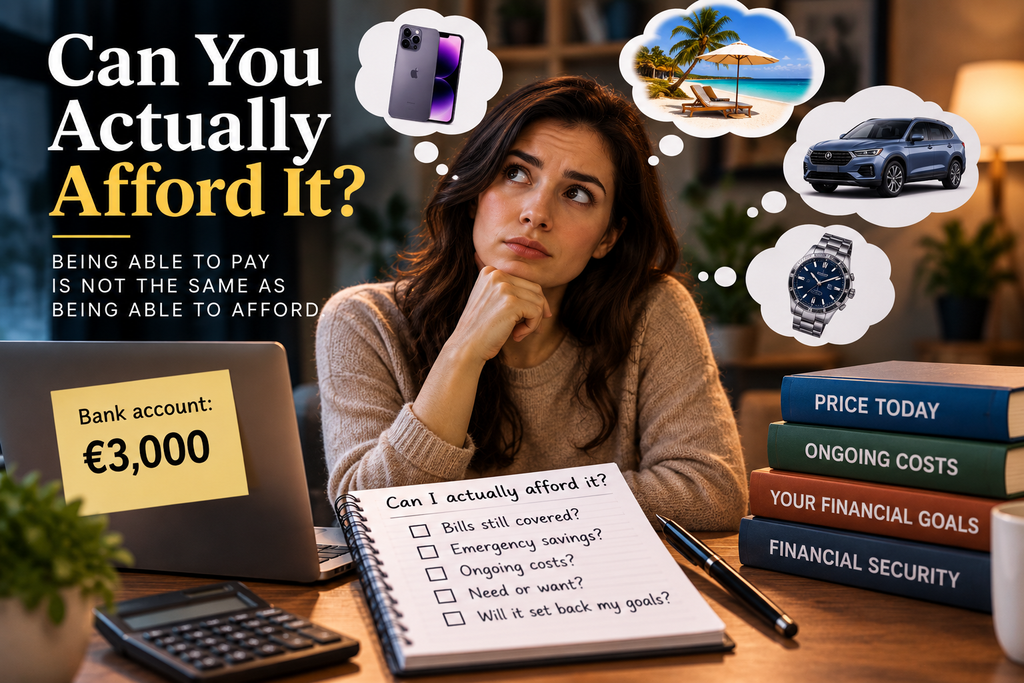
You have:
€3,000 in your bank account.
The new phone costs:
€1,300.
Can you buy it?
Of course.
Your card will work. The money is there.
But can you afford it?
That is a different question.
If buying the phone leaves you with €1,700 while rent, insurance and a car repair are all due soon, the fact that the transaction went through tells you almost nothing about whether the purchase was financially comfortable.
The Short Answer: Affordability Begins After the Purchase
To know whether you can afford something, look at what your finances will look like after you buy it.
A purchase is more likely to be affordable if you can make it without missing essential bills, using cash you genuinely need for emergencies, creating expensive debt, abandoning an important near-term goal or leaving yourself dependent on the next paycheck just to recover.
Price answers:
“Can I pay for this today?”
Affordability asks:
“What does my financial life look like tomorrow?”
That distinction is more useful than any universal spending rule.
Being Able to Pay Is Not the Same as Being Able to Afford
Consider two people buying exactly the same €1,300 phone.
Person A has €20,000 in savings, monthly essential expenses of €1,800 and stable income.
Person B has €1,500 in savings, monthly essential expenses of €1,400 and the same phone in their shopping basket.
Both cards could approve the €1,300 transaction.
But Person A would retain €18,700. Person B would have only €200 left.
The price is identical. The financial consequences are not.
This is why affordability cannot be determined from the price tag alone.
The First Question: What Money Are You Actually Spending?
A bank balance can be misleading because some of that money may already have jobs.
Suppose your account shows:
€6,000
But within that €6,000 you have:
- €1,500 for rent and bills
- €2,000 reserved for emergencies
- €1,000 for a holiday deposit already due
- €800 for an upcoming tax payment
- €700 genuinely unallocated
You do not really have €6,000 available for spontaneous spending.
You may have something closer to €700.
Bank balance ≠ disposable cash.
This is where having a broader personal finance system becomes useful: money allocated to bills, reserves, goals and discretionary spending can be distinguished before a purchase is made. Crown Altessa
Known Expenses Are Not Savings
If your insurance bill is due next month, that money is already spoken for.
The same applies to a known car repair, tuition payment, rental deposit or tax bill.
A €5,000 bank balance with €3,000 of upcoming obligations is not the same as €5,000 of genuinely available cash.
Treating committed money as spending money can make an affordable-looking purchase expensive a few weeks later.
Would the Purchase Damage Your Emergency Buffer?
Now suppose you have:
€4,000 in savings
and want something costing:
€2,500
After buying it:
€1,500 remains.
What happens if a €2,000 unexpected expense arrives next month?
Would you need a credit card? Miss another payment? Borrow? Sell an asset you did not intend to sell?
The CFPB describes emergency savings as cash reserved for unplanned expenses such as repairs, medical bills or loss of income, and notes that without savings even relatively small financial shocks can turn into debt. Consumer Financial Protection Bureau
This is not an argument that you must reach one arbitrary emergency-fund number before buying anything enjoyable. The appropriate reserve depends on your circumstances.
It means the purchase should be judged partly by what it does to your resilience. Crown Altessa’s article on building stability when circumstances change explores that broader resilience question separately. Crown Altessa
Can You Afford the Item — or Only the Monthly Payment?
This distinction becomes particularly important with financing.
Imagine a car priced at:
€35,000
The advertisement emphasizes:
€399 per month
€399 sounds much easier to absorb than €35,000.
But the monthly payment does not tell you the car’s complete financial footprint. Depending on the arrangement and where you live, there may also be a deposit, financing costs, insurance, fuel or electricity, servicing, tyres, registration, parking and depreciation.
The payment can fit your monthly budget while the total commitment does not.
A monthly payment can hide an expensive purchase.
The same principle applies to smaller items. A phone at €60 per month may involve a long contract. Furniture at “only €150 per month” can commit future income for years. A €3,000 holiday divided into several buy-now-pay-later instalments is still a €3,000 holiday.
Financing changes when you pay. It does not make the underlying purchase disappear.
The CFPB similarly warns that qualifying for BNPL does not mean using it is necessarily appropriate; consumers should consider whether the scheduled payments fit their finances and examine the loan’s fees and terms. Consumer Financial Protection Bureau
Recurring Costs Matter More Than the Price Tag
Some purchases largely end at checkout. Others create years of expenses.
A €2,000 bicycle may require relatively modest ongoing spending.
A €20,000 car may continue generating insurance, maintenance, fuel, tax, parking and other costs.
A €300 pet adoption fee may be tiny compared with years of food, veterinary care and insurance.
Affordability therefore includes ownership cost, not merely acquisition cost.
This is especially important when asking, “Can I afford a new car?” A car you can purchase may still put too much pressure on future monthly cash flow.
A Simple “After the Purchase” Test
Before buying something meaningful, picture your finances immediately afterward and ask:
- How much accessible cash remains?
- Are my near-term bills already covered?
- Is my emergency position still reasonable for my circumstances?
- Will this purchase create or increase expensive debt?
- Do I still have room for important goals?
- Can I comfortably absorb the ongoing costs?
- Would one ordinary financial surprise immediately create a problem?
One uncomfortable answer does not automatically make a purchase unaffordable.
Several serious problems appearing at once are a reason to reconsider.
The “Buy It Twice” Rule: Useful or Nonsense?
A popular internet rule says:
“If you can’t afford to buy it twice, you can’t afford it.”
It can be a useful psychological brake on impulsive spending.
It is not a financial law.
Imagine a €1,500 professional laptop. Someone may reasonably be able to afford one without having any reason to keep €3,000 available for two.
For a €50 restaurant meal, the ability to spend €100 tells you little about whether eating out fits your monthly finances.
For a €30,000 car, requiring an ordinary household to have enough disposable cash to purchase two cars may make the rule almost meaningless.
The better question is not:
“Could I literally buy two?”
It is:
“Can I buy one without destabilising the rest of my finances?”
What About the 24-Hour Rule?
Waiting before a non-essential purchase can be useful as a behavioural technique.
For something inexpensive, that might mean 24 or 48 hours. For a significant purchase, you may prefer several days or longer.
The waiting period does not prove whether something is affordable. It simply separates:
“I want this now”
from:
“I still want this after I’ve considered the financial consequences.”
It is a cooling-off mechanism, not an affordability formula.
How Much of Your Income Should a Purchase Cost?
There is no percentage that works for everyone.
Two people earning €3,000 net per month could have radically different finances.
One might pay €700 in housing costs with no dependants and substantial savings. The other might support children, pay €1,500 for housing, carry debt and have little cash.
Income provides context.
It does not determine affordability on its own.
This is also why broader articles about why saving money can feel difficult when fixed costs are high address a different problem: the amount of genuinely discretionary income can vary enormously even among people with similar salaries. Crown Altessa
A €1,300 Phone: Affordable or Not?
Consider three situations.
Person A: €4,000 monthly net income, €15,000 emergency savings, no expensive debt.
A €1,300 cash purchase is likely much easier for this household to absorb.
Person B: €2,000 monthly net income, €1,500 savings and €2,500 of credit-card debt.
Exactly the same phone could have a much larger effect on liquidity and debt.
Person C: €2,500 monthly net income, €5,000 savings, and their existing phone has broken. They rely on it for work.
Here the purchase also serves a practical purpose.
The examples do not tell us automatically whether each person “should” buy the phone. They show why price alone cannot answer the affordability question.
A €4,000 Holiday: Can You Afford the Experience?
Person A deliberately saves €4,000 into a travel fund over 12 months. Their emergency savings remain untouched and normal bills continue to be covered.
Person B has €4,500 of total cash and spends €4,000 of it on the same holiday.
Same trip.
Same €4,000.
Completely different financial aftermath.
A holiday is not inherently irresponsible because it is discretionary. What matters is whether the money was genuinely available for the purpose.
A €35,000 Car: The Price Is Only the Beginning
With a car, asking whether you have €35,000 or whether you can make a monthly payment is incomplete.
You need to consider the entire commitment: purchase or financing costs, insurance, fuel, maintenance, registration or taxes where applicable, parking and depreciation.
The relevant question becomes:
Can my finances support owning this car, not merely acquiring it?
What About Something That Helps You Earn Money?
Purpose matters too.
A €2,000 laptop used for professional work is not economically identical to a €2,000 luxury accessory.
The laptop might support employment, improve productivity, generate income or replace another expense.
That does not automatically make it profitable or affordable. Expected benefits can fail to materialise.
But a sensible affordability test should consider what the purchase does, not merely what it costs.
Luxury Purchases Are Not Automatically Irresponsible
Watches, clothes, restaurants, cars, travel and hobbies are not financial failures simply because they are optional.
Personal finance exists to support a life, not merely to maximise an account balance.
If someone’s essentials are covered, their financial resilience remains acceptable, expensive debt is under control and the purchase fits money deliberately allocated for discretionary spending, enjoying that money can be perfectly compatible with responsible finances.
Some people experience the opposite problem: the purchase fits comfortably, but spending still creates guilt. Crown Altessa’s archive discusses why spending can trigger financial anxiety even when the purchase itself is manageable in its article Why So Many Young Adults Feel Guilty About Spending Money. Crown Altessa
Affordability and emotional permission are separate questions.
Opportunity Cost: What Are You Giving Up?
Spending €3,000 means that €3,000 cannot simultaneously fund another goal, reduce debt, remain in savings or pay for another experience.
That does not make spending it wrong.
Opportunity cost is simply a reminder to ask:
“If I choose this, what am I choosing not to do?”
If you would still prefer the purchase, the trade-off may be entirely acceptable.
Financing has an opportunity cost too. A €400 monthly commitment for 48 months means €400 of future monthly cash flow has already been assigned before those months arrive.
Debt lets you move the purchase forward. It also commits future income.
Income Stability Changes What You Can Afford
Imagine an employee and a freelancer who each earn €45,000 over a year.
The employee receives predictable monthly income.
The freelancer may earn €7,000 one month and €1,000 the next.
Annual income is identical, but the amount of liquidity each needs to feel comfortable making a large purchase may differ.
Affordability is partly about uncertainty.
That is why financial confidence should not simply mean feeling brave enough to spend. Crown Altessa’s guide to building financial confidence during uncertain times frames confidence around resilience and the ability to adapt when circumstances change. Crown Altessa
What If You Have the Money but Feel Guilty Spending It?
Suppose your emergency position is adequate for your circumstances, you have no expensive debt, your important obligations are funded, and you deliberately saved €2,000 for something you want.
You buy it.
Then you feel guilty.
That does not necessarily reveal an affordability problem.
If money was deliberately allocated for discretionary spending, using it for that purpose is not automatically evidence of poor financial management.
The question “Can I afford it?” can be answered with financial facts.
The question “Do I feel comfortable allowing myself to enjoy the money?” may be different.
What If You Can’t Afford It Yet?
Not being able to comfortably afford something today does not require turning it into a moral issue.
You can wait, save specifically for it, choose a less expensive version, consider used or refurbished options where appropriate, reduce another discretionary expense, or reconsider the timing.
Financing may sometimes be appropriate too, but approval for credit should not be mistaken for evidence of affordability.
The Crown Altessa Affordability Test
Before a meaningful purchase, ask:
- Is the money genuinely uncommitted?
- Will my essential bills remain covered?
- Will my emergency position remain acceptable for my circumstances?
- Will this create or increase expensive debt?
- Can I afford the ongoing costs?
- Does this damage a more important near-term goal?
- Would one normal financial surprise immediately make me regret the purchase?
No single answer automatically decides everything.
But if several answers expose serious problems, the purchase probably deserves another look.
Three Purchases, Three Different Answers
Case A: A €1,500 laptop is needed for freelance work. The buyer has €10,000 in savings and no expensive debt.
The purchase consumes cash, but it leaves substantial liquidity and serves an income-related purpose.
Case B: A €2,500 watch. The buyer has €3,000 in total savings and €2,000 of credit-card debt.
The transaction may be possible, but its effect on liquidity and existing debt makes the financial footprint much larger.
Case C: A €4,000 holiday has been fully saved for in a separate travel fund. Emergency savings remain untouched and there is no expensive debt.
The price is larger than the laptop or watch, yet the purchase may fit the buyer’s finances more comfortably.
Affordable does not mean cheap.
Common Affordability Mistakes
The most common mistake is checking only whether the account contains enough money. Others include counting cash already needed for bills, draining emergency savings for discretionary purchases, focusing only on a financing payment, ignoring ownership costs, assuming a high income makes every purchase affordable, treating internet rules as financial laws, forgetting opportunity cost and feeling guilty about purchases that were deliberately planned and funded.
Price is visible. Financial consequences are not.
Frequently Asked Questions
How Do I Know If I Can Afford Something?
Look at your finances after the purchase. Check remaining cash, upcoming obligations, emergency resilience, debt, recurring costs, important goals and income stability.
If I Have Enough Money in Savings, Can I Afford It?
Not necessarily. Some savings may already be needed for emergencies, bills or known expenses. The relevant amount is the money genuinely available after those obligations are considered.
What Is the Difference Between Being Able to Pay and Afford?
Being able to pay means you have sufficient cash or credit to complete the transaction. Affordability asks whether your finances remain healthy enough afterward.
Is the “Buy It Twice” Rule Accurate?
It is a heuristic, not a financial law. It can encourage caution, but whether you could literally buy two of something says little about your obligations, liquidity or income stability.
Should I Finance Something If I Cannot Pay Cash?
Financing is not automatically good or bad. Examine the total cost, terms, monthly commitment and effect on future cash flow. Being approved for financing does not prove the purchase is affordable.
How Long Should I Wait Before Making a Big Purchase?
There is no required period. A cooling-off period of a day, several days or longer can help with non-essential purchases, but waiting itself does not determine affordability.
Does Affordability Depend More on Income or Savings?
Both can matter, along with expenses, debt, emergency reserves, recurring ownership costs, goals and income stability. No single number provides the complete answer.
Conclusion
Return to the phone.
You have:
€3,000 in your account.
The phone costs:
€1,300.
Yes, the card will work.
But that tells you only that the purchase is possible.
It does not tell you what cash remains, whether upcoming bills are covered, whether you will create debt later, whether an important goal gets disrupted or whether the item’s ongoing costs fit comfortably.
For a broader beginner-friendly framework for organizing spending, saving and other financial decisions, Personal Finance Made Simple for Beginners is available on Gumroad and Amazon.
Being able to pay tells you whether the transaction works. Being able to afford it tells you whether your finances still work afterward.
Feeling financially stuck?
When financial pressure becomes constant, long-term decisions start feeling emotionally heavy.
The Crown Altessa newsletter was created to help people rebuild clarity slowly and strategically through practical financial frameworks, long-term thinking, and structured decision-making insights.
Join the newsletter and receive:
• the free Financial Foundation Guide
• strategic financial insights
• practical tools for long-term stability
• frameworks designed to reduce financial overwhelm
Start building financial clarity one step at a time.