
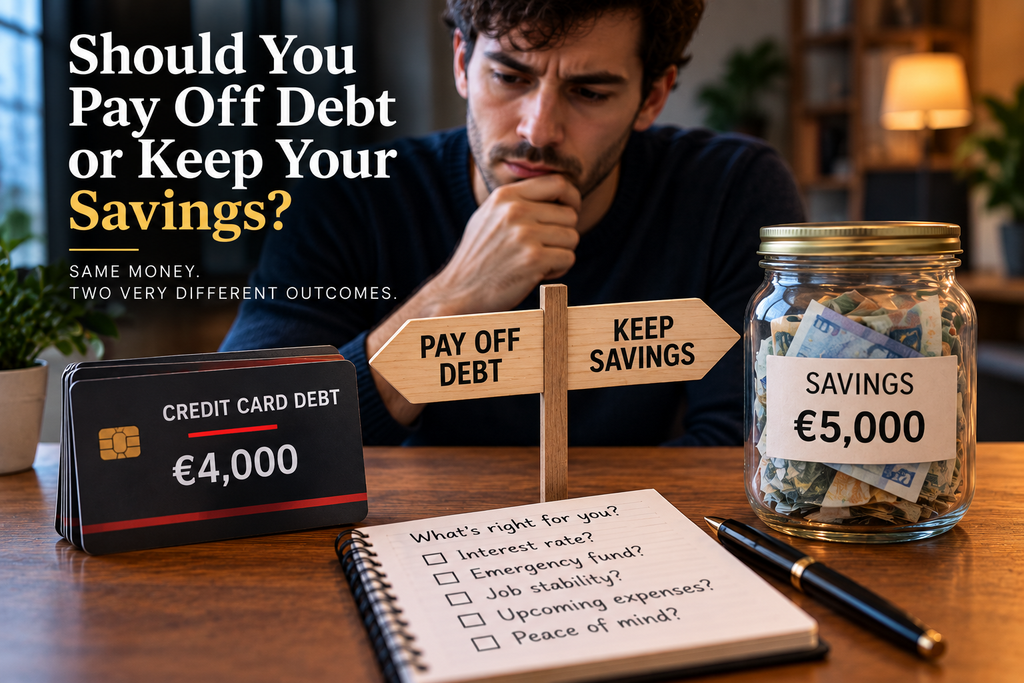
You have:
€5,000 in savings.
You also owe:
€4,000 on a credit card.
One option seems obvious: pay off the card tomorrow.
But then your savings fall to €1,000.
What if your car breaks next week? What if you lose your job? What if the boiler dies?
Now the decision is no longer just about interest. It is about the price of debt versus the value of having cash available.
The Short Answer: It Depends on Two Numbers
If you’re deciding whether to pay off debt or save money, start with two questions:
- How expensive is the debt?
- How much emergency cash would remain after paying it?
Very expensive debt creates a strong financial reason to reduce it quickly. Very little remaining cash creates a reason to avoid draining savings completely.
The sensible answer often sits between those two pressures.
Why Paying Off Debt Usually Wins the Math
Suppose you have €4,000 in savings earning 3% a year and €4,000 of credit-card debt costing 20%.
Ignoring compounding, taxes and fees for simplicity:
Approximate annual savings interest: €120
Approximate annual debt interest: €800
You’re earning €120 while paying roughly €800.
The difference is about €680 per year.
Keeping cash at 3% while carrying equivalent debt at 20% is expensive. Reducing that debt removes a much larger interest cost than the savings account generates.
But that does not automatically mean every available euro belongs on the credit card.
Cash has another job.
Why Keeping Some Savings Can Still Make Sense
Emergency savings provide liquidity: money you can access when something goes wrong.
The CFPB describes an emergency fund as cash reserved for unplanned expenses such as car or home repairs, medical bills and loss of income. It also notes that without savings, even a relatively small financial shock can push someone toward credit cards or loans. Consumer Financial Protection Bureau
That matters to the debt decision.
If you pay off your credit card today but have to use it again next month because you have no cash left, you have not solved much.
Debt costs money. Cash buys time.
Crown Altessa has a separate guide on building financial stability when circumstances change, including the role liquidity plays during income disruptions. Crown Altessa
The Problem With Using Every Last Euro
Return to the original example.
Savings:
€5,000
Credit-card debt:
€4,000
You pay the full €4,000.
Savings left:
€1,000
Two weeks later, an unavoidable expense costs:
€2,500
If you have no other resources, you are €1,500 short. You may end up borrowing again.
That does not mean paying the €4,000 was necessarily wrong. It demonstrates why liquidity has economic value even when debt is expensive.
Zero debt with zero liquidity can still be financially fragile.
High-Interest Debt Changes the Calculation
A credit card charging 20% creates a very different problem from a fixed loan charging 3%.
The higher the rate, the more expensive it becomes to preserve large amounts of cash while carrying the debt.
This is especially relevant for expensive revolving credit and other high-cost consumer borrowing.
If you’re struggling even to make required credit-card payments, the problem has moved beyond optimizing savings. The CFPB advises borrowers in that position to contact their card issuer promptly rather than simply stopping payments. Consumer Financial Protection Bureau
But if you can make your payments and are deciding what to do with additional cash, the interest rate provides a useful measure of urgency.
Low-Interest Debt Is a Different Problem
Suppose you have:
Debt: €10,000
Interest rate: 2.5% fixed
Savings: €8,000
Using nearly all €8,000 to eliminate most of a relatively cheap loan may save interest, but it would also remove much of your liquidity.
Now other factors deserve more weight:
- How stable is your income?
- Are significant expenses approaching?
- How flexible is the repayment schedule?
- Is the rate fixed or variable?
- What other cash can you access?
Low-interest debt should not automatically be kept. The point is that the urgency is different.
“Debt” is too broad a word to produce one answer.
What About 0% Debt?
A genuine 0% promotional balance changes the arithmetic again.
If the debt currently costs no interest, paying it off immediately does not provide the same interest saving as eliminating a 20% balance.
But 0% does not mean “ignore it.”
Check:
- when the promotional period ends;
- what interest rate applies afterward;
- required minimum payments;
- the consequences of late or missed payments;
- whether you can realistically clear the balance before the offer expires.
For example, CFPB guidance on balance-transfer promotions notes that promotional rates generally last for a limited period and that terms and fees matter. Consumer Financial Protection Bureau
Read the terms of your own agreement rather than assuming every 0% product works the same way.
The Emergency Buffer Question
So how much should you keep before aggressively paying debt?
There is no universal number.
Your appropriate cash buffer depends on your circumstances, including employment stability, household size, housing costs, transport needs, insurance, health-related costs, access to other cash and upcoming expenses.
Someone with stable employment, low fixed expenses and no dependants may reasonably view liquidity differently from a freelancer supporting a family.
The CFPB similarly says the amount needed in emergency savings depends on the individual’s situation rather than prescribing one number for everyone. Consumer Financial Protection Bureau
Starter Emergency Buffer vs Full Emergency Fund
It can help to distinguish two concepts.
A starter buffer is enough accessible cash to absorb smaller surprises without immediately borrowing again.
A full emergency fund is a larger reserve intended for more serious disruptions, such as losing income for an extended period.
Someone carrying very expensive debt may choose to protect a smaller starter buffer, direct substantial additional cash toward the debt and then rebuild a larger reserve afterward.
That is a framework, not a universal prescription.
For the broader question of how emergency reserves fit into financial stability, see Crown Altessa’s guide to building financial confidence in uncertain times. Crown Altessa
A Simple Debt vs Savings Decision Framework
| Situation | What deserves attention |
|---|---|
| High-interest debt + low savings | Protecting basic liquidity while reducing expensive debt |
| High-interest debt + strong savings | Using part of excess savings to reduce costly debt |
| Low-interest debt + low savings | Strengthening liquidity may deserve greater weight |
| Low-interest debt + strong savings | Goals, flexibility, risk tolerance and opportunity cost become more important |
This is not individualized advice. It is a way of identifying which side of the trade-off deserves the most attention.
What If You Have €10,000 Savings and €5,000 Debt?
Suppose:
Savings: €10,000
Credit-card debt: €5,000 at 20%
Essential monthly expenses: €2,000
Using €5,000 to clear the card would still leave:
€5,000 in cash
That is approximately 2.5 months of essential expenses.
This is fundamentally different from having €5,000 of savings and spending every euro of it to eliminate €5,000 of debt.
The debt is identical.
The liquidity after repayment is not.
What If You Have €5,000 Savings and €5,000 Debt?
This is harder.
Paying everything eliminates the debt but leaves no emergency cash.
Possible approaches could include preserving a starter buffer, using part of the remaining savings against the debt, continuing aggressive monthly repayments and then rebuilding savings as the debt falls.
There is no single correct split without knowing the household’s circumstances.
Interestingly, a CFPB experiment involving hypothetical savings-and-debt decisions found that participants generally wanted to reduce debt and preserve some savings rather than treating the choice as completely binary. The CFPB cautioned that the experiment was not nationally representative, but it illustrates the balancing instinct behind this decision. Consumer Financial Protection Bureau
What If You Have €1,000 Savings and €5,000 Debt?
Now liquidity becomes even more important to the calculation.
Using the entire €1,000 reduces the debt to €4,000.
But cash falls to zero.
If an emergency arrives next week, borrowing may become necessary again.
That does not mean you should never use any of the €1,000. It means comparing 20% debt with a low-yield savings account tells only part of the story.
You also need to ask what happens the day after the payment.
For people whose monthly budget already leaves little room for unexpected costs, Crown Altessa’s article on what to do when there is no money left after bills examines the underlying cash-flow problem in more detail. Crown Altessa
Can You Save and Pay Debt at the Same Time?
Yes.
The choice does not have to be:
100% debt
or:
100% savings.
Someone could maintain a basic cash reserve, direct most additional money toward expensive debt and continue a smaller automatic savings contribution.
This can preserve both liquidity and the savings habit without pretending that a 20% debt cost is financially harmless.
The appropriate split depends on the person’s finances. There is no universal percentage.
Why the Interest Rate Is Not the Only Risk
Consider two households.
The first has unstable income, high fixed expenses and very little cash.
The second has stable employment, low monthly obligations, good insurance coverage and several accessible reserves.
Even with identical debt, their financial fragility is different.
The first household has a greater chance of needing to borrow again if something goes wrong.
This is why liquidity cannot be valued solely by looking at the interest rate on a savings account.
Debt costs money. Illiquidity can cost money too.
A broader personal finance system can help identify how much money is genuinely available for debt reduction rather than treating the bank balance as one undifferentiated pot. Crown Altessa
What About Mortgages and Student Loans?
Mortgage debt is structurally different from revolving credit-card debt.
The decision can depend on the mortgage rate, whether it is fixed or variable, prepayment conditions, housing plans, emergency liquidity and local tax rules.
Student loans vary even more between countries. They may involve subsidised interest, income-linked repayments, government protections or conventional fixed repayment schedules.
Neither category should be treated automatically like a 20% credit-card balance.
The same broad question still applies:
What does this debt cost, and what is the value of keeping the cash available?
Known Expense or Emergency Fund?
Suppose you have €5,000 in the bank but know that a €2,000 car repair must be paid next month.
You do not really have €5,000 of uncommitted emergency savings.
You have:
€2,000 assigned to a known expense
plus:
€3,000 available for everything else.
Using the €2,000 against debt today and borrowing again to pay the repair next month simply shifts the problem.
The Psychological Side of Debt vs Savings
Some people feel intense discomfort when they see debt.
Others feel unsafe unless there is substantial cash in their bank account.
Both reactions are understandable, but neither should completely replace arithmetic.
Keeping €20,000 in cash while carrying €15,000 of extremely expensive revolving debt may feel reassuring while costing a considerable amount in interest.
The opposite extreme has a problem too: using every euro available simply to see a €0 debt balance can leave a household vulnerable to the next unexpected bill.
Financial security depends on more than making one number disappear.
A Better Question Than “Debt or Savings?”
Instead of asking:
“Should I pay debt or save?”
try asking:
“How much liquidity do I need to avoid borrowing again, and what should I do with the money above that amount?”
That framing separates money that has a genuine protective purpose from cash that may be sitting idle while expensive interest accumulates.
It also avoids treating the decision as all-or-nothing.
A Simple Priority Sequence
Circumstances differ, but a general framework can look like this:
- Cover essential current expenses.
- Make required debt payments.
- Preserve enough immediate liquidity that a modest financial shock does not automatically create new debt.
- Give expensive debt serious priority.
- Strengthen the emergency reserve as the expensive debt comes under control.
- Reassess lower-cost debt according to your circumstances and goals.
If the underlying problem is that expenses regularly exceed income, debt repayment alone may not fix it. Crown Altessa’s guide on how to manage your personal finances covers the wider cash-flow structure rather than this specific debt-versus-savings decision. Crown Altessa
Three Different People, Three Different Answers
Case A: €8,000 savings, €3,000 debt at 22%, stable income.
Paying some or all of the expensive debt from savings may be attractive because substantial liquidity can remain afterward.
Case B: €2,000 savings, €3,000 debt at 22%, variable freelance income.
The interest cost is painful, but preserving some emergency liquidity may carry more weight because income is unpredictable.
Case C: €10,000 savings, €10,000 fixed-rate debt at 2.5%, stable income.
There is less mathematical urgency to sacrifice all liquidity merely to eliminate relatively inexpensive debt.
Same question.
Different balance of risks.
Common Mistakes
Common errors include draining all savings solely to become debt-free, carrying extremely expensive debt while hoarding far more cash than is realistically needed, treating every type of debt identically, forgetting when a 0% promotion expires, counting money for known expenses as an emergency fund, and paying off a card only to immediately build the balance again.
Another mistake is making the decision without knowing your actual monthly expenses. You cannot judge whether €3,000 is a strong or weak cash buffer without understanding what your household actually needs.
A Five-Minute Debt vs Savings Check
Before moving money, answer these questions:
- What is the debt balance?
- What is the interest rate?
- Is that rate fixed, variable or promotional?
- How much accessible cash do I have?
- How much of that cash is already committed to upcoming expenses?
- What are my essential monthly expenses?
- How stable is my income?
- What would happen if I had a €1,000 emergency next week?
- How much savings would remain after the proposed debt payment?
- Would paying the debt today make it likely that I need to borrow again soon?
Those answers usually reveal more than a generic rule about whether debt or savings should “come first.”
Frequently Asked Questions
Should I Use Savings to Pay Off Debt?
It can make financial sense when the debt is expensive and you can still preserve adequate liquidity afterward. Draining essential cash is a different decision from using genuinely excess savings.
Should I Pay Off Credit-Card Debt or Build an Emergency Fund?
Both can matter. Expensive credit-card debt creates substantial interest costs, while having no emergency cash increases the risk of borrowing again after an unexpected expense.
Should I Drain My Savings to Pay Off Debt?
Not automatically. Consider how much cash would remain, how stable your income is, upcoming expenses and the interest cost of the debt.
Is It Better to Save Money or Pay Off a Loan?
It depends heavily on the loan’s cost and your need for liquidity. A 20% credit-card balance and a 2.5% fixed loan present very different trade-offs.
What If My Debt Is at 0% Interest?
Check when the promotional period expires, the future rate, required payments, applicable fees and whether you can realistically repay the balance before the offer ends.
How Much Savings Should I Keep While Paying Debt?
There is no universal amount. Consider essential expenses, income stability, dependants, housing, transport, insurance, upcoming obligations and access to other cash.
Can I Save and Pay Debt at the Same Time?
Yes. Maintaining some cash while directing additional money toward expensive debt can be reasonable. The appropriate balance depends on your circumstances.
Conclusion
Return to the original dilemma.
Savings:
€5,000
Debt:
€4,000
The decision is not simply:
€5,000 − €4,000 = €1,000
You also need to ask:
What does the debt cost?
How much emergency cash would remain?
How likely are you to need that cash?
Could paying everything off force you back into debt?
For a broader beginner-friendly framework for managing saving, debt and other financial priorities, Personal Finance Made Simple for Beginners is available on Gumroad and Amazon.
The goal is not merely to eliminate debt or maximize savings. It is to reduce expensive debt without making your finances fragile.
Feeling financially stuck?
When financial pressure becomes constant, long-term decisions start feeling emotionally heavy.
The Crown Altessa newsletter was created to help people rebuild clarity slowly and strategically through practical financial frameworks, long-term thinking, and structured decision-making insights.
Join the newsletter and receive:
• the free Financial Foundation Guide
• strategic financial insights
• practical tools for long-term stability
• frameworks designed to reduce financial overwhelm
Start building financial clarity one step at a time.