
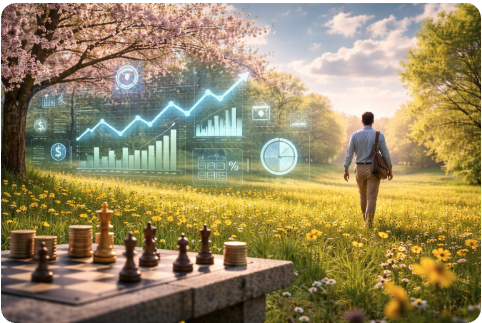

Most people treat spring as administrative season.
They file taxes.
They clean their homes.
They reorganize paperwork.
And then they return to normal life.
But I started noticing something early on: the people who actually built wealth didn’t treat spring as maintenance season.
They treated it as positioning season.
And there’s a difference.
The Pattern I Noticed Growing Up
When I was younger, I saw two very different financial behaviors.
In Italy, especially in smaller areas, many people relied on stability. There was always someone who knew someone. There was always a system that would absorb you. The urgency to position yourself strategically wasn’t always there.
When I visited Nigeria, I saw something else entirely.
There was no safety net mindset. People paid attention. They watched who was growing. They observed opportunities early because waiting meant losing.
Later, in Germany, I saw another layer: structure. Discipline. Timing. Quiet financial preparation.
That’s when I began recognizing a pattern:
Wealth is rarely accidental.
It’s seasonal.
And spring is one of its most underestimated windows.
Why Spring Matters Financially
Spring follows:
- Year-end financial reporting
- Corporate earnings releases
- Tax adjustments
- Central bank policy shifts
- Budget announcements
In Europe, this is when households review income declarations. In Germany, it’s tax optimization season. In Italy, families analyze fiscal outcomes. Globally, companies publish annual results.
This creates clarity.
And clarity creates opportunity.
The wealthy don’t just observe this cycle. They prepare around it.
1. Portfolio Rebalancing Before Risk Compounds
If markets performed strongly in the previous year, your portfolio is no longer balanced.
Most people don’t notice this drift. They see growth and assume safety.
But if equities outperformed significantly, your risk exposure has increased automatically. Your allocation may now be overweight in assets that already ran.
Rebalancing in spring restores discipline.
Not emotionally.
Structurally.
This aligns with what I discussed in Why Boring Investors Win (And Why Most People Can’t Be One) — the real advantage is not intelligence, but restraint.
Spring is when disciplined investors quietly reduce overexposure before volatility returns.
2. Tax Optimization — Not Just Tax Filing
Most households file taxes reactively.
Wealthier individuals analyze taxes strategically.
They ask:
- Are assets structured efficiently?
- Are there unrealized losses worth harvesting?
- Should income timing be adjusted?
- Can deductions be optimized?
According to OECD data, higher-income households consistently reduce effective tax burdens through structural planning — not evasion, but timing and asset structuring.
Spring is when those calculations happen.
This connects closely to the idea explored in Designing Your Personal Financial System to Stay in Control — systems outperform improvisation.
Taxes are not just compliance.
They are a lever.
3. Liquidity Assessment After Lifestyle Inflation
Here’s something most people miss.
If your income increased last year, your emergency fund should increase too.
But rarely does.
Lifestyle upgrades happen immediately.
Safety net upgrades are postponed.
In my early years in Germany, I lived month-to-month. I remember the psychological weight of having no reserves. When income finally stabilized, the first thing that changed wasn’t my lifestyle — it was my liquidity.
Savings equal clarity.
Spring is the ideal moment to ask:
- Does my emergency fund still cover six months?
- Did my fixed costs increase?
- Is my liquidity aligned with my current risk exposure?
This directly connects to How to Create an Emergency Fund Step-by-Step, but with a strategic overlay: liquidity is not static. It evolves with your life.
4. Strategic Sector Awareness
I remember noticing that people with money paid attention to markets in ways everyday households didn’t.
Not obsessively. Not emotionally.
But seasonally.
Spring often follows:
- Government budget decisions
- Infrastructure announcements
- Monetary policy updates
Certain sectors historically move after these signals.
This is not prediction.
It’s awareness.
There’s a reason professional investors monitor earnings season closely. According to JPMorgan research, market volatility tends to cluster around earnings cycles and policy announcements.
The everyday person sees movement after it happens.
The disciplined investor prepares before narratives form.
This idea overlaps with the thinking behind The War for Opportunity: Why Success Requires a Competitive Mindset — competition isn’t aggression. It’s timing.
The Cultural Contrast
In villages in Nigeria, money was displayed immediately.
In parts of Italy, stability was assumed.
In Germany, structure is respected.
What I learned from observing these systems is simple:
Wealth is rarely built through dramatic moves.
It’s built through seasonal awareness.
Most people think in days or months.
The wealthy think in cycles.
Spring Is Not About Prediction
It’s about preparation.
You’re not trying to guess what markets will do.
You’re asking:
- Is my structure still aligned?
- Has risk drifted?
- Has income changed?
- Has policy shifted?
- Am I positioned — or passive?
That’s the difference.
Final Thought
The average person cleans their house in spring.
The disciplined investor cleans their balance sheet.
That difference, repeated over years, compounds quietly.
And by autumn, when results begin to show, it looks like foresight.
But it wasn’t foresight.
It was preparation.
Related Reading
- Designing Your Personal Financial System to Stay in Control
- Why Boring Investors Win (And Why Most People Can’t Be One)
- The War for Opportunity: Why Success Requires a Competitive Mindset
My book on GumRoad: How Personal Finance Made Simple Can Transform Your Future
Or on Amazon:
Build Financial Clarity
Join the Crown Altessa newsletter and receive:
• the free Financial Foundation Guide
• practical financial frameworks
• strategic decision-making insights
• tools designed to help you think long term about money and stability
If you want calmer, more structured financial thinking in an uncertain world, subscribe below.