
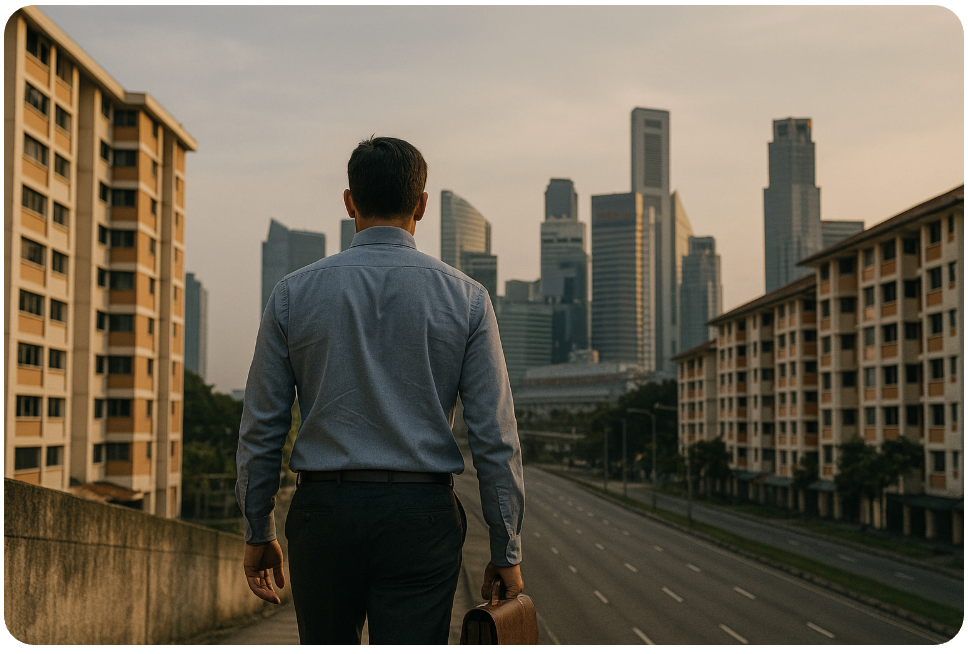
When global wealth enters a country, it doesn’t sit silently in a bank vault.
It reshapes the environment. It changes how cities feel, how people live, and how opportunity distributes itself.
Singapore is one example, but this pattern appears everywhere global capital concentrates: Dubai, London, Vancouver, Lisbon, Hong Kong, New York.
The moment enough high-net-worth individuals arrive, the city bends around them — often at the expense of those already living there.
But the deeper truth is this:
What brings stability to the wealthy often creates instability for everyone else.
When Global Money Meets Local Reality
A city designed around global capital slowly stops serving local life.
The shift happens in layers.
1. Housing becomes a global marketplace
Prices stop reflecting local wages and begin reflecting global wealth.
People feel this instantly — and painfully.
This is where understanding economic transitions becomes essential.
Cities evolve faster than salaries.
2. The cost of living rises without local incomes rising
Everything becomes premium:
- food
- transport
- basic services
- healthcare
- education
This is not greed — it’s repricing based on wealth inflows.
3. Locals feel like tenants in their own cities
Not because they did anything wrong — but because the environment is no longer priced for them.
This is a pattern seen worldwide: prosperity on paper, pressure in real life.
And that psychological strain often breaks people long before the financial strain does.
Why Elites Don’t Feel What Everyday People Feel
The wealthy operate in a different economic reality:
- Their income is not tied to local conditions.
- Their assets earn money globally.
- Their lifestyle does not depend on wages.
- Their safety net is not made of savings but of positioning strategies (link to: The Ascent).
If local prices rise, they barely notice.
If the economy slows, their assets often grow elsewhere.
This isn’t personal — it’s structural.
The system bends toward global capital because global capital can move.
People cannot.
Stability for the Rich, Instability for Everyone Else
When elites seek stability, they bring volatility for others:
- Predictable investment → unpredictable rent
- Predictable asset growth → unpredictable home ownership
- Predictable regulatory environments → unpredictable wage dynamics
This dynamic explains why ordinary people often feel like they’re moving backward even when the broader economy looks strong.
And it’s why developing personal buffers becomes non-negotiable.
Without buffers, the modern world punishes fragility.
The Emotional Cost No One Talks About
You can measure money.
You can measure prices.
But you cannot measure the emotional toll of losing access to the place you grew up in.
People feel:
- disoriented
- displaced
- squeezed
- and quietly ashamed
This shame is undeserved.
You’re not failing — the system is shifting around you.
Understanding these shifts is the first step to regaining power.
The second step is creating systems, not reactions —
systems that keep you stable even when your environment stops being stable.
This is what long-term future building looks like.
Why This Isn’t About Blame — It’s About Awareness
Blaming the wealthy won’t help you.
Blaming the government won’t help you.
Blaming “the market” won’t help you.
Understanding the structure will.
When you understand the forces shaping your environment, your choices change:
- You save differently
- You invest differently
- You choose your city differently
- You negotiate work differently
- You plan your future differently
And these decisions multiply over time.
This is why financial awareness is far more valuable than financial perfection.
Awareness is a structural advantage.
Everyday people rarely have access to it —
but elites build their entire lives around it.
Articles like The Education Trap explore exactly how systems shape opportunity. The same logic applies here: systems create outcomes.
You cannot escape a system you don’t understand.
What Comes Next
In Article 3, you will learn:
- how to build a mobility plan
- how to convert physical life into digital resilience
- how to defend digital assets against shutdowns, freezes, or surveillance
- how to build protection using everyday tools, not elite structures
Because stability is not something the system hands you —
it’s something you build, layer by layer.