
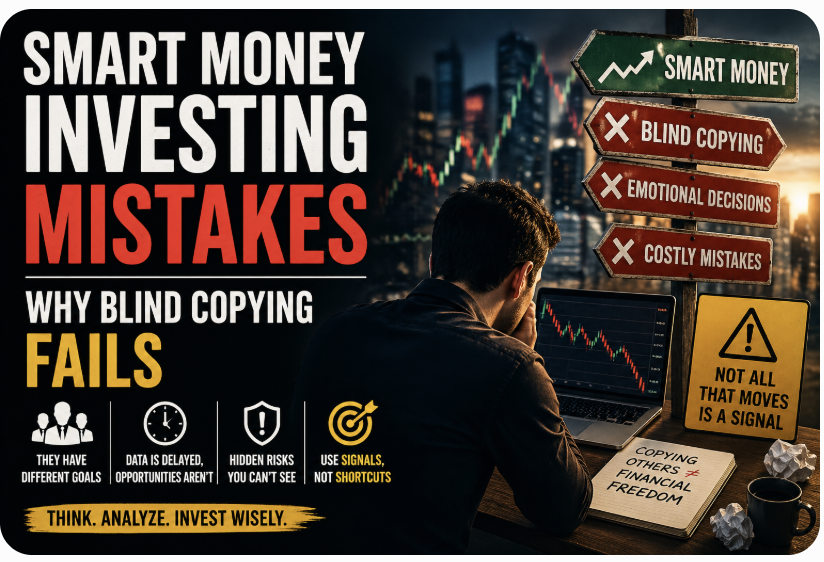
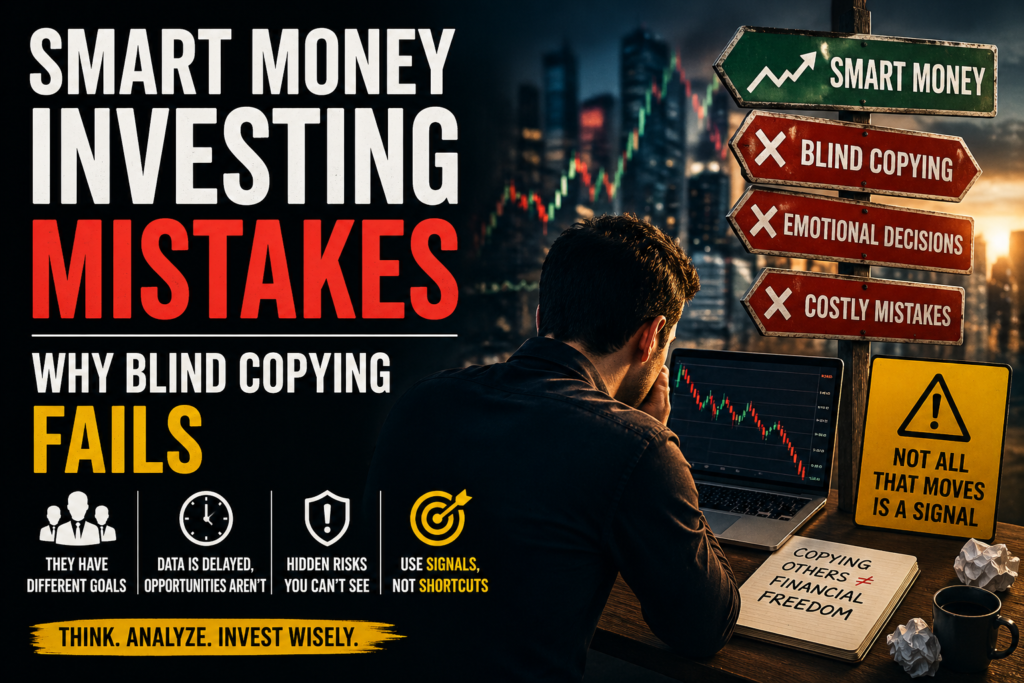
Markets have never been more transparent, yet investors still trip over the same myth: smart money knows something you don’t, so just copy what it does. At first glance, it seems reasonable. Hedge funds and pension managers control trillions, employ legions of analysts and, as our earlier smart‑money investing guide shows, their trades leave a public trail. If the goal is to build wealth, why not simply mimic their moves?
The reality is more complicated. Blindly following big investors often fails – and sometimes hurts your own portfolio. Below we unpack why the strategy feels so convincing, where it goes wrong, and how to use institutional signals responsibly.
Why following smart money feels logical
There’s a simple psychological reason people like to follow smart money: fear of missing out. Financial FOMO is the anxious belief that everyone else is making money while you sit on the sidelines. It rides on herd mentality, recency bias and overconfidence. When you see a respected hedge fund manager buying a stock or your social feed buzzing about a “big whale” position, it triggers a rush of urgency: buy now or regret it. This urgency is rarely grounded in a plan.
Authority bias amplifies the effect. Large institutions hire teams of analysts, have access to management and enjoy research resources that retail investors lack. It’s tempting to assume these professionals must know better. And because many institutional trades are visible via public disclosures like Form 13F and insider filings, the data creates an illusion of transparency. When a famous fund buys a stock you already like, it feels like validation. When a sector suddenly sees increased government funding, it appears to confirm your hunch.
That’s why the strategy feels logical. Unfortunately, it often ignores the hidden mechanics behind institutional investing.
The hidden problems with smart‑money signals
Data delays and stale information
Most “smart money” data comes with a significant lag. For example, Form 13F filings – the quarterly reports used to track institutional holdings – are published up to 45 days after each quarter. A position disclosed on February 14 reflects holdings as of the previous December. By the time you read it, the manager may have already sold the stock, the price may have moved dramatically, and market conditions may have changed. That delay makes it easy to buy yesterday’s idea at tomorrow’s price.
Current event reports (like 8‑K filings) and insider transactions offer more timely clues, but even these are reactive, not predictive. They tell you what a company or executive just did, not necessarily what they will do next. In Europe, major shareholding notifications must be filed when thresholds are crossed, but they still only show a snapshot in time.
Incomplete picture: hedges and hidden risk
Public filings only show part of the story. A 13F report lists long positions in U.S. equities, but it doesn’t reveal short positions, derivatives exposure, intraday trades or hedging strategies. A hedge fund might own Stock A and short Stock B as part of a pair trade. Copying the long position without the short exposes you to market risk the manager has offset. Options and derivatives positions are reported without context; they may form part of a complex strategy that looks nothing like a simple buy.
Institutional risk frameworks also differ. Funds use leverage, stop‑loss rules and dynamic position sizing that aren’t visible in a filing. Without that context, buying the same stock is like playing chess after seeing only one move.
Different time horizons and objectives
Institutions manage money for pensioners, endowments and governments. They have very long or even unlimited investment horizons, allowing them to ride out volatility that would terrify a typical saver. Their goals may include matching liabilities or outperforming a benchmark, not maximizing absolute returns. Following a position because a sovereign wealth fund owns it doesn’t tell you when they intend to sell or how it fits into their broader asset allocation. Your personal objectives and risk tolerance may be completely different.
Complexity and processing power
Retail investors often underestimate the effort required to interpret institutional data. Even though Form 4 insider reports are filed within two business days and dark‑pool volumes are published in near real time, analysing these signals requires normalising data across thousands of filers and millions of contracts. Platforms like Meridian note that retail investors’ disadvantage isn’t access but processing capacity. Simply scrolling through raw filings doesn’t replicate professional research.
Common mistakes beginners make
- Acting too late. Many copycat investors buy after a signal becomes public. As the HedgeTrace analysis notes, a fund could have sold the position weeks earlier. You end up paying a higher price without the original thesis.
- Misinterpreting position sizes. Seeing a stock in a fund’s portfolio doesn’t tell you much unless you know the conviction level. Swissquote warns that a 0.3 % “tracking position” is just a placeholder, whereas a 5 % allocation signals strong conviction.
- Ignoring fundamentals. Copying smart money without understanding why the position exists leads to overconfidence. HedgeTrace stresses that new positions and significant increases are meaningful only if you do your own research.
- Overlooking hedges and diversification. Buying one stock from a long‑short strategy exposes you to risks the hedge fund has offset. Without diversification, you can suffer large drawdowns.
- Chasing every signal. Professionals filter thousands of data points and focus on confluence – multiple independent signals pointing in the same direction. Single signals should be research leads, not automatic trades.
What smart investors actually do instead
Experienced investors treat smart‑money data as context, not instruction. They look for patterns rather than isolated events. For example, a credible signal emerges when insider buying, dark‑pool accumulation and multiple institutional filings all point to the same stock. This “signal confluence” framework helps separate noise from insight.
Professionals also combine signals with fundamentals. They read the company’s financial statements, understand the business model and assess valuation. They use institutional trades as evidence to investigate, not as a shopping list. When they do buy, they size positions based on their own risk tolerance and diversify across ideas, as Swissquote advises. They manage risk actively, scaling in when conviction grows and cutting losses when the thesis breaks.
If you want a deeper understanding of how smart money moves the market, our guide on tracking institutional flows explains the mechanics and shows how to interpret public data without jumping to conclusions. And if you’re ready to learn how to decode multiple signals in a systematic way, our early investment signals tutorial breaks down a framework anyone can apply.
Reality check: professionals can be wrong too
Even with superior resources, most professional managers fail to outperform simple index funds. Standard & Poor’s found that nearly 90 % of fund managers do not beat their benchmarks, and low‑cost index funds have repeatedly outperformed active funds. On a risk‑adjusted basis, passive benchmarks beat active managers 95 % of the time. That’s not because professionals are clueless; it’s because markets are competitive, fees are high and size makes it hard to be nimble. Copying their trades after the fact won’t change these odds.
What This Looks Like in Real Life
Picture a 30‑something developer in Frankfurt who has just started investing. She reads that a respected hedge fund has bought a large stake in a renewable‑energy company, and a wave of fear of missing out hits. The fund’s 13F filing is six weeks old, but she doesn’t realise how stale the information is. She buys the stock at €48 – almost 30 % higher than the price the professionals paid.
For a while it feels great to be on the “smart money” train. But then the next quarter’s report shows the hedge fund has already trimmed its position. The share price falls back to €35, and our novice sells in a panic, locking in a loss. The experience stings, but it teaches her that blindly following big investors without understanding timing, valuation or her own risk tolerance is a recipe for regret. Signals are clues, not instructions, and chasing them too late can be costly.
How to use smart‑money signals responsibly
You don’t need to abandon institutional data altogether. Instead:
- Treat filings as leads, not instructions. Use 13F and insider reports to generate research ideas, then study the company yourself.
- Look for confluence. Prioritise signals that align across multiple sources (insider buying, government funding, dark‑pool activity) rather than single data points.
- Pay attention to timing. Focus on new positions and significant increases rather than stale holdings.
- Respect your own horizon. Institutions can ride out volatility; if you need your money in five years, your strategy should reflect that.
- Practise risk management. Diversify, size positions appropriately and set exit rules. Don’t assume a hedge fund’s 5 % position should be 5 % of your portfolio.
These principles align with the way we encourage readers to design systems that build wealth automatically and habits that support long‑term success, rather than chasing every hot tip.
The bottom line
Blindly following smart money is a seductive but dangerous shortcut. It feels logical because of FOMO and authority bias, but it overlooks data delays, hidden hedges, differing time horizons and the complexity of professional risk management. Most fund managers don’t beat the market, and copycat strategies suffer from stale information.
The smarter approach is to think like an investor, not a mimic. Use institutional signals as clues, combine them with your own research, and make decisions that fit your goals. As our articles on building wealth systems and acting like your future self highlight, true progress comes from consistent behaviour and clear frameworks—not from chasing the latest “smart money” headline. By understanding both the value and the limits of public data, you can avoid costly mistakes and build a strategy you actually believe in. Remember: great investing isn’t about mimicking; it’s about mastery.
About Crown Altessa
Crown Altessa publishes practical insights on personal finance, investing, and financial systems. The focus is on helping individuals make smarter financial decisions using clear frameworks, realistic thinking, and long-term strategies.
Disclaimer: This article is for educational purposes only and does not constitute financial advice.
My book on Gumroad: How Personal Finance Made Simple Can Transform Your Future
https://ukandu0.gumroad.com/l/bteyh