
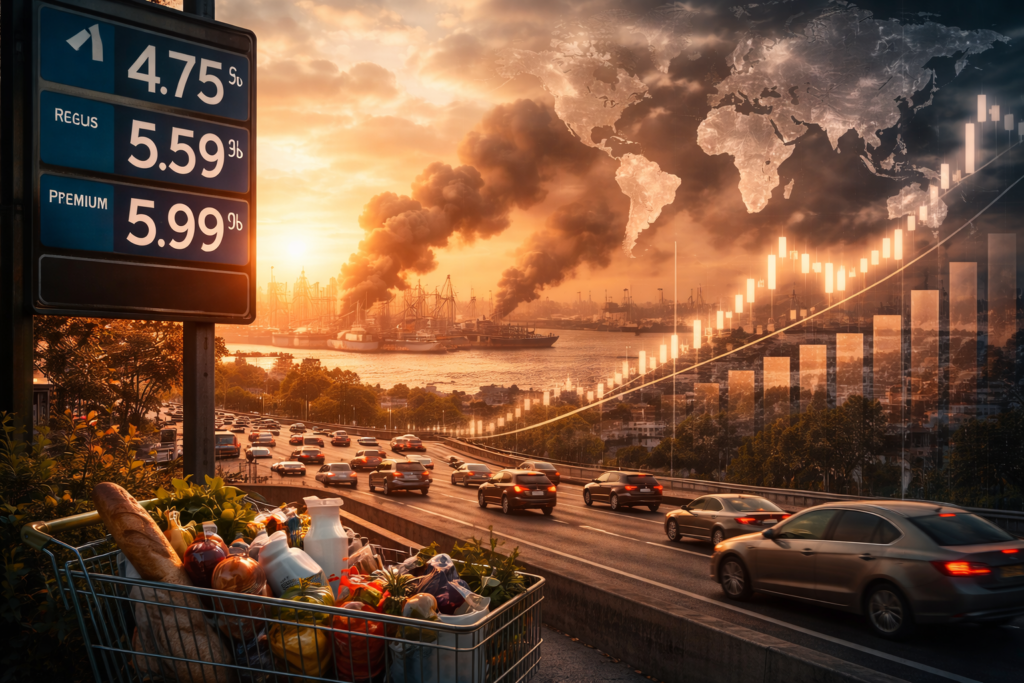
In modern economies, price increases rarely happen in isolation. A conflict thousands of kilometers away can quietly influence the cost of fuel, food, transportation, and eventually rent in cities across the world.
Many people assume global geopolitical tensions only affect governments, energy companies, or financial markets. In reality, these events gradually move through supply chains and reach everyday households in the form of rising prices.
Understanding how this process works is important. When people recognize the mechanisms behind inflationary pressure, they can make better financial decisions before the full effects reach their personal budgets.
This article explains how global conflicts influence prices and what individuals can do to protect their financial stability when economic conditions become uncertain.
Why Energy Prices Affect Almost Everything
One of the first economic effects of geopolitical instability often appears in energy markets. Oil and natural gas are among the most globally traded commodities, and even the possibility of supply disruptions can move prices significantly.
According to the International Energy Agency (IEA), oil price increases historically ripple across multiple sectors of the economy because energy is embedded in nearly every stage of production and transportation.
When fuel costs rise, several things happen simultaneously:
- Shipping becomes more expensive
- Manufacturing costs increase
- Agricultural production becomes more costly
- Airline and logistics prices rise
These costs eventually pass through the supply chain. Businesses rarely absorb them permanently; instead, they gradually increase prices for consumers.
This is why energy shocks often lead to broader inflation.
The Supply Chain Reaction
Once transportation and production costs increase, companies begin adjusting prices across a wide range of goods.
Food is particularly sensitive to these shifts.
Agriculture depends heavily on fuel, fertilizers, and international transport. According to the Food and Agriculture Organization (FAO), disruptions in energy markets often contribute to food price volatility because modern agricultural systems are energy intensive.
For example, fertilizer production relies heavily on natural gas. When gas prices increase, fertilizer prices follow. Farmers then face higher costs to produce crops, and those costs eventually reach supermarkets.
In recent years, food inflation has been one of the most visible outcomes of global economic disruption.
According to Eurostat data, food prices in the European Union rose significantly during the inflationary period of 2022–2023, peaking above 15% in several countries.
Even after inflation slows, prices often remain elevated.
Why Housing Costs Can Rise During Global Instability
Housing markets may seem unrelated to geopolitical conflict, but they are often influenced indirectly.
When uncertainty increases, investors frequently move capital into assets perceived as stable. Real estate in major cities is often considered one of those safe havens.
The result can be increased demand for property in financially stable countries or cities, which can contribute to higher housing prices and rents.
According to the European Central Bank and Eurostat housing statistics, property prices across the European Union have increased substantially over the past decade, particularly in major urban centers.
For everyday residents, this creates a challenging dynamic: the same global forces that move capital toward “safe” locations can increase the cost of living in those locations.
Inflation Does Not Hit Everyone Equally
One of the most important realities of inflation is that it affects households differently.
Higher-income individuals often hold assets that benefit from inflation, such as equities or real estate. Lower-income households tend to spend a larger portion of their income on essentials like food, housing, and energy — the very areas most sensitive to price increases.
This difference means that inflation can widen financial inequality over time.
For middle-income households, the key challenge is maintaining financial stability while essential expenses increase faster than income.
This is why building personal financial resilience becomes essential during uncertain economic periods.
What Households Can Do When Prices Start Rising
Individuals cannot control global conflicts or international energy markets. However, they can control how resilient their personal finances are when economic conditions shift.
Several practical strategies can help reduce financial vulnerability.
Build a Liquidity Buffer
Financial resilience begins with liquidity.
Households with accessible savings can absorb temporary price increases or income disruptions without falling into debt. Many financial planners recommend maintaining liquid reserves equal to three to six months of essential expenses.
This type of buffer provides flexibility when unexpected financial pressure appears.
Control Fixed Expenses
High fixed expenses reduce flexibility.
When rent, loans, subscriptions, and other obligations consume a large portion of monthly income, households have little room to adapt when prices increase.
Maintaining a margin between income and essential spending allows individuals to adjust without immediate financial stress.
Automate Long-Term Investing
While inflation increases prices in the short term, long-term investing remains one of the most effective ways to preserve purchasing power over time.
Historically, diversified global equities have delivered average annual real returns of approximately 6–7% over long periods, according to the Credit Suisse Global Investment Returns Yearbook and MSCI World historical data.
Automated monthly investing helps individuals remain consistent even when markets are volatile.
Focus on Financial Flexibility
Flexibility is often more valuable than prediction.
Economic conditions can change quickly, and no individual can forecast every global event. Instead of trying to predict crises, households benefit from building systems that allow them to adapt.
This includes maintaining savings, avoiding excessive debt, and developing skills that allow income mobility if necessary.
Why Awareness Matters More Than Prediction
Global economic systems are complex. Events that begin as geopolitical tensions can eventually affect everyday life through supply chains, energy markets, and capital flows.
However, individuals do not need to predict every economic shift to protect themselves.
What matters more is understanding that these shifts occur and building a financial structure capable of withstanding them.
Households that maintain liquidity, control fixed costs, and invest consistently are far more resilient when prices rise or economic uncertainty increases.
Financial stability is not created by reacting to every global event.
It is created by building systems that remain strong even when the world changes.
Final Thoughts
Global conflicts and economic uncertainty will always exist. Markets fluctuate, supply chains shift, and prices occasionally rise faster than incomes.
But while individuals cannot control global forces, they can control their financial structure.
Building liquidity, maintaining flexibility, and investing consistently allows households to remain stable even when the broader system becomes unpredictable.
The goal is not to eliminate uncertainty.
The goal is to be prepared for it.
Data & Sources
- International Energy Agency (IEA) – Energy Market Reports
- Food and Agriculture Organization (FAO) – Food Price Index
- Eurostat – Housing Price Index and Food Inflation Data
- European Central Bank – Housing Market Statistics
- Credit Suisse Global Investment Returns Yearbook
- MSCI World Historical Performance Data
For readers seeking a clear structural foundation to implement this discipline step by step:
How Personal Finance Made Simple Can Transform Your Future