
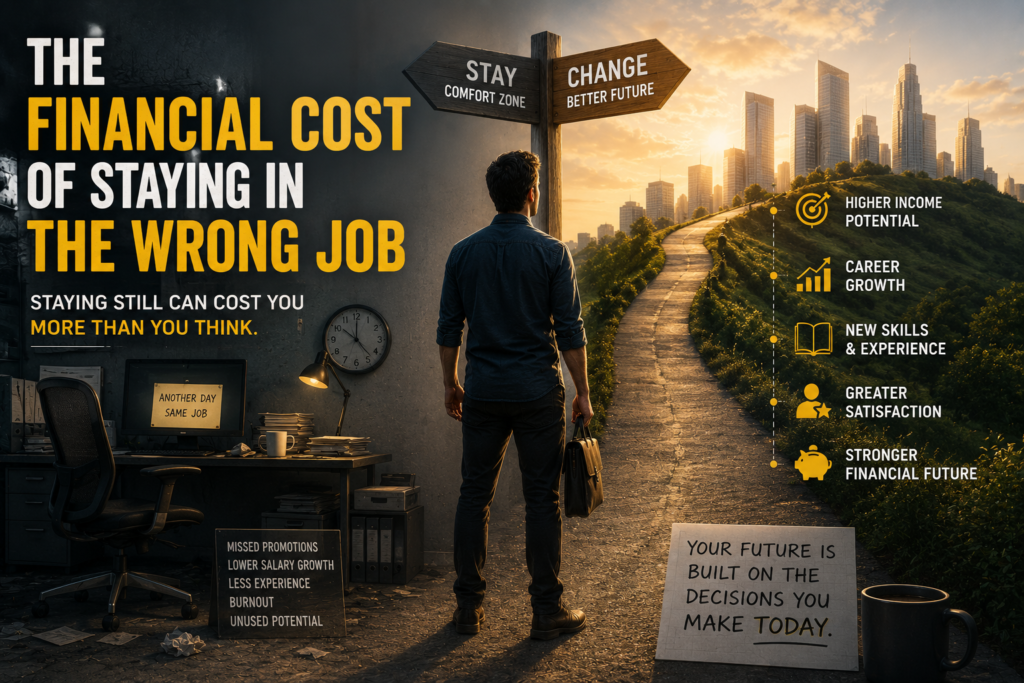
Most people assume that changing jobs is the risky career decision.
Sometimes it is.
Changing employers means adapting to new colleagues, learning different systems and stepping into unfamiliar situations. There is never complete certainty that the new role will meet your expectations.
But there is another risk that often receives far less attention.
Never changing at all.
Many professionals spend years in roles they have quietly outgrown. They still perform well, receive acceptable performance reviews and collect a regular salary each month. From the outside, everything appears stable.
Inside, however, something has changed.
Learning has slowed.
Motivation has faded.
Salary increases no longer keep pace with experience.
Career progression has stalled.
The danger is that this situation often develops gradually. One year becomes three. Three years become seven. By then, staying has become part of the routine.
A career change is never the right choice for everyone, and leaving a stable job should never be an impulsive decision. Every career move involves uncertainty.
However, remaining in a role that no longer supports your professional development can also carry significant long-term financial consequences.
Sometimes the most expensive career decision isn’t changing jobs.
It’s never changing at all.
Why People Stay In Jobs They No Longer Enjoy
If someone is unhappy at work, an obvious question often follows:
“Why don’t they just leave?”
The answer is usually far more complicated than outsiders realise.
For many people, stability has genuine value.
A predictable income pays the mortgage.
It supports children.
It provides healthcare, pension contributions and routine.
Those are not small benefits.
Changing jobs means stepping into uncertainty, even when the opportunity looks promising.
Fear naturally becomes part of the decision.
Some people worry they won’t perform well in a new environment.
Others fear interviews after spending years with the same employer.
Many simply become comfortable with familiar routines.
Even if work feels repetitive, they know what tomorrow looks like.
Financial obligations make these decisions even harder.
Someone supporting a family or repaying a mortgage may reasonably decide that preserving stability is the right choice—for now.
That doesn’t mean staying is automatically the wrong decision.
It simply means recognising that stability has benefits and costs.
The goal isn’t to encourage constant job hopping.
The goal is to ensure that staying remains an intentional decision rather than one driven purely by fear or habit.
The Hidden Financial Costs
When people think about career progression, they often focus on their next salary.
The bigger picture is much broader.
Remaining in a role that no longer challenges you can quietly influence your finances for years.
One of the biggest hidden costs is opportunity cost.
Opportunity cost simply means giving up one opportunity because you chose another.
Imagine two professionals with similar experience.
One stays in the same position for another five years.
The other carefully prepares for a career change after improving their skills and researching the market.
Even if the second person receives only a modest salary increase, that higher income may continue for many years.
Future raises are then often calculated from a higher starting point.
Employer pension contributions may also increase.
Greater income can allow more regular saving and investing.
Over a working lifetime, those differences can become substantial.
The financial impact isn’t limited to salary growth.
Remaining in a stagnant role may also mean:
- fewer opportunities to learn new skills
- slower career progression
- less exposure to new technologies
- fewer leadership opportunities
- reduced professional networks
- lower long-term earning potential
These costs are easy to overlook because they don’t appear on a monthly bank statement.
They accumulate quietly.
Just as compound interest can steadily grow wealth, small differences in salary growth and professional development can gradually widen over an entire career.
This doesn’t mean every career change increases earnings.
It simply highlights that staying also carries financial consequences that deserve careful consideration.
When Staying Makes Sense
Career advice on the internet often creates the impression that changing jobs is always the smarter move.
Reality is rarely that simple.
Sometimes staying is absolutely the right decision.
For example, changing employers during periods of economic uncertainty may not suit everyone’s circumstances.
Someone supporting young children may value predictable income above faster salary growth.
Another professional may be close to completing an important qualification or project that significantly strengthens future career opportunities.
Some people remain in a role because they are still learning valuable skills.
Others stay because they have an excellent manager, flexible working arrangements or a healthy work-life balance.
These advantages shouldn’t be underestimated.
Job satisfaction is about more than salary alone.
Financial wellbeing also includes stability, health and sustainable working conditions.
A career change should improve your overall situation—not simply your monthly income.
Sometimes waiting is the wisest decision.
The important question is whether you’re staying because it genuinely supports your long-term goals, or because uncertainty feels too uncomfortable.
The Emotional Side Of Career Decisions
Career decisions are rarely based on logic alone.
Emotion often plays a much larger role than we realise.
Fear of failure is one of the biggest obstacles.
Someone may privately believe they are capable of earning more but worry that another employer won’t see the same potential.
Imposter syndrome reinforces this fear.
Even experienced professionals sometimes feel they have simply been “lucky” and worry that a new employer will discover they aren’t as capable as everyone thinks.
Interviews create another emotional barrier.
After several years in one organisation, applying for new positions can feel intimidating.
The longer someone waits, the bigger that challenge often appears.
Fear of regret also keeps many people where they are.
What if the new manager is worse?
What if the company culture isn’t as good?
What if the new role turns out to be disappointing?
These are reasonable concerns.
Yet uncertainty often feels riskier than dissatisfaction simply because dissatisfaction is familiar.
People adapt to situations that no longer make them happy.
Over time, they begin seeing their current reality as safer than the unknown—even when the unknown might offer better opportunities.
Recognising these emotional patterns helps separate genuine risks from fears that may be preventing thoughtful career progression.
A Real-Life Example
Michael is a 31-year-old logistics coordinator living in Stuttgart.
He enjoys his colleagues and appreciates the stability of his employer.
But over time, something begins to bother him.
His responsibilities keep increasing.
His salary does not.
Every year he tells himself he’ll update his CV after the busy season.
Then another project begins.
Another deadline arrives.
Another year passes.
Occasionally he looks at job advertisements online.
Several positions appear to offer noticeably higher salaries.
He closes the browser each time.
Part of him worries he isn’t experienced enough.
Another part fears leaving the security of a company he already knows.
Eventually, after talking with a trusted mentor, Michael changes his approach.
Instead of quitting immediately, he prepares carefully.
He updates his CV.
Completes an online certification related to supply chain management.
Reconnects with former colleagues.
Builds additional emergency savings to give himself more flexibility.
Over several months, he applies selectively rather than sending dozens of rushed applications.
Eventually, he accepts a role with another employer.
The salary increase is meaningful, but what surprises him most isn’t the money.
It’s his confidence.
He realises that years of postponing applications had made the challenge seem much larger than it really was.
Looking back, Michael doesn’t regret staying while he prepared.
He regrets waiting so long before beginning the preparation itself.
His experience reminds him that thoughtful planning—not impulsive decisions—often creates the strongest foundation for a successful career change.
Signs You May Have Outgrown Your Current Job
Not every difficult week at work means it’s time for a career change.
Every job has stressful periods, frustrating projects and moments when motivation dips.
The bigger question is whether those feelings have become your normal experience.
Here are some signs that it may be worth reflecting on your current role:
- You’ve stopped learning new skills or taking on meaningful challenges.
- Your salary has remained largely unchanged despite increased responsibilities.
- Career progression has stalled with no clear path forward.
- You feel mentally exhausted before the workday even begins.
- Your work no longer aligns with your long-term goals.
- You regularly postpone updating your CV or exploring new opportunities.
- You find yourself saying, “Maybe next year,” every time you think about changing jobs.
- You feel more comfortable with familiarity than excited about future possibilities.
- You notice that you’re no longer motivated to improve because your efforts seem to make little difference.
None of these signs automatically means you should resign.
Instead, they are invitations to step back and honestly evaluate whether your current role is still helping you build the future you want.
How To Prepare For A Career Change Without Taking Unnecessary Risks
A successful career change usually begins long before you hand in your notice.
Preparation reduces uncertainty and gives you more options.
Start by updating your CV, even if you have no immediate plans to apply elsewhere. Waiting until an opportunity appears often creates unnecessary pressure.
Next, identify the skills that employers in your field are currently looking for.
Sometimes a short certification, a new software skill or additional industry knowledge can make a significant difference.
Building financial resilience also matters.
An emergency fund can make career decisions feel less stressful because it reduces the pressure to accept the first offer available.
Networking is another habit many professionals underestimate.
Reconnect with former colleagues.
Attend industry events.
Participate in professional communities.
Many opportunities arise through conversations long before they appear on job boards.
Finally, research employers carefully.
Salary is only one part of the picture.
Company culture, flexibility, learning opportunities, leadership quality and long-term career progression all influence your overall financial wellbeing.
Preparation also helps prevent rushed decisions. As we explored in our article on financial decisions, thoughtful choices usually produce better long-term outcomes than decisions made under emotional pressure.
A career change doesn’t have to happen all at once.
Often, the smartest move is to prepare gradually until you’re ready.
Why Career Decisions Are Financial Decisions
Many people separate career planning from personal finance.
In reality, they are closely connected.
Your career influences far more than your monthly salary.
It affects:
- your ability to save
- your ability to invest
- your pension contributions
- your financial flexibility
- your long-term wealth-building potential
A higher income alone doesn’t guarantee financial freedom.
Without healthy financial habits, additional earnings can disappear through higher spending or lifestyle inflation.
However, increasing your earning potential does create more opportunities to strengthen your financial future.
Career growth can make it easier to:
- build an emergency fund
- increase long-term investments
- reduce financial stress
- prepare for unexpected expenses
- improve overall financial confidence
At the same time, staying in a role that consistently limits your earning potential may reduce those opportunities over many years.
That doesn’t mean every higher-paying job is automatically better.
A role that damages your health or leads to severe burnout can also carry significant financial and personal costs.
The goal is balance.
A thoughtful career decision considers both present stability and future opportunity.
The right career decision can improve your financial future for years—not because it guarantees wealth, but because it expands your options.
If you’re thinking about investing more once your income grows, our guide on start investing explains why building the habit matters more than waiting for the perfect moment.
Likewise, strengthening your financial confidence can help you evaluate career opportunities more calmly instead of making decisions based purely on fear.
Frequently Asked Questions
When should I change jobs?
There is no universal answer.
A career change may be worth considering if you’ve stopped learning, your salary has stagnated, your work no longer aligns with your goals or you’ve carefully identified opportunities that better fit your long-term plans.
The key is making an informed decision rather than reacting to a difficult week.
Is changing jobs good for salary growth?
It can be, but there are no guarantees.
Changing roles sometimes creates opportunities for higher earnings, greater responsibility or faster career progression.
However, every situation is different, and salary should be considered alongside factors such as job satisfaction, stability, benefits and professional development.
How do I know if I’m underpaid?
Compare your responsibilities, experience and skills with reliable salary information for similar roles in your region.
If your responsibilities have grown significantly while your compensation has remained largely unchanged, it may be worth discussing your situation with your employer or researching the wider job market.
Should I leave a stable job?
Not necessarily.
Stability has real value.
If your current role supports your financial responsibilities, wellbeing and long-term goals, staying may be the right choice.
A career change should be based on thoughtful preparation rather than frustration alone.
How can I prepare financially for a career change?
Building emergency savings, updating your CV, improving relevant skills, researching employers and applying gradually can all reduce financial risk.
Preparation gives you more flexibility and confidence throughout the process.
Conclusion
Career decisions rarely have simple answers.
Sometimes staying is the wisest choice.
Sometimes moving on creates opportunities that would never have appeared otherwise.
The important thing is to make the decision intentionally.
Don’t let fear keep you stuck.
Don’t let impatience push you into unnecessary risks.
Prepare carefully.
Keep learning.
Strengthen your financial foundation.
Over time, thoughtful career decisions—supported by patience and planning—can improve not only your professional life but also your long-term financial wellbeing.
My book on Gumroad:
https://ukandu0.gumroad.com/l/bteyh
Or on Amazon:
Feeling financially stuck?
When financial pressure becomes constant, long-term decisions start feeling emotionally heavy.
The Crown Altessa newsletter was created to help people rebuild clarity slowly and strategically through practical financial frameworks, long-term thinking, and structured decision-making insights.
Join the newsletter and receive:
• the free Financial Foundation Guide
• strategic financial insights
• practical tools for long-term stability
• frameworks designed to reduce financial overwhelm
Start building financial clarity one step at a time.