
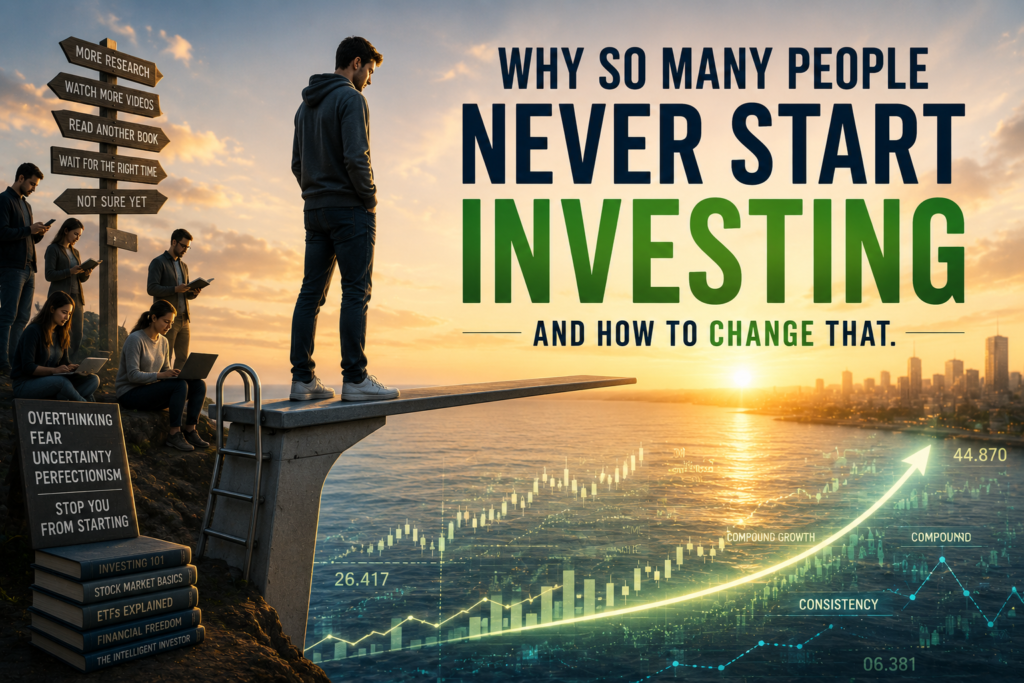
For many people, investing feels like one of those things they know they should do someday.
They read articles about long-term wealth.
Watch YouTube videos explaining compound growth.
Listen to podcasts discussing financial freedom.
Promise themselves they’ll begin after their next pay rise.
Then months pass.
Sometimes years.
Nothing happens.
Ironically, most people don’t fail at investing because they choose poor investments.
They fail because they never make their first investment at all.
The biggest obstacle is rarely a lack of intelligence.
It’s uncertainty.
Investing introduces unfamiliar terminology, conflicting advice and the possibility of losing money. Those feelings can make even financially responsible people postpone getting started.
If you’ve delayed investing despite genuinely wanting to begin, you’re far from alone.
Understanding why this happens is often the first step towards changing it.
This article won’t tell you what to invest in.
Instead, it will help you understand the psychology behind delaying your first investment and explain how to build enough confidence to take that first step when you’re ready.
Why Investing Feels So Intimidating
Few financial topics create as much anxiety as investing.
Part of the reason is simple:
Most of us were never taught how investing works.
School may teach mathematics, but it rarely teaches practical investing for beginners.
As adults, we’re suddenly expected to understand concepts like:
- diversification
- inflation
- volatility
- risk tolerance
- market corrections
- dividends
- index funds
- compound growth
For someone encountering these ideas for the first time, it can feel like learning a completely new language.
Then comes the internet.
One video says investing is easy.
Another warns that a market crash is coming.
One article says you should start immediately.
Another insists you should wait.
Instead of creating clarity, the huge amount of available information often creates confusion.
The fear of losing money makes everything feel even more important.
Unlike buying a new phone or choosing a holiday, investing carries uncertainty.
No investment can guarantee future returns.
That uncertainty is enough to keep many people permanently stuck in the research phase.
Ironically, the hardest part of investing is often not understanding the markets.
It’s taking the first step despite not having complete certainty.
The Psychology Behind Never Getting Started
The biggest barriers to investing are often emotional rather than financial.
Fear plays a surprisingly large role.
People worry about making an expensive mistake.
They fear investing just before markets fall.
They imagine losing money immediately after getting started.
These fears feel very real, even if they never happen.
Perfectionism makes the situation worse.
Many people believe they need to know everything before they begin.
In reality, that belief often keeps them from ever starting.
Every new article leads to another question.
Every YouTube video introduces another strategy.
Every investing book recommends another approach.
Instead of becoming more confident, people become overwhelmed.
This is a classic example of analysis paralysis.
The search for certainty becomes an excuse to delay action.
Procrastination quietly joins the process.
Someone decides they’ll start investing after reading one more book.
Then after finishing one more podcast.
Then after comparing one more platform.
Months later, nothing has changed except the amount of information they’ve consumed.
If this sounds familiar, you may recognise similar patterns from our article on the financial cost of procrastination.
The emotional pattern is almost identical.
Waiting feels safer.
But over time, waiting creates its own costs.
The Biggest Myths About Investing
Many investing delays begin with beliefs that sound sensible but don’t always reflect reality.
Let’s look at some of the most common ones.
“I need a lot of money.”
Many beginners assume investing is only worthwhile if they can contribute large amounts.
This belief often causes people to postpone investing until they earn significantly more.
In reality, consistency often matters more than the size of your first contribution.
Learning how investing works while contributing manageable amounts can build valuable experience over time.
“I’m too late.”
Someone in their twenties believes they should have started at eighteen.
Someone in their thirties thinks they’ve missed their chance.
Someone in their forties compares themselves with investors who began decades ago.
Financial comparison creates the illusion that everyone else started earlier.
The truth is that many people begin investing much later than they admit.
Focusing on someone else’s timeline rarely improves your own.
If comparison regularly affects your financial confidence, our article on financial comparison explores why measuring your progress against others often leads to unnecessary stress.
“Investing is only for experts.”
Many people imagine professional investors constantly analysing financial reports and predicting markets.
While investing knowledge certainly matters, beginner investing doesn’t require becoming an economist before taking your first step.
Learning usually continues throughout your investing journey.
Experience becomes one of your greatest teachers.
“I’ll start when I earn more.”
Higher income certainly creates more flexibility.
Unfortunately, waiting for a larger salary often becomes a moving target.
Many people receive raises only to discover that lifestyle inflation quietly absorbs the extra income before they begin investing.
Without intentional habits, a higher salary doesn’t automatically lead to greater investing.
The Cost Of Waiting
Choosing not to invest is still a financial decision.
It simply feels less visible than making an investment.
Many people assume waiting carries no risk.
In reality, waiting often has hidden costs.
The first is missed learning.
Reading about investing teaches concepts.
Actually investing teaches behaviour.
You experience how markets move.
You notice your emotional reactions.
You begin understanding your own comfort with uncertainty.
Those lessons are difficult to learn through theory alone.
The second cost is time.
Long-term investing often benefits from giving investments more years to grow.
While future returns are never guaranteed, time is one of the few factors investors can influence.
Delaying several years means delaying not only potential growth but also valuable experience.
The third cost is confidence.
Many people expect confidence to appear before they begin.
More often, confidence grows because they begin.
Waiting for the perfect time often becomes the most expensive investment decision.
That doesn’t mean everyone should invest immediately.
Investing involves risk, and it isn’t suitable for every financial situation.
For example, someone struggling with high-interest debt or lacking an emergency fund may decide that strengthening those areas first better suits their circumstances.
The important point is that waiting should be an intentional decision—not simply the result of fear or endless uncertainty.
A Real-Life Example
Daniel is 28 and works in Frankfurt.
After university, he becomes interested in investing.
He buys two investing books.
Subscribes to several finance YouTube channels.
Listens to podcasts during his commute.
He genuinely enjoys learning.
Whenever he feels close to opening an investment account, however, another question appears.
“Should I wait until markets fall?”
“Should I read one more book?”
“Maybe I should understand every investment strategy first.”
Three years pass.
Daniel knows far more about investing terminology than most of his friends.
Ironically, he still hasn’t made a single investment.
Eventually, he realises something surprising.
His biggest problem isn’t knowledge.
It’s fear of making an imperfect first decision.
Instead of trying to eliminate every uncertainty, he decides to begin cautiously after reviewing his financial situation and ensuring he has emergency savings in place.
He starts with an amount he feels comfortable risking over the long term, fully aware that investing always involves uncertainty.
Within a few months, Daniel notices something unexpected.
He learns more from watching his own emotions during normal market movements than he did from years of endless research.
He stops checking financial news every hour.
He becomes more patient.
Most importantly, he finally feels like someone who is learning through experience rather than preparing forever.
His first investment wasn’t perfect.
It didn’t need to be.
Making the habit of investing part of his financial life mattered far more than trying to find the perfect starting point.
Signs You’re Ready To Start Investing
There is no universal moment when someone becomes “ready” to invest.
Life circumstances differ, and investing isn’t appropriate for everyone at every stage. However, many beginners find they feel more prepared when a few important foundations are already in place.
Consider the following checklist:
- You have a reasonably stable source of income.
- You’ve started building an emergency fund for unexpected expenses.
- You’re thinking in terms of years rather than weeks or months.
- You’re willing to continue learning as you gain experience.
- You understand that investing involves risk and that values can go up as well as down.
- You’re comfortable starting small instead of waiting until you have a large amount of money.
- You no longer expect your first investment to be perfect.
You don’t need to tick every box before taking your first step.
The goal isn’t perfect preparation.
The goal is being prepared enough to begin thoughtfully while recognising that learning continues throughout your investing journey.
How To Start Investing With More Confidence
Confidence rarely appears before action.
More often, it develops because of action.
That doesn’t mean rushing into investing without preparation. Instead, it means reducing unnecessary pressure and focusing on behaviours you can control.
Start small
Many beginners assume their first investment has to be significant.
In reality, starting with an amount you’re genuinely comfortable setting aside for the long term can make the emotional experience much easier.
Beginning small allows you to observe how you react to market movements without feeling overwhelmed.
Learn gradually
Trying to understand every investment concept before you begin often creates information overload.
Instead, focus on learning one concept at a time.
As your experience grows, your understanding usually becomes more practical and less intimidating.
Think long term
Daily market movements attract attention because they are dramatic.
Long-term investing, however, is built on patience rather than constant activity.
Checking investments every hour rarely improves decision-making.
Instead, it often increases anxiety.
Automate where appropriate
Many people find it easier to stay consistent when saving or investing becomes part of an automatic monthly routine.
Automation reduces the temptation to delay decisions every month and supports the kind of financial habits that quietly build long-term wealth.
Avoid emotional decisions
Markets rise.
Markets fall.
Both situations can trigger emotional reactions.
Successful investing often depends less on predicting markets and more on avoiding decisions driven by panic, excitement or fear of missing out.
If you’ve noticed that emotions have influenced your spending or saving in the past, our article on bad money decisions explains why this happens and how greater self-awareness can improve financial choices.
The aim isn’t to remove emotion completely.
It’s to avoid letting temporary emotions determine long-term decisions.
Why Your First Investment Matters Less Than Your First Habit
People often place enormous pressure on their first investment.
They worry about choosing the wrong moment.
The wrong amount.
The wrong approach.
The reality is that your first investment is unlikely to determine your financial future on its own.
Your habits will.
One investment teaches you very little.
Investing consistently over many years teaches you a great deal.
Every regular contribution reinforces a valuable behaviour.
Every review of your long-term goals strengthens discipline.
Every decision to continue learning improves your confidence.
This mirrors many areas of personal finance.
Building wealth is rarely about one perfect action.
It’s usually about repeating sensible actions for a long time.
If your first investment isn’t perfect, that doesn’t mean you’ve failed.
It means you’ve begun.
That mindset is often far more valuable than trying to predict every possible outcome before taking any action.
Successful investing is usually built through repeated behaviour, not one perfect investment.
Frequently Asked Questions
When should I start investing?
There is no perfect age or perfect moment.
Many people choose to begin once they have a stable income, some emergency savings and a long-term perspective. The most important factor is making a thoughtful decision that fits your own financial situation rather than rushing because other people appear to be investing.
How much money do I need to start investing?
That depends on your personal circumstances and the options available to you.
Many beginners discover that starting consistently with an amount they can comfortably afford is more sustainable than waiting until they can invest a much larger sum.
Is investing risky?
Yes.
All investments carry risk, and there is always the possibility of losing money.
That is why it’s important to understand your own financial situation, think long term and continue learning rather than expecting guaranteed returns.
Should beginners invest immediately?
Not necessarily.
If you’re dealing with high-interest debt, have no emergency savings or are struggling to cover essential living expenses, it may make sense to strengthen those foundations first.
Investing should be part of a broader personal finance plan, not viewed in isolation.
What mistakes do new investors make?
Some of the most common mistakes include:
- waiting for perfect certainty
- trying to learn everything before beginning
- making emotional decisions
- comparing themselves with experienced investors
- expecting quick results instead of focusing on long-term consistency
Conclusion
Starting to invest isn’t about becoming an expert overnight.
It’s about taking thoughtful, realistic steps that fit your financial situation and continuing to learn along the way.
Every experienced investor was once a beginner.
Every long-term habit started with a first action.
You don’t need perfect knowledge to begin building investing confidence.
You need patience, realistic expectations and a willingness to keep learning.
Over time, those qualities often matter far more than trying to make the perfect first investment.
My book on Gumroad:
https://ukandu0.gumroad.com/l/bteyh
Or on Amazon:
Feeling financially stuck?
When financial pressure becomes constant, long-term decisions start feeling emotionally heavy.
The Crown Altessa newsletter was created to help people rebuild clarity slowly and strategically through practical financial frameworks, long-term thinking, and structured decision-making insights.
Join the newsletter and receive:
• the free Financial Foundation Guide
• strategic financial insights
• practical tools for long-term stability
• frameworks designed to reduce financial overwhelm
Start building financial clarity one step at a time.