
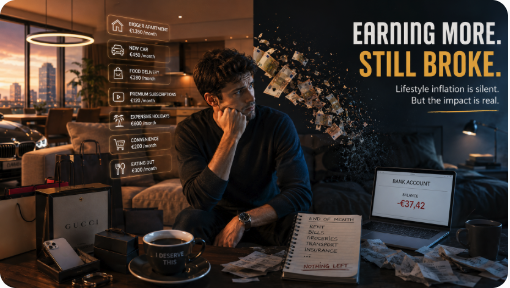

Receiving a salary increase should feel like a turning point. After years of hard work, promotions, changing jobs or gaining new qualifications, earning more money often feels like proof that you’re moving forward.
Yet many people experience something confusing.
A few months after a raise, their financial situation feels almost exactly the same.
The excitement fades. The bank account still empties before payday. Saving feels difficult. Financial stress remains.
It isn’t always because the raise was too small.
More often, it’s because of lifestyle inflation—a subtle behavioural pattern where spending quietly rises alongside income until the extra money disappears.
The difficult part is that lifestyle inflation rarely feels irresponsible. Most spending decisions seem reasonable on their own. A nicer apartment. Better groceries. A newer phone. More holidays. More convenience.
Individually, none of these choices look excessive.
Together, they can quietly delay financial freedom for years.
Understanding why lifestyle inflation happens—and how to manage it without feeling deprived—can make a significant difference to your long-term financial wellbeing.
What Is Lifestyle Inflation?
Lifestyle inflation happens when your spending increases as your income increases.
Instead of allowing a salary increase to improve your savings or investments, much of the additional income gradually becomes part of your everyday lifestyle.
This process usually happens slowly.
Few people wake up one morning and decide to dramatically increase their spending. Instead, the changes arrive one by one.
Perhaps after a promotion you decide that cooking every evening feels unnecessary because you can now afford food delivery several times a week.
A few months later you upgrade your streaming subscriptions.
Then your next phone contract.
Then a more expensive gym.
Later, maybe a larger apartment or a newer car.
Each decision feels affordable because your salary has increased.
Over time, however, your new monthly expenses become permanent.
This gradual process is often called lifestyle creep, and because it develops slowly, many people don’t realise it is happening until they wonder why their higher salary hasn’t created greater financial security.
Why Earning More Doesn’t Always Create Wealth
One of the biggest misconceptions in personal finance is that wealth automatically follows income.
Income certainly helps.
But income alone rarely creates lasting financial freedom.
The difference between someone earning €3,000 a month and someone earning €5,000 a month is often much smaller than expected if both spend nearly everything they earn.
The size of your salary matters less than the gap between what you earn and what you spend.
That gap becomes your opportunity.
It funds your emergency savings.
It builds investments.
It creates flexibility when unexpected expenses appear.
It gives you options if you want to change careers, start a business or reduce your working hours later in life.
Without that gap, every salary increase simply supports a more expensive lifestyle rather than building wealth.
This explains why two colleagues with similar salaries can experience completely different financial lives.
One quietly invests every raise.
The other upgrades nearly every aspect of daily life.
Five or ten years later, their incomes may still look similar on paper, yet one has growing assets while the other still feels financially stretched.
Many people who feel financially exhausted are not necessarily earning too little. Sometimes their income has grown steadily while their spending has quietly kept pace, leaving little room to breathe despite years of career progress.
The Psychology Behind Lifestyle Inflation
Lifestyle inflation is not primarily about mathematics.
It’s about psychology.
Human beings adapt remarkably quickly to improvements.
A larger apartment feels luxurious during the first few weeks.
After several months, it simply feels normal.
The same happens with a premium coffee every morning, business-class flights, expensive restaurants or a new car.
Psychologists refer to this as hedonic adaptation.
We quickly become accustomed to higher levels of comfort.
Once something becomes our new normal, we rarely experience the same excitement again.
Instead, we begin looking for the next upgrade.
Reward also plays an important role.
After working hard for a promotion, buying something nice feels justified.
Many people naturally think:
“I’ve worked hard for this.”
That feeling is understandable.
Rewarding yourself occasionally is healthy.
Problems arise when temporary rewards become permanent monthly expenses.
Social comparison makes this even more powerful.
As salaries rise, people often compare themselves with colleagues whose lifestyles also improve.
Someone buys a new car.
Another moves into a fashionable neighbourhood.
Another starts travelling more frequently.
Without noticing, expectations shift.
What once felt luxurious now starts feeling ordinary.
This doesn’t necessarily come from vanity.
Humans naturally compare themselves with the people around them.
Unfortunately, comparisons often encourage spending that reflects identity rather than long-term financial goals.
The Hidden Expenses Nobody Notices
Most people imagine lifestyle inflation as buying luxury watches or expensive sports cars.
In reality, it is usually much quieter.
Small upgrades accumulate month after month.
Consider how easily these expenses appear:
- an additional streaming service
- premium music subscriptions
- cloud storage upgrades
- meal delivery apps
- takeaway coffee every workday
- grocery delivery fees
- faster internet packages
- more expensive mobile contracts
- premium banking services
- rideshare apps instead of public transport
Individually, none seem significant.
Together, they can easily add several hundred euros every month.
Convenience spending deserves particular attention.
Convenience saves time.
Sometimes it is absolutely worthwhile.
However, when convenience becomes the default choice for every situation, monthly costs quietly expand.
Food delivery several evenings each week.
Laundry services.
Taxi rides instead of trains.
Prepared meals instead of cooking.
None of these decisions feels dramatic.
Yet dozens of small upgrades often have a greater impact on monthly cash flow than a single large purchase.
Our article on financial decisions explores how the growing number of financial choices available today makes these small spending decisions increasingly difficult to recognise before they become habits.
Why Lifestyle Inflation Feels Like Progress
One reason lifestyle inflation is so difficult to notice is that it often feels like success.
After years of studying, building a career and earning promotions, improving your lifestyle feels like evidence that your hard work has paid off.
There is nothing wrong with enjoying the benefits of your efforts.
The challenge begins when spending becomes the primary way you measure progress.
A larger apartment can certainly improve your quality of life.
So can taking holidays, eating better food or investing in hobbies you genuinely enjoy.
The difficulty is assuming that every salary increase should automatically translate into a higher standard of living.
Over time, your identity begins to adapt.
You no longer see yourself as someone who occasionally enjoys premium experiences.
You begin to see yourself as someone who needs them.
This shift is subtle but powerful.
Returning to cheaper alternatives suddenly feels like losing something, even if your happiness has barely changed.
Social expectations reinforce this pattern.
Friends may assume you’ll join increasingly expensive activities.
Colleagues may celebrate promotions with larger purchases.
Without consciously deciding to, you begin matching the lifestyles around you.
Feeling richer is not the same as becoming wealthier.
One is based on consumption.
The other is built through ownership, savings and long-term financial choices.
Many of the bad money decisions people regret later didn’t feel irresponsible at the time. They simply felt like natural rewards after working hard.
A Real-Life Example
Daniel is a 31-year-old software engineer living in Munich.
After several successful projects, he receives a salary increase of approximately €500 per month.
Initially, he plans to save most of it.
Then reality unfolds differently.
His current apartment suddenly feels too small.
He upgrades to a larger flat closer to the city centre.
Monthly rent increases significantly.
Next, he replaces his perfectly functional smartphone because the monthly contract now seems affordable.
He signs up for several premium streaming services he had previously avoided.
He starts ordering dinner more frequently because work is busy.
Weekend brunch becomes a regular habit instead of an occasional treat.
None of these decisions feels irresponsible.
Each one seems deserved.
After all, his salary has increased.
Six months later, Daniel notices something surprising.
His savings account has barely grown.
Despite earning considerably more than before, his financial situation feels almost unchanged.
The raise disappeared—not because he made one reckless purchase, but because dozens of small lifestyle upgrades quietly became permanent monthly commitments.
The turning point comes when he reviews his finances honestly.
Rather than eliminating every comfort, he decides that future salary increases will follow a simple rule:
Part of every raise automatically goes into long-term investments before he adjusts his lifestyle.
He still enjoys his higher income.
He simply stops allowing every increase to become permanent spending.
Signs Lifestyle Inflation Is Affecting You
Lifestyle inflation rarely announces itself.
It usually appears as a series of small changes that feel harmless until you look back over several years.
Ask yourself whether any of these sound familiar:
- Your salary increases seem to disappear within a few months.
- Your savings rate stays roughly the same despite earning more.
- You regularly upgrade products that still work perfectly well.
- Convenience spending has become your default choice.
- Every year seems to introduce several new monthly subscriptions.
- You feel uncomfortable saying no to expensive social activities.
- Your monthly spending keeps rising, even though your needs haven’t changed very much.
- You often wonder where your money went at the end of the month.
- You associate every career milestone with buying something new.
- You find it difficult to imagine reducing your spending because your current lifestyle now feels “normal.”
None of these automatically means you’re managing money badly.
However, if several apply to you, it may be worth reviewing whether your income is improving your long-term financial position—or simply financing a more expensive version of your current life.
How To Enjoy More Income Without Lifestyle Inflation
Avoiding lifestyle inflation does not mean refusing to enjoy your money.
The goal isn’t extreme frugality.
The goal is intentional spending.
A salary increase should improve your life.
The question is how.
One simple strategy is to save or invest part of every raise before you adjust your lifestyle.
For example, if your monthly income increases by €500, you might decide:
- €250 automatically goes into investments.
- €100 goes toward building your emergency fund.
- €150 is available to improve your lifestyle.
This approach allows you to enjoy your success while still increasing your future financial security.
Automation makes this much easier.
If savings and investments happen automatically on payday, you never become accustomed to spending that money.
Another helpful strategy is to introduce lifestyle limits.
Ask yourself:
“Will this expense still improve my life a year from now?”
Sometimes the answer is yes.
A healthier home, better education or experiences with family can absolutely be worthwhile.
Other purchases simply become part of the background within a few weeks.
Intentional spending also means distinguishing between purchases that genuinely increase happiness and those driven by habit, comparison or convenience.
If you notice yourself delaying important financial goals because current spending leaves little room to save, our article on the financial cost of procrastination explores how small delays today can become expensive over time.
Similarly, building lasting financial confidence often starts with creating simple systems that make saving and investing automatic instead of relying on willpower.
Remember:
You don’t need to avoid enjoying your money.
You simply shouldn’t allow every salary increase to become permanent spending.
Why Small Choices Matter More Than Big Purchases
When people think about improving their finances, they often focus on major purchases.
Buying a house.
Replacing a car.
Planning a holiday.
These decisions certainly matter.
Yet they usually happen only occasionally.
Far more important are the decisions you make almost every day.
A €12 lunch instead of bringing food from home.
Several food delivery orders each week.
Premium subscriptions you rarely use.
Daily convenience purchases.
None of these feels significant.
Together, however, they become recurring monthly commitments that continue year after year.
Unlike one-off purchases, recurring expenses quietly compound.
An additional €200 each month may not feel dramatic today.
Over ten or twenty years, however, it represents tens of thousands of euros that could otherwise have supported investments, financial security or greater freedom later in life.
This isn’t about feeling guilty every time you spend money.
In fact, excessive guilt often leads to unhealthy financial behaviour, something we explore further in our article on spending guilt.
Instead, it’s about recognising that your daily financial habits usually shape your future more than occasional expensive purchases.
Long-term financial freedom is rarely built through one spectacular decision.
It is usually created through hundreds of small, intentional choices repeated consistently.
Frequently Asked Questions
What is lifestyle inflation?
Lifestyle inflation is the gradual increase in spending that often follows an increase in income. Instead of directing additional earnings toward savings or investments, people slowly upgrade different areas of their lifestyle until most of the extra income is being spent.
Is lifestyle inflation always bad?
No.
Improving your quality of life is one of the reasons people work hard.
Lifestyle inflation becomes problematic only when every increase in income automatically becomes permanent spending, leaving little room to build wealth or improve financial security.
How can I avoid lifestyle inflation?
Start by automatically saving or investing part of every salary increase before changing your lifestyle. Set clear financial priorities, review recurring expenses regularly, and spend intentionally rather than automatically upgrading everything as your income grows.
What is the difference between lifestyle inflation and lifestyle creep?
The two terms are closely related and are often used interchangeably.
Lifestyle inflation generally refers to increased spending as income grows, while lifestyle creep emphasises how those spending increases happen gradually over time without people noticing.
Can lifestyle inflation prevent wealth building?
Yes.
When every pay rise is absorbed by higher monthly expenses, very little money remains available for investing, emergency savings or other long-term financial goals. Over many years, this can significantly delay financial freedom, even for people with relatively high incomes.
Conclusion
Lifestyle inflation isn’t usually caused by poor discipline or reckless spending.
More often, it grows quietly through small decisions that feel reasonable on their own.
A little more convenience.
A few more subscriptions.
A nicer apartment.
A slightly more expensive holiday.
None of these choices is necessarily wrong.
The important question is whether they move you closer to the life you truly want.
Financial freedom isn’t about denying yourself every comfort.
It’s about making sure your income creates more than a more expensive lifestyle.
By spending intentionally, saving consistently and allowing your future to benefit alongside your present, you can enjoy your success today while giving yourself greater freedom tomorrow.
My book on Gumroad:
https://ukandu0.gumroad.com/l/bteyh
Or on Amazon:
Feeling financially stuck?
When financial pressure becomes constant, long-term decisions start feeling emotionally heavy.
The Crown Altessa newsletter was created to help people rebuild clarity slowly and strategically through practical financial frameworks, long-term thinking, and structured decision-making insights.
Join the newsletter and receive:
• the free Financial Foundation Guide
• strategic financial insights
• practical tools for long-term stability
• frameworks designed to reduce financial overwhelm
Start building financial clarity one step at a time.