
Introduction: The Quest to Trade Without Losing Money
Every week, thousands of people type questions into Google like “How can I test my trading strategy without risking money?” or “What’s the best way to practise stock trading risk‑free?” The problem is that most learning options either feel too complex, lack real‑world insight or don’t explain why a strategy wins or loses. As a result, novices jump from one method to another and never build confidence.
There is a better way. Professionals know that reading about strategies isn’t enough—you need structured practice. Simulated trading bridges the gap by giving you a controlled space to test ideas, refine execution and measure consistency without the noise of financial stress. In this article you’ll discover how a free, AI‑powered simulator can help you practise trading, understand market behaviour and build discipline.
Storyline: Imagine you’re Lina, a 32‑year‑old marketing manager in Frankfurt. She’s fascinated by the markets but doesn’t want to gamble her savings on untested trades. She tries a broker’s demo account but feels lost—there’s no guidance, no explanation of what she’s doing right or wrong. She reads blog posts about smart‑money investing but realises that blindly copying big funds can backfire. She knows she needs a better approach—one that turns numbers into a narrative she can learn from.
Why Practising Without Risk Matters
Before discussing solutions, let’s clarify why simulated trading is so valuable:
- Risk‑free learning: Simulated trading (also called paper trading) lets you buy and sell assets with virtual funds, meaning mistakes cost you nothing.
- Real market dynamics: The best simulators replicate live price movements so you can see how news, earnings reports and volatility affect positions in real time.
- Skill development and confidence: Practising order types, technical patterns and strategy rules in a safe space builds discipline and decision‑making.
- Strategy comparison: By running small experiments—such as trading breakouts one week and moving‑average crossovers the next—you can see which style suits you and adjust accordingly.
Even experienced traders use simulators to refine execution and build confidence. Yet most platforms only mimic order entry; they rarely explain what’s happening behind the scenes or why a particular strategy wins.
The Problem With Traditional Paper‑Trading Platforms
Many broker‑hosted demo accounts or “stock market games” advertise risk‑free practice, but they have limitations:
- They focus on execution, not education. Demo platforms let you place orders but seldom explain why a strategy worked or what market condition you faced. They don’t highlight key events, scenario changes or trader psychology. This leaves users repeating mistakes without realising it.
- They mirror complex trading terminals. Beginners are thrown into interfaces designed for professionals, which can be overwhelming. Without guidance, it’s easy to misread signals or chase the wrong metrics.
- They treat paper trading like a competition. Some simulators rank users by percentage returns. While fun, this encourages risky behaviour that doesn’t translate to sustainable investing.
- They overlook the “smart money” pitfalls. Following institutional trades without understanding context often backfires. Copycat strategies ignore delays in filings and differences in risk profiles, leading to poor decisions.
In other words, most paper‑trading tools teach you how to click buttons, not how to think like an investor. To succeed, you need a simulator that tells you the story of the market.
Introducing the Trading Intelligence Playground
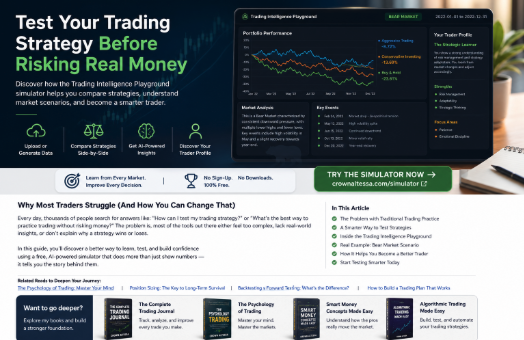
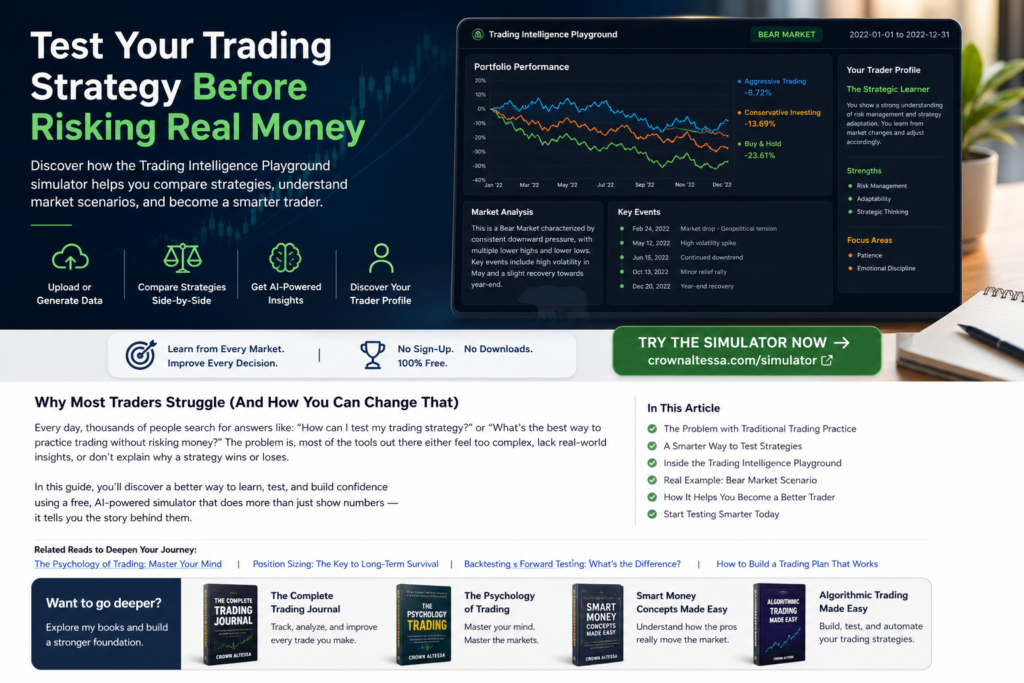
That’s where the Trading Intelligence Playground comes in. It’s a free web‑based simulator designed to transform raw data into a narrative. Unlike standard paper‑trading platforms, it helps you:
- Upload or generate data: Use your own CSV file or choose from built‑in samples (bull market, bear market, high volatility) to simulate different conditions.
- See market scenarios at a glance: The tool automatically labels datasets as bullish, bearish or high volatility, so you know what environment you’re trading in.
- Compare strategies side‑by‑side: It runs three approaches—buy‑and‑hold, aggressive day trading and conservative investing—on the same data and visualises their performance together.
- View a timeline breakdown: Switch to the detailed view to see each trade decision, profit or loss, and the reasoning behind it. This feature turns numbers into a story.
- Discover your trader profile: After each run, the simulator analyses your behaviour (risk tolerance, patience, strengths and weaknesses) and offers educational resources tailored to you.
- Test “what‑if” scenarios: Adjust risk tolerance, trade frequency or exit timing and see how the outcome changes.
- No sign‑up, no download: It’s accessible via browser, making it ideal for quick practice sessions.
This unique combination answers the question many searchers ask: “How can I test trading strategies and understand why they work?” The simulator does more than track returns—it teaches you how to think about markets.
If you’re curious about analysing institutional flows, read our article on decoding early investment signals and why blindly copying smart money often fails . These posts provide deeper context for the insights our simulator surfaces.
How to Use the Simulator: A Step‑by‑Step Guide
Let’s walk through a real example. Remember Lina from Frankfurt? Here’s how she used the Trading Intelligence Playground to practise without risking a cent:
- Choose a dataset. Lina clicked “Bear Market” to load a sample of declining prices. Alternatively, she could have uploaded her own CSV from past market data.
- Select strategies and risk settings. She left all three strategies enabled and set risk tolerance to medium. (Later she could adjust to high or low and see how it affects her trader profile.)
- Run the simulation. The tool plotted the performance of buy‑and‑hold, aggressive day trading and conservative investing on the same chart. It tagged the scenario as bearish and highlighted key events such as major drops and brief rallies.
- Read the verdict. The simulator explained that in a down‑trending, high‑volatility market, the conservative strategy preserved capital better. Lina’s attempts to day trade cost her money—an insight that would have been expensive in real life.
- Dive into the timeline. By clicking “Show Detailed View,” she saw each decision: when the aggressive trader sold after a 2% bounce or when the conservative investor waited for confirmation before buying. She could learn from these actions instead of just memorising final returns.
- Adjust and iterate. Curious, Lina used the “What If” buttons to increase risk tolerance and trade more frequently. She noted how small parameter changes altered outcomes. Over several sessions, she recognised her own tendencies toward impatience and the benefits of restraint.
- Review her trader profile. At the end, the simulator described her as a balanced learner, emphasising that developing emotional discipline and consistent habits would improve her results.
By following this process, Lina gained practical experience in different markets and saw firsthand why some strategies outperform others. She didn’t just watch charts; she learned from the story behind them.
How This Tool Helps You Become a Better Trader
Practising with the Trading Intelligence Playground offers several advantages beyond basic paper trading:
- Closes the knowledge–action gap. Many beginners read about strategies but struggle to implement them. The simulator provides a structured environment to test rules, measure consistency and refine execution.
- Builds discipline and confidence. Repeated practice with virtual funds helps you master order types, control emotions and develop sound decision‑making.
- Reveals why a strategy works. By highlighting key events and explaining each action, the tool teaches you to think critically. This aligns with our view that wealth comes from systems and habits, not hunches—see The Financial Systems That Keep Building Wealth While You Rest.
- Supports independent thinking. Instead of chasing every “smart money” tip or trading based on FOMO, you learn to analyse scenarios and adopt strategies that suit your goals.
- Encourages continuous improvement. With “what‑if” analysis and multiple datasets, you can iteratively refine your approach and avoid the common mistakes we discuss in Smart Money Investing Mistakes .
Ultimately, the Trading Intelligence Playground equips you with the mindset and skills to transition from simulation to real investing without unnecessary risk.
Start Testing Smarter Today
If you’ve ever wondered, “What is the best free stock‑market simulator for beginners?” or “How can I practise day trading without losing money?”—this is your answer. The Trading Intelligence Playground offers a comprehensive, narrative‑driven experience that other platforms lack. You’ll understand not just what happened but why it happened, building a foundation you can trust when real money is on the line.
Ready to begin? Click here to try the Trading Intelligence Playground now—no sign‑up or download required. Experiment with different market scenarios, test strategies side‑by‑side and uncover your trader profile. Then explore our other articles, such as How to Set Up Your Money to Work While You’re on Holiday and Act Like Your Future Self (And Watch Your Life Catch Up) to build a holistic plan for financial success.
About Crown Altessa
Crown Altessa publishes practical insights on personal finance, investing and financial systems. Our focus is on helping individuals make smarter decisions using clear frameworks, realistic thinking and long‑term strategies.
My book on Gumroad: How Personal Finance Made Simple Can Transform Your Future
Or on Amazon:
Disclaimer: This article is for educational purposes only and does not constitute financial advice.
Build Financial Clarity
Join the Crown Altessa newsletter and receive:
• the free Financial Foundation Guide
• practical financial frameworks
• strategic decision-making insights
• tools designed to help you think long term about money and stability
If you want calmer, more structured financial thinking in an uncertain world, subscribe below.