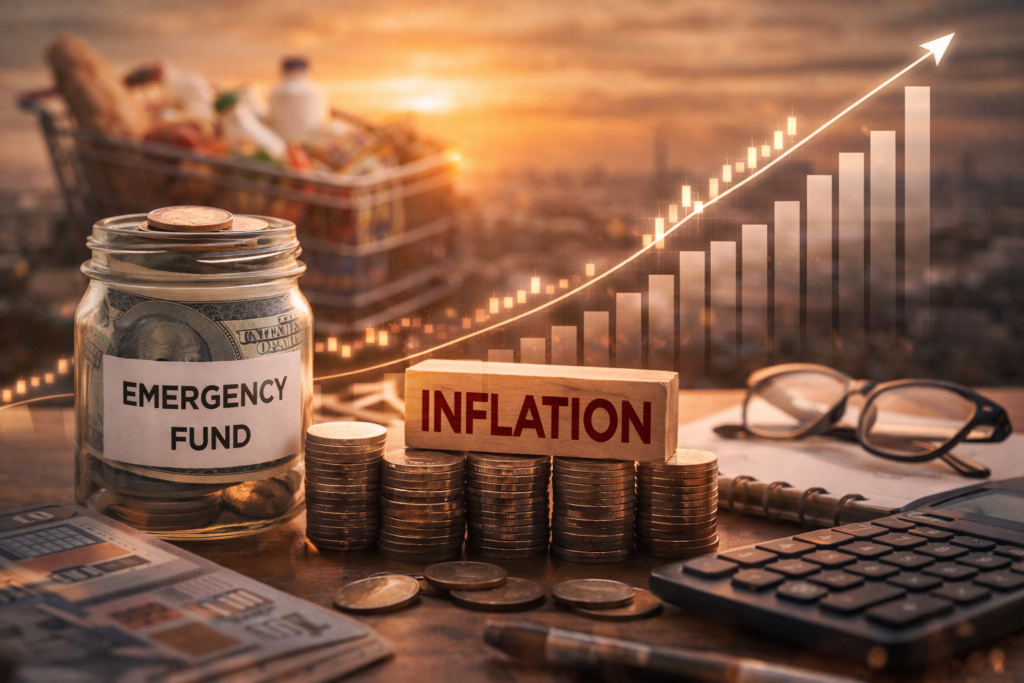
Inflation rarely arrives suddenly. More often, it builds gradually through rising energy costs, disrupted supply chains, or global economic instability. By the time inflation becomes visible in everyday expenses, it has usually been developing for months.
For households, the consequences are immediate. Groceries become more expensive, transportation costs rise, and housing pressures intensify. In many cases, salaries do not increase at the same pace.
While individuals cannot control inflation itself, they can control how resilient their personal finances are when prices start rising again.
Understanding how to protect your finances during inflationary periods is one of the most important elements of long-term financial stability.
Why Inflation Erodes Financial Stability
Inflation reduces the purchasing power of money over time. When prices increase faster than income, households effectively become poorer even if their salary remains unchanged.
According to data from the Organisation for Economic Co-operation and Development (OECD), periods of sustained inflation disproportionately affect middle-income households because essential goods—such as housing, food, and energy—represent a larger share of their spending.
For example:
- Food prices in the European Union rose significantly during the inflationary spike of 2022–2023 (Eurostat data).
- Energy prices surged globally following supply disruptions and geopolitical tensions (International Energy Agency reports).
- Housing costs in many cities have continued rising even after inflation slowed.
These trends demonstrate why inflation is not simply an economic statistic—it is a direct pressure on everyday budgets.
The First Line of Defense: Liquidity
When prices begin rising, the most important financial protection is liquidity.
Liquidity refers to easily accessible cash or savings that can cover essential expenses without forcing individuals to sell investments or accumulate debt.
Financial planners typically recommend maintaining three to six months of essential expenses in liquid reserves. This buffer allows households to absorb temporary cost increases, unexpected expenses, or income disruptions.
For example, if a household spends €2,400 per month on essential expenses, a six-month liquidity reserve would equal €14,400. This reserve provides flexibility during periods of economic uncertainty.
Liquidity is not about maximizing returns—it is about protecting stability.
Control Fixed Expenses Before They Control You
One of the most dangerous financial positions during inflation is having high fixed expenses.
Fixed expenses include:
- Rent or mortgage payments
- Car loans
- Subscription services
- Insurance premiums
- Debt repayments
When these obligations consume most of a household’s income, there is very little flexibility when prices increase elsewhere.
Maintaining a margin between income and fixed costs creates room to adjust when inflation rises. Households that keep their essential expenses below roughly 60% of net income are generally more resilient during economic pressure.
This margin acts as a shock absorber for rising costs.
Protect Purchasing Power Through Long-Term Investing
While inflation reduces the value of cash over time, certain assets historically maintain or increase purchasing power.
Global equities have historically delivered long-term real returns of approximately 6–7% annually, according to the Credit Suisse Global Investment Returns Yearbook and MSCI World historical data.
Although markets fluctuate in the short term, diversified long-term investments have historically outpaced inflation over extended periods.
For many households, the most effective strategy is consistent, automated investing rather than attempting to time the market.
This approach allows individuals to benefit from long-term economic growth while reducing the impact of short-term volatility.
Reduce Fragility in Your Financial Structure
Financial fragility occurs when a household has little ability to absorb economic shocks.
Common signs of financial fragility include:
- Dependence on a single income source
- Minimal or no emergency savings
- High-interest debt
- Fixed expenses that consume most of monthly income
During inflationary periods, fragile financial structures can quickly lead to financial stress.
Building resilience means gradually reducing these vulnerabilities.
This can include:
- paying down high-interest debt,
- building emergency savings,
- diversifying income sources when possible, and
- maintaining a manageable level of fixed expenses.
Even small improvements in financial structure can significantly increase long-term stability.
Focus on Flexibility Instead of Prediction
Economic forecasts are notoriously unreliable. Few analysts predicted the speed of global inflation during recent years, and future economic conditions remain uncertain.
Instead of trying to predict every economic shift, households benefit more from building flexibility.
Flexibility means:
- having accessible savings,
- maintaining a manageable cost structure,
- investing consistently over time, and
- keeping career and income options open.
This approach allows individuals to adapt to changing economic conditions rather than being overwhelmed by them.
Inflation Is a Cycle — Preparation Matters
Inflation tends to move in cycles. Periods of stability are often followed by periods of rising prices, which eventually slow again as economic conditions change.
The households that navigate these cycles most successfully are those that build strong financial foundations before inflation accelerates.
Liquidity, controlled expenses, disciplined investing, and financial flexibility form the core pillars of resilience.
These principles are simple, but they are powerful.
Final Thoughts
Inflation is a recurring feature of modern economies. Global conflicts, supply chain disruptions, and economic shifts can all contribute to rising prices.
While individuals cannot eliminate these forces, they can prepare for them.
By building liquidity, controlling expenses, investing for the long term, and maintaining financial flexibility, households can protect their financial stability even during uncertain economic periods.
The goal is not to predict the next inflation cycle.
The goal is to be ready for it.
Data & Sources
- Eurostat – Food Inflation Data (HICP)
- Organisation for Economic Co-operation and Development (OECD) – Household Economic Data
- International Energy Agency (IEA) – Energy Market Reports
- Credit Suisse Global Investment Returns Yearbook
- MSCI World Historical Performance Data
For readers seeking a clear structural foundation to implement this discipline step by step:
My book on GumRoad: How Personal Finance Made Simple Can Transform Your Future
Or on Amazon: Personal Finance Made Simple: A Beginner’s Guide to Financial Freedom
Build Financial Clarity
Join the Crown Altessa newsletter and receive:
• the free Financial Foundation Guide
• practical financial frameworks
• strategic decision-making insights
• tools designed to help you think long term about money and stability
If you want calmer, more structured financial thinking in an uncertain world, subscribe below.