
If traditional financial education fails Generation Alpha, the next logical question is:
So how do they actually learn?
The answer isn’t complicated — but it does require parents to change perspective.
Generation Alpha doesn’t learn money through explanations.
They learn it through experience, visuals, and repetition embedded in daily life.
This isn’t a disadvantage.
It’s a different learning interface.
Generation Alpha Learns Through Systems, Not Speeches
Children today grow up surrounded by systems:
- games with levels and rewards
- apps with progress bars
- stories with clear cause-and-effect
- visuals that explain faster than words
When parents sit a child down to “explain budgeting,” the child disengages.
But when money becomes part of a system they interact with, curiosity appears.
This is the same reason adults struggle with abstract financial advice but respond better to clear frameworks and lived experience — something explored in why financial clarity beats financial complexity.
Learning sticks when it’s felt, not explained.
Visual Learning Is Not a Distraction — It’s the Language
For Generation Alpha, visuals are not decoration.
They are the primary language of understanding.
Charts, stories, characters, examples, and concrete scenarios work because they:
- reduce abstraction
- create memory anchors
- show consequences immediately
This is why stories outperform rules.
Instead of saying:
“You should save money.”
A story shows:
“This character saved, and now they have choices.”
This storytelling approach mirrors how systems create understanding before outcomes.
Short Attention Doesn’t Mean Shallow Thinking
Parents often worry about attention span — but attention hasn’t disappeared.
It’s selective.
Generation Alpha can focus deeply when:
- feedback is immediate
- progress is visible
- participation is active
This is why micro-lessons work better than long explanations:
- small concepts
- repeated often
- tied to real decisions
Five minutes regularly beats one long “lesson” that creates resistance.
Everyday Life Is the Best Classroom
You don’t need special lessons to teach money.
Money education happens naturally when parents:
- involve children in small spending choices
- explain trade-offs (“If we buy this, we can’t buy that”)
- show saving toward a goal
- talk out loud about decisions
These moments teach:
- opportunity cost
- prioritization
- patience
- delayed gratification
This is far more effective than abstract explanations about “the future.”
It also helps children avoid the confusion many adults face later — a confusion explored in why people feel financially lost despite working hard.
Why Structured Tools Matter for Parents
While everyday life teaches a lot, parents still need structure.
Most parents struggle not because they don’t care — but because they don’t know:
- what to introduce first
- how much is too much
- how to keep it age-appropriate
This is where guided tools make a difference.
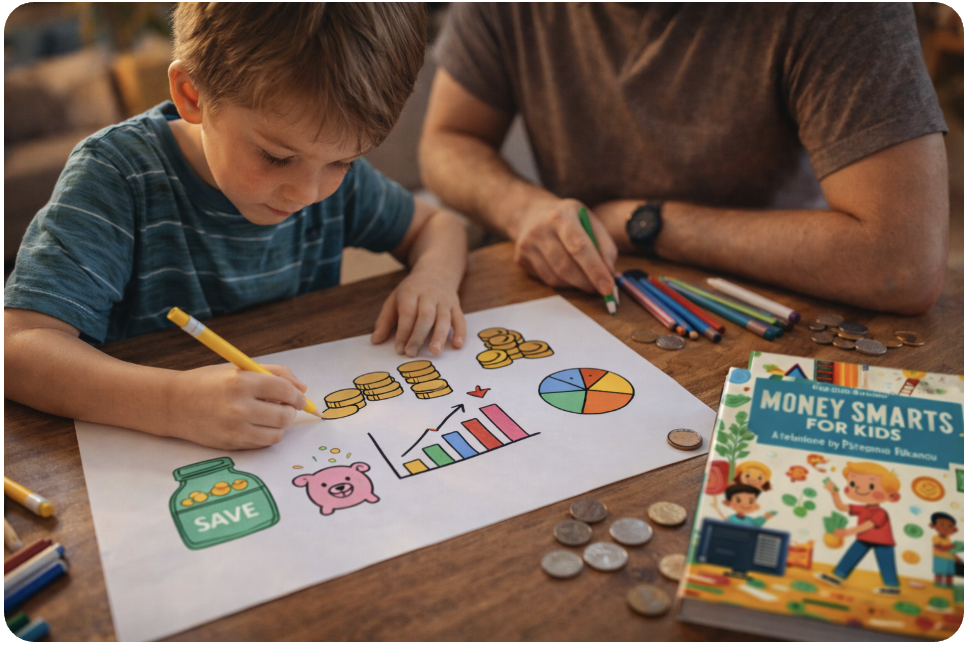
That’s exactly why Money Smarts for Kids: Teach Children Budgeting, Saving, and Investing with Fun Stories & Activities exists — not as a textbook, but as a shared experience.
The book:
- uses stories instead of lectures
- introduces concepts visually
- includes activities instead of rules
- scales from young children to teens
- gives parents a clear, calm structure
It allows money conversations to happen without pressure.
From Passive Listening to Active Participation
The goal of financial education for Generation Alpha is not knowledge.
It’s confidence.
Confidence comes when children:
- understand consequences
- feel involved
- see progress
- connect effort with outcome
This prepares them for a world where:
- money is increasingly digital
- jobs are less linear
- decisions matter earlier
Which is why early, gentle exposure is so powerful.
What Parents Should Stop Doing
Just as important as what to do is what to stop doing.
Parents should stop:
- waiting until “they’re older”
- using fear-based money language
- presenting money as stressful
- hiding all financial decisions
- assuming schools will cover it
Silence doesn’t protect children — it leaves gaps they’ll fill elsewhere.
The Bigger Picture
Financial literacy for Generation Alpha is not about raising investors.
It’s about raising children who:
- understand value
- aren’t afraid of money
- can make decisions calmly
- aren’t overwhelmed by financial complexity later in life
This aligns with your broader philosophy:
stability is built early, quietly, and intentionally — a theme running through how personal finance becomes a life system.
What Comes Next
In the final article, we’ll address the hardest question parents ask:
What should we teach Generation Alpha about money — and what should we stop teaching altogether?
We’ll separate:
- timeless principles
- outdated ideas
- essential skills for the future
So parents can focus on what truly matters.
Related Resources
- The Foundation: Liquidity First — ETFs, Index Funds, and Your First Real Safety Net
- The Illusion of Security: How Elite Wealth Reshapes Everyday Life
- My book on GumRoad: How Personal Finance Made Simple Can Transform Your Future
- My book on GumRoad: Money Smarts for Kids: Teach Children Budgeting, Saving, and Investing with Fun Stories & Activities
Or on Amazon:
Build Financial Clarity
Join the Crown Altessa newsletter and receive:
• the free Financial Foundation Guide
• practical financial frameworks
• strategic decision-making insights
• tools designed to help you think long term about money and stability
If you want calmer, more structured financial thinking in an uncertain world, subscribe below.